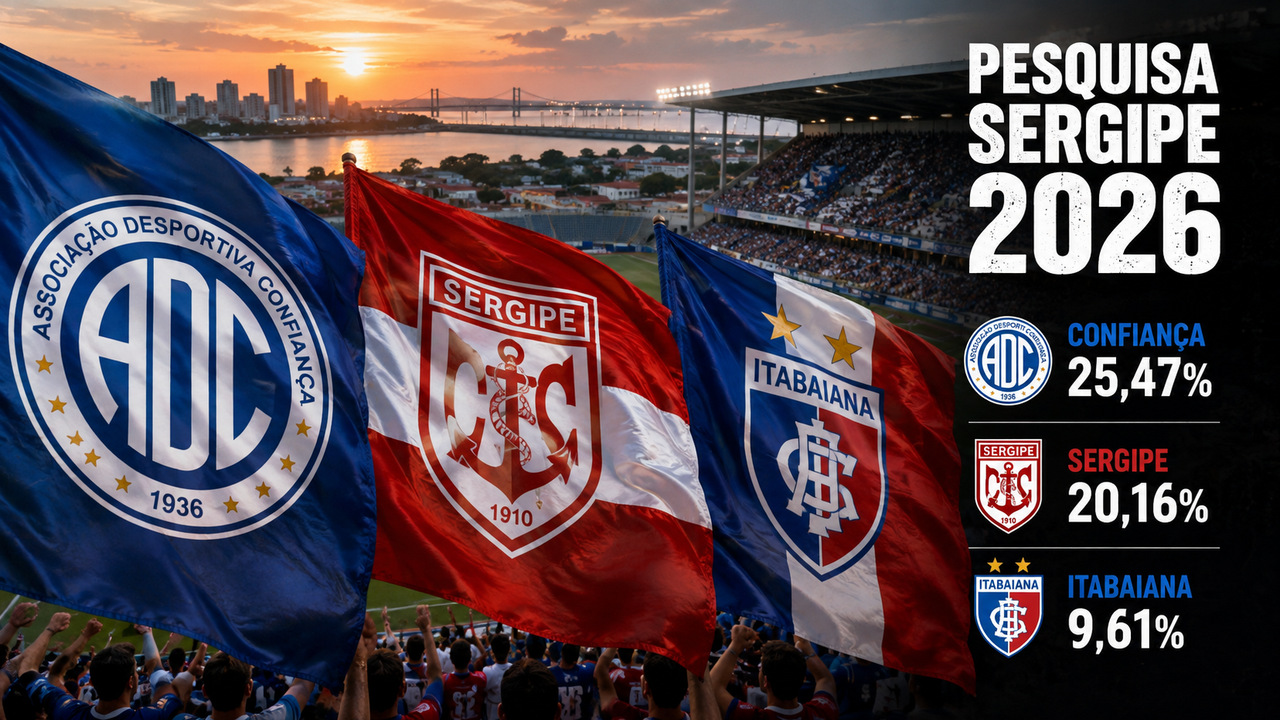
If the question is who comes out on top in the survey released in 2026, the answer is Confiança. The publications that reproduced the research attributed to Instituto França recorded 25.47% for Associação Desportiva Confiança, 20.16% for Club Sportivo Sergipe and 9.61% for Associação Olímpica de Itabaiana. This places Dragão in numerical leadership among Sergipe clubs in that survey.
The conclusion must, however, stop there. A sample survey does not transform 25.47% into a fan census, and the available public information does not allow treating the result as definitive proof that Confiança has, under any possible definition, the largest fan base in the state. What the data reliably supports is a more specific phrase: Confiança led the preference survey among local clubs released in 2026.
What the 2026 numbers really say
The ITnet Portal published on April 22, 2026 the distribution that associates the percentages with the clubs. Confiança appears with 25.47%, Sergipe with 20.16% and Itabaiana with 9.61%. Then come Lagarto, with 4.55%, Boquinhense, with 2.48%, Guarany de Porto da Folha, with 1.91%, América de Propriá, with 1.56%, Falcon, with 1.01%, and the “other teams” category, with 4.05%.
The same publication records 29.20% for those who said they did not support any team. This detail changes the wording of the headline: among the clubs mentioned, Confiança occupies first place, but the largest individual category in the survey is that of people without declared fans for any team within that group.
Therefore, saying “Confiança has the biggest fans among Sergipe clubs in the 2026 survey” is more rigorous than simply saying “Confiança has the biggest fans in Sergipe”. The second sentence seems to assert a general and definitive truth; the first tells you exactly what was measured and disclosed.
Is the difference between Confiança and Sergipe enough to take the lead?
A republication of the research informs that the survey was carried out between April 17 and 19, 2026, with 1,125 interviews in the state, a margin of error of plus or minus 3 percentage points and a confidence level of 95%. This data helps to measure uncertainty, but does not alone resolve all statistical doubts.
The difference observed between Confiança and Sergipe is 5.31 percentage points. If someone applies the 3-point margin for illustration purposes only to each estimate, Confiança would be between 22.47% and 28.47%, while Sergipe would be between 17.16% and 23.16%. The tracks overlap in a small region. This does not authorize the conclusion, in itself, that there is a technical tie, just as the absence of overlap would not be a sufficient formal test for any comparison.
The reason is simple: the published margin of error usually summarizes the uncertainty of an individual estimate. To formally test the difference between two responses from the same survey, it is necessary to know the difference error and the sampling design. Weightings, stratification, selection of interviewees and other details that can alter effective precision also matter. Without the complete methodological report for 2026, the safest editorial treatment is to say that Confiança numerically leads the survey, avoiding stating that the distance to Sergipe was statistically proven to be definitive.
The separation between Sergipe and Itabaiana is much greater in the published result: 10.55 percentage points. Still, the same principle holds true. The observed ranking is clear, but the survey remains a sample estimate, not a full count of fans.
“Biggest local crowd” is not the same thing as “biggest crowd in the state”
This is the point that most confuses the comparison with old surveys. The public material from 2026 reproduced by the reports shows clubs from Sergipe, the “other teams” category and people who do not support any team. In the open sources consulted for this audit, neither the complete questionnaire nor an original report from 2026 was found that sets out the exact wording of the question and all the options presented to respondents.
Without this piece, it is not safe to assume that the survey measured exactly the same thing as the survey associated with the France Institute in 2019. In that previous study, the available report is explicit: the objective was to quantify fans of national and local teams, and the question was asked spontaneously about which football team the person supported.
The 2019 result had a different scale. Flamengo appeared with 40.19% in the state, Corinthians with 8.63%, Vasco with 7.39% and Palmeiras with 5.11%. Confiança was the first club in Sergipe, with 4.25%, followed by Sergipe, with 2.77%, and Itabaiana had 0.65%. The category “doesn’t support any team” totaled 21.79%.
Therefore, the 25.47% of Confiança in 2026 cannot be automatically read as a jump from 4.25% to 25.47% of the Sergipe population. Before calculating any growth, it would be necessary to prove that the question, universe, answer options, collection method and denominator are equivalent. The available information does not allow this to be done.
Why the 2019 survey is not a direct ruler for 2026
The previous report reports more than 3,000 interviews in more than 50 municipalities, covering more than 90% of the state's inhabitants, with a margin of error of 2.5 points and confidence of 95%. The 2026 survey, according to the republished methodology, had 1,125 interviews and a margin of 3 points. This difference alone recommends caution in comparison.
More important than the sample size is the possible contrast in scope. In 2019, Flamengo, Corinthians, Vasco, Palmeiras and other national clubs appear individually in the ranking. In the 2026 set reproduced by the reports, the names associated with the percentages are clubs from Sergipe, in addition to “other teams” and “don’t support”. This suggests a different approach, but the absence of the full questionnaire prevents us from stating exactly how it was constructed.
Comparing percentages of surveys with different questions or bases can produce a false sense of progress. It is possible that part of the difference comes from a real shift in identification with local clubs; It is also possible that it comes from the way the question was asked, the alternatives available, the composition of the sample or the way it was tabulated. Without demonstrated methodological equivalence, separating these effects is not possible.
There is an important divergence in republications
The audit finds a specific problem in the circulation of numbers. ITnet published 29.20% for “does not support any team”. This percentage also appears in other republications and, when added to the other published categories, amounts to exactly 100%.
An article from FixNews, published two days later, reports 30.21% for the same category. If the other percentages are maintained, the sum exceeds 100%, reaching 101.01%. The report also describes some of the smaller clubs differently. This indicates a transcription or republication inconsistency, not a change that can be reconciled simply by rounding the data.
For the core of the question, the divergence does not change the order of the three main clubs: Confiança remains with 25.47%, Sergipe with 20.16% and Itabaiana with 9.61% in both versions. But it's a good example of why poll numbers should be tracked back to the report.
original whenever possible. In the absence of this 2026 document in a consultable open source, 29.20% is the most consistent value with the published set because it appears in more than one reproduction and makes the distribution total 100%.
What the research does not allow us to conclude
The survey does not allow the percentages to be directly converted into an exact number of fans for each club. Doing so would require precisely defining the universe represented, the reference population, the treatment of age, the weighting and the very meaning of “support”. A simple multiplication by the entire state population would give an appearance of precision that the sample does not possess.
It is also not correct to use stadium attendance, followers on social networks, number of members or sports performance as if they were automatic confirmation of the size of the crowd. These metrics measure different behaviors. A club can take more people to a specific match, have greater digital reach or go through a better sporting phase without this being equivalent to a population preference survey.
In the same way, Sergipe's state title in 2026 or the participation of Confiança and Itabaiana in national competitions does not resolve the dispute over crowd size. Result on the field and crowd identification are related phenomena, but not interchangeable.
So, what is the biggest fan base in Sergipe according to available data?
The editorially defensible answer is: in the 2026 survey published by Instituto França and reproduced by local vehicles, Confiança appears as the most preferred club in Sergipe, with 25.47%, ahead of Sergipe, with 20.16%, and Itabaiana, with 9.61%.
This supports Confiança's leadership in that survey. It does not support transforming the result into a census, claiming direct growth over 2019 or ignoring the margin of error and methodological gaps. It is also important to distinguish “first among the clubs” from the biggest individual response from the published set, which was “does not support any team”, with 29.20% in the numerically consistent version.
A future survey would be much easier to compare if it published the full questionnaire, the sample selection method, the territorial distribution of interviews, weighting criteria, age range of the universe, treatment of multiple fans and the calculation of uncertainty for differences between clubs. With this information, the discussion could move beyond the realm of the headline and actually enter the realm of statistical comparison.
Until then, the most accurate sentence remains the simplest: Confiança leads the 2026 survey among clubs in Sergipe, but the available data does not allow treating this leadership as a definitive and universal measurement of the size of the fans in the state.