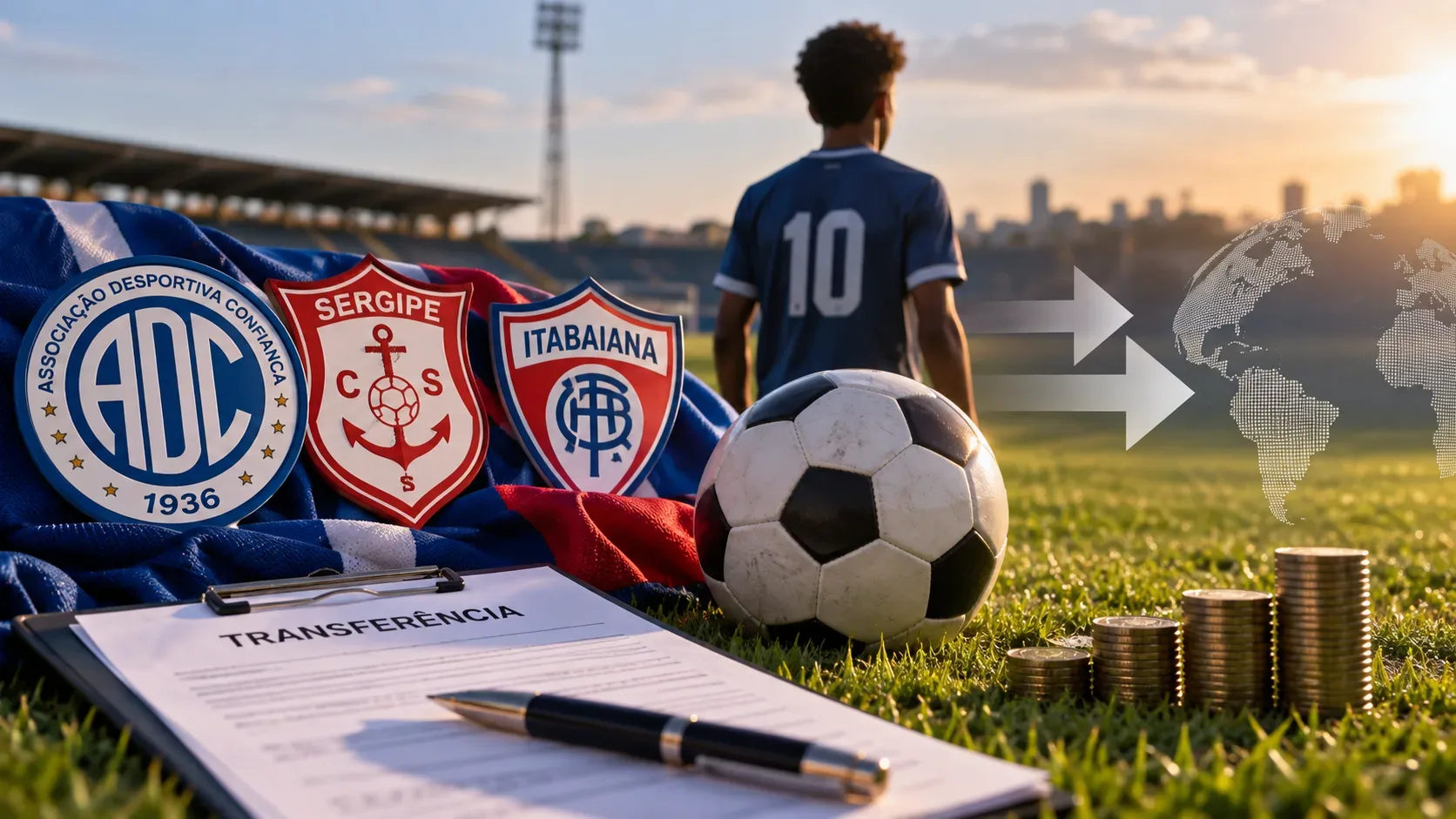
Confiança, Club Sportivo Sergipe or Itabaiana may be entitled to money linked to a player's development even when they are not the club selling him. But there is no single rule. In men's football, at least three concepts are often mixed together: training indemnity under Brazilian law, FIFA training compensation and solidarity mechanisms, which follow different rules in Brazil and in the international system.
To determine whether a payment is due, it is not enough to ask whether the player spent time in the academy. The player's registration history must be reconstructed, his age in each period identified, the move classified as domestic or international, any transfer fee confirmed and the applicable legal framework established. This guide uses the rules in force in September 2026. FIFA has already approved a new RSTP version that will enter into force on 1 January 2027, so triggering events after that date should be checked again.
Short answer: which mechanism may pay?
| Situation | Mechanism to check | Core idea |
|---|---|---|
| First registration as a professional, or an international transfer before the end of the year in which the player turns 23 | FIFA training compensation | Rewards development based on the registration history and the training costs attached to the new club's category. |
| Fee-paying transfer of a professional during the contract with an international dimension | FIFA solidarity mechanism | Up to 5% of the transfer compensation is distributed to clubs that trained the player between the calendar years of his 12th and 23rd birthdays. |
| Domestic permanent or loan transfer for a fee in Brazil | Domestic solidarity under article 102 of Brazil's General Sports Law | Up to 6% of the amount paid is distributed according to the player's training years from age 12 to 19. |
| A training organisation is prevented from signing the player's first special sports employment contract because the player refuses or joins another organisation without authorisation | Training indemnity under article 99 of Brazil's General Sports Law | This is not a percentage of a sale. It is a specific indemnity linked to legal training-organisation status and documented development expenses. |
Training can refer to two different legal mechanisms
In everyday usage, the expression "training indemnity" is used for different situations. Under FIFA, training compensation is governed by article 20 and Annexe 4 of the Regulations on the Status and Transfer of Players, the RSTP. It may arise upon a player's first registration as a professional and on subsequent international transfers until the end of the calendar year of the player's 23rd birthday.
In Brazil, article 99 of Law No. 14,597/2023, the General Sports Law, governs the status of a sports training organisation. Paragraph 5 provides for an indemnity when the training organisation is prevented from signing the first special sports employment contract because the player refuses, or when he joins another organisation without the training organisation's express authorisation. The cap is 200 times the documented expenses actually incurred in the player's development and specified in the training contract.
Therefore, an ordinary sale of a professional player does not automatically trigger the Brazilian indemnity in article 99. In a fee-paying transfer, the more likely route to examine is the solidarity mechanism, domestic or FIFA, depending on the case. On a first professional registration or an international transfer of a young player, FIFA training compensation may also arise.
When FIFA training compensation may benefit a club from Sergipe
Under the current RSTP, training compensation is due in two main situations: when a player is registered for the first time as a professional, and when a professional is transferred between clubs belonging to different national associations before the end of the calendar year in which he turns 23. Payment may be due even when the transfer happens at the end of the player's contract.
On the first professional registration, the new club must take into account clubs that contributed to the player's development starting from the calendar year of his 12th birthday, with amounts allocated pro rata according to the registration period. On subsequent international transfers, training compensation is owed only to the former club for the time it actually trained the player.
The amount is not calculated as a percentage of the sale price. FIFA uses training costs associated with the new club's category. For 2026, the official table sets annual CONMEBOL training costs at USD 50,000, USD 30,000, USD 10,000 and USD 2,000 for categories I, II, III and IV, respectively. For the calendar years of the player's 12th to 15th birthdays, the calculation uses category IV costs. The club's actual category must be checked in official systems and must not be inferred from the division it plays in or from the size of its fan base.
There are exceptions. Annexe 4 provides, among other cases, that training compensation is not due if the former club terminates the player's contract without just cause, if the player moves to a category IV club or if a professional reacquires amateur status upon transfer. In women's football, the current article 20 states that the principles of training compensation do not apply.
Fictional training compensation example
Suppose a player spent three full years at Itabaiana, covering the calendar years of his 16th to 18th birthdays, and is then registered for the first time as a professional with a CONMEBOL category II club. Using only that portion of the history and the 2026 cost of USD 30,000 per year, Itabaiana's theoretical share would be USD 90,000. The actual amount depends on exact dates, the new club's official category, the complete registration history and the rules applicable to the case.
How FIFA solidarity works
The international solidarity mechanism is different. If a professional moves during the term of a contract and transfer compensation is paid, 5% of that compensation, excluding training compensation paid to the former club, is allocated to the clubs involved in the player's training between the calendar years of his 12th and 23rd birthdays.
FIFA's distribution is tiered. For each calendar year of the player's 12th to 15th birthdays, a club receives 5% of the 5% solidarity pool, equivalent to 0.25% of the transfer fee per full year. For each year from the 16th to the 23rd birthday, a club receives 10% of the 5% pool, equivalent to 0.5% of the transfer fee per full year. Periods shorter than a year are calculated pro rata.
Annexe 5 also recognises entitlement when the professional is transferred permanently or on loan between clubs from different associations. It also covers a transfer between clubs in the same association when the training club belongs to a different association.
Fictional FIFA solidarity example
Suppose a player spent the four calendar years of his 16th to 19th birthdays with Club Sportivo Sergipe and, years later, is transferred during his contract for EUR 3 million between clubs belonging to different associations. Each of those four years represents 0.5% of the transfer fee. If the entire period is recognised for Sergipe, the share would be 2% of the total, or EUR 60,000. This example ignores fractions of a year and any documentary adjustments.
What about a sale between Brazilian clubs?
For domestic transfers, the main reference is article 102 of Brazil's General Sports Law. It states that whenever a professional player is transferred domestically, permanently or on loan, up to 6% of the amount paid by the new organisation must be distributed among the organisations that contributed to the player's development.
- 0.5% of the transfer value for each training year from age 12 to 13;
- 1% per year from age 14 to 17;
- 0.5% per year from age 18 to 19.
The new organisation must retain 6% of the amount payable to the releasing club and distribute the relevant shares according to the certificate issued by the national sports governing organisation. The law sets a deadline of up to 30 days from the effective transfer. If the player leaves unilaterally through payment of the contractual sports indemnity clause, the organisation that received that clause becomes responsible for distributing the 6%.
Fictional domestic solidarity example
Imagine a player who spent four full training years at Confiança, from age 14 to 17, and is sold between two Brazilian clubs for BRL 2 million. Each of those four years represents 1% of the transfer value. If the certificate fully recognises that period for Confiança, its share would be 4%, or BRL 80,000. If other clubs trained the player at other ages, they receive their own shares within the statutory limit.
Does the Brazilian Training Club Certificate decide every case?
No. The CBF Training Club Certificate belongs to the Brazilian legal regime for training organisations and is relevant to rights that depend on that status. FIFA training rewards, by contrast, are based on the player's registration history, the Electronic Player Passport, the triggers in articles 20 and 21 of the RSTP and the FIFA Clearing House rules. Therefore, the absence of a Brazilian training certificate does not, by itself, eliminate a possible FIFA training compensation or solidarity entitlement.
There is, however, an important current fact for Brazilian mechanisms. On the CBF public list of certified training clubs, updated on 24 August 2026, the Sergipe Football Federation does not appear and Confiança, Club Sportivo Sergipe and Itabaiana are not listed among certified clubs. This is a snapshot that must be checked on the date of the triggering event because certificates may be obtained, renewed, suspended or expire.
For a claim specifically based on article 99 of the General Sports Law, proving that the player once spent time in the academy is not enough. The organisation's legal training status, the training contract and the other statutory requirements must be checked. For article 102, documentation recognised by the national governing body is also essential.
Which documents should be checked before calculating
- Complete registration history: dates of entry and exit at each club, amateur or professional status and type of registration.
- Player passport and Electronic Player Passport: central to FIFA training rewards and to reviewing the period credited to each club.
- Transfer or loan agreement: confirms whether compensation exists, fixed instalments, contingent bonuses and the nature of the move.
- Player's age and calendar years: determine which development brackets apply under each mechanism.
- New club's training category: required to calculate FIFA training compensation.
- National training certificate: key evidence for domestic solidarity under article 102.
- Training status certification and training contract: essential when the claim concerns the Brazilian indemnity under article 99.
- Evidence of expenses: required when the amount depends on training costs actually incurred.
The role of the FIFA Clearing House
The FIFA Clearing House centralises the processing of training compensation and solidarity in cases covered by the system. Triggers are identified from registration, transfer and first-professional-registration data supplied by associations and clubs. The Electronic Player Passport then goes through a review process before becoming final, and the allocation determines which clubs are entitled to payment.
For a club from Sergipe, this makes registration data quality especially important. A development period that is missing, has incorrect dates or is linked to the wrong club can change the amount recognised. FIFA also provides a Training Rewards Calculator for estimates, but FIFA itself states that the tool is illustrative and does not replace the official determination.
How to quickly decide which rule to investigate
- If the move is domestic and fee-paying, start with article 102 of Brazil's General Sports Law.
- If it is the first professional registration or an international transfer before the end of the year of the player's 23rd birthday, check FIFA training compensation.
- If it is a fee-paying transfer during a contract with an international dimension, check FIFA solidarity.
- If the issue arose before the first professional contract and involves a legally recognised training organisation, examine the indemnity under article 99.
- In every case, confirm dates and documents before applying percentages or annual training costs.
The same career history can generate different rights at different times. A club may receive training compensation when the player becomes a professional, FIFA solidarity on a later international sale and, in another context, domestic solidarity on a transfer within Brazil. Having trained the player is the starting point, not the conclusion of the calculation.
Official sources and update note
- FIFA: RSTP, training compensation and solidarity contribution
- FIFA Clearing House
- FIFA Training Rewards Calculator
- Brazilian Law No. 14,597/2023, General Sports Law
- CBF: certified training clubs list
- FIFA: new RSTP effective from 1 January 2027
This content is for informational purposes. Whether a payment exists and its amount depend on the triggering event, official records and the documents of the specific case.