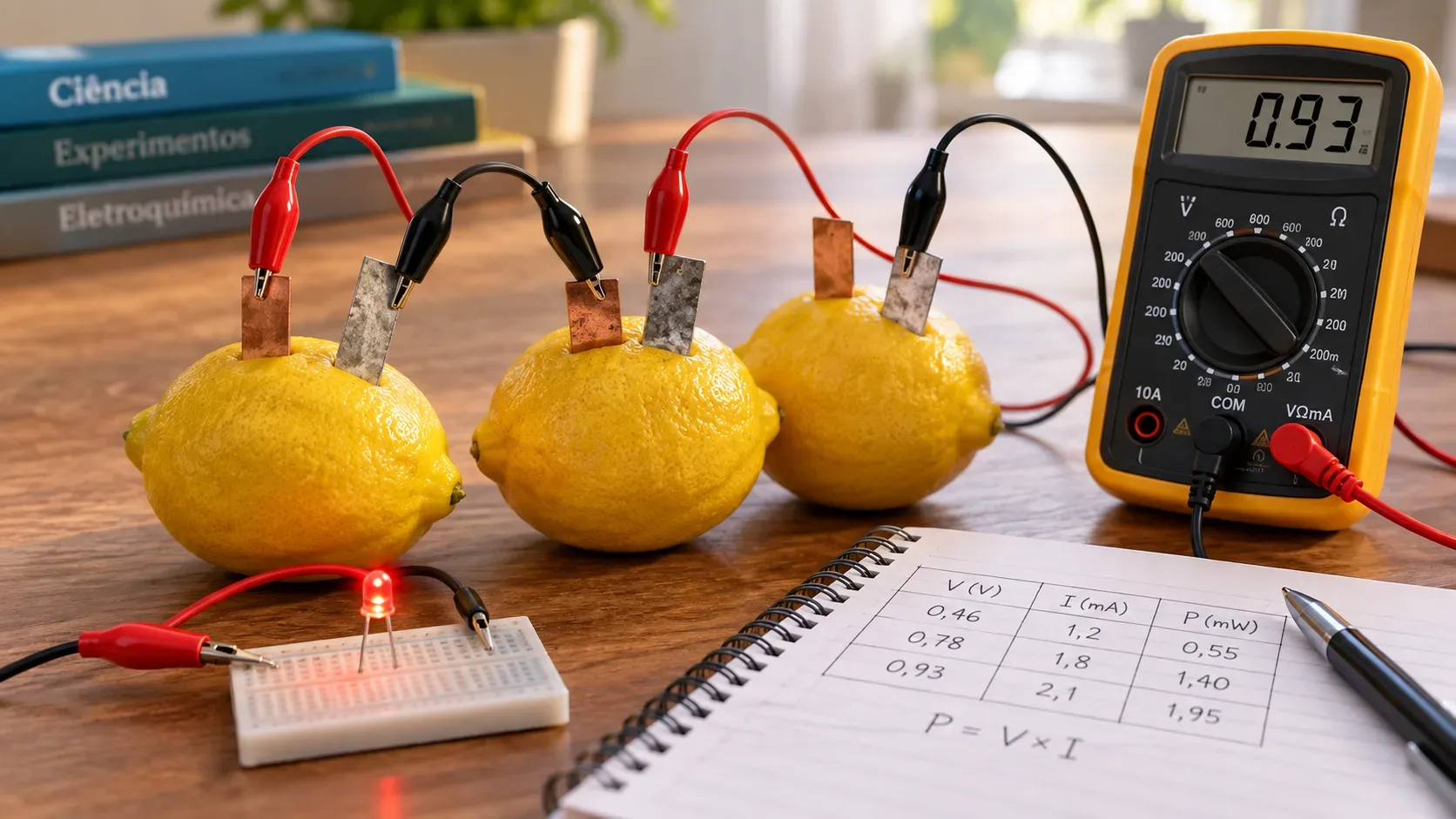
Yes. A lemon battery works as a simple electrochemical cell. The experiment becomes much more useful when it goes beyond “the LED lit up” and starts measuring voltage, current, and power. Those three quantities show not only that a potential difference exists between the electrodes, but also how much the cell can deliver when a load is connected.
The principle is the same as in other cells: two different conductive materials act as electrodes, while the acidic lemon juice acts as the electrolyte. A common setup uses zinc — such as a galvanized nail — and copper. Zinc tends to oxidize and release electrons, which can flow through the external circuit. Carnegie Mellon University specifically proposes measuring the voltage and current of lemon batteries and using those readings to calculate power.
What to measure to know whether the battery really “works”
There is an important difference between seeing voltage on a multimeter and being able to power a device. A cell may show a reasonable open-circuit voltage and still deliver very little current when a load is attached. That happens because the cell has internal resistance and its chemical reactions cannot supply unlimited current.
- Voltage (V): the potential difference between the terminals, measured in volts.
- Current (I): the flow of electric charge through the circuit, measured in amperes; in this experiment, the milliampere range is usually the relevant one.
- Power (P): the rate at which electrical energy is transferred. For a DC load, it can be calculated as P = V × I.
If voltage is in volts and current is in milliamperes, V × mA gives the result directly in milliwatts (mW). For example, an illustrative reading of 0.62 V under load and 0.45 mA corresponds to about 0.28 mW. Real values vary widely with the fruit, electrodes, connections, and load.
Materials for a measurement-based experiment
- 2 to 5 lemons;
- one copper electrode per lemon;
- one zinc electrode per lemon, such as a galvanized nail or zinc strip;
- wires with alligator clips;
- a digital multimeter that measures DC voltage and, if possible, current in mA;
- a known resistor to act as a load, for example 1 kΩ;
- a low-power LED for an optional visual test.
Insert copper and zinc into the same lemon without allowing the metals to touch. Gently pressing or rolling the lemon beforehand, without breaking the peel, can improve internal electrolyte contact. The Australian National University uses the same principle and recommends several cells in series when the goal is to power an LED.
Step 1: measure open-circuit voltage
Set the multimeter to DC voltage. Put the black lead in COM and the red lead in V/Ω. Touch the red probe to copper and the black probe to zinc. The reading can differ from lemon to lemon; the point is to record what you actually measure rather than force the setup to match a supposed “correct” number. This method is consistent with the basic DC-voltage guidance from Fluke.
This first value is the no-load voltage. It confirms a potential difference, but it does not yet tell you how much the cell can deliver in use.
Step 2: connect a load and measure again
Connect a known resistor across the cell terminals, for example 1 kΩ, and measure the voltage across that resistor. This is the voltage under load. It is normal for it to be lower than open-circuit voltage because part of the voltage is lost across the cell's internal resistance.
With a known resistor, there is a simple and beginner-friendly way to obtain current without placing the multimeter directly in current mode: use Ohm's law, I = V/R. If the voltage across a 1 kΩ resistor is 0.60 V, for example, the current is 0.60 mA.
Step 3: if you measure current directly, put the multimeter in series
To measure current directly, open the circuit and insert the multimeter in series with the load. This differs from a voltage measurement, which is made in parallel. Use the correct input jack and DC mA range specified by your multimeter's manual.
Do not place a multimeter set to current mode directly across the two battery terminals. In that configuration, the meter provides a very low-resistance path and may blow its internal fuse. After measuring current, it is good practice to return the red lead to the V/Ω jack before taking voltage measurements again.
Step 4: calculate power delivered to the load
With the voltage under load and the current, calculate P = V × I. The calculation should use values measured under the same load condition. Combining open-circuit voltage with loaded current gives a power figure that does not represent the circuit's real operating point.
| Setup | No-load voltage (V) | Loaded voltage (V) | Loaded current (mA) | Power (mW) |
|---|---|---|---|---|
| 1 cell | measure | measure | measure or calculate | V × I |
| 2 cells in series | measure | measure | measure or calculate | V × I |
| 3 cells in series | measure | measure | measure or calculate | V × I |
| 4 cells in series | measure | measure | measure or calculate | V × I |
Why several cells may be necessary
An LED does not need just “some voltage.” It has a minimum forward voltage that varies with its type and color, and it also needs enough current to produce visible light. That is why a single lemon cell can produce a perfectly visible multimeter reading and still fail to light an LED.
When cells are connected in series, with the copper of one connected to the zinc of the next, their voltages tend to add. ANU reports that a four- or five-lemon series setup can reach roughly 2.5 to 3.0 V, but that is not a guaranteed result: electrodes, fruit condition, contact area, and internal resistance all affect performance.
It is also important to note that series connection does not automatically multiply the available current by the same factor. The more predictable gain is voltage. That is why comparing no-load voltage, loaded voltage, and power tells you more than simply counting the lemons.
Troubleshooting: why the LED does not light
- The multimeter shows a negative voltage: the probes are reversed; swap them or simply record the polarity correctly.
- Voltage is almost zero: check that copper and zinc are not touching, clean the contacts, and make sure the clips grip exposed metal.
- Open-circuit voltage looks good but collapses under load: internal resistance is high. Try clean electrodes, larger contact area, and more uniform cells.
- Voltage seems adequate but the LED stays dark: check LED polarity and remember that current may still be too low.
- The meter reads 0 mA: the current may be below the meter's resolution, the red lead may be in the wrong jack, the selected range may be wrong, or the current-input fuse may be open.
- Readings vary widely among lemons: that is expected. Treat the variation as experimental data and compare individual cells before wiring them in series.
Turn the activity into an investigation
Instead of asking only “did the LED light?”, choose a question that can be answered with data. For example: how does the power delivered to a 1 kΩ resistor change as the setup goes from one to four cells in series? Take three readings for each configuration, calculate an average, and compare the drop from no-load to loaded voltage.
You can also compare fruit types, electrode area, or the spacing between copper and zinc, while never allowing the electrodes to touch directly. Change one variable at a time so the result remains interpretable.
Basic safety
This is a low-voltage experiment, but it still requires orderly handling. Work with dry hands and a dry surface, as Carnegie Mellon University recommends; be careful with sharp metal points; do not connect the setup to wall outlets, chargers, or other external circuits; and do not eat the lemons after metal electrodes have been inserted. In a school setting, assembly and multimeter use should follow the teacher's guidance and the specific meter manual.
The main lesson is that a lemon battery is more than a visual trick. By measuring open-circuit voltage, loaded voltage, current, and power, the experiment reveals the difference between having a potential difference and being able to deliver energy to a load — exactly the distinction that explains why several cells may be needed for an LED.