
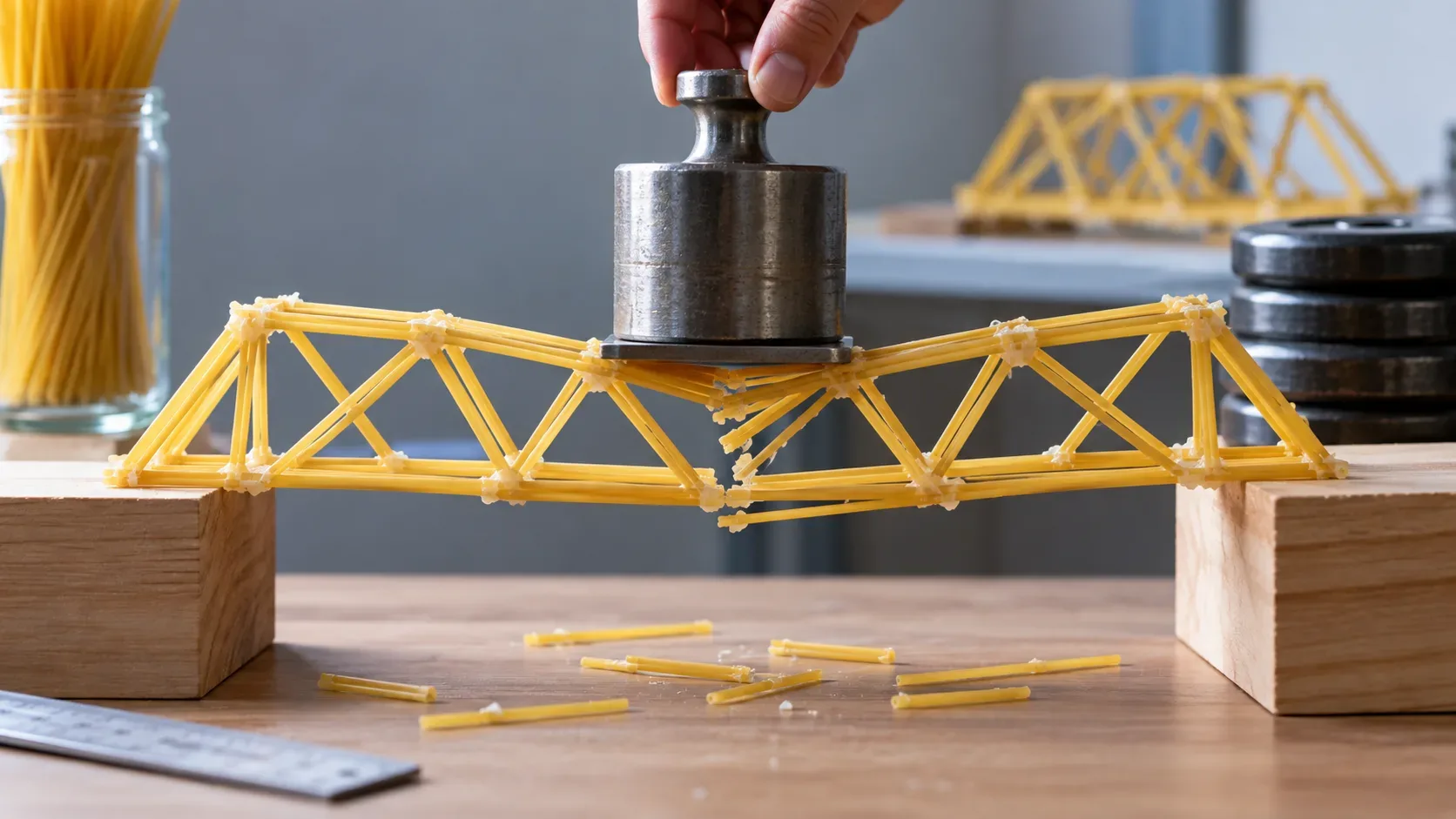
A spaghetti bridge becomes a comparable experiment only when the test moves beyond “add weight until it breaks” and follows the same rules for every design. The goal is to control variables that are not being investigated — span, supports, material, load position and loading procedure — so that differences in performance can be attributed mainly to structural design and construction quality.
Educational activities from TeachEngineering use construction followed by loading to failure, while school competition rules such as those from Engineers Geoscientists Manitoba standardize dimensions, materials, span and center loading. That principle is the foundation of a fair test.
What must stay the same to compare designs
Before building, turn the activity into a protocol. Every group should know the same constraints and use the same test equipment. At minimum, control:
- Clear span: the distance between supports must be identical in every test.
- Supports: use the same surfaces at the same height, without adding lateral restraint to one bridge but not another.
- Material: keep the same type of spaghetti and the same adhesive. If there is a quantity or mass limit, it must apply to everyone.
- Allowed geometry: define length, width and height limits in advance if they are part of the investigation.
- Load point: apply the load at the same position every time, preferably through a fixture that does not change between designs.
- Load progression: use equal increments and the same observation interval between increments.
- Material condition: test bridges after equivalent adhesive curing time and under similar environmental conditions.
If the question is “which geometry is more efficient?”, every bridge does not need to have exactly the same mass. Instead, use the same material rules and a mass limit, weigh each bridge before testing, and normalize performance by bridge mass. If the question is “which design is stronger with the same amount of material?”, then target mass should be a controlled variable with a tolerance defined in advance.
A repeatable load-test protocol
- Identify the design. Assign a code to the bridge and record its drawing, main dimensions, truss type and the details that distinguish that version.
- Weigh the completed bridge. Record its mass before installing any loading hardware that is not part of the structure being evaluated.
- Place it on the standardized span. Mark the support positions so every bridge crosses exactly the same clear distance.
- Position the loading fixture. Center the load point and confirm that it transfers force in the same way for every test.
- Load progressively. Add load in equal steps, without impact, and use the same waiting time at each stage. Record visible deformation.
- Define failure. End the test when there is a clear loss of capacity: member fracture, joint opening, severe instability or collapse that prevents the bridge from carrying the next load step.
- Record the last sustained value. With step loading, the actual failure load lies between the last fully sustained step and the step that caused failure. Record both when possible.
- Document the first failure location. Photograph or video the bridge from the side and front. The place where the collapse ends is not always where it started.
For safety, keep hands, face and eyes away from the likely failure line, use a tray or containment area for fragments, and never stand under suspended loads. When large masses are involved, the setup and loading procedure should have appropriate supervision.
How to compare strength and efficiency
Maximum sustained load answers “which bridge carried more?”. By itself, however, that value favors heavier structures. A simple material-efficiency metric is:
efficiency index = maximum sustained load ÷ bridge mass
Use the same units in the numerator and denominator. If the applied load is represented by hanging mass, convert bridge mass to the same unit before dividing. The index does not replace maximum load; it answers a different question.
| Design | Bridge mass | Maximum sustained load | Efficiency index |
|---|---|---|---|
| A | 0.20 kg | 8 kg | 40 |
| B | 0.40 kg | 10 kg | 25 |
In this illustrative example, bridge B is stronger in absolute terms because it carries 10 kg, but bridge A is more efficient relative to its own mass. A good report presents both measures instead of choosing only the one that favors a result.
Where a spaghetti bridge commonly fails
Idealized trusses are analyzed mainly through tension and compression. Real materials, however, also suffer from geometric imperfections, weak connections and instability. TeachEngineering uses truss analysis to identify members in tension and compression, and an open statics reference also notes that long, slender members under compression can buckle.
- Compression buckling: a member bends sideways before breaking. This suggests that the compression member is too slender or has insufficient lateral bracing.
- Tension fracture: a member in tension snaps or a splice opens while the element is being pulled.
- Joint failure: adhesive peels, shears or allows excessive rotation before the members themselves reach their capacity.
- Lateral instability or twisting: the bridge starts rotating or tipping out of its main plane. This may indicate insufficient bracing between the two side trusses.
- Local failure at the load point or support: members break or crush near the region where force enters the structure. The loading fixture may be concentrating stress too strongly.
These modes can occur in sequence. That is why the useful observation is not simply “the bridge broke in the middle,” but which member lost stability or which joint opened first.
A data sheet prevents conclusions based on memory
| Field | What to record |
|---|---|
| Design | Drawing code or version |
| Bridge mass | Measured value before testing |
| Clear span | Actual distance between supports |
| Load point | Position and fixture used |
| Last sustained load | Highest stage held without collapse |
| Stage that caused failure | Next applied increment |
| First failure location | Observed member, joint or region |
| Failure mode | Buckling, tension, joint, twisting or local failure |
| Efficiency index | Sustained load ÷ bridge mass |
| Evidence | Photo, video and notes |
How to use failure to redesign
The strongest experimental cycle changes one variable at a time. If a long member buckles, the redesign hypothesis might be to reduce its unsupported length or add bracing. If a joint opens first, simply adding more spaghetti elsewhere is unlikely to fix the bottleneck. If the bridge twists, the problem may lie in the connection between the two side trusses rather than in the strength of either side by itself.
After redesigning, repeat exactly the same test. The comparison becomes stronger when the new version uses the same span, material, load point and loading sequence. The activity then moves from a visual contest toward an engineering investigation: hypothesis, test, observed failure, modification and retest.
What the result actually allows you to conclude
A spaghetti bridge does not show which bridge would be best in the real world because its material, joints and scale are very different from full-size engineering structures. It is useful for investigating principles: load paths, tension, compression, buckling, the importance of connections, bracing, and the relationship between strength and mass.
With one protocol for every design, the final question becomes more precise. You can state which bridge carried more load, which was more efficient and, most importantly, which mechanism limited each structure. That combination of measurement and failure analysis is what turns a spaghetti bridge into a comparable experiment.