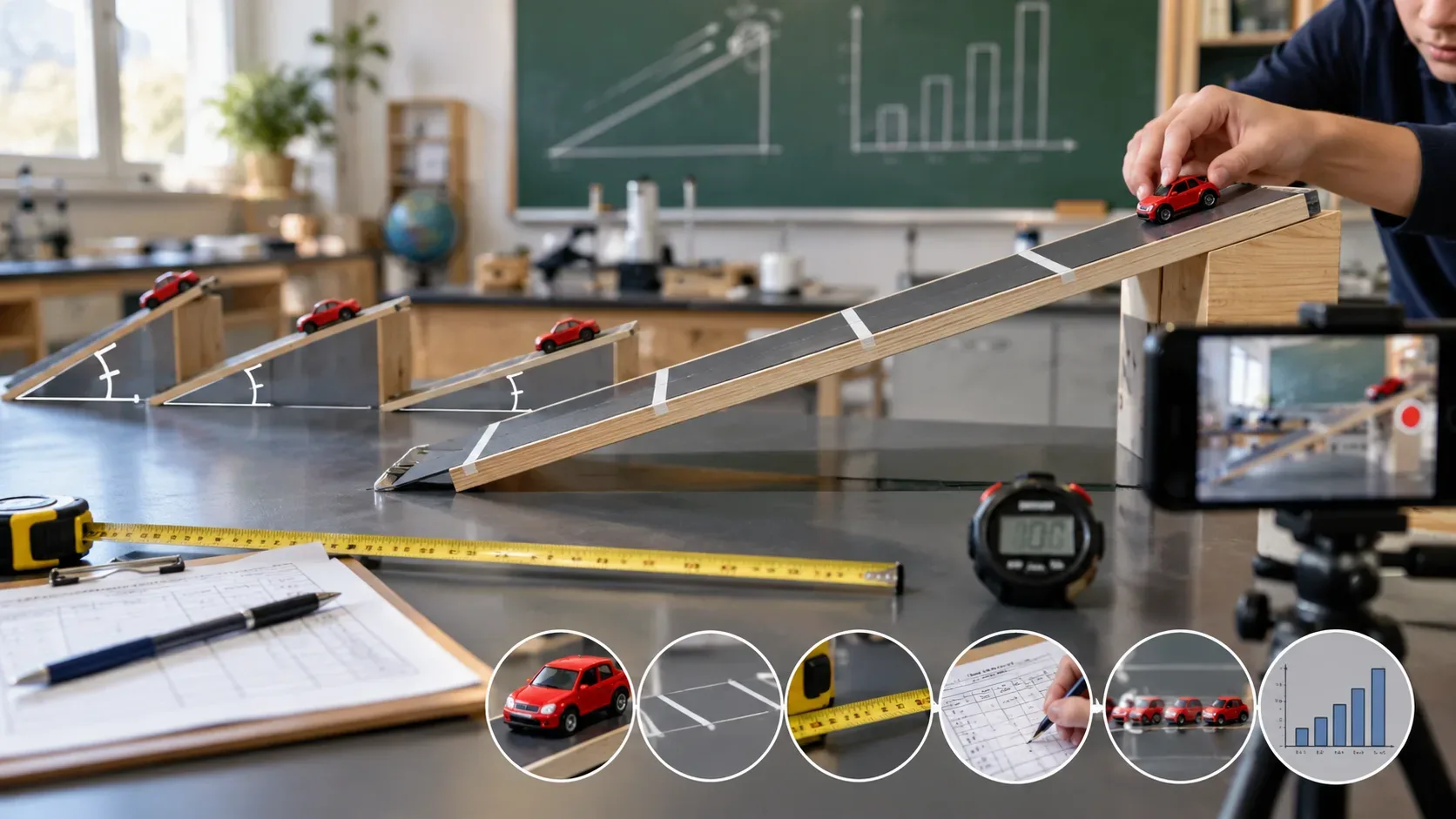
To test whether ramp inclination changes a toy car's descent time, use the same car, the same ramp, and the same marked distance along the track. Change only the planned inclination setting, release the car without pushing it, and measure the time over several trials. This helps prevent differences caused by distance, surface, release technique, or timing from being attributed to the angle.
Research question, hypothesis, and variables
The question is: as inclination increases, how much does the time needed to cover a fixed distance along the ramp change? A testable hypothesis is that, under the chosen conditions, steeper slopes tend to produce shorter times. The conclusion must come from measurements, not from the hypothesis.
- Independent variable: inclination of the same ramp, recorded in degrees or identified by measured support-height settings while ramp length remains constant.
- Dependent variable: elapsed time between the start of release and the moment the same reference point on the car crosses the finish mark.
- Controlled conditions: car and wheels, track and surface, location of the marks, release method, camera position, and criteria used to identify the start and finish.
Measure distance along the track, not its horizontal projection on the floor. When the same track is tilted, the vertical drop between the marks naturally changes: that is part of the effect being tested. Switching cars, replacing the track surface, or changing the traveled section adds new variables. Keeping the materials the same reduces contact differences, but it does not mean all frictional forces stay numerically constant as the angle changes.
Materials and safe setup
- A rigid, smooth board or channel without sharp edges, with secure supports for three inclination settings.
- One toy car with freely turning wheels; adhesive tape for two visible marks; a measuring tape or ruler.
- A phone that records video, a fixed support or tripod, a recording sheet, and, if available, a stopwatch for cross-checking.
- A soft barrier at the end of the course to stop the car from falling off the table.
Secure the lower end, avoid unstable supports, and keep hands and faces clear of the car's path. Ask an adult for help if wood needs to be cut or fastened with tools. Run a low-inclination safety test before filming.
Procedure: fixed distance, repeated trials, and video
- Mark a start and finish on the same track, for example 60 cm apart. Do not move these marks during the comparison.
- Choose three inclination settings, A, B, and C. Record the angle if you can measure it, or the support height with the same board; do not treat height alone as if it were the angle.
- Place the same part of the car at the start mark each time and release it from rest without a push. Follow the same procedure in every trial.
- Keep the camera stationary, approximately side-on and perpendicular to the track plane, with both marks visible. Note the frame rate reported for the video.
- Record at least five valid runs for each setting. If the car is pushed, leaves the track, or hits something before the finish mark, record what happened and repeat the trial.
- In the video, identify the frame in which the car starts moving and the frame in which the same reference point, such as the front axle, reaches the finish line. Count the difference between frame numbers.
- Calculate time in seconds by dividing the frame difference by the number of frames per second. Illustrative example: 30 frames at 60 frames per second equal 0.50 s. Check the actual file frame rate rather than assuming every recording uses the same rate.
- Record every trial time and calculate the mean for each slope. Frame-by-frame measurement is also described in the Science Buddies educational project.
Recording and comparing results
Create a table like the one below and fill it with actual measurements only. The range column is the longest time minus the shortest time for that setting.
| Slope | Support height | Trial 1 | Trial 2 | Trial 3 | Trial 4 | Trial 5 | Mean time | Range |
|---|---|---|---|---|---|---|---|---|
| A | Measure | Measure | Measure | Measure | Measure | Measure | Calculate | Calculate |
| B | Measure | Measure | Measure | Measure | Measure | Measure | Calculate | Calculate |
| C | Measure | Measure | Measure | Measure | Measure | Measure | Calculate | Calculate |
Calculate the mean by adding the five times and dividing by five. Compare the means and the spread of repeated measurements; a graph with slope on the horizontal axis and mean time on the vertical axis helps reveal a pattern. If the differences are similar to the trial-to-trial variation or video resolution, report that the experiment did not clearly distinguish the settings rather than claiming the times are equal. Frame rate limits how precisely the start and finish can be identified.
What the physics does and does not establish
In an ideal model of an object sliding without friction, the component of gravity parallel to the plane is proportional to the sine of the angle, so acceleration increases with inclination. OpenStax explains the weight components on an inclined plane. A real toy car, however, has rotating wheels, rolling resistance, possible axle friction, and potential slipping. Do not use the ideal sliding expression as an exact prediction of the toy's times; OpenStax's analysis of rolling motion explains why rotation matters too.
If mean time decreases as inclination increases and the repeated trials are consistent, the evidence supports the hypothesis for that car and setup. If it does not, check the release, distance, wheel binding, stability, and frame selection before proposing an explanation. Comparing a coated track with an uncoated one would require a second experiment with angle and travel distance held constant.
Common mistakes to avoid
- Changing distance unintentionally: keep the same pair of marks along the ramp even when its horizontal projection changes.
- Changing the friction conditions: do not replace the car, wheels, or surface between settings; record any mechanical issue.
- Pushing at release: always start from rest, at the same position, using the same timing-start criterion.
- Timing only one run: repeat, show the mean and variation, and do not invent or discard inconvenient times.
- Filming from different angles: keep the device fixed and make sure the marks and the car's reference point are clearly visible.
The final report should include the question, hypothesis, setup diagram, variables, completed table, graph, limitations, and a conclusion proportionate to the observed data.