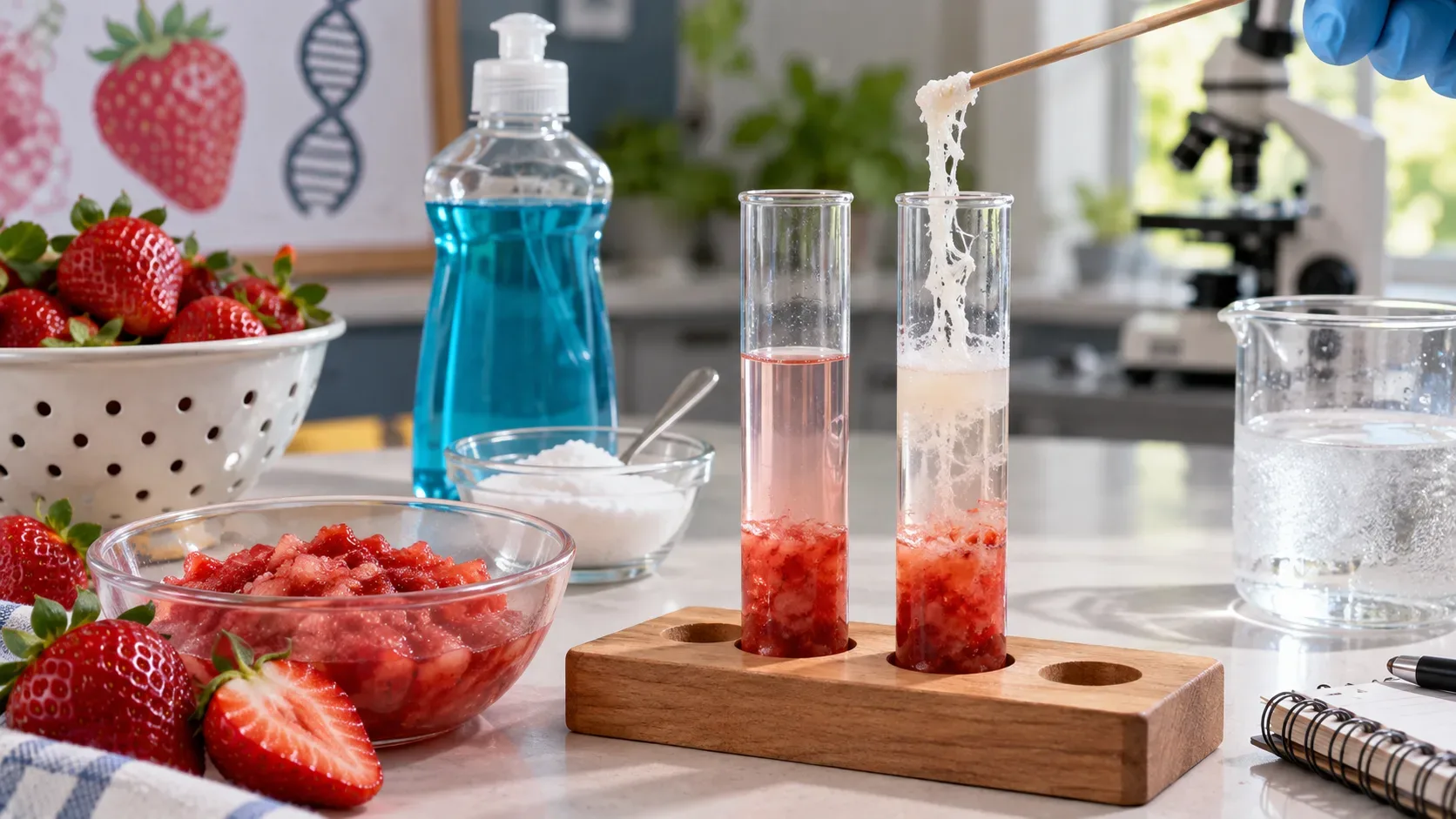
The white strands that appear in a strawberry DNA extraction are a crude precipitate rich in DNA: many molecules gather and become visible when the extract meets alcohol. That does not mean the material is pure DNA. The classroom procedure disrupts tissue and membranes, filters out some debris, and precipitates nucleic acids, but it does not include the laboratory purification steps used to systematically remove proteins, carbohydrates, and other contaminants.
That distinction makes the experiment better. Instead of merely “making DNA appear,” the goal becomes understanding what each step changes, which observations truly support the interpretation, and how a comparison control can separate the effect of an ingredient from ordinary sample-to-sample variation.
Why strawberries work so well
Cultivated strawberries are convenient teaching material because they are soft, easy to mash, and produce plenty of visible material. Educational resources also point out that cultivated strawberries are octoploid, meaning their cells carry multiple copies of the chromosome set, which helps create a strong visual yield. That is one reason strawberries are common in genetics activities, but it does not make the precipitate a high-purity preparation.
Ingredient by ingredient: what is happening
| Step or ingredient | Main role | What you may observe |
|---|---|---|
| Mashing the strawberry | Disrupts the tissue, damages many cells, and increases contact between cell contents and the extraction solution. | A fairly uniform pulp forms; standardized mashing makes samples easier to compare. |
| Detergent | Disrupts lipid-rich membranes, including cell membranes and internal envelopes, releasing cell contents into solution. | The mixture becomes more fluid and may foam; excessive foam is not the goal. |
| Salt | Changes the ionic environment, reduces repulsion among DNA molecules, and favors aggregation; it also helps separate DNA from some associated proteins. | Its effect is not usually visible by itself, but it contributes to the later precipitate. |
| Filtration | Retains seeds, fibers, and large tissue pieces while allowing a liquid phase containing DNA and many other dissolved molecules to pass through. | The filtrate is thinner and contains fewer large particles. |
| Cold alcohol | Reduces DNA solubility in the mixture and causes precipitation, especially at the interface between the aqueous phase and the alcohol. | Whitish, stringy, or cloudy material appears and can often be spooled onto a thin rod. |
The National Human Genome Research Institute (NHGRI) protocol follows exactly this logic: mashing, detergent-and-salt extraction solution, filtration, and cold alcohol. Science Buddies describes detergent as the lysis agent, salt as helping DNA molecules gather together, and alcohol as the step that pulls DNA out of solution.
A home or classroom protocol focused on interpretation
A simple version based on the NHGRI material uses two strawberries, a resealable plastic bag, two teaspoons of dish detergent, one teaspoon of salt, half a cup of water, clear cups, a coffee filter, cold isopropyl rubbing alcohol, and a thin stirring rod.
- Remove the leaves and mash the strawberries in the sealed bag for about two minutes.
- In a separate container, slowly mix the water, salt, and detergent, avoiding excessive foam.
- Add the extraction solution to the strawberries and gently massage the bag for about one minute.
- Filter the mixture into another cup, retaining most of the pulp and seeds.
- Tilt the cup and slowly add a volume of cold alcohol approximately equal to the volume of filtrate. Avoid shaking so the two phases remain distinguishable.
- Watch the boundary between the phases. Clear or whitish material that appears can be carefully spooled onto a rod.
Safety: isopropyl rubbing alcohol is flammable and should never be swallowed. Keep it away from flames, sparks, and heat sources, work in a ventilated area, and use adult supervision with children. Utensils used in the experiment should not return to food use without proper cleaning. Safety guidance for rubbing alcohol is available from Poison Control.
What the white strands actually contain
An individual DNA molecule is far too small to see with the naked eye. What becomes visible is an enormous collection of molecules that aggregate as their solubility drops. A Washington University educational demonstration described this product as “raw and crude” DNA and noted that applications such as sequencing require a far more advanced preparation.
For that reason, the more accurate wording is “a DNA-rich precipitate.” The material may also carry proteins, carbohydrates, pigments, RNA, and other cell components in varying proportions. The University of Utah's Learn.Genetics activity likewise points to contaminants such as proteins and carbohydrates in simple extractions. Without centrifugation, specific enzymes, wash steps, and purification columns, the result should not be presented as pure DNA.
Appearance should not be confused with identity either. A white or gel-like precipitate is consistent with DNA extraction, but color and texture alone do not prove purity or tell you how much DNA is present.
A comparison control that improves the experiment
To turn the demonstration into a more informative experiment, compare a complete condition with a condition that contains no detergent. The aim is not to prove that “there is no DNA without detergent,” but to test whether detergent increases the release of material that later precipitates.
- Mash one batch of strawberry until the pulp is reasonably uniform.
- Divide the pulp into two equal masses or volumes.
- For the experimental condition, use water, salt, and detergent in the chosen proportions.
- For the comparison control, keep the water and salt but replace the detergent volume with water so total volume stays the same.
- Use the same mashing time and intensity, filter type, and filtrate volume for both tubes.
- Add the same amount of the same cold alcohol in the same way, and observe after the same time interval.
| Condition | Changed variable | Expected interpretation |
|---|---|---|
| Complete | Contains detergent | Should favor more membrane lysis and therefore make more DNA-rich material available to precipitate. |
| No-detergent control | Detergent replaced with water | May produce less precipitate, but not necessarily none, because mechanical mashing also breaks cells and the sample contains other substances that can cloud or precipitate. |
This design prevents a common wrong conclusion: “anything white is DNA” or “if anything appeared in the control, the experiment failed.” A control is used to compare conditions. If the complete sample produces a more obvious precipitate under standardized conditions, that is consistent with detergent's role in lysis, but it is still not a measurement of pure DNA.
How to record the result without pretending to have precision
For a classroom or science-fair setting, use simple, repeatable observations. Photograph the tubes side by side under the same lighting with a visible scale. Decide in advance on an observation window, such as the same number of minutes after alcohol is added. You can also use a predefined ordinal scale such as “none,” “low,” “moderate,” and “high precipitate,” as long as the same evaluator applies the same rule to all samples.
Do not treat the wet mass collected on a rod as the mass of DNA. Water, alcohol, and contaminants strongly affect that value. True DNA concentration and purity measurements require instrumental methods and additional purification steps.
Common errors and how to interpret them
- Shaking after adding alcohol: mixes the phases and makes the interface where precipitate usually appears harder to see.
- Making too much foam: complicates filtration and observation; mix detergent gently.
- Using different amounts of strawberry between conditions: changes the starting number of cells and undermines the comparison.
- Changing detergent, salt, and alcohol temperature at the same time: makes it impossible to identify which factor caused the difference.
- Calling the material pure DNA: goes beyond what the method demonstrates.
- Assuming a small precipitate means “the strawberry had little DNA”: visible yield also depends on mashing, volumes, filtration, temperature, and how the alcohol is added.
What this experiment actually demonstrates
The value of strawberry DNA extraction is that it makes three ideas visible: cells can be disrupted, molecules can be separated through chemical properties, and a visual result needs controls to be interpreted. Detergent promotes lysis, salt creates conditions that help DNA aggregate, filtration removes coarse debris, and alcohol causes DNA to precipitate.
When the activity is described as the “extraction of a crude DNA-rich precipitate” and paired with a control, it teaches more science than a version whose only goal is producing white strands. The methodological difference matters: observation is the beginning; comparing conditions and recognizing the limits of the evidence is what turns a demonstration into an investigation.