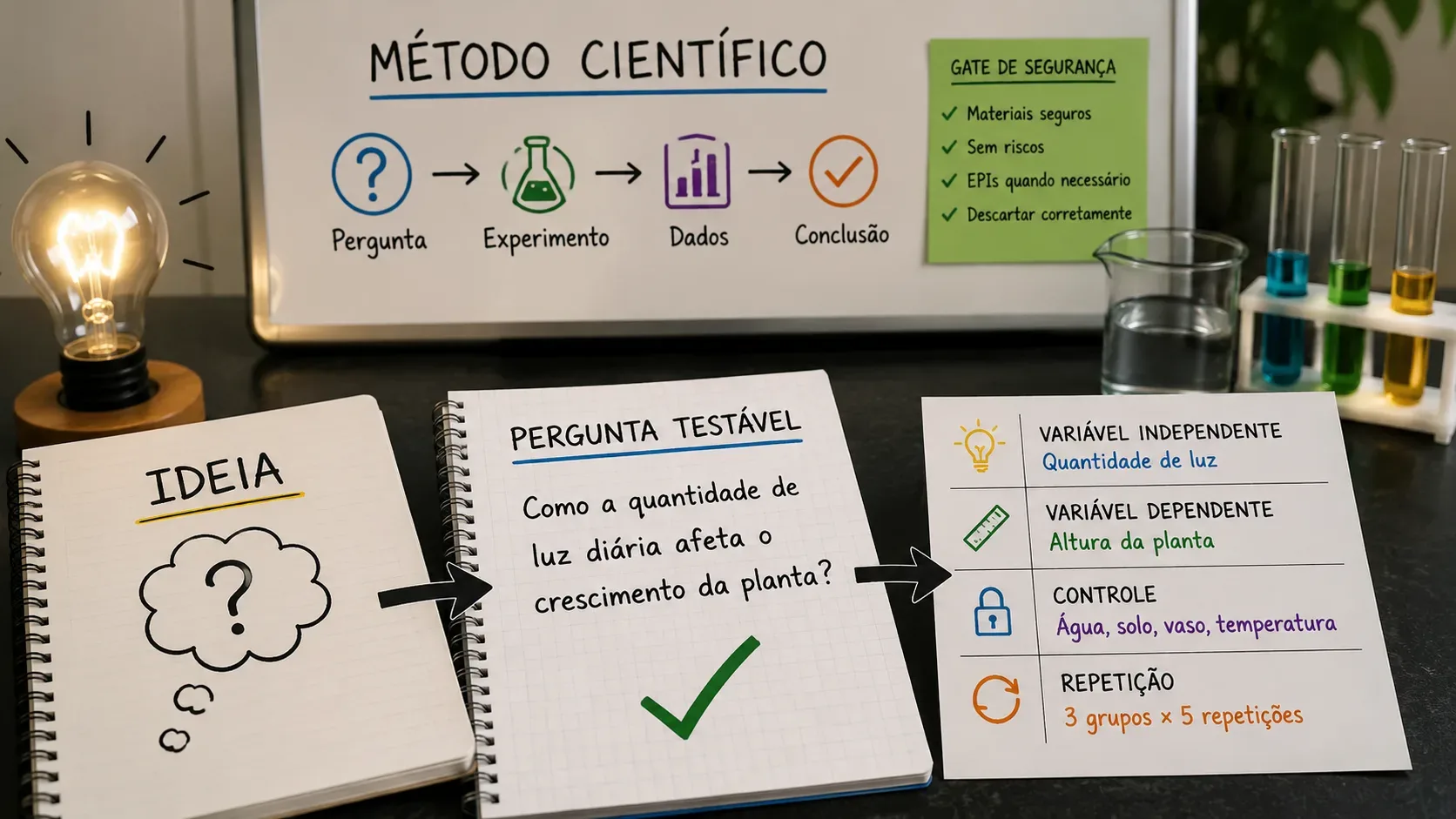
A science fair idea is not an experiment yet. “Plants and light,” “which paper is strongest?” or “temperature and dissolving” are topics. To become investigations, they must be turned into a question that states what will be changed, what will be measured, and what must remain comparable.
The Society for Science summarizes several foundations of a sound experimental project: identify a testable question, test one variable at a time, repeat tests, record measurements and observations, and analyze the data. This guide turns those principles into a practical planning model to use before the experiment begins.
1. Start with the effect you want to measure
A broad topic often hides several different questions. “Light and plants,” for example, could mean light color, daily duration, intensity, distance from the source, or exposure to natural light. If several of those factors change at the same time, it becomes difficult to tell which one explains the result.
For a simple school experiment, use this structure:
How does [independent variable] affect [dependent variable], while keeping [main control conditions] constant?
The independent variable is the factor you deliberately change. The dependent variable is the outcome you measure. Controlled variables are the conditions you try to keep the same across groups so that the comparison is fairer.
Example:
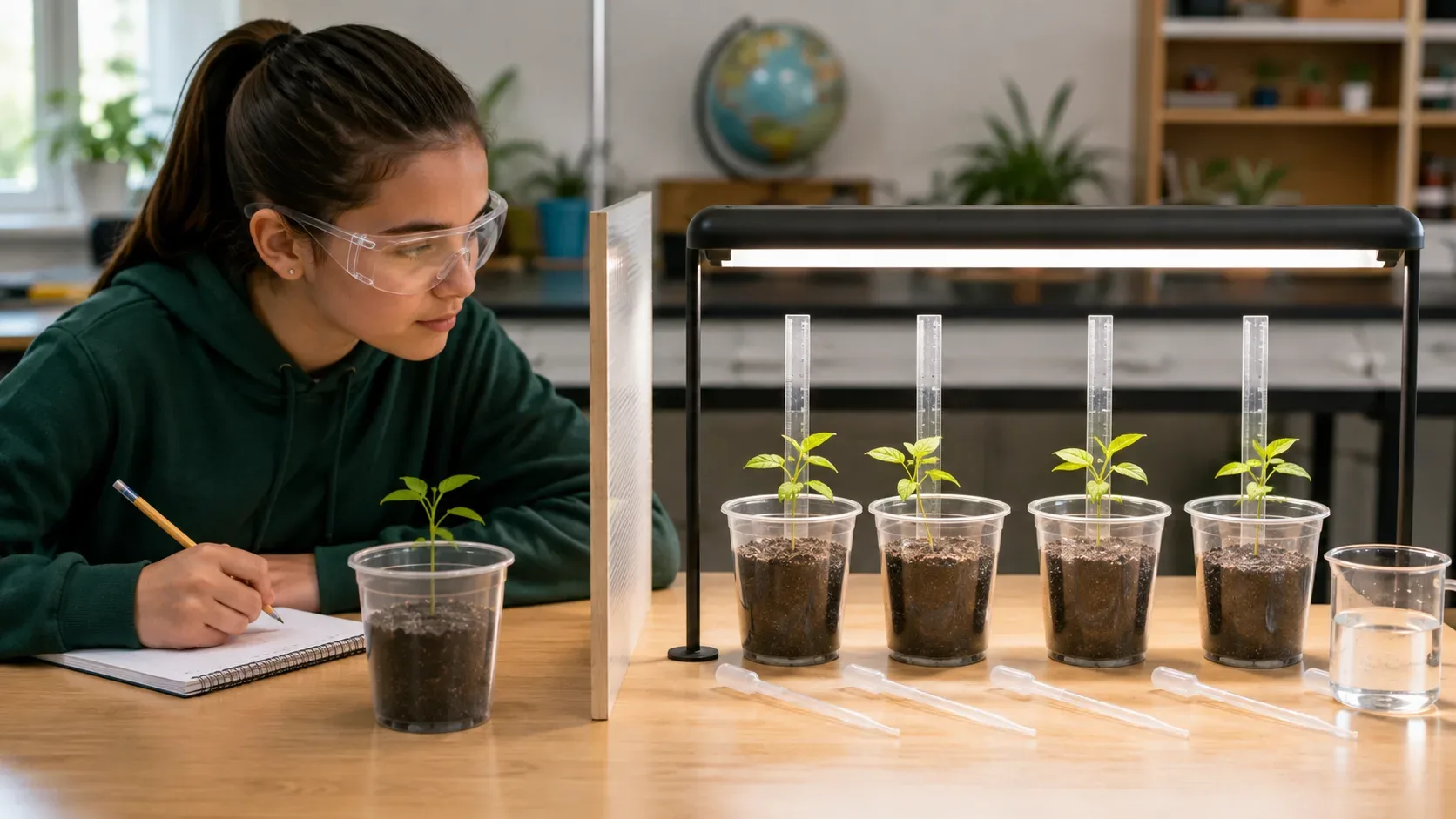
How does daily light duration, at 4, 8, and 12 hours, affect the growth of bean seedlings over 14 days, while keeping the bean variety, starting age of the seedlings, amount of water, type and amount of soil, pot size, and other growing conditions the same?
In this case there are three levels of one independent variable — light duration. This still counts as testing “one variable at a time”: the factor that changes across groups is the same factor, only at different values.
2. Check whether the question is truly testable
Before gathering materials, put the question through five tests:
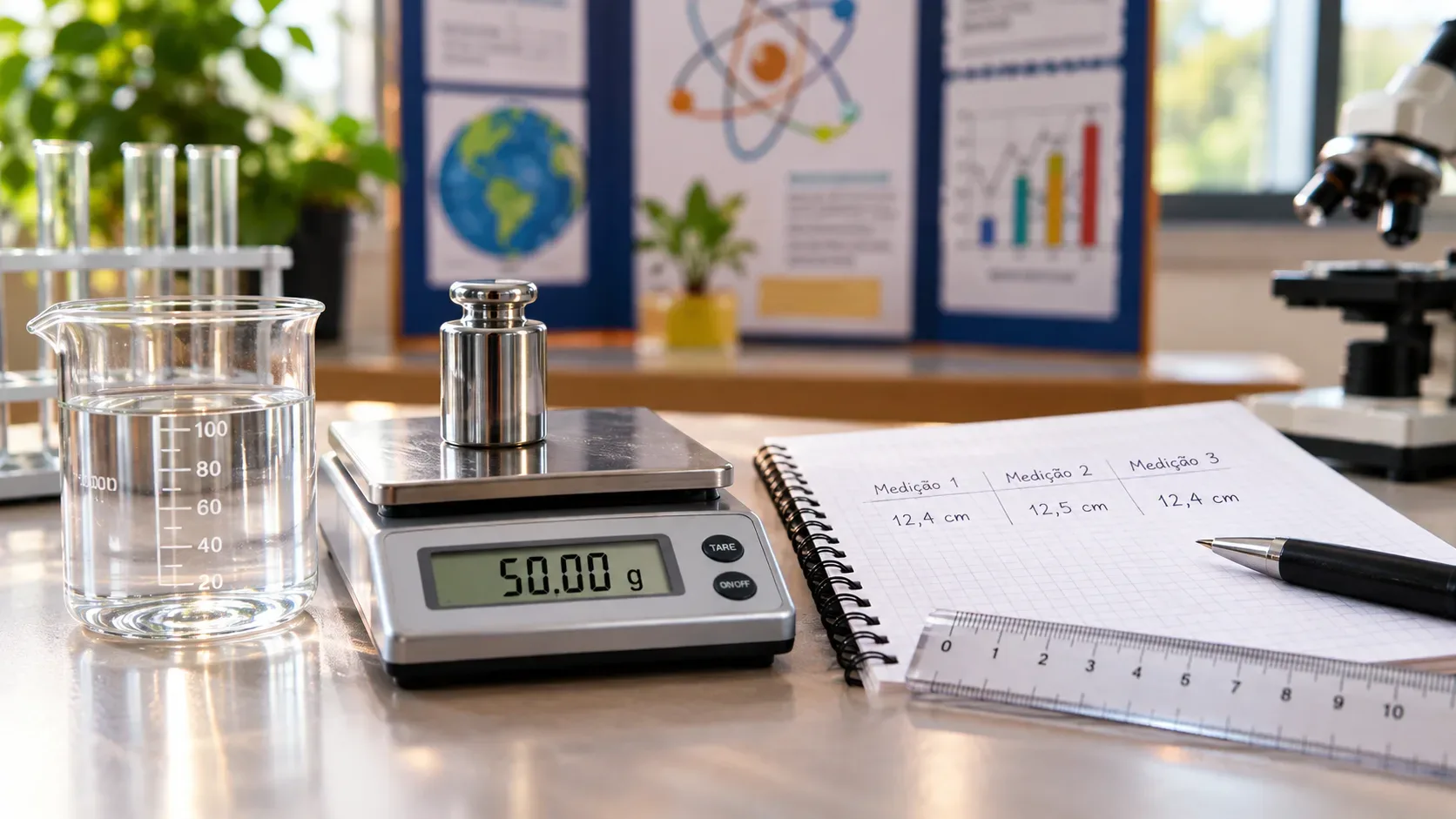
- Measurable: is there an objective way to record the outcome using a unit, count, scale, or predefined criterion?
- Comparable: do the groups or conditions differ mainly in the factor you chose to test?
- Repeatable: can the procedure be carried out more than once in the same way?
- Feasible: can the project fit the available time, space, budget, and materials?
- Safe and permitted: does the experiment follow school or fair rules, and will it wait for any required approvals before starting?
A question such as “which plant grows best?” is still vague. Best in what sense: height, mass, number of leaves, germination rate? And under what experimental change? The more explicit the measurement is, the easier it is to build a data plan.
3. Separate the independent variable, dependent variable, and control conditions
Complete these sentences before you start:
- I will change: ________.
- I will measure: ________.
- I will keep the same, as far as possible: ________.
In the seedling example:
- Independent variable: hours of light per day.
- Levels: 4 h, 8 h, and 12 h.
- Dependent variable: seedling growth, defined in advance as the change in height in millimeters or centimeters between the beginning and end of the test period.
- Control conditions: bean variety, starting stage, soil, pot, water volume and frequency, measurement method, and total duration of the test.
A controlled variable is not the same as a control group
This distinction prevents a common source of confusion. Controlled variables are conditions kept constant. A control group, by contrast, is a reference condition used for comparison when the experimental design calls for one. Not every school project needs a group literally labeled “control,” but almost every comparative experiment needs to control conditions that could otherwise distort the interpretation.
4. Plan replication before collecting any data
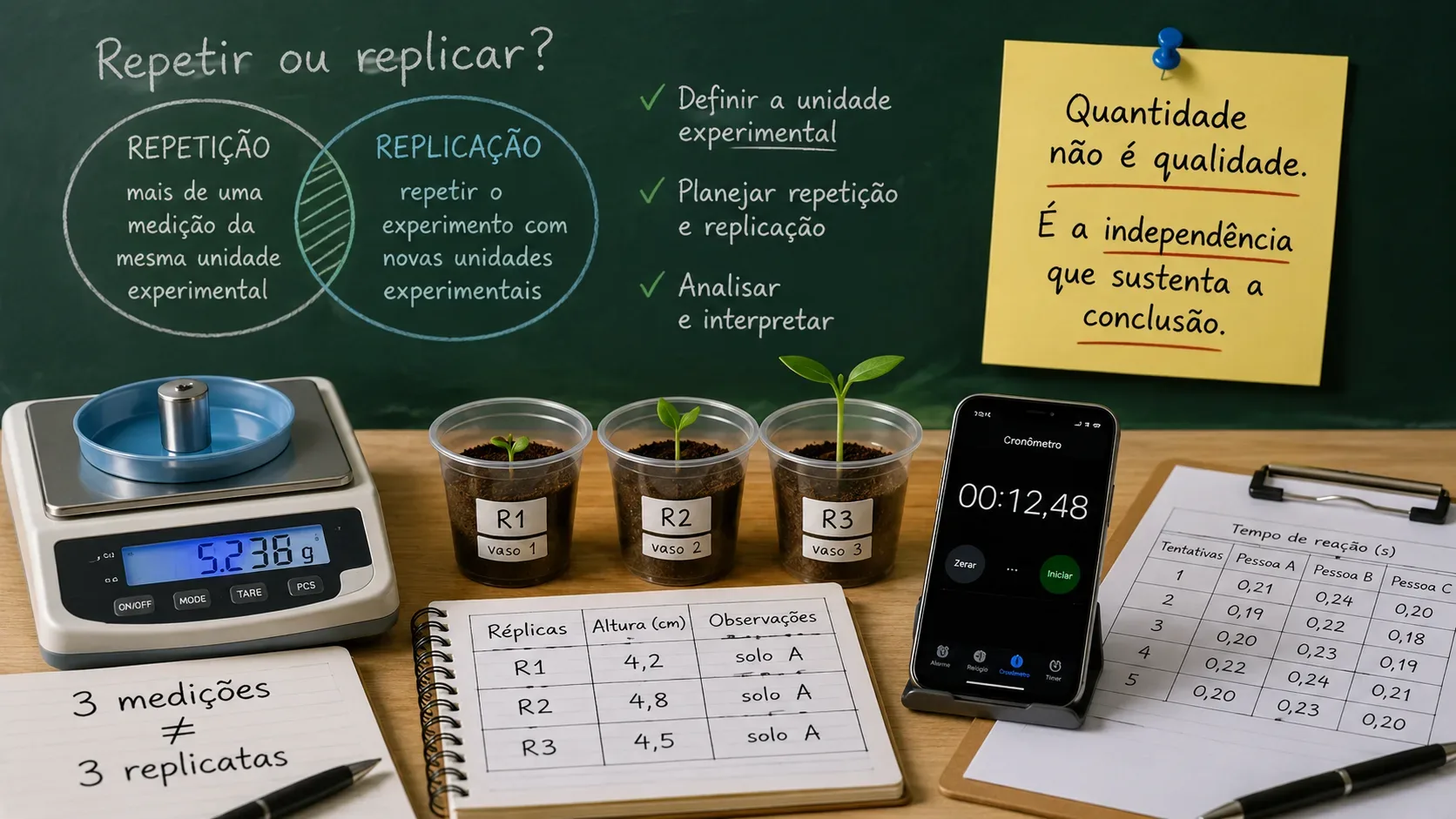
Society for Science recommends testing each variable more than once because repeated testing provides more data to support a conclusion. That does not mean taking the same reading several times and treating every reading as an independent experiment.
If you measure the same seedling five times in five minutes, you have five readings from one individual. If the goal is to compare growth under different conditions, a more useful experimental replication may be to have several independent seedlings under each condition, all following the same procedure.
An illustrative plan could use 3 groups × 5 seedlings per group. The number “5” is not a universal rule; it is only an example design. An appropriate number depends on the kind of project, available time and resources, fair rules, and the amount of variability expected.
Also define what counts as one replicate. For example: “one seedling in one individual pot” or “one complete run of the test with a new sample.” This prevents the replication count from being inflated unintentionally.
5. Decide what data you expect — without deciding the result you expect
“Expected data” does not mean predicting which group will win. It means defining what type of data the experiment will produce and how those data will be recorded.
Before the experiment, answer:
- What measurement will be collected?
- What unit will be used?
- When will each measurement be taken?
- Who will measure it, and with which instrument?
- How will raw values be recorded?
- What summary will be calculated afterward: mean, median, percentage, time, count, or another suitable metric?
- What graph will help compare the conditions?
In the seedling example, a data sheet could record each plant’s starting height, measurements on predefined days, and final height. The analysis can compare each seedling’s change in height and then summarize the results for each light condition. If a plant dies, a measurement is missed, or another problem occurs, record it; do not silently remove an inconvenient result.
6. Use this fill-in model before building the experiment
| Field | Complete before starting |
|---|---|
| Broad topic | Example: light and plant growth |
| Testable question | How does ______ affect ______, while keeping ______ constant? |
| Independent variable | The factor that will be changed |
| Levels/conditions | The values or groups of the independent variable |
| Dependent variable | The outcome that will be measured |
| Measurement and unit | Example: change in height, in mm |
| Controlled variables | Conditions that must remain comparable |
| Experimental unit | What counts as one independent replicate |
| Replication plan | How many units or runs there will be per condition |
| Measurement schedule | When data will be collected |
| Raw data record | The table where every measurement and observation will be recorded |
| Planned analysis | How groups will be summarized and compared |
| Safety gate | Risks, rules, supervision, and approvals required before starting |
7. Run a safety gate before the first test
Safety should not be added after the experiment has already begun. The Regeneron ISEF rules for all projects, for example, require risk and safety planning and establish prior review requirements for certain categories of research. Specific rules can vary by fair, school, and country.
Before starting, check:
- Are the materials and procedures appropriate for the place where the test will be conducted?
- Does the project involve heat, flame, electricity, pressure, tools, chemicals, radiation, or another activity beyond ordinary everyday risk?
- Does it involve people, surveys, user testing, or collection of identifiable information?
- Does it involve vertebrate animals?
- Does it involve culturing or handling microorganisms, tissue, blood, or other biological materials?
- Does any rule require a supervisor, risk assessment, consent, or approval before data collection?
Projects involving human participants, vertebrate animals, or potentially hazardous biological agents may require prior review and approval under ISEF rules. Projects involving hazardous chemicals, activities, or devices also require risk assessment and appropriate supervision. If there is uncertainty, stop the operational planning and check your fair’s rules with a responsible adult before experimenting.
8. Only then write the hypothesis and procedure
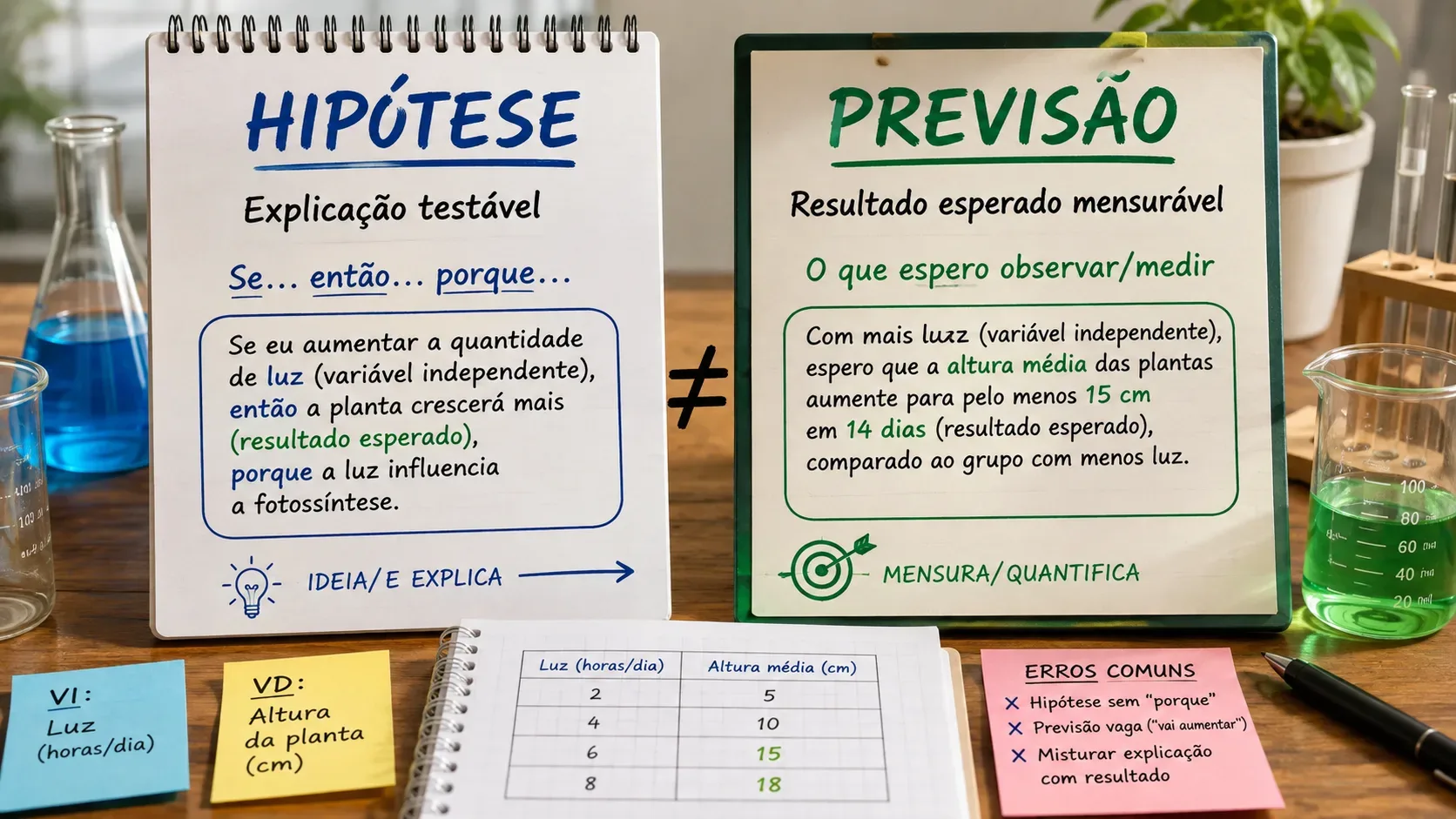
Once the question is defined, you can write a hypothesis that links the independent variable to the expected outcome and explains the reasoning behind the prediction. Then turn the design into a procedure detailed enough to be repeated in the same way.
A good procedure states the order of steps, quantities, timing, instruments, measurement criteria, and how foreseeable situations will be handled. It must also match the stated design: if the question promises to change only light duration, the procedure should not also change the amount of water or type of soil between groups.
9. Final checklist: has the idea become an experiment?
- Does the question describe a relationship that can be measured?
- Is the independent variable clearly defined?
- Does the dependent variable have a measurement and unit or an objective criterion?
- Are the main control conditions listed?
- Is it clear what counts as an independent replicate?
- Does the plan include more than one test or unit per condition when appropriate?
- Is there a table for raw data and observations?
- Was the analysis planned before seeing the result?
- Has the project passed the safety gate and any required approvals?
If you can answer “yes” to those questions, the idea is no longer only an interesting topic: it has become a verifiable experimental structure. The testable question is the backbone of the project because it defines what changes, what is measured, what must be controlled, how repetition will work, and what data can — or cannot — support the conclusion.