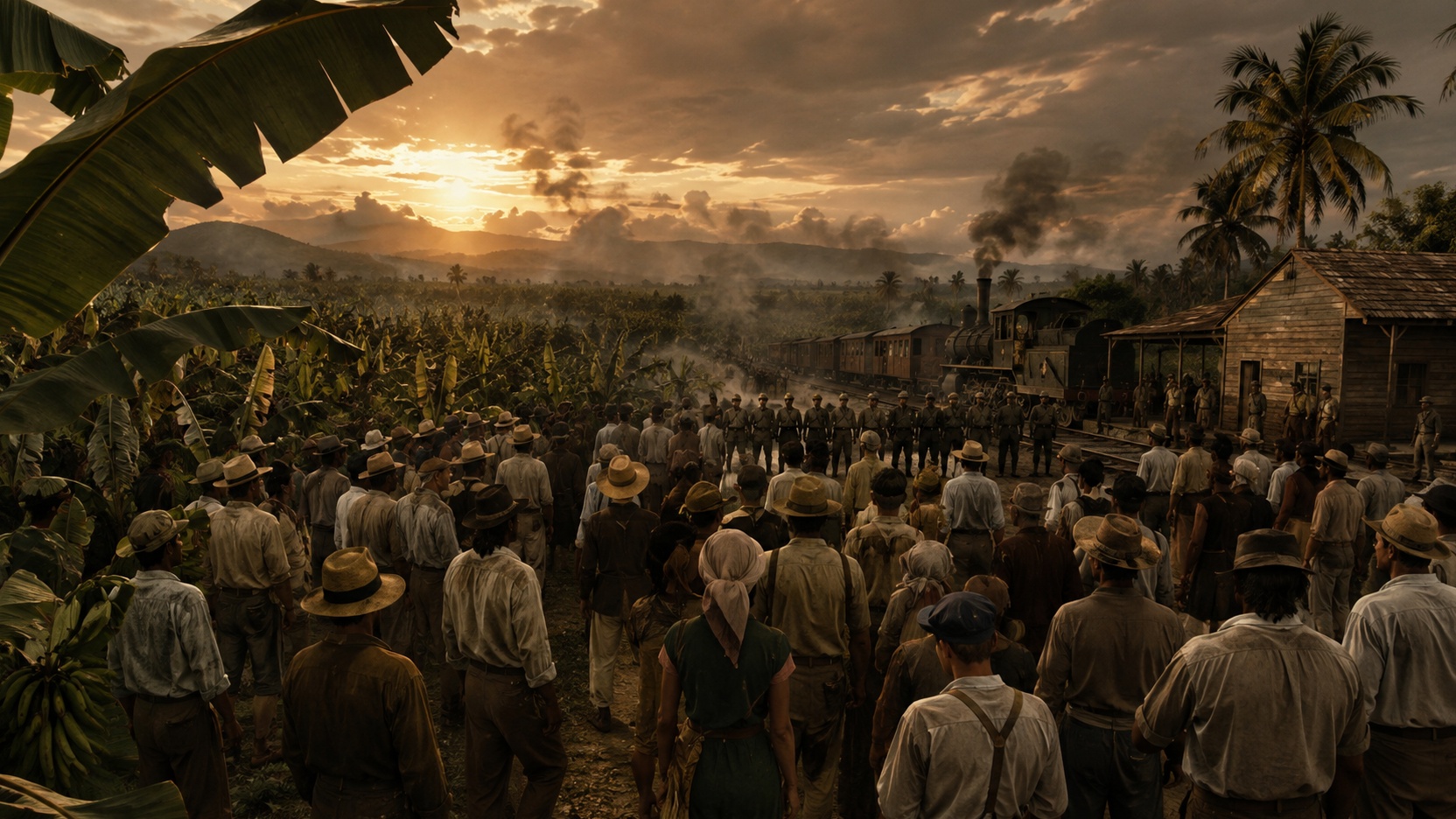
If you reached episode 6 of the second part of One Hundred Years of Solitude and felt that the banana company sequence looked too historical to be pure fiction, the short answer is yes: the massacre happened. In December 1928, Colombian Army troops opened fire on a gathering connected to a strike by workers in the banana-growing zone of Ciénaga, in the department of Magdalena. What still does not exist, almost a century later, is a death toll accepted definitively by historians.
The most misleading part of the question is not whether there was a massacre, but whether "more than three thousand" can be treated as a historically proven count. Gabriel García Márquez made that figure famous in the novel, and the adaptation preserves it. It carries literary, memorial and political force, but it does not function as a closed archival number.
What happened in Ciénaga in December 1928
That year, workers in Magdalena's banana-producing zone went on strike against conditions in the production system linked to the United Fruit Company. Their demands included changes to hiring through intermediaries, better wages, paid rest, compensation for workplace accidents and more dignified working conditions.
The conflict escalated throughout November. The government of President Miguel Abadía Méndez also treated the crisis as a public-order issue and sent troops to the region. The military command became associated with General Carlos Cortés Vargas.
On the night of December 5-6, a crowd was gathered near the Ciénaga railway station. Some workers were waiting for an authority who might mediate the conflict. The gathering did not end in negotiation. After an order to disperse, troops opened fire.
That core does not depend on the novel in order to exist. The strike, the Army's presence, the gathering in Ciénaga and the armed repression appear in historical documentation, academic studies, contemporary accounts and later reconstructions by Colombia's Banco de la República and Centro Nacional de Memoria Histórica.
Who took part and what role did each side play
Workers in the banana-growing zone
The strike involved workers in the United Fruit Company's production chain, many of them hired through intermediaries. The dispute was not a later invention by García Márquez. There was a real labor conflict, with concrete demands and weeks of stoppage before the early hours of December 6.
The United Fruit Company
The US company was at the economic center of the conflict. The hiring system and working conditions were among the strikers' demands. That does not mean company employees formed the firing squad that shot into the crowd. The armed repression was carried out by the Colombian Army.
At the same time, documents and studies show that protecting the company's interests and US citizens weighed on the political environment surrounding the crisis. US diplomatic correspondence followed the situation closely, and a later dispatch even recorded a death estimate relayed to diplomat Jefferson Caffery by a representative of the United Fruit Company itself.
The Colombian government and Army
The armed action was carried out by the state. The troops were under the command of Carlos Cortés Vargas, in a context in which the government feared social unrest and also viewed labor movements through the era's anti-communist lens. The repression is therefore not a fictional detail inserted into Macondo: it corresponds to an episode in Colombian history.
So how many people died?
This is where a simple answer would be less accurate than acknowledging the uncertainty.
Contemporary and later figures contradict one another. A historical overview published by the Banco de la República's cultural network notes that the earliest official acknowledgments were extremely low and mentions nine dead as a figure officially admitted at one point. Other reconstructions based on Cortés Vargas's later account point to numbers in the dozens, reaching 47 civilian deaths, or 48 if one soldier is included, depending on the scope used.
At the other extreme are estimates of hundreds and more than a thousand deaths. A January 16, 1929 dispatch from US representative Jefferson Caffery to the State Department recorded that a United Fruit Company representative in Bogotá had told him that the total number of strikers killed by Colombian military forces exceeded one thousand.
That document matters, but it must be read for what it actually is. It proves that an estimate above one thousand was circulating in January 1929 between a company representative and a US diplomat. It is not a named list of victims, a body count or a forensic inquiry. It is contemporary evidence that the perceived scale of the massacre could be far larger than the lowest official version.
Historiography has not resolved the count either. A study published in the Banco de la República's Boletín Cultural y Bibliográfico notes that research on the banana zone compiled 17 different estimates ranging from 47 to 2,000 deaths. In another overview, the Banco de la República itself treats the number of victims as undetermined.
For that reason, the historically safest wording is neither "three thousand died" nor "nine died." It is that there were deaths in a number that cannot be established precisely, with versions ranging from dozens to hundreds or thousands, and that the available records do not allow one final figure to be fixed.
Where did the "more than three thousand" in One Hundred Years of
Solitude come from? The figure of three thousand belongs directly to Gabriel García Márquez's literary project. In the novel, José Arcadio Segundo's memory resists a kind of collective erasure of the massacre. The
enormous scale of death is part of the way the book transforms a historical event into the mythical memory of Macondo.
There is also a decisive clue outside the novel. In an interview cited in a Banco de la República study, García Márquez explained that when he researched the episode he found uncertain figures that were much smaller than the scale he wanted for the narrative. He then chose three thousand to preserve the epic proportions of One Hundred Years of Solitude. In his memoirs, he again explained that he kept that figure within the logic of the literary drama.
That changes how the episode should be read. The phrase should not be used as though it were a historical certificate of 3,000 deaths. It is a deliberate fictional choice built on a real tragedy whose exact scale remained disputed.
Series, novel and historical record: three different layers
In the Netflix series
Netflix released the seven episodes of the second part on August 5, 2026. Episode 6 was officially titled in Spanish Eran más de tres mil. The platform itself connects this stage of the story to the arrival of the railway, the banana trade and the decline of Macondo. The special episode that concludes the adaptation is scheduled for August 26, 2026.
The series is therefore adapting the novel. When it keeps a figure in the thousands, it preserves a central element of the memory constructed by García Márquez. It is not presenting a new historical survey of Ciénaga.
In the novel
One Hundred Years of Solitude moves the episode to Macondo and turns the killing into a point of rupture. The enormous number of victims reinforces two important ideas in the book: violence on an absurd scale and a society's capacity to deny what has just happened.
That second element helps explain why the figure became so powerful. The novel does not merely say that thousands died; it dramatizes the dispute over the very existence of memory. José Arcadio Segundo keeps a memory that the rest of the world seems to reject.
In the historical record
The historical record confirms the massacre, but it does not confirm a count of three thousand dead. It confirms the strike, the military intervention, the shooting at the gathering and the repression that followed. It also documents the enormous divergence among the figures.
That is the fundamental difference. The existence of the massacre is a historical fact. The exact figure remains open. The "more than three thousand" belong to the literary truth of One Hundred Years of Solitude, not to a consensus death toll in historiography.
What Jorge Eliécer Gaitán's investigations added
In 1929, Jorge Eliécer Gaitán took the case to the Colombian Congress after investigating the region. The Centro Nacional de Memoria Histórica has again highlighted that set of debates, held from September 3 to 6 of that year, as a key source for understanding accusations about the repression, the relationship between public power and company interests, and the treatment of workers.
Reconstructions of Gaitán's investigation mention interviews with residents and workers, photographs and allegations of abuses committed during and after the repression. The importance of this material is not that it gives us a definitive count today. It shows that only months after the massacre there was already an intense political and documentary dispute against minimized versions of what happened.
That detail is essential to avoid a false dilemma. Recognizing that three thousand is not a proven figure does not mean accepting that almost no one died. Serious historiography also questions reducing the episode to the lowest official figures.
And did the train full of bodies really happen?
The image of a train carrying corpses is one of the novel's most powerful scenes, and it also appears in memories and accusations associated with the massacre. Accounts collected over the decades speak of bodies being removed, buried or taken elsewhere. Gaitán also presented allegations about the fate of corpses.
The problem is turning that memory into a logistical operation documented exactly as it appears in fiction, with the same scale, number of railway cars and number of dead. The available records do not allow that equivalence to be made safely.
The same principle applies here as with the death toll: the historical event and the literary image touch one another, but they are not identical. García Márquez works with rumors, oral memory, regional trauma and fragmentary documentation to create a scene that has historical meaning without functioning as a literal reproduction of a military report.
So was the Banana Massacre real, or was it created by García Márquez?
It was real. The massacre did not originate in One Hundred Years of Solitude. The novel transformed a 1928 episode of Colombian history into one of the most remembered scenes in Latin American literature.
What García Márquez enlarged was the narrative scale. The figure of three thousand was deliberately incorporated into the epic logic of the book and, over time, often began circulating as though it were the definitive historical number. Netflix's adaptation preserves that legacy by calling episode 6 Eran más de tres mil.
The most precise way to separate the layers is this: there was a real strike; the Colombian Army fired on workers and other people gathered in Ciénaga; people died; the United Fruit Company was at the center of the labor conflict; the number of victims was disputed from the earliest days; contemporary documents speak of dozens, hundreds and more than a thousand; and there is not enough evidence to treat three thousand as a proven total.
What can be said safely after episode 6
After watching the series, you can treat the scene as a gateway to a real event, but not as a documentary reconstruction of every detail. The station, the strike, the banana company, the military intervention and the massacre have a historical basis. The figure and some of the most extreme images belong to García Márquez's work with memory and fiction.
That tension is precisely what makes the episode so powerful. In Ciénaga, the historical problem was never only about counting the dead. It was also about understanding why the versions diverged so sharply, who had the power to record the event, and how literature ended up preserving a tragedy that the documents themselves could never close with a single number.