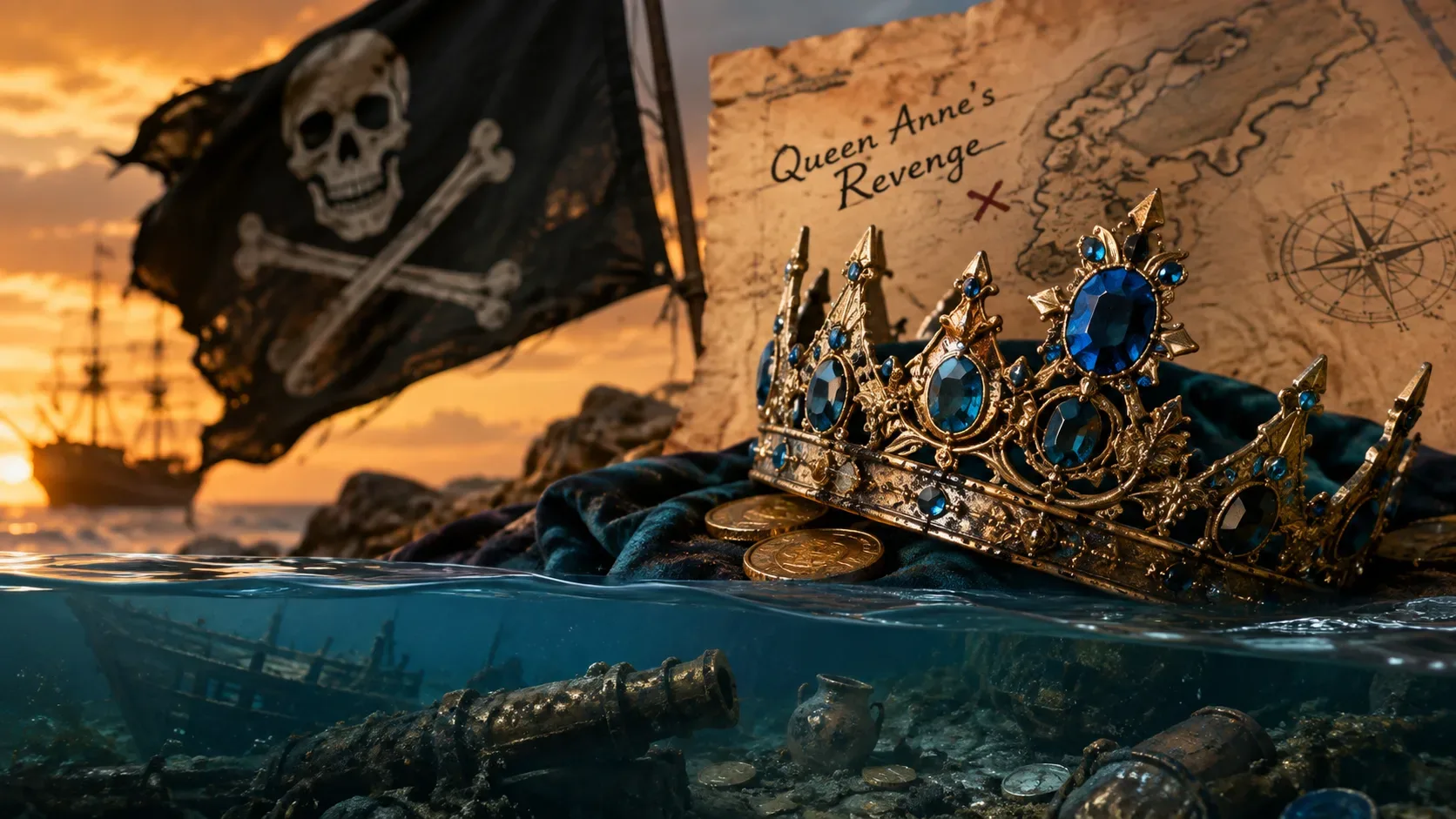
There is no historical or archaeological evidence that the “Blue Crown” in Outer Banks existed as one of Blackbeard’s treasures. The series starts with a real figure — the pirate known as Blackbeard — and a real ship, Queen Anne’s Revenge, but builds a fictional treasure hunt around them. The distinction matters because the wreck attributed to the ship has been located, excavated, and studied by archaeologists for decades, leaving a large body of material evidence showing what was actually connected to the vessel.
In the story, the Blue Crown is presented as an extraordinary ancient artifact associated with rulers from antiquity, capable of granting wishes and bringing exceptional favor to its owner. Netflix itself describes it as a fabled, enchanted treasure within the narrative. Historical research on Blackbeard and Queen Anne’s Revenge, by contrast, documents cannons, anchors, instruments, tableware, weapons, personal objects, and even gold dust — but not a blue crown, a royal jewel by that name, or an object with the powers assigned to it by the series.
Short answer: the Blue Crown is fiction; Blackbeard and the ship are real
The starting point of Outer Banks is historically recognizable. Blackbeard, usually identified as Edward Teach or Thatch, operated in the early 18th century and turned the former French slave ship La Concorde into his flagship, renamed Queen Anne’s Revenge. In June 1718, the vessel ran aground near present-day Beaufort Inlet, North Carolina, and was abandoned.
Those facts are supported by historical documents and the work of the Queen Anne’s Revenge Project, part of North Carolina’s state heritage program. The series adds another layer: the Blue Crown, a legendary object supposedly sought by Blackbeard and later made central to the treasure hunt in Seasons 4 and 5.
In its own guide to the storyline, Netflix Tudum explains that, within the fiction, the crown was said to have been worn by figures such as Darius the Great and Julius Caesar, to grant wishes and invincibility, and to have disappeared in the 18th century before Blackbeard went looking for it. Those claims belong to the mythology of the show, not to the known historical record of the pirate.
What archaeology actually found at Queen Anne’s Revenge
The wreck associated with Queen Anne’s Revenge was located on Nov. 21, 1996, near Beaufort Inlet. According to the official archaeology project, its identification was built from a combination of location, historical documentation, the size and distribution of the site, the number of weapons, and the characteristics of the artifacts. There was no single object bearing the ship’s name; the conclusion came from the total body of evidence.
Since then, hundreds of thousands of objects have been recovered and studied. Published finds include:
- Cannons and ammunition: the site contains dozens of artillery pieces. The official catalog reports 30 cannons identified and 24 recovered by 2015, with examples from different countries and in different calibers.
- Anchors and ship components: structural remains and fittings help researchers reconstruct the vessel’s size, construction, and use.
- Small arms and weapon parts: barrels, locks, fittings, and other components of muskets and firearms are part of the assemblage.
- Navigational, scientific, and medical instruments: chart dividers, weights, and medical equipment reveal practical work performed on board.
- Tableware and personal objects: pewter plates, bottles, tools, glass beads, and everyday items provide evidence of early 18th-century material culture.
- Paper fragments: conservators found tiny printed fragments linked to a travel book published in 1712, a rare survival in a marine wreck.
- Gold dust: the project reports nearly 17,000 flakes totaling about 25 grams of natural gold recovered across the wreck site.
The broader inventory is available in the Queen Anne’s Revenge Project artifact collection. The recovered gold dust is documented separately in the official catalog.
So did archaeologists find “Blackbeard’s treasure”?
That depends on what counts as treasure. If the idea is an intact chest full of crowns, jewels, and coins, no. What archaeologists found is historically more valuable: an assemblage that makes it possible to study a ship used in piracy, its weapons, its equipment, and shipboard life.
The gold dust proves that valuable material was present, but it is not the same as a legendary hidden fortune. The project itself notes that large valuables were not expected at the wreck because Blackbeard and part of his crew left after the grounding and appear to have taken important property with them. The site is therefore better understood as an archaeological time capsule than as a classic “X marks the spot” treasure cache.
There is also a history that pirate mythology often pushes into the background. Before Blackbeard captured it in 1717, La Concorde was a French slave ship. Research by the QAR Project documents its role in the transatlantic trafficking of enslaved Africans and shows that on its final voyage it carried hundreds of enslaved people as well as gold dust. That history belongs to the same hull that later became Queen Anne’s Revenge.
Why the absence of a crown in the wreck is not, by itself, the main proof
A logical distinction is important. Even if archaeologists never recovered a blue crown from the wreck, that alone would not prove that a similar object could never have existed somewhere else. In the show, after all, the Blue Crown is part of a chain of clues that ultimately leads far beyond North Carolina.
The stronger reason to classify the Blue Crown as fictional is the wider evidence: it does not appear as a recognized artifact in the historical documentation of Blackbeard; it is not part of the archaeological catalog of Queen Anne’s Revenge; and the official presentation of Outer Banks treats it as a legendary story element, complete with supernatural attributes and a backstory linking Persian kings, Rome, Blackbeard, and a modern quest.
In other words, the wreck helps test what is materially known about Blackbeard, but the historical status of the Blue Crown does not depend only on what was or was not recovered from the seabed.
What Outer Banks borrowed from history — and what it invented
| Element | Historical basis | In the series |
|---|---|---|
| Blackbeard | A real early 18th-century pirate active in the Caribbean and along the North American coast. | He becomes the starting point for a new chain of clues and treasures. |
| Queen Anne’s Revenge | A real vessel, formerly the French slave ship La Concorde, captured by Blackbeard and lost in 1718. | Its name and connection to the pirate give the treasure hunt historical plausibility. |
| Charleston blockade | A documented 1718 event in which Blackbeard blockaded the port and demanded medicine. | The series reuses Charleston and references to the event as part of the clue trail. |
| Blue Crown | No recognized historical artifact with that identity is associated with Blackbeard. | A legendary treasure with powers, an ancient lineage, and a central role in the plot. |
| Maps, inscriptions, and puzzle chain | They do not correspond to a known historical dossier about a Blackbeard treasure. | They function as an adventure device connecting North Carolina, Charleston, Morocco, and Portugal. |
The series is not trying to reproduce a documentary biography of Blackbeard
The creators themselves have indicated that they were not aiming to tell the “usual” Blackbeard story. That fits the genre of Outer Banks: real figures and places provide a recognizable anchor, while manuscripts, curses, riddles, and treasures are rearranged to sustain a serialized adventure.
That also explains how the plot can place a real fact — such as Blackbeard’s May 1718 blockade of Charleston — next to invented material. The blockade happened; a Blue Crown with powers and a history running from Darius to Caesar and then to Blackbeard is not presented by historians or archaeologists as part of the pirate’s biography.
What about Season 5?
The fifth and final season premiered on Aug. 20, 2026. The official Netflix page confirms that all 10 episodes are available and that the pursuit of the Blue Crown remains part of the final conflict. That has put the object back at the center of the series, but it does not change its historical status: it remains a fictional device built on a foundation of real names, places, and events.
Verdict
The Blue Crown in Outer Banks is not a known historical treasure of Blackbeard. What exists outside the fiction is more concrete and, in many ways, more interesting: a wreck attributed to Queen Anne’s Revenge, early 18th-century documents, and hundreds of thousands of artifacts that help reconstruct the life of the ship and the maritime world in which Blackbeard operated.
The series is on solid ground when it chooses Blackbeard and North Carolina as the historical setting for an adventure. What it invents is the centerpiece of the mystery: the Blue Crown, its powers, its ancient lineage, and the international hunt surrounding it. To separate the two, the best reference is not the treasure legend but the official archaeological record of Queen Anne’s Revenge.