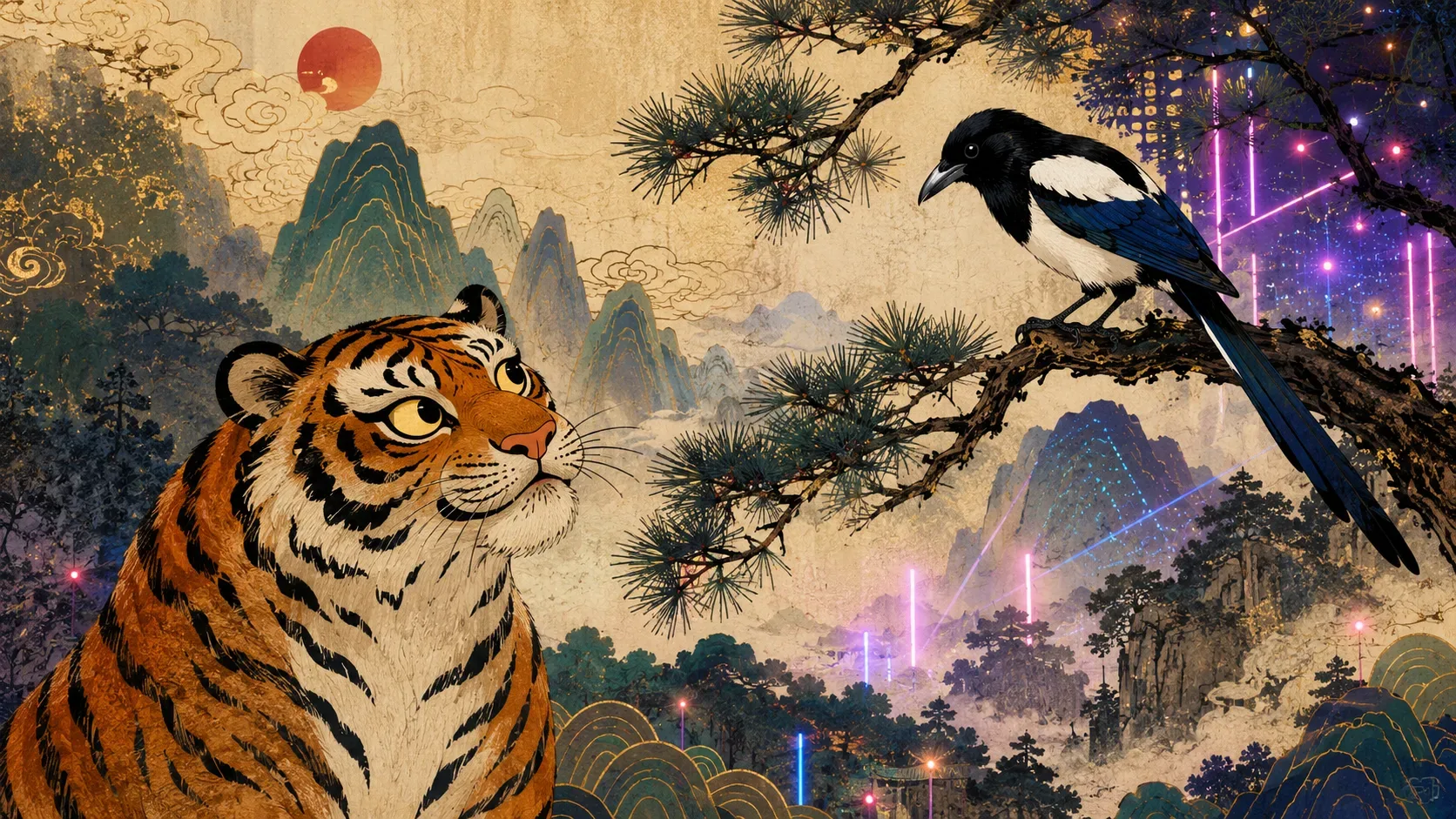
Derpy being a tiger and Sussie being a magpie is not a random combination invented for KPop Demon Hunters. The pair comes from a traditional motif in Korean folk painting: jakhodo, also associated with kkachi horangi images, in which a tiger appears together with a magpie, often beneath or near a pine tree. The Korea Tourism Organization explicitly explains that the film's two messengers were directly inspired by this painting genre, while Netflix identifies Derpy as a reinterpretation of the babo horangi, the “foolish” or comic tiger recurring in minhwa.
The key to understanding the characters, then, is to separate two things: what comes from Korean visual tradition and what the film invents for its own story. The protective tiger, the magpie associated with good news, and the pair's humor have recognizable roots in Korean culture. Their role delivering messages between Rumi and Jinu, their supernatural appearance, and details such as Sussie's extra eyes are choices made by the film.
What is jakhodo, and how does minhwa fit in?
Minhwa is a term used for Korean folk painting, especially associated with the Joseon period and with images that circulated in everyday life for decorative, auspicious, and symbolic purposes. One of its most recognizable motifs is the combination of a tiger and a magpie.
Material from a Korean Cultural Center presents jakhodo literally as a “Magpie and Tiger Painting.” The same source describes the magpie as a symbol of good news and welcome guests, and the tiger as a guardian figure capable of warding off evil spirits. VisitKorea uses this same tradition to explain Derpy and Sussie.
Texts on the subject use several related names — including hojakdo and kkachi horangi — but the visual point is consistent: the tiger + magpie pairing is a recognizable motif in Korean folk art. It is not necessary to treat every label as absolutely identical in every historical context; for viewers of the film, the essential point is the shared tradition that puts the two animals in visual dialogue.
Why the tiger is powerful and funny at the same time
The tiger occupies a much larger place in Korean culture than that of a simple predator. It appears in stories, religious imagery, and folk painting as a symbol of strength and, in many contexts, as a protector against evil. Korea.net notes that tiger paintings were used to repel negative influences and that tiger-and-magpie images were also displayed around the beginning of the lunar year.
The crucial detail for Derpy is that the minhwa tiger often does not look majestic in the conventional sense. It may have crossed or wandering eyes, a curious expression, an awkward body, and an almost domestic quality. Netflix describes Derpy as a version of the babo horangi, a recurring figure in these paintings. In an interview about the creative process, director Maggie Kang explained that the “goofy” appearance of these painted tigers helped shape the character's visual personality.
That helps explain why Derpy works as a huge tiger who is also clumsy. The contrast does not break the reference: it is part of the reference. The film carries into animation a tradition in which a fearsome animal can remain powerful without being drawn as threatening at every moment.
And why is Sussie a magpie?
In iconography associated with jakhodo, the magpie commonly occupies a higher position, often perched on a branch while the tiger remains below. Culturally, it is associated with good news, welcome visitors, and auspicious signs. Its presence beside the tiger is therefore not a random accessory: it completes the composition's meaning.
The film adapts that association quite directly. Derpy and Sussie become messengers between Jinu and Rumi. Tradition does not say that a magpie must literally carry notes between two people; that is the movie's narrative solution. But turning a bird associated with good news into part of a communication system is a coherent reinterpretation of the older symbol.
The satirical side of the tiger and magpie
There is also a widely discussed historical reading in which some tiger-and-magpie paintings operate as social satire. In this interpretation, the awkward tiger represents figures of authority or the yangban elite, while the small, self-assured magpie placed above it stands for the voice of ordinary people. The joke visually reverses the hierarchy: the large, powerful animal becomes the target of humor while the small bird seems to have the upper hand in the exchange.
Korean cultural reporting also highlights this layer, but it is better not to reduce the whole genre to one mandatory interpretation. Jakhodo can combine protection, good fortune, humor, and social commentary. That multiplicity is part of what makes the reference richer than a simple “tiger means X, magpie means Y” formula.
What the film preserves and what it invents
| Element | In jakhodo/minhwa tradition | In KPop Demon Hunters |
|---|---|---|
| Tiger | Strength, protection, and in many images a deliberately comic appearance | Derpy keeps the large, awkward presence but receives his own personality and story function |
| Magpie | Good news, welcome visitors, auspicious signs; can interact with the tiger in a satirical way | Sussie accompanies Derpy and participates in communication between Jinu and Rumi |
| Tiger + magpie pair | A recurring traditional motif in Korean folk painting | Becomes a supernatural character duo embedded in the plot |
| Supernatural appearance | Not a historical requirement of the motif | Color, extra eyes, and other details signal that they are not ordinary animals |
| Message delivery | Not a literal function prescribed by tradition | A narrative invention that echoes the magpie's association with good news |
The creative interview published by Salon makes this separation particularly clear. Kang says the tiger design came from minhwa and its visual pairing with the magpie. Artist Radford Sechrist described the final design as heavily based on the traditional art while also borrowing traits from a crew member's pet cat. When the story needed a way for Jinu to communicate with Rumi, the tiger was turned into a message carrier and the bird “tagged along.”
In other words, the film is not adapting a legend in which Derpy and Sussie already existed as named characters. It takes an old visual pairing and builds new characters from it.
So what is the cultural reference behind Derpy and Sussie?
The short answer is: jakhodo/minhwa. Derpy inherits the Korean tiger that can be a guardian, powerful, and intentionally funny. Sussie inherits the magpie associated with good news and with the traditional interaction between the two animals. Together they reproduce a combination Korean viewers may recognize immediately, while the movie transforms it into something functional for its own narrative.
That is why the question “why a tiger and a magpie?” has a more interesting answer than “because they look good together.” The design works on two levels at once: as a supernatural comic duo inside KPop Demon Hunters and as a gateway into a centuries-old Korean visual tradition.