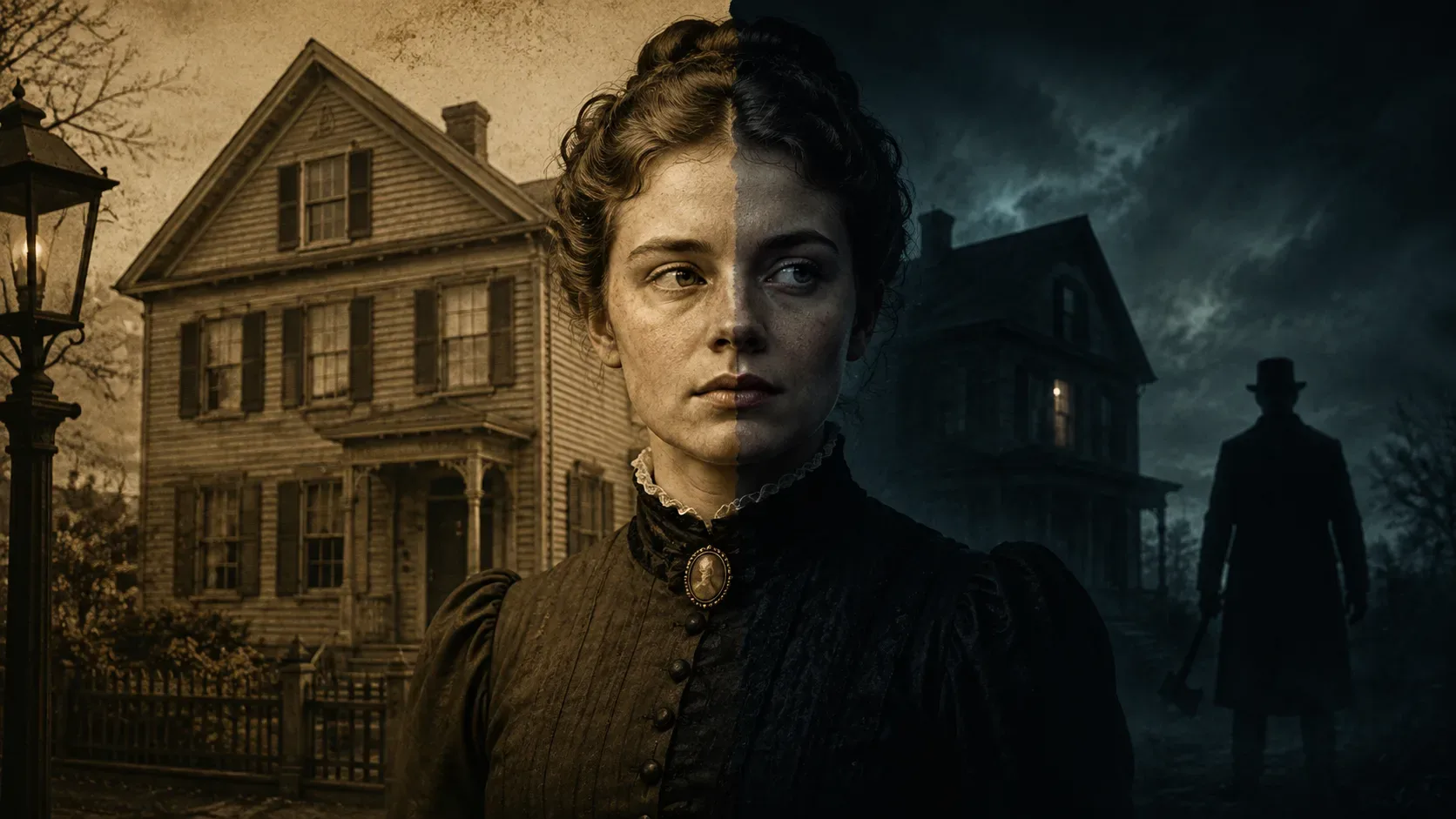
Monster: The Lizzie Borden Story premieres on Netflix on September 17, 2026 with a narrative choice that is already visible in the official material: the platform describes Lizzie Borden as the person who kills Andrew and Abby Borden. Historically, however, that point was never established by a conviction. Lizzie was tried in 1893 and acquitted. The safest way to follow the series, then, is to separate three layers: what is documented in the court record and testimony, what remains disputed, and what the adaptation assumes or invents to build its story.
What the historical record confirms
On August 4, 1892, Andrew J. Borden and his wife, Abby Durfee Borden, were killed inside the family home on Second Street in Fall River, Massachusetts. Trial records place Abby's body in the guest room and Andrew's on the sitting-room sofa. Medical examiner William Dolan testified that Abby died before Andrew and that the wounds were consistent with a cutting instrument such as a hatchet.
Lizzie, Andrew's daughter and Abby's stepdaughter, was in the house during part of the morning. Household servant Bridget Sullivan was also at the residence and gave some of the case's most important testimony. Sullivan said that Lizzie and her sister Emma called her “Maggie,” even though her name was Bridget, and she described that morning's routine, including washing the windows, Andrew's return home, and the moment Lizzie called her downstairs saying her father was dead.
The investigation increasingly focused on Lizzie. She was questioned at the inquest, arrested in August 1892, and brought to trial the following year. The trial began on June 5, 1893 and ended on June 20 with a not guilty verdict. That outcome is a central legal fact: the jury did not find that the prosecution had proved guilt beyond a reasonable doubt.
What the evidence failed to settle
The case became famous precisely because there were suspicious circumstances but no conclusive physical link between Lizzie and the killings. The prosecution relied on opportunity, family tensions, statements attributed to Lizzie, and episodes such as her burning a dress a few days after the murders. The defense argued that these pieces did not amount to direct proof of authorship.
The weapon issue is a good example. Dolan said a hatchet would be consistent with the injuries. Chemist Edward Wood, however, examined axes and hatchets collected from the house and reported negative blood tests on the pieces he tested. In other words, the type of instrument could be inferred from the wounds, but the proceedings did not conclusively establish which specific object was used or physically connect it to Lizzie.
There was also controversy over reports that Lizzie had tried to buy prussic acid and over conflict within the family. Those points became part of the prosecution narrative, but they did not resolve the central question. More than a century later, historians and writers still debate different hypotheses because the documentary record allows interpretations rather than an uncontested reconstruction of every step of the crimes.
Where the series already goes beyond reconstruction
Netflix's official material is explicit about the new season being a dramatization. The series description states that Lizzie kills her parents, while the judicial record ends in acquittal. That does not make the show “wrong” as historical fiction, but it does mean viewers should not confuse its dramatic premise with a conclusion reached by the court.
Another example is the relationship between Lizzie and the servant. Netflix presents Vicky Krieps as Bridget “Maggie” Sullivan and describes an illicit romantic relationship between the two, while also suggesting that Maggie pushes Lizzie toward the crime. Sullivan's historical testimony confirms that she worked in the house and was called Maggie by Lizzie and Emma. In the same testimony, however, Sullivan said she had no trouble with the family and had not witnessed quarrels. The romance and instigator role therefore belong to the fictional construction announced by the series, not to a fact established by the cited court record.
Actor Ella Beatty has also publicly described her work as creating a “very fictionalized” version of the real woman. That is a useful viewing cue: costumes, places, characters, and incidents may grow out of historical documentation, while private dialogue, intimate relationships, psychological motives, and the identity of the killer are areas in which the series can choose an interpretation.
Documented, disputed, or created for the series?
| Point | Status | How to read it |
|---|---|---|
| Andrew and Abby Borden were killed in Fall River on August 4, 1892 | Documented | This is the factual basis of the case and appears in the trial record. |
| Abby died before Andrew | Documented in medical testimony | Medical examiner William Dolan gave that conclusion based on the condition of the bodies and other evidence he examined. |
| Bridget Sullivan was the servant and Lizzie and Emma called her “Maggie” | Documented | Sullivan herself said so under oath at trial. |
| Lizzie killed Andrew and Abby | Historically disputed; assumed by the series | Lizzie was accused, tried, and acquitted. Netflix chooses a narrative answer that the trial did not establish. |
| Lizzie and Maggie had a romantic relationship | Announced creation/dramatization | The relationship appears in the show's promotional premise, not as a fact demonstrated by Sullivan's cited testimony. |
| Maggie encouraged Lizzie to commit the murders | Announced creation/dramatization | This is a dramatic mechanism shown in Netflix's promotional material. |
| A specific hatchet found in the house was the murder weapon | Not conclusively demonstrated | The wounds were consistent with a hatchet, but the tested objects did not provide the decisive physical link. |
| Family tensions explain the motive for the murders | Disputed | Conflict and property issues were discussed, but turning them into a proven motive goes beyond what the verdict established. |
Why the acquittal did not end the historical debate
Two opposite shortcuts should be avoided. The first is saying that the acquittal “proved” Lizzie was innocent; a not-guilty verdict means the prosecution did not reach the legal standard required for conviction. The second is treating the case's later fame as if it replaced the judicial result and turned guilt into a fact. Historically, authorship remains disputed.
The preserved material helps explain why. There is detailed testimony about who was in the house, doors, and timing; medical evidence about the probable order of death; and disputes over a burned dress, an alleged note said to have called Abby away, and a possible attempt to buy poison. At the same time, there was no eyewitness to the attack, no murder weapon was conclusively linked to Lizzie, and the jury acquitted her.
How to watch the series without turning fiction into evidence
- Treat private scenes as dramatic reconstruction. Unwitnessed conversations, thoughts, intimate relationships, and motives generally require invention by the writers.
- Separate “it happened in the case” from “the show depicts it happening.” An adaptation may choose one hypothesis to create narrative closure.
- Use the verdict as the legal landmark. Lizzie Borden was acquitted on June 20, 1893.
- Be cautious with famous details that came from popular culture. The rhyme about “40 whacks” and “41” does not literally match the case's medical record.
- Compare characters with testimony. Bridget Sullivan existed and was called Maggie, but that does not automatically make the relationships and actions assigned to her by the series historical facts.
What is already confirmed about Monster: The Lizzie Borden Story
As of September 2, 2026, Netflix confirms a September 17, 2026 premiere. Ella Beatty plays Lizzie Borden; Vicky Krieps plays Bridget “Maggie” Sullivan; Charlie Hunnam and Rebecca Hall play Andrew and Abby Borden. The official page classifies the production as a period crime drama, and the trailer already signals a deliberately fictionalized reading of the events.
Because the season has not premiered as of this date, any scene-by-scene comparison should wait for the episodes. The most useful post-release update will be to identify which scenes reproduce known testimony or documents, which combine separate facts, and which create dialogue, relationships, or causes without direct support in the record. That makes it possible to analyze the adaptation without using gratuitous spoilers as a substitute for evidence.
Sources for checking the case and the adaptation
- Netflix Tudum: release date, cast, and official season overview
- Netflix Tudum: trailer and statements about the fictionalized version
- Netflix: official Monster: The Lizzie Borden Story page
- Famous Trials/UMKC: account of the Lizzie Borden proceedings
- Famous Trials: Bridget Sullivan testimony
- Famous Trials: medical examiner William Dolan testimony
- Famous Trials: chemist Edward Wood testimony