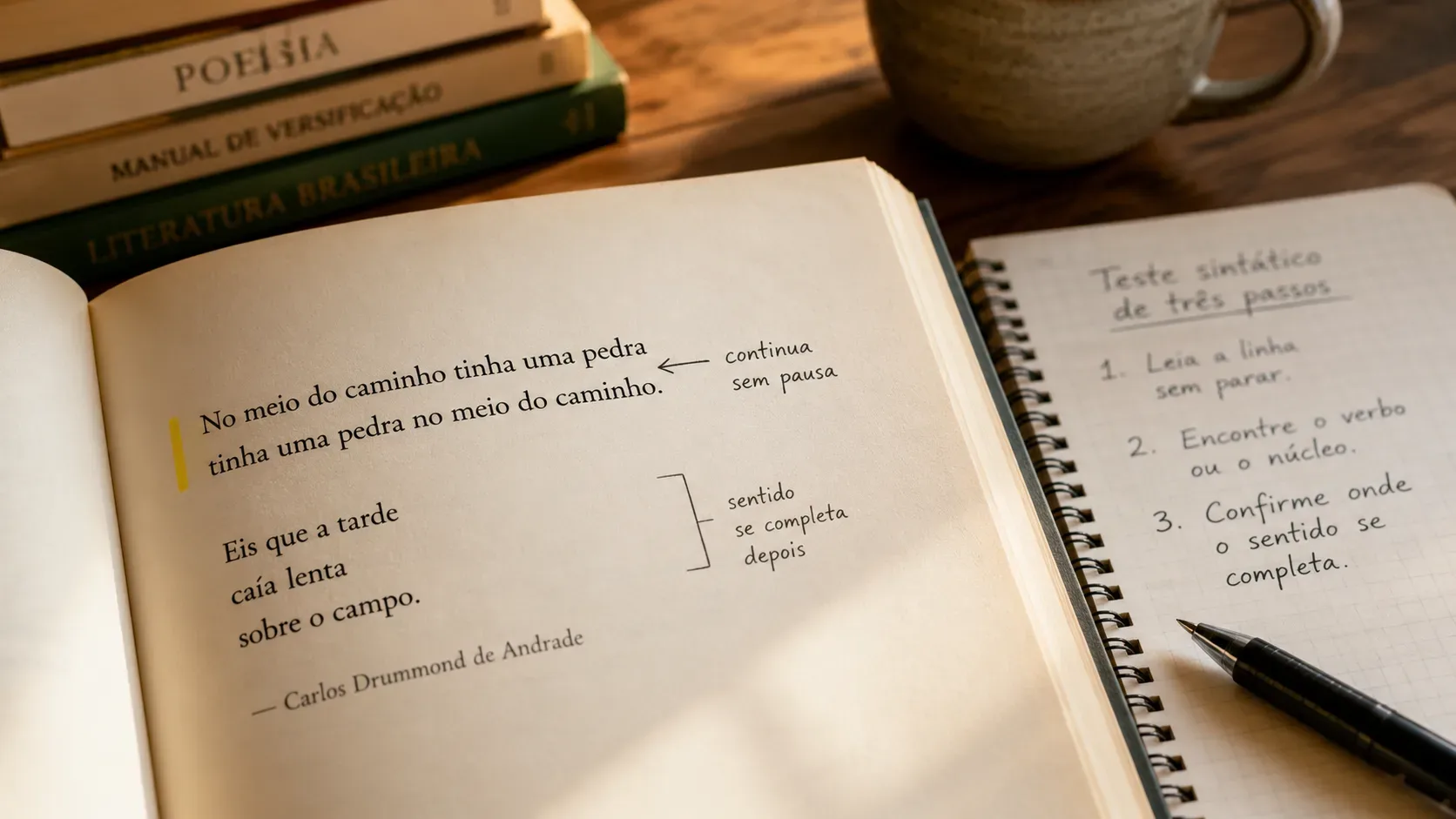

Alliteration and assonance are devices based on sound repetition. The main difference lies in the kind of sound that returns: alliteration repeats consonant sounds, especially at the beginnings of nearby words, while assonance repeats vowel sounds. In both cases, the point is not only to identify a literary device, but to notice how recurrence changes rhythm, emphasis, and atmosphere in a line.
Alliteration and assonance: the essential difference
| Device | What repeats | Where to listen | Original example | What to notice |
|---|---|---|---|---|
| Alliteration | Consonant sounds | Often at the beginnings of nearby words | “Wild winds wash the window.” | The repeated /w/ sound creates an audible current and links different words through their consonant onset. |
| Assonance | Vowel sounds | Inside nearby words, regardless of their consonants | “Low boats float home.” | The recurring long “o” sound creates an echo and a sense of vocal continuity. |
The Poetry Foundation defines alliteration as the repetition of initial stressed consonant sounds in a series of words. The same institution describes assonance as the repetition of vowel sounds without requiring the consonants to repeat. The Academy of American Poets places both among forms of sound recurrence that help build rhythmic patterns.
Listen for sounds, not just letters
The first precaution is not to treat alliteration and assonance as a visual hunt for matching letters. The object of analysis is the sound that is actually pronounced. Two words may begin with different spellings and still produce a similar consonant onset. Likewise, the same letter can represent different sounds depending on the word, accent, and phonetic context.
This is why reading aloud matters. When a passage seems “musical,” read it slowly and ask: which sound comes back? At what interval? Is the repetition concentrated in one line or spread across several lines? Does it accompany semantically related words, or does it connect terms that would otherwise feel distant in meaning?
How to recognize alliteration in practice
Look for an unusual concentration of the same consonant sound in nearby words. Not every word has to begin with the same letter, and the pattern does not need to occupy the whole line. What matters is that the recurrence is audible enough to participate in the organization of the verse.
Consider this example created for analysis:
“Bright branches bend beside the brook.”
The /b/ sound returns in “bright,” “branches,” “bend,” “beside,” and “brook.” The repetition gives the sentence sonic unity. Depending on the reading, the sequence can sound marked, percussive, or insistent. That does not mean the /b/ sound has a fixed meaning. Its effect arises from the combination of articulation, speed, vocabulary, and context.
Alliteration is not the same as consonance
The terms overlap, but they are not identical. In common teaching practice, alliteration usually highlights consonant repetition in initial or prominent positions. Consonance is broader and can describe recurring consonants elsewhere in a word. The distinction is useful when a poem distributes the same sound through the middle or end of words without creating a clear sequence of initial attacks.
How to recognize assonance in practice
With assonance, attention shifts to vowels. They can create internal echoes even when the consonants change completely. Read:
“Slow smoke rolls over the road.”
The long “o” sound runs through the line, connecting words built from different consonants. The result may suggest continuity, roundness, or prolongation, but those interpretations should be tested against the rest of the poem.
Assonance also does not require end rhyme. It can occur in the middle of words and work as a kind of sonic stitching. In poems without a fixed rhyme scheme, it can create cohesion without drawing as much attention as regular end rhyme.
Sound effects do not come with fixed meanings
It is tempting to use formulas such as “s sounds are soft” or “hard consonants create aggression.” Such associations can serve as an initial hypothesis, but they should not become rules. The same sound can produce different effects in different contexts.
- Density: many repetitions in a small space make the pattern more noticeable.
- Position: repeated sounds at word beginnings can mark strong impulses, while sounds scattered inside words may act more subtly.
- Speed: consonant clusters can speed up or slow down articulation depending on their combination.
- Vocabulary: the meanings of the words change how the sound pattern is interpreted.
- Syntax and punctuation: pauses, breaks, and continuities determine how the ear perceives recurrence.
When alliteration and assonance appear together
The two devices can coexist in the same line. Consider:
“Wild winds wash the window.”
There is clear alliteration in /w/. At the same time, related vowel sounds recur across “wild,” “winds,” and “window.” A reading does not have to choose only one label. Several layers of sound can operate at once.
In another construction:
“Thin rain slips across the street.”
The consonants create repeated textures, while the vowels in “thin,” “slips,” and “street” set up additional echoes. The critical task is to ask how these recurrences reinforce movement, image, or rhythm, rather than simply accumulating terminology.
A read-aloud method
- Read the passage once without marking anything. Notice the overall impression of rhythm and sound.
- Read it again and mentally mark the returning sound. Separate consonant patterns from vowel patterns.
- Pronounce the words slowly. This helps distinguish sound repetition from spelling coincidence.
- Return to a normal pace. Notice whether the recurrence speeds up, slows down, joins, or fragments the phrase.
- Connect sound and meaning. Ask why these words, with these sounds, appear together.
- Test a paraphrase. Imagine synonyms that would break the pattern. If the line loses force, the sound organization is probably meaningful.
How to discuss the effect without becoming vague
A strong analysis avoids statements such as “the alliteration makes the poem beautiful.” Instead, describe the mechanism and then propose an effect. A useful formula is:
recurring sound + location + rhythmic consequence + relation to meaning.
For example: “The repeated /w/ at the beginnings of several words links them through the same articulatory impulse; read in sequence, the pattern reinforces the sense of movement suggested by the verbs.” The claim is more precise because it shows where the device occurs and how it participates in the reading.
Common mistakes when identifying these devices
- Counting letters instead of sounds. Analysis should follow pronunciation.
- Calling every repetition alliteration. If the main recurrence is vocalic, assonance is the more appropriate term.
- Confusing assonance with rhyme. Assonance can occur inside a line and does not depend on identical endings.
- Forcing a universal effect. A sound does not carry a fixed meaning by itself.
- Ignoring context. Rhythm, syntax, imagery, and theme help determine why the repetition matters.
In summary
To distinguish alliteration from assonance, begin with your ear: recurring consonants point toward alliteration; recurring vowels point toward assonance. Then move beyond classification. Observe density, position, reading speed, and the relationship between sound and meaning. That second step is where a literary device stops being merely a name and becomes a tool for interpreting poetry.