When a poetic line ends, the sentence does not always end with it. In enjambment, a syntactic unit continues into the next line. The best starting point for reading it is simple: follow syntax and punctuation before turning the visual line break into a pause. The line still matters, but it does not automatically function like a full stop.
What enjambment is
The Academy of American Poets defines enjambment as the continuation of a sentence or clause across a poetic line break. The Poetry Foundation presents the same idea in contrast with an end-stopped line, whose ending coincides with syntactic or punctuational closure. In other words, enjambment makes the eye move down the page before grammar has finished the thought.
That does not mean reading the poem as if it were plain prose. A line break can still create expectation, emphasize a word, speed up movement, or produce a slight suspension. The mistake is to convert every change of line into a strong pause even when the sentence requires continuity.
The most common mistake: reading every line ending like a period
Beginning readers often associate the visual end of a line with a mandatory pause. With enjambment, that pause may separate elements that belong to the same construction: article and noun, adjective and noun, verb and complement, or subject and predicate. The result is a choppy reading that adds punctuation the poem does not contain.
| Signal | What to notice | How to read it |
|---|---|---|
| Strong punctuation appears at the end of the line | The phrase or clause closes there | Make the pause indicated by the text |
| There is no punctuation and the syntax is incomplete | A word depends on the next line | Continue without an artificial stop |
| The syntax continues, but the break spotlights a word | The line creates expectation or double focus | Keep the syntax moving while letting the line boundary register lightly |
The three-step syntax test
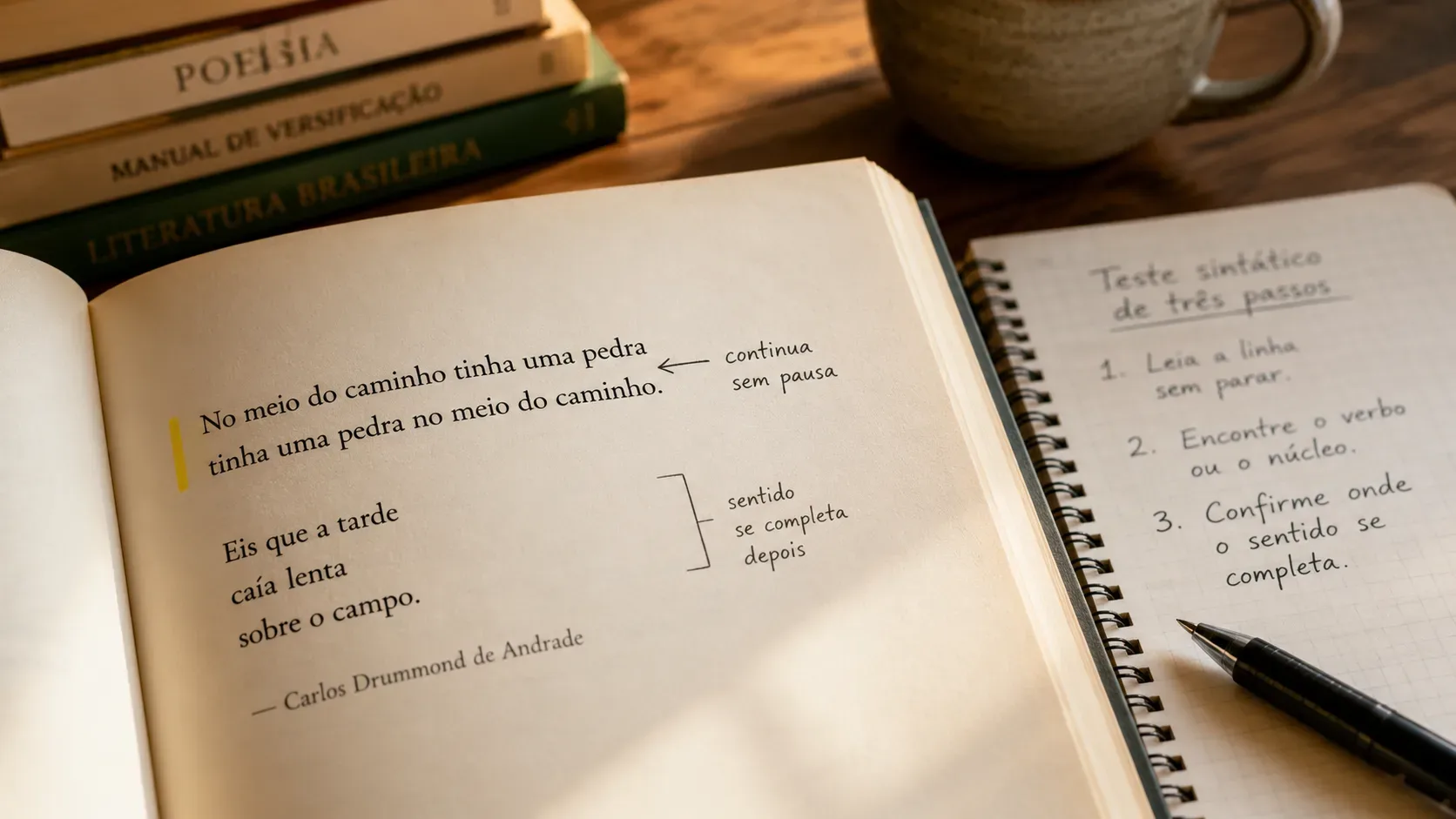
- Read the sentence across the break. For a moment, ignore the verse layout and find where the clause actually becomes complete.
- Find the syntactic core. Look for the verb, subject, complements, and words that depend on one another. If the line ends in the middle of that relationship, enjambment is likely.
- Put the line break back into the reading. Read again without inventing a strong pause. Notice what the break highlights, delays, or makes temporarily ambiguous.
This method helps because it separates two questions: where does the sentence ask for a pause? and what does the line break do to that sentence?
A public-domain example: Camões
In Os Lusíadas, published in 1572 and available digitally through Project Gutenberg, Camões writes:
Dai-me igual canto aos feitos da famosa
Gente vossa, que a Marte tanto ajuda;
The first line ends with “famosa,” but the adjective is completed syntactically only by “Gente” at the start of the next line. A strong pause after “famosa” interrupts the relationship between the two words. The reading has to move forward to complete the noun phrase.
Before and after marking the reading
- Stilted reading: “Dai-me igual canto aos feitos da famosa [strong pause] / Gente vossa...”
- Functional reading: “Dai-me igual canto aos feitos da famosa → Gente vossa...”
The second version does not erase the line break. On the contrary, because “famosa” is briefly suspended at the edge of the line, the noun arrives only afterward. The cut delays information that syntax requires, creating expectation and emphasis.
What the break can do even without a strong pause
A poetic line is not just packaging for a sentence. A guide from Oregon State University notes that enjambment carries the reader smoothly into the next line, while discussions of lineation show how break placement can modify meaning, rhythm, and the perception of syntax.
- Momentum: an unfinished sentence pushes the reader forward.
- Suspension: the final word of the line remains briefly unresolved.
- Emphasis: a word gains weight because it occupies the line edge.
- Reinterpretation: the next line may force the reader to revise an impression formed a moment earlier.
- Rhythmic contrast: syntax may keep running while meter, rhyme, or visual design still marks separate lines.
Enjambment, end-stopping, and caesura are not the same thing
| Device | Where it occurs | Main reading effect |
|---|---|---|
| Enjambment | Syntax crosses the end of the line | Continuity with tension or expectation at the break |
| End-stopped line | The line ending coincides with syntactic closure or punctuation | The stop tends to feel more complete |
| Caesura | A perceptible pause occurs inside the line | It divides or reorganizes the rhythm internally |
A practical read-aloud routine
- Read the passage silently and reconstruct the full sentence.
- Mark the actual punctuation: commas, semicolons, colons, dashes, and periods.
- Read once by following syntax only, without stopping just because the line ended.
- Read again while allowing the line edge to register as light tension rather than an automatic pause rule.
- Ask what was highlighted at the end of each line and what became clear only afterward.
- Compare: if the same words were set as prose, what effect would disappear?
When you should not simply speed up
“Do not stop” does not mean “rush.” A poem can combine enjambment with meter, rhyme, alliteration, changes in intonation, or a very brief expressive hold. The goal is to avoid imposing an interruption that destroys the syntactic construction. In oral reading, continuity can coexist with a slight sustaining of the voice at the line ending.
Punctuation can also occur inside a line while enjambment happens at its end. That is why the safest rule is neither “pause at the line” nor “ignore the line,” but to read in two layers: syntax guides the sentence; the line organizes the rhythmic and visual experience of that sentence.
Quick checklist for recognizing and reading enjambment
- Is the sentence grammatically incomplete at the end of the line?
- Does a word depend directly on the beginning of the next line?
- Is there no strong punctuation at the break?
- Would a long pause make the sentence sound artificial or confusing?
- Does the cut create expectation, emphasis, or a possible shift in meaning?
If several answers are yes, read across the break first and then consider the effect the poet created by choosing that exact point for the next line.