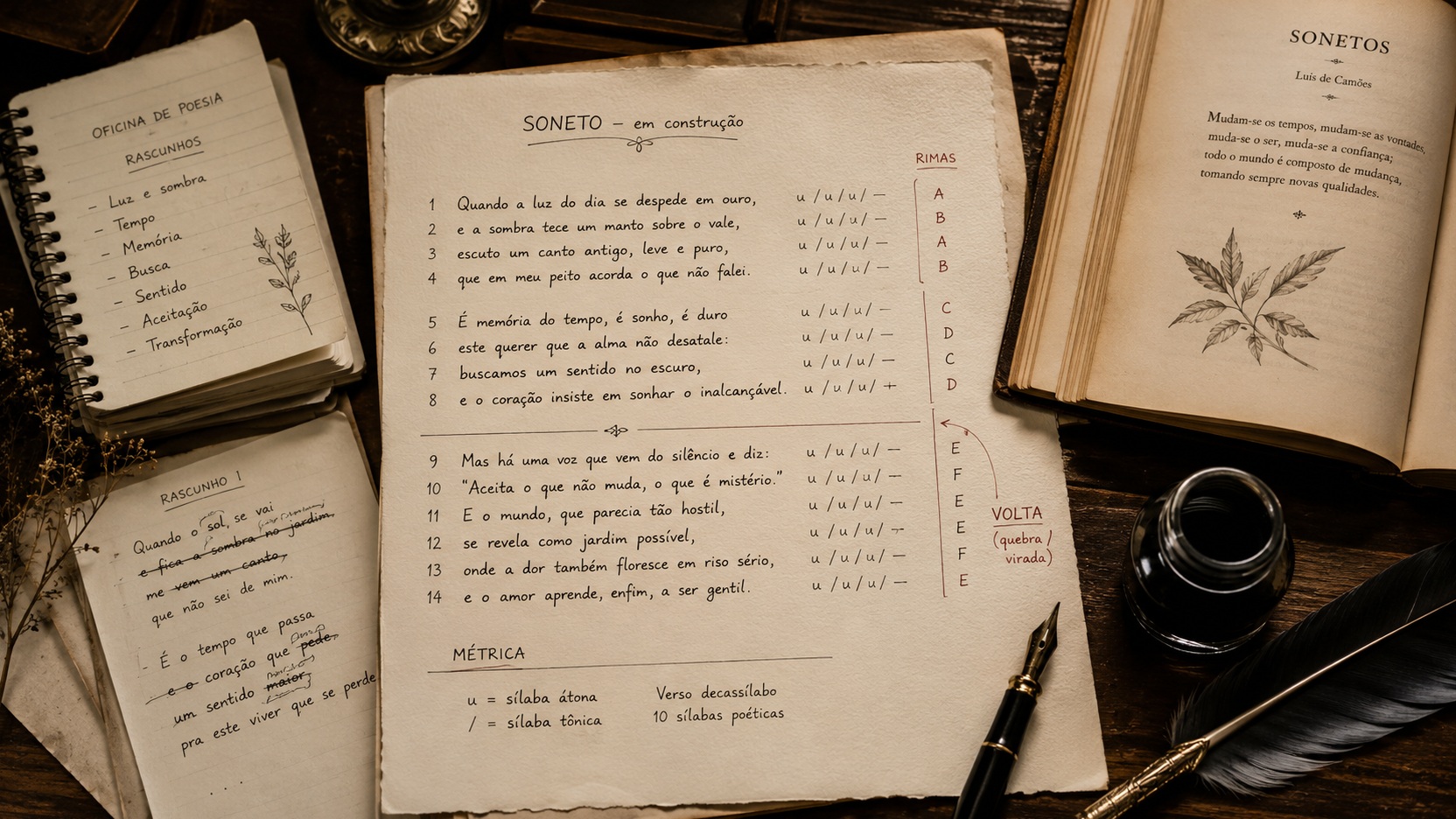
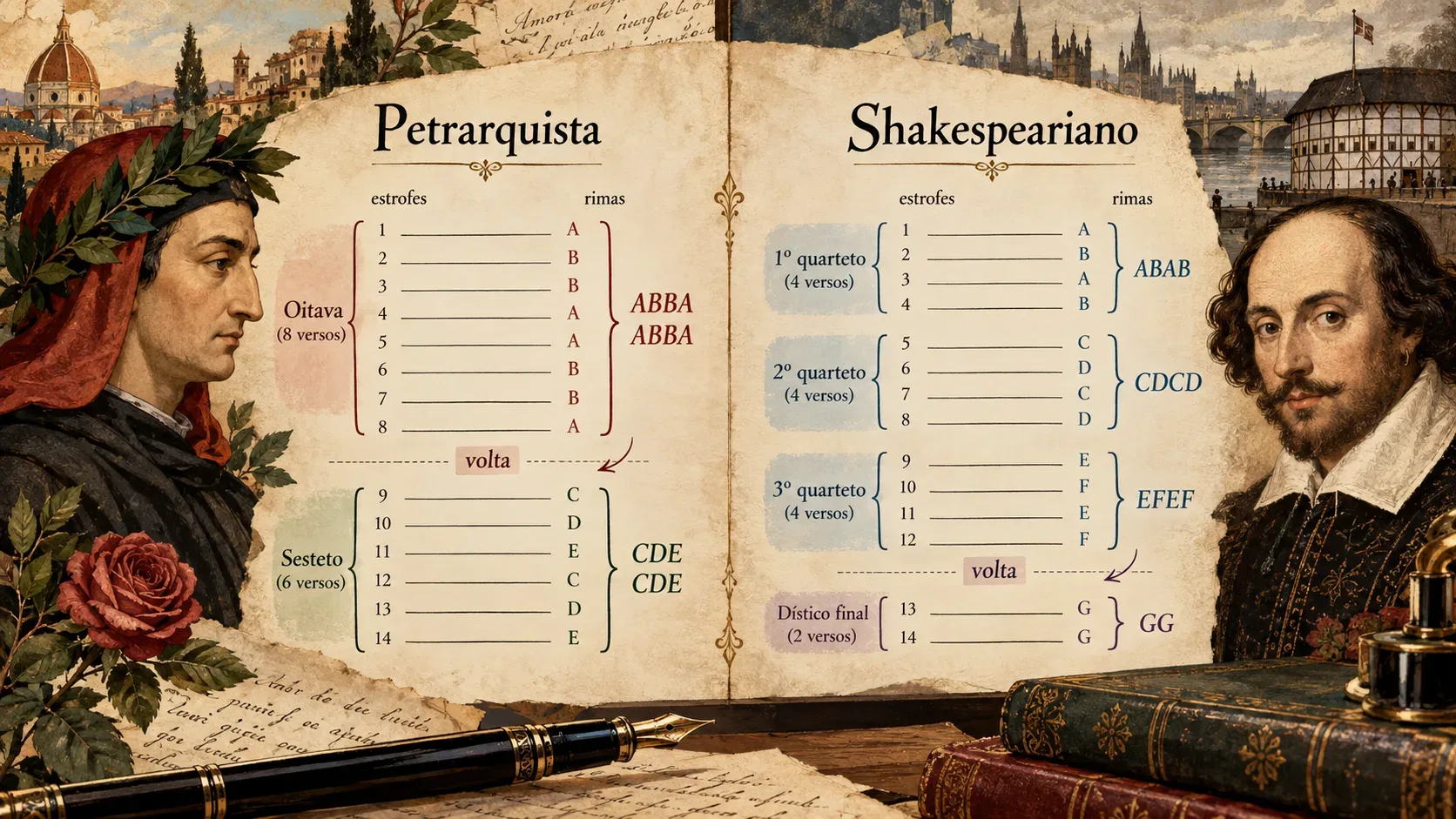
The two models both have 14 lines, but they distribute rhyme and movements of argument differently. In the Petrarchan sonnet, the traditional form separates an eight-line octave from a six-line sestet; in the Shakespearean sonnet, the most recognizable organization is three quatrains followed by a final couplet. The volta is the change in thought, perspective, or argument that reorganizes what the poem has been saying.
What changes between the Petrarchan and Shakespearean sonnet
| Aspect | Petrarchan | Shakespearean |
|---|---|---|
| Total lines | 14 | 14 |
| Traditional division | Octave, 8 lines, plus sestet, 6 lines | Three quatrains, 4 lines each, plus final couplet, 2 lines |
| Reference rhyme scheme | ABBA ABBA CDE CDE or ABBA ABBA CDC DCD | ABAB CDCD EFEF GG |
| Classic location of the volta | Between lines 8 and 9, at the passage from octave to sestet | Before the final couplet, although the reading should confirm where the argument actually changes |
| Frequent movement of argument | The octave presents a situation, question, or tension; the sestet answers, reconsiders, or changes perspective | The three quatrains develop the subject in stages; the couplet may conclude, amplify, or contradict what came before |
These schemes are traditional models, not a rule that can classify every 14-line poem on its own. Poets vary rhyme and even the way a change of thought coincides with formal divisions.
Line-by-line map of the Petrarchan sonnet
A practical way to read the structure is to mark each line ending with a letter. Matching letters indicate endings that rhyme with one another. In the model below, the octave uses ABBA ABBA and the sestet uses CDE CDE.
| Lines | Part | Rhymes | Reading function |
|---|---|---|---|
| 1 to 4 | First quatrain of the octave | ABBA | Introduces the theme, image, situation, or opening question |
| 5 to 8 | Second quatrain of the octave | ABBA | Develops or intensifies the first movement |
| Between 8 and 9 | Volta | Not a specific rhyme | Changes the direction of thought, from a problem to a response, from a statement to a qualification, or from one perspective to another |
| 9 to 11 | First tercet of the sestet | CDE | Begins the response, reconsideration, or consequence |
| 12 to 14 | Second tercet of the sestet | CDE | Completes the new direction of the argument |
The Poetry Foundation also records CDCDCD as a possible traditional scheme for the sestet. Therefore, the most stable sign of the Petrarchan model is not a single six-line sequence, but the combination of an ABBA ABBA octave with a structurally distinct sestet.
How to see the change in argument
Imagine a poem in which the first eight lines describe a memory as a source of comfort. In line 9, the speaker recognizes that the same memory also makes the loss sharper. No real poem needs to be quoted to see the logic: the volta is the point at which the interpretation of the subject changes. The 8 plus 6 division helps the reader look for that point.
Line-by-line map of the Shakespearean sonnet
The Shakespearean sonnet distributes its space differently. Instead of octave and sestet, it uses three quatrains in sequence and ends with a rhyming couplet.
| Lines | Part | Rhymes | Reading function |
|---|---|---|---|
| 1 to 4 | First quatrain | ABAB | Introduces the subject or first claim |
| 5 to 8 | Second quatrain | CDCD | Adds contrast, an example, or development |
| 9 to 12 | Third quatrain | EFEF | Takes the reasoning to a third stage or prepares the resolution |
| Before line 13 | Traditional volta | Not a specific rhyme | Redirects the argument before the close |
| 13 and 14 | Final couplet | GG | May conclude, amplify, condense, or even refute the preceding development |
The Poetry Foundation defines the Shakespearean form through the ABAB CDCD EFEF GG sequence, and the Academy of American Poets highlights the decisive role of the couplet, which can function as conclusion, amplification, or refutation. The Folger Shakespeare Library notes that the rhyme scheme also organizes the reading into three parallel four-line blocks and a two-line close.
Why the couplet changes the effect of the ending
With only two final lines and a new rhyme, the reader perceives formal compression. If the first twelve lines accumulate comparisons, doubts, or arguments, lines 13 and 14 can turn that material into a brief synthesis. This does not mean every Shakespearean sonnet must contain a surprise at the end. The point is to observe whether the couplet confirms, qualifies, expands, or challenges what the quatrains have built.
How to read a rhyme scheme
The letters do not name specific words. They record rhyme relationships. The first ending receives A; when another ending rhymes with it, it also receives A. A different ending receives B, then C, and so on. Thus, ABBA indicates that lines 1 and 4 rhyme with each other and that lines 2 and 3 form another rhyming pair.
In the Shakespearean model, ABAB creates alternating rhymes in the first quatrain. The second quatrain starts a new set, CDCD, and the third another, EFEF. The GG couplet closes with two lines that rhyme with one another. In the Petrarchan model, ABBA ABBA binds the two halves of the octave with enclosing rhymes.
How to locate the volta without relying only on counting
The Italian word volta means “turn.” In reading terms, it is a rhetorical change: the poem begins to answer what it asked, reconsider what it asserted, introduce an objection, change addressee, shift tone, or reinterpret an image. Words equivalent to “but,” “yet,” or “however” may signal the change, but the volta can also occur without an explicit marker.
In the Petrarchan form, the move from line 8 to line 9 provides a strong formal point for that turn. In the Shakespearean form, the best-known convention places the turn before the final couplet. Even so, analysis should confirm what happens in the argument: the volta is a function of the poem's thought, not merely a numbered line.
A quick method for comparing any sonnet
- Count the lines and confirm whether the poem works with the 14-line form or with a variation.
- Mark stanza divisions or formal blocks.
- Assign letters to the rhymes at each line ending.
- Compare the pattern with ABBA ABBA plus a sestet for the Petrarchan model, or ABAB CDCD EFEF GG for the Shakespearean model.
- Find the real change in thought and ask what it does to the previous argument.
- Read the close: in the Petrarchan sestet, observe how the second part answers the first; in the Shakespearean couplet, see whether the last two lines conclude, amplify, or challenge the quatrains.
This sequence avoids two common errors: calling any 14-line poem “Shakespearean” simply because it ends in a couplet, or locating the volta mechanically without checking whether there is actually a change in argument.