No. The 5-7-5 is an important haiku tradition, but, in Portuguese, it does not mechanically reproduce the Japanese meter. In Japanese, the classic pattern is counted in 17 on, normally described in linguistics as moraic units, organized in 5, 7 and 5. In Portuguese, when someone writes a haiku in 5-7-5, they usually count poetic syllables. The two measurements are not equivalent.
This changes the practical answer. You can choose 5-7-5 and be part of a strong tradition of adapting haiku into Portuguese. You can also make the count more flexible if the metric requires adding words, inverting the sentence or explaining the scene too much. The point is to know which convention you are following and not confuse a Brazilian or Western adaptation with an exact copy of the Japanese form.
Why Japanese 5-7-5 is not a syllable count in Portuguese
The difference starts in the counting unit. Mora is a unit of duration or rhythmic weight in the Japanese language. In certain words, a long vowel, a geminate consonant or the moraic n occupies its own metric time. Thus, a Japanese syllable can correspond to more than one mora.
Therefore, saying that Japanese haiku simply has 17 syllables is a didactic approximation, not a strict linguistic equivalence. The traditional 5-7-5 pattern organizes 17 Japanese sound units. By transporting the same numerical sequence to Portuguese, we start to work with another language, another prosody and another density of information per syllable.
In practice, 17 poetic syllables in Portuguese can contain more words and more explanation than a typical Japanese haiku contains in 17 on. This is why too rigid an attempt to fill five, seven, and five syllables can make the poem longer in effect, even if the math is correct.
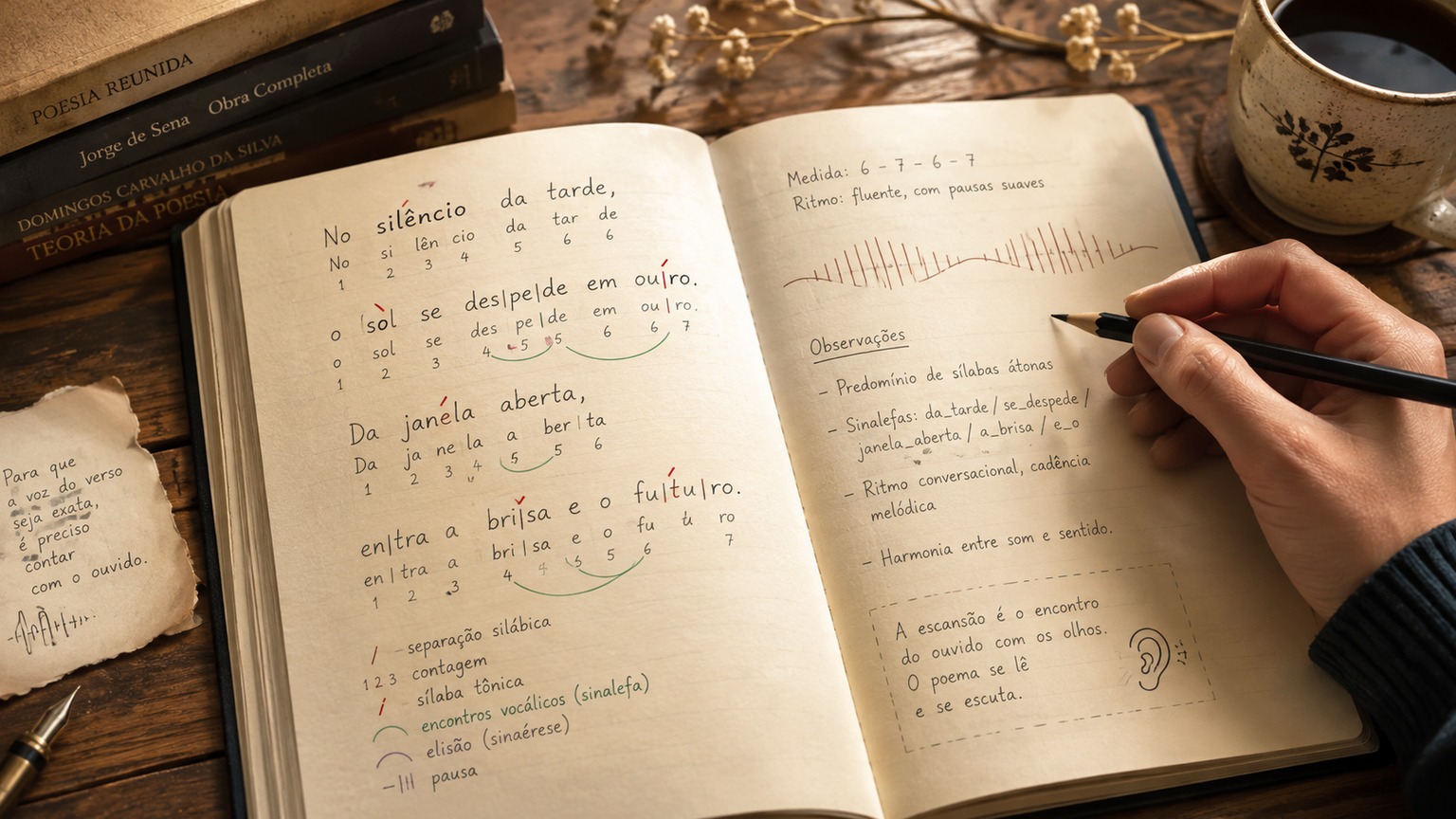
If you choose 5-7-5 in Portuguese, use the poetic syllable count, not the school syllable separation. The collection scanning guide is the appropriate place to review this procedure; Here, the main point is different: Portuguese counting is an adaptation convention.
So is 5-7-5 a rule or a choice?
It depends on what you call haiku and the context in which you are writing. Japanese tradition associates haiku with a brief form of 5-7-5 sound units and, in its classical aspect, with resources such as seasonal reference and cutting. At the same time, contemporary practices, in Japan and abroad, allow for variations in form.
In Portuguese, 5-7-5 has historical legitimacy. There are authors, workshops, groups and competitions that adopt this metric as an explicit part of their proposal. In these contexts, following the count is neither a mistake nor naivety: it is complying with a chosen aesthetic rule.
The problem appears when the formula becomes the only possible definition. A triplet of 5-7-5 might just be a short metered poem. To function as haiku within traditions closer to the Japanese genre, economy of language, attention to a concrete experience, the relationship between images and some type of cut or change of perspective are also normally important.
Kigo: the season comes as a context, not as an ornament
Kigo is the seasonal word or expression that places the poem in the cycle of the year. It can indicate the season directly, but it can also do so through a phenomenon, a plant, an animal, a custom or other element culturally associated with a particular season.
In classic haiku, the kigo does not function as a Japanese decoration. It expands the scene by connecting it to a shared time. A small image starts to carry a larger dimension because the reader recognizes in it a season, a change in weather or a recurring moment on the calendar.
When writing in Brazil, this requires paying attention to the place. A country with a large territorial extension does not have the same seasonal experience in all regions. The Brazilian tradition linked to Masuda Goga and Grêmio Haicai Ipê faced the challenge of adapting the seasonal repertoire to the local environment. Therefore, it is not enough to import cherry trees, snow or maple leaves to seem closer to Japan. A coherent kigo needs to be born from the observed world and the repertoire that the poem intends to share.
It is also not necessary to force a station word into any short text. If you follow a traditionalist style that requires kigo, look for an organic seasonal reference to the scene. If a freer contemporary practice is followed, the absence of kigo may be deliberate. The important thing is to know that, by giving up on it, you move away from one of the central criteria of classic haiku.
Kireji and Corte: what can replace them in Portuguese
Kireji is usually translated as court word. In Japanese, they are specific linguistic forms that can mark pause, emphasis or closure. Portuguese does not have an equivalent set of words with the same grammatical and poetic function.
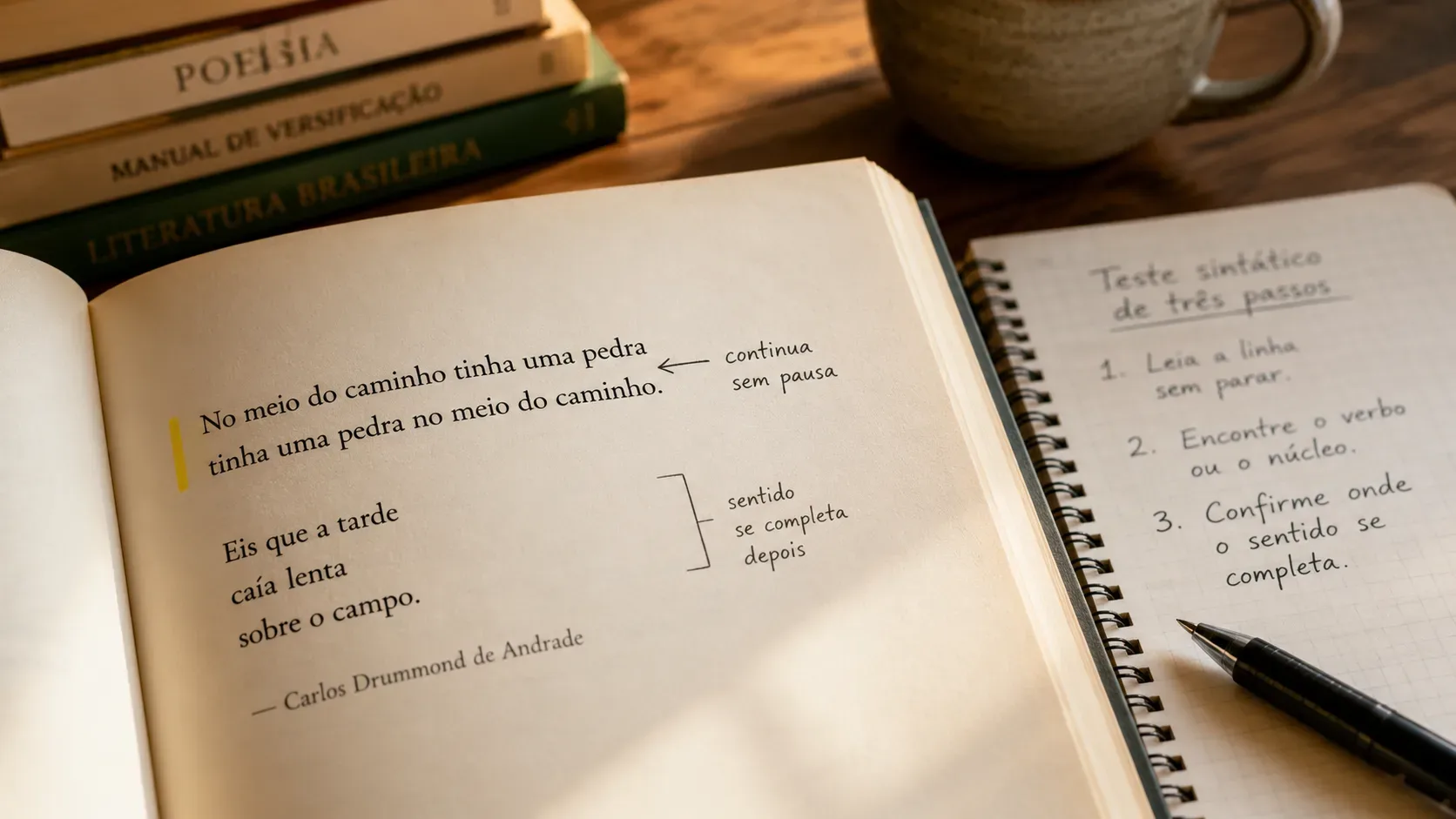
Therefore, copying the idea of kireji does not necessarily mean putting a dash in the poem. What can be carried over is the cutting effect, called kire: an interruption or articulation that
makes two parts of the haiku meet without one fully explaining the other.
In Portuguese, this effect can arise through punctuation, verse breaks, syntactic changes or simple juxtaposition. Think of a poem that shows an image and then another that displaces the first. Instead of explaining the relationship, the haiku lets the reader understand it.
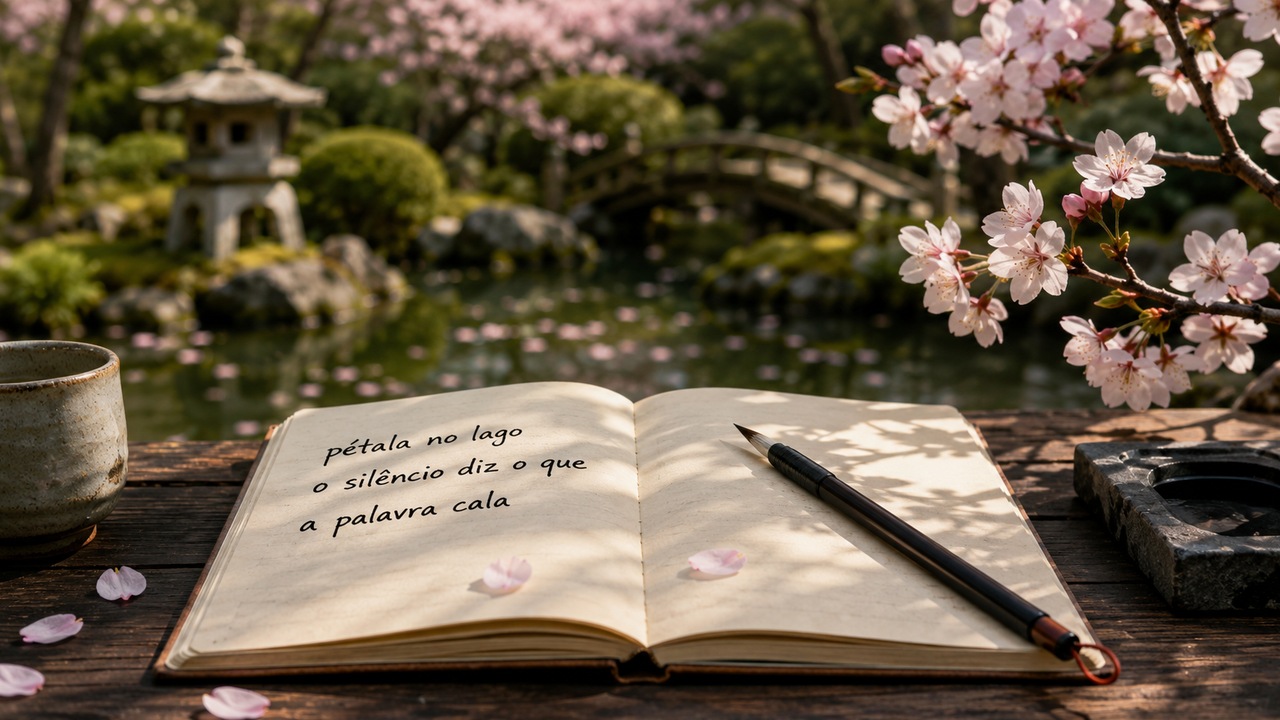
Consider an example invented just to observe the structure: “summer rain / on the dot plate / a map of drops”. The first part creates a seasonal context; the second transforms a banal surface into another image. The interest is not in a hidden moral or in completing 17 syllables at any cost, but in the space created between the two perceptions.
A good test is to remove the punctuation and ask if the cut can still be felt through the syntax and the relationship between the images. If only the dash produces the sensation of depth, perhaps the poem still depends more on the graphic sign than on the composition.
Why Brazil has more than one idea of haiku
Brazilian history helps explain why two people can defend different rules and both point to real traditions. Haiku was received, adapted and recreated in different ways, not by a single school.
Guilherme de Almeida and the rhymed adaptation
Guilherme de Almeida played a decisive role in the popularization of haiku in Brazil in the 1930s and 1940s. His adaptation preserved the triplet and metric regularity, but added resources typical of poetry in Portuguese: title, rhyme between the first and third verses and an internal rhyme in the second.
This model shows why “following 5-7-5” does not necessarily mean “following traditional Japanese haiku.” Guilherme created a deliberately formalized Brazilian solution. It has coherence within its proposal, but incorporates elements that do not define the classic Japanese model.
The traditionalist aspect of Goga and Grêmio Haicai Ipê
Another Brazilian line sought to bring the practice in Portuguese closer to the tradition brought by Japanese immigrants. Studies on Grêmio Haicai Ipê record rules such as three verses in 5-7-5, absence of title and rhyme and presence of kigo.
Here, 5-7-5 continues to be counted according to the possibilities of Portuguese, therefore it is still a linguistic adaptation. The difference is that the metric appears together with a discipline of seasonal observation, conciseness and simplicity, and not in isolation as a numerical template.
Freer and more contemporary forms
Brazilian poetry also developed freer, epigrammatic, concrete and authorial aspects. Paulo Leminski, for example, worked with great freedom of measure, rhyme and visual arrangement, without abandoning his attraction to brevity, the montage of images and everyday experience.
This does not create a new rule that replaces the previous ones. It shows that “haiku in Portuguese” is a field of practice. If you write for a specific group, you need to know that group's convention. If you write in an authorial way, you need to make it clear to yourself what you are preserving from the genre and what you are transforming.
How to write without counting
Start with the scene
Before counting syllables, choose something that can be understood. A sound after the rain, a shadow crossing the wall, the smell of cut fruit, an empty street at dawn. The more concrete the scene, the less the poem needs to explain what the reader should feel.
Haiku tends to gain strength when it starts from what is observed and reduces abstract commentary. Phrases like “life is brief” or “love always returns” may be true for the writer, but they already give away the conclusion. Haiku often works best when the image allows that conclusion, if any, to occur to the reader.
Look for a relationship between two parties
After the first image, look for a second element that creates contrast, continuity or displacement. The cut does not need to separate two completely different scenes. Sometimes you just need to change the scale, from the sky to a puddle; from street noise to an immovable object; from a season to a human gesture.
This relationship between parts is more important than inserting a rare word to sound poetic. A short haiku has no room for gratuitous ornamentation: each word needs to support image, rhythm or relationship.
Decide if the kigo belongs in the poem
If your intention is to dialogue with the classical or traditionalist aspect, identify the seasonal dimension of the scene. Ask what places the time of the year in it and whether this reference is recognizable in your context.
Don't choose kigo later, just to fulfill a technical sheet. When the word seasonal is grafted in, the poem can seem assembled around the rule. When born from observation, it helps to give depth to the moment.
Only then test the metric
With the scene and the cut working, tell us. If the text naturally lands in 5-7-5 and that's the convention you want to follow, great. If a syllable is missing, be suspicious before adding an adjective. If one is left, see if removing it makes the sentence cleaner or destroys its naturalness.
The metric is useful when compressing. It hurts when it forces you to fill it up. The best 5-7-5 doesn't feel like a successfully completed counting exercise; It seems like a sentence that found exactly that size.
Cut what came in just to close the account
Vague expressions such as “very”, “beautiful”, “so”, “soft”, “eternal” and “silent” may have a real function, but they are also used as metric filler. Reread each word and ask if it shows something that the scene didn't already show.
Also do the reverse test: if to get to 5-7-5 you needed to reverse the natural order of the sentence, use a word you wouldn't normally say or add an explanation, compare it with a shorter version. Flexibility is defensible when it better preserves the precision and lightness of the poem.
When to maintain 5-7-5 and when to relax
Keeping 5-7-5 makes sense when it is an explicit part of the tradition you want to practice, when a workshop or competition requires it, when restriction helps you find a more economical solution, or when the resulting rhythm sounds natural in Portuguese.
Flexibility makes sense when counting forces superfluous words, creates artificial inversions, lengthens a simple image, or prevents cropping from working. In this case, abandoning a syllable may bring the effect of the poem closer to Japanese conciseness than completing 17 Portuguese syllables just to preserve the number.
The same reasoning applies to kigo and corte. In a traditionalist practice, they may be structural criteria. In a contemporary perspective, they can be treated more freely. What doesn't work well is mixing different conventions and then presenting them as if they were a single universal rule.
What makes the choice coherent
If you want a safe formula to start with, use this mental order: first the concrete experience, then the relationship between images, then the crop and seasonal dimension, and finally the count. 5-7-5 can be an excellent discipline, as long as it serves the poem rather than turning it into a word search.
The question “does haiku need to be 5-7-5?” does not have a universal answer because haiku itself has crossed different languages, schools and adaptations. But there is a practical answer: in Portuguese, 5-7-5 is a legitimate and historical convention, not an automatic equivalence to the Japanese 17 on. Choose it when it is part of the tradition you want to follow and allow yourself to be flexible when fidelity to the number sacrifices precisely what the haiku seeks to preserve: conciseness, image, cut and presence of the moment.