
Writing in free verse doesn't mean writing a sentence and hitting Enter when the line seems long. The absence of an obligatory meter gives the poet freedom, but it also transfers to him a decision that other forms partially resolve in advance: where the verse ends and why it ends there.
Specialized references define free verse as poetry not subject to a previously established form or meter and often related to the rhythms of speech. This does not equate to the absence of rhythm. The graphic arrangement of the lines itself participates in the form of the poem and can interfere with the speed, intonation and emphasis perceived by the reader.
Hence “free verse is not broken prose” works better as a workshop rule than as an absolute definition. There are prose poems, poems whose syntax is very close to prose and theoretical discussions that question a simple border between the two fields. The practical point is different: if you decided to work with verses, the position of the cuts must participate in the poem.
The verse cut needs to do something
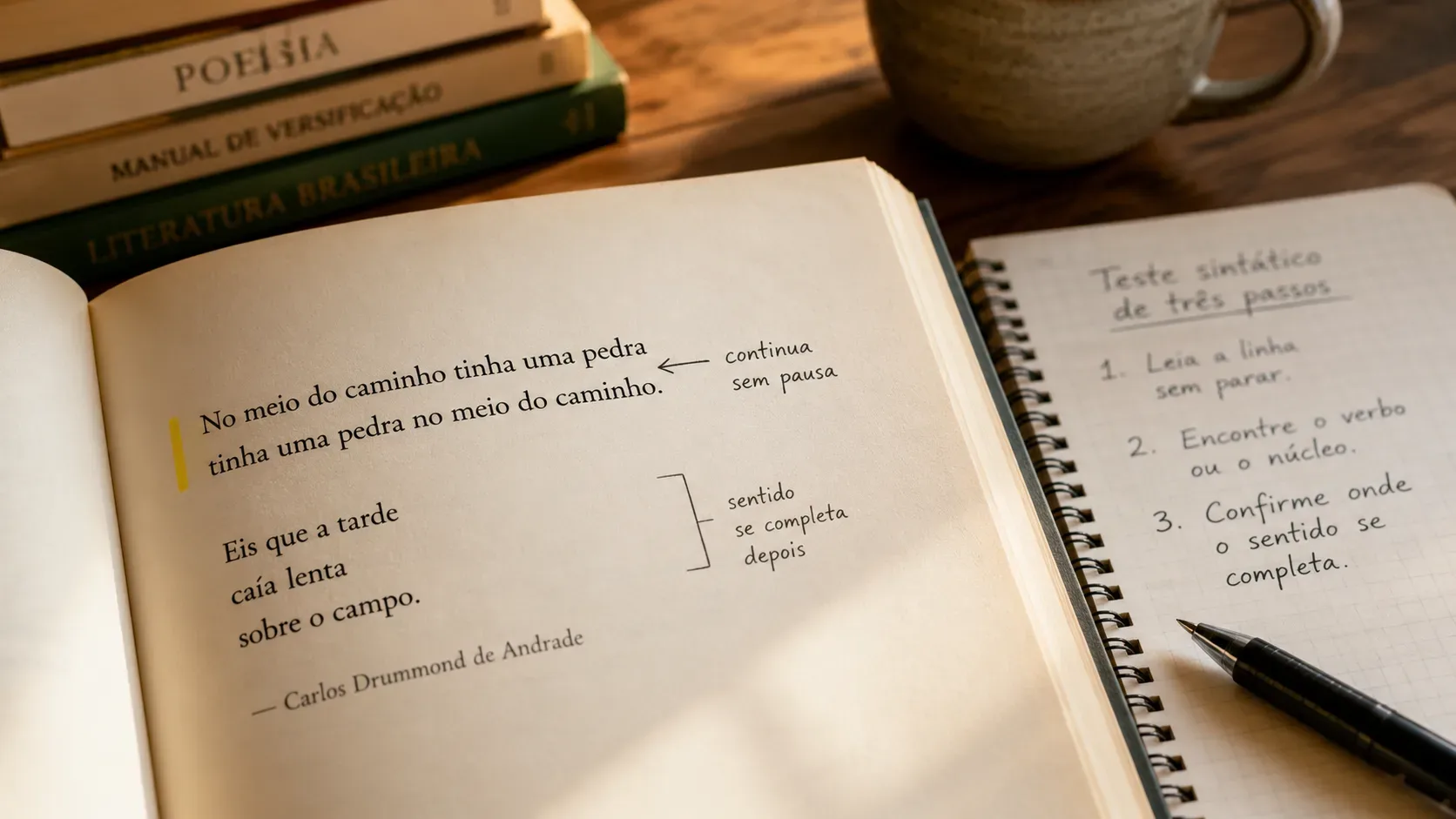
A line break can coincide with the end of a sentence or interrupt it before the syntax is complete. In the first case, the back tends to offer a greater sense of closure. In the second, enjambment appears: the phrase or sentence continues on the next line. The Academy of American Poets notes that this lengthening can increase the speed of the poem, while syntactically closed lines tend to offer clearer points of rest.
Does this offer a better question than “does this line look nice?”:
What changes if I end the verse right here?
The answer may lie in rhythm. It may be in the right direction. It can be highlighting a word. It may be a small expectation created before the next line. It may be a hesitation. It may even be deliberate discomfort.
If the answer is just “because the line was too long”, the cut still deserves review.
It is also not necessary to imagine that every verse break corresponds to an audible pause of the same length. Punctuation, syntax, rhythm and line changes work together. In enjambment, precisely because the sentence continues, the reading can cross the break with momentum. The line ends visually while the verbal construction still calls for continuation.
The same sentence can produce different poems
Consider first this sentence without lineation:
After the rain I found your name on the window and I almost believed you were coming back.
The words will remain exactly the same in the following examples. Only the cuts change.
1. Close syntax breaks
After the rain
I found your name in the window
and I almost believed
you were coming back.
Here, the syntactic blocks remain relatively recognizable. The reading progresses without major collisions between sentence and verse. “After the rain” establishes the moment; “I found your name in the window” preserves the central image; the last two verses discreetly delay the conclusion.
It is a relatively stable lineation. That doesn't make it better or worse. Makes its effect more continuous and less distracting.
2. Isolation to create emphasis
After the rain I found
your name
in the window
and I almost believed you were coming back.
Now “your name” occupies a single line.
The information was already in the original sentence, but its position has changed. The reader reaches the end of “I found” still hoping to discover the object of the verb. In the next line, it receives only “your name”. Then, “in the window” also gains its own space.
The cut did not add vocabulary; added relative weight.
This is one of the most useful ways to review free verse: noticing which words you are promoting by placing them at the beginning, end, or alone in a verse. Teaching materials from the Academy of American Poets use comparisons of different breaks to show how they alter sound, meaning, appearance, emotional impact, and emphasis.
3. Suspension before decisive information
After the rain
I found your name in the window
and I almost
believed you were coming back.
The third verse ends in “almost”.
Grammatically, the word requires continuation: almost what? The visual end of the line interrupts for a moment a still incomplete construction. When “I believed” arrives, the reader resolves the expectation.
This is one possible use of enjambment: creating a small difference between the point at which the line ends and the point at which the sentence is completed.
The risk appears when the resource becomes a habit. If practically all verses interrupt syntactic constructions at tense points, no cut stands out. The effect that should create attention starts to function as a predictable pattern.
4. Longer lines to increase momentum
After the rain I found your name
on the window and I almost believed you
returning.
Here there are fewer returns to the margin and a greater amount of language accumulated before each break. The second verse ends in “you”, while the verb that completes the sentence remains on the next line.
Reading can gain momentum because the syntax continues to cut through the cuts. This is consistent with the description of enjambment as continuation of the phrase through line change and with its potential to speed up tempo.
But “long line = fast” should not become a formula. Rhythm also depends on accents, repetitions, sounds, punctuation, vocabulary and syntax. Free verse admits different prosodic organizations; Studies in Portuguese show precisely that the category brings together distinct practices and not a single rhythmic model.
5. One word as a turning point
After the rain
I found your name
in the window and I almost believed
you were coming back.
Now “you” are left alone.
The effect is different from the previous example. Before, “you” served as an impetus to achieve “I came back”. Here, it gains its own visual presence before the action is revealed.
This little experiment shows why lineation needs to be treated as composition, not decoration. The five versions contain the same words in the same order. Even so, they distribute attention, expectations and progress in different ways.
Where to cut a free verse
There is no universal formula capable of indicating the correct point. The very nature of free verse admits varied solutions. The most productive procedure is to first decide what effect that passage needs to produce and test competing cuts.
You can notice five especially useful zones.
At the end of a syntactic unit, cutting tends to reinforce closure. It is a good choice when the poem needs to establish an image, statement or change of thought.
Before completing the syntax, the cut creates tension between verse and phrase. Use it when the continuation has value: surprise, acceleration, hesitation, contrast or momentary double reading.
After an important word, the end of the line can increase your exposure. Ask if that word really deserves to be highlighted.
Before an important word, the new line can act as an arrival. The reader crosses the cut and finds the word in its initial position, often with renewed attention.
Between groups of different lengths, the poem can change its visual and sound tempo. Very short lines can split the reading; extensive lines allow for greater accumulation before return. These effects, however, depend on the rest of the composition and should not be applied mechanically.
The goal is not to make each line produce a trick. A poem also needs passages in which the language simply moves forward. If all cuts require maximum attention, the hierarchy disappears.
The most useful test is to compare versions
A simple procedure avoids many arbitrary breaks:
- Write the passage first without worrying about the verses. Find out what the sentence needs to say.
- Mark words, images and shifts in thinking that really matter.
- Make at least three different lines of the same passage: one close to the syntax, one more tense and one focused on emphasis.
- Read each version aloud without turning every end of line into a theatrical pause.
- Compare what happened with speed, breathing, expectation and highlighted words.
- Choose the version whose effect helps the entire poem, not just the isolated line.
Reading aloud has grounds beyond personal preference. Research on the vocal performance of poetry highlights that the performance of the voice makes the rhythm, tempo and intonation of the verse perceptible.
There is also a complementary test: read the excerpt once, obeying mainly the syntax and punctuation; then read it again, allowing the line changes to be discreetly noticed. If the second reading reveals a tension, emphasis, or movement consistent with the poem, the cut is probably working. If nothing significant changes, try another division.
Be careful with the “Poetic Enter”
A common sign of poorly worked lineation is the repetition of cuts for no discernible reason:
I came home
and left the key
on the table because
I was very tired
after a long day.
This is not automatically a bad poem, nor is it possible to condemn the cuts outside of a larger context. The problem appears when we don't know why “key”, “because” or “tired” need to occupy those positions.
Do the opposite test: transform the verses back into sentences.
I came home and left the key on the table because I was very tired after a long day.
Then ask what the verse version added.
If the answer is “nothing”, you have found a review point.
The point is not to make the text less like speech or prose. Free verse can approximate the rhythms of spoken language, and certain traditions deliberately work with dictions close to prose. What needs to exist is a discernible relationship between the formal choice and the outcome.
Review the poem looking at each line ending
When reviewing, scroll only to the right margin of the poem. Read the last words of each verse.
Ask:
- which words are receiving emphasis just because they occupy this position?
- has any preposition, article or conjunction been isolated without producing effect?
- Do enjambments create useful tension or do they appear out of habit?
- do the cuts always coincide with the syntax and make the poem predictable?
- do all verses have a similar length by decision or by automatism?
- is there a passage where a longer or shorter line would change the tempo?
- does the break make the reader anticipate a continuation that the following verse confirms, corrects or complicates?
- when the poem is read aloud, does the lineation unnecessarily help or combat the sentence?
Don't look for the “correct” break in the abstract. Look for the one that makes the specific intention of the poem clearer.
Free verse remains form. A Brazilian academic publication from 2025, when resuming studies by Paulo Henriques Britto on the subject, highlights precisely the variety of modalities that fit under this name and the possible relationships between graphic organization, sound base, metrics and neighboring verses.
The discussion remains active also in contemporary teaching: in January 2026, the Academia Brasileira de Letras published a course by Paulo Henriques Britto whose schedule separated a specific class for traditional free verse and new free verse, also paying attention to the sound aspect and versification.
This helps dismantle a misleading idea: formal freedom is not formal indifference.
In your next revision, take four or five lines from a poem of yours, return them to sentence form, and produce three new divisions. Don’t try to make one of them “more poetic”. Give each version a different task: speed up, highlight an image, create suspension.
Then listen.
The best cut is the one you can defend due to the effect it produces.