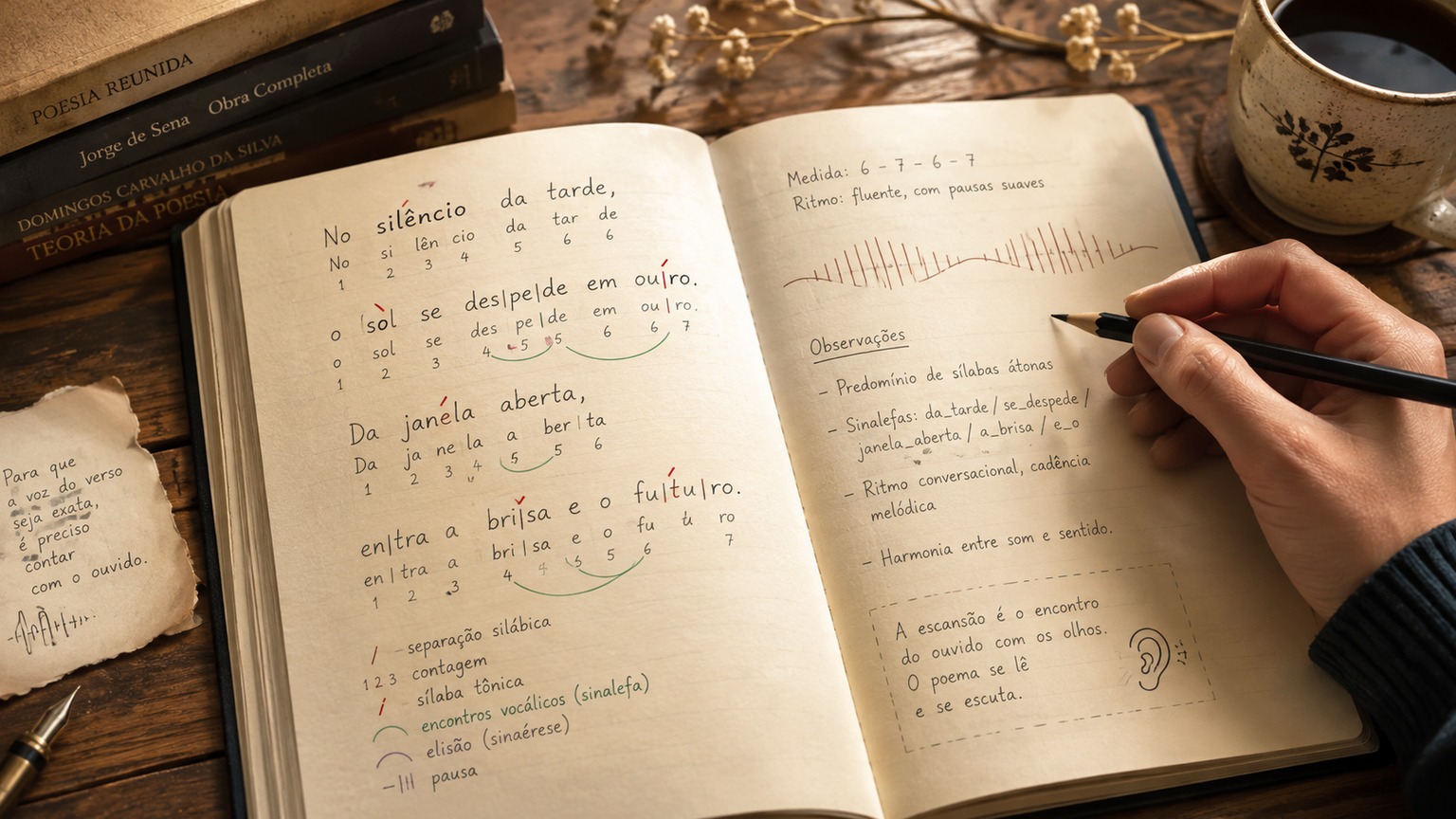
Counting poetic syllables is not taking the syllabic separation learned at school and simply adding them up. Scansion measures the verse as a sound realization: the count goes up to the last stressed syllable, vowel encounters can change the number of voice emissions and the distribution of accents and pauses participates in the rhythm. Therefore, when the account “on paper” does not match what the verse seems to ask the ear, the best way is not to force an isolated rule, but to test the reading in an organized way.
The safest procedure has two passes. In the first, you make a provisional, conservative count, without trying to fit the verse at any cost. In the second, read aloud, examine the vowel clusters and check whether the solution matches the rhythm of the verse itself and, if applicable, the pattern of neighboring verses.
The rule that avoids half the mistakes: count to the last tonic
In the tradition of versification in Portuguese, the metric count ends on the last stressed syllable of the verse. Whatever comes after it, within the final word, does not count. This rule is simpler than memorizing compensations depending on whether the final word is oxytone, paroxytone or proparoxytone: just find the last really accented syllable and stop there.
See a verse created just for the exercise: “The rain falls on the roof.” The grammatical separation of the final word is te-lha-do, but the last stressed syllable of the verse is LHA. A possible scansion goes like this: A / chu / va / cai / no / te / LHA(do) = 7 poetic syllables.
Now compare with “The wind sleeps on the sea.” As mar is tonic and is at the end, it is counted: O / VEN / to / DOR / me / no / MAR = 7.
And in “The lamp turns pale”, the final word is proparoxytone. The count stops at SPADE: A / LÂM / pa / da / FI / ca / SPADE(li-da) = 7. The method has not changed; Only the point at which the last word delivers its stressed syllable has changed.
This first step must be done before discussing signalefa, syneresis or any other license. Many apparently “wrong” counts are resolved only when the final unstressed syllables are no longer included.
Poetic syllable is not a spelling box
The grammatical syllable is a good starting point, but the metrical syllable follows the pronunciation of the verse. When a word ends in a vowel and the next begins in a vowel, the two emissions can come close or merge in reading. If this happens naturally, the encounter could be worth a single poetic syllable.
Consider “Spend the night slowly.” Without taking into account the connection between words, the count to GAR reaches eight. In a fluid reading, however, the end of passa and the following a can be performed together. The scansion is: Pas / sa_a / noi / te / de / va / GAR = 7.
The important point is the verb pode. There is no automatic key that combines every final vowel with every initial vowel. Scansion describes a plausible and rhythmically functional sound realization. In some verses, separating the vowels is the more natural reading; in others, bringing them together is part of the cadence.
It is also not advisable to turn the score into a mechanical referee. A comma may suggest a pause, but does not in itself prevent a metric connection between vowels. What decides is the combination of syntax, reading, rhythm and verse tradition.
Sinalefa, crasis and elision: the name varies more than the practical effect
There is an additional difficulty for those who study from different sources: the terminology is not completely uniform. Some teaching materials use signalefa as a broad name for the union of vowels between words. Stricter descriptions distinguish different phenomena within these rhythmic links.
In this distinction, signalefa can designate the case in which a vowel loses syllabic autonomy and starts to function as a semivowel next to the next one. Crase is the fusion of identical vowels. Elision is the disappearance of a vowel, normally the first in the encounter, in front of another. For a practical scansion, the essential thing is to first listen to the result: how many syllabic emissions does the verse make at that point? Then, if the analysis requires terminological precision, you name the process adopting the system from the grammar or manual you are using.
This avoids a common mistake: discussing the label before knowing what happened in the sound. Two books can use different words for the same family of encounters, while the metric consequence remains clear: two positions that would exist in a segmented reading now occupy a single voice emission.
Syneresis and diaeresis: when the change occurs within the word
Not every difference between a grammatical syllable and a poetic syllable occurs at the border between two words. Metric reading can also approximate or separate vowels within the same word.
Syneresis transforms what would normally be a hiatus into a single emission. A classic example of possibility is yours. In syllabic pronunciation, su-a has two syllables; in a poetic context, it can be performed as a single metrical syllable if the diction and rhythm support this contraction.
Take “His voice comes from the sea.” With su-a in two syllables, we would have: su / a /voz / che / ga / do / MAR = 7. With syneresis, sua can occupy a single position, and the verse now has 6. The isolated verse, therefore, does not necessarily require a single response. If it belongs to a sequence of hexasyllables and the compressed reading sounds natural, this is a strong indication. If it belongs to a sequence of heptasyllables and the pronunciation in two syllables flows well, the context points to the other solution.
Dieresis makes the opposite movement: it separates into two emissions what would normally be performed as a diphthong. It is less frequent in everyday reading, but is part of the possibilities of the metric tradition. Again, the license should not be applied just because “we need to earn a syllable”. The resulting pronunciation must remain recognizable and coherent with the rhythmic design of the poem.
Rhythm breaks the ties that seem equally possible
Meter and rhythm are not synonymous. The meter tells you how many poetic syllables the verse has; the rhythm also depends on where the strong accents fall, how the pauses are organized and how
syntactic units cross the verse. Two seven-syllable lines can sound very different.
Compare “The wind sleeps in the sea” with “Passes the night slowly”. Both can be heptasyllables, but the tonic supports are distributed differently. In the first, VEN, DOR and MAR structure the cadence. In the second, PAS, NOI and GAR produce another drawing. Count equality does not erase this difference.
This is especially useful when two scansions seem possible. If one of them creates a pattern of accents and pauses that is repeated in neighboring verses, while the other requires artificial diction and breaks the cadence, the first gains strength. The ear does not replace analysis; it provides evidence that mechanical counting alone does not capture.
The same goes for longer traditional verses. A decasyllable, for example, is not defined just by the number ten: there are different accentual designs recognized in the tradition. Therefore, reaching the expected quantity is part of the work, not the end of it.
Scansion laboratory: four cases in order of difficulty
Clear case: first find the last tonic
Verse: “The rain falls on the roof.”
Scansion: A / chu / va / cai / no / te / LHA(do) = 7.
There is no decisive vowel encounter between words. The main challenge is to remember that do, as it comes after the last tonic, is left out of the count. This is the kind of verse you might want to use to practice before going into licenses.
Case with encounter between words: test fluid reading
Verse: “Spend the night slowly.”
Segmented reading: Pas / sa / a / noi / te / de / va / GAR = 8.
Reading with connection: Pas / sa_a / noi / te / de / va / GAR = 7.
The second reading is perfectly natural in continuous speech and produces a measure very common in Portuguese poetry. This alone does not prove that every similar verse should be read like this; shows how sound realization changes counting.
Case with an alternative within the word: don't choose before listening to the context
Verse: “Your voice comes from the sea.”
No syneresis: su / a /voz / che / ga / do / MAR = 7.
With syneresis: your / voice / che / ga / do / MAR = 6.
Here the doubt is legitimate. If the verse stands alone, recording both possibilities may be more correct than feigning certainty. In a regular poem, the surrounding lines, the stress pattern, and the naturalness of the diction help decide.
Case with punctuation: a comma is not an acoustic wall
Verse: “Pass now, slowly.”
A reading with a marked pause after passa tends to keep the vowels of passa and agora separate, reaching eight syllables until GAR. A more connected reading can bring them together and reach seven. The comma guides the syntax and can suggest a pause, but it does not resolve the metric alone. The tiebreaker depends on the reading that the poem constructs.
A tie-breaking procedure that works better than memorizing three rules
Start at the end
Mark the last stressed syllable of the verse and mentally cross out everything that comes after it. This sets the count limit before the other decisions come into play.
Do a conservative count
Separate words as you would pronounce them without special licenses. That's your base hypothesis. Don't try to make the verse fit into five, seven, ten or twelve syllables yet.
Mark meeting points
Look for a vowel at the end of a word followed by a vowel at the beginning of the next. Also look, within words, for gaps or diphthongs that may admit a different poetic realization. These are test points, not merger or separation orders.
Read aloud without acting out
Take a natural reading first. Then repeat the verse paying attention to the voice emissions. If a connection arises spontaneously, it has more force than a contraction that only appears when you speed up or distort your pronunciation to save the bill.
Compare with neighboring verses
In regular poems, recurrence is one of the best clues. If several verses clearly establish a measure and an accentual design, an ambiguous reading can be resolved by the solution that preserves this system without requiring implausible pronunciation.
Check the accents, not just the total
After arriving at a possible measurement, locate the tonic supports. Ask if they form a coherent cadence with the rest of the poem. A numerically correct count can still hide a rhythmically weak reading.
Preserve doubt when it is real
Not every verse has a single indisputable scansion outside its historical, authorial and performative context. When two readings are phonetically plausible and the poem does not offer enough elements to choose from, presenting both and explaining the difference is a stronger analysis than declaring an artificial certainty.
Errors that make the scansion seem more mysterious than it is
Count grammatical syllables until the end point
This is the basic error. The metric count does not go to the last written syllable; goes up to the last stressed syllable. Solving this first greatly reduces the difference between the school account and the poetic account.
Merge every vowel sequence
Vowel encounter is a possibility of connection, not an obligation. Real pauses, accents, lexical clarity and pronunciation tradition can favor separation.
Let the comma decide the pronunciation
Scores and metrics talk, but they are not the same thing. There are cases of metric connection even with a comma between words. The graphic sign does not function as an automatic barrier between syllables.
Force the word until it becomes something else
Metric license does not authorize deleting sounds to the point of altering the lexical identity. If a supposed contraction turns the word into another word or requires an unrecognizable pronunciation, the problem probably lies with the scansion hypothesis, not the verse.
Only look at the final number
Saying “it has ten syllables” still doesn’t explain how the verse goes. The position of accents and pauses is part of the phenomenon. In fixed forms this is decisive; in less regular verses, it continues to be a reading tool.
How this helps in sonnets, redondilhas and haiku
In redondilha, the utility is straightforward: you check whether the verse contains five or seven poetic syllables and observe where the speech is supported. In a metered sonnet, the scansion allows checking the pattern chosen by the poem and perceiving rhythmic variations within the same measure. In haiku written with a deliberate syllable scheme, the same attention to vowel clusters avoids counting solely on spelling and losing sound realization.
The principle, however, applies beyond fixed forms. Scanning is a way of making visible what the ear perceives: where the voice joins, separates, accelerates, sustains or ends. The count serves the rhythm, not the other way around.
The practical rule for not getting lost
When the mechanical account and the ear disagree, do not choose one of the two immediately. Mark the last tonic, do the simplest counting, identify vowel clusters, read the verse aloud and only then compare the solution with the rhythm and neighboring verses. If a license solves the measure without violating the pronunciation, it is plausible. If it only works by force, look for another reading.
Scansion becomes much less abstract when it stops being a table of exceptions and becomes a small reading laboratory. The paper shows the possibilities; the ear tests which of them really belong to the verse.