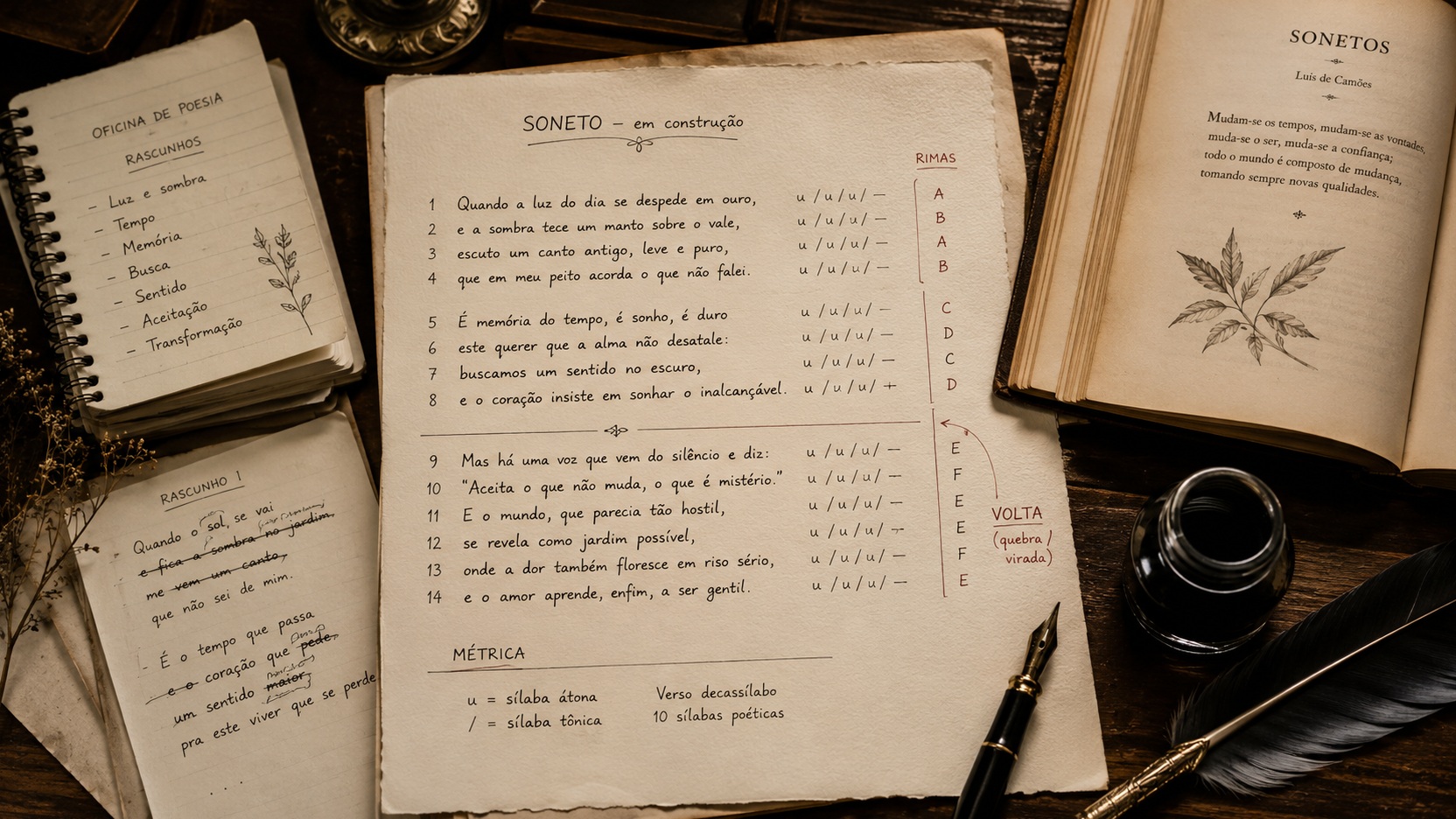
Free verse does not mean verse without rhythm. It simply removes the obligation to follow a regular metrical scheme. The Poetry Foundation defines free verse as nonmetrical verse without obligatory rhyme that may follow the natural rhythms of speech, while the Academy of American Poets emphasizes that its music can emerge from organic rhythms, cadence, and the visual organization of the line. For a writer, that changes the question: instead of counting syllables, you decide how the reader will hear, breathe, and move through the poem.
A practical way to do this is to revise the draft in four layers: strong stresses, sentence length, pauses and breaks, and sound recurrence. Each layer can be tested separately before you decide how to combine them.
Rhythm in free verse is not the absence of pattern
Rhythm is the sense of movement created by the distribution of emphasis, pauses, recurrence, and variation. The Poetry Foundation relates rhythm to the intervals between stressed syllables. In free verse, those intervals do not need to form regular metrical feet in order to create a perceptible pulse.
This allows flexible patterns. A passage may concentrate strong words in short lines, then expand into a longer sentence. Three lines may begin the same way and the fourth may break the expectation. An internal pause can slow the reading, while enjambment can carry the sentence quickly into the next line.
The goal, then, is not to eliminate irregularity. It is to make irregularity purposeful.
The four-layer revision method
1. Listen for strong stresses
Read the poem aloud and notice the words that receive the most force in speech. Nouns, verbs, adjectives, and adverbs often carry much of that pressure, but context can move emphasis onto almost any word. What matters is hearing where the voice naturally lands.
Instead of asking how many syllables a line contains, ask how many points of force you hear and how close together they are. A line with three tightly packed stresses may sound tense or incisive. A sentence with wide gaps between stresses may feel slower, more contemplative, or more diffuse.
Try a simple test: read the passage while lightly tapping the table only on the most emphasized words. If the movement feels accidental, try replacing, removing, or moving words. If you hear an interesting pulse, keep it even if the syllable count changes sharply from line to line.
2. Control sentence length
Rhythm does not come only from the line. Syntax also controls speed. Short sentences tend to create sharper attacks and frequent pauses. Long sentences can accumulate images, delay closure, or create a sense of flow.
A useful strategy is to observe the size of units of meaning, not only the visual length of lines. If every sentence has a similar span, the poem can become predictable even when the line lengths vary. If every sentence is long, the reading may lose contrast.
Try placing an expansive sentence beside a short one. You can also reverse the pattern: begin with brief strokes, then let one sentence travel across several lines. The contrast between compression and expansion creates rhythm because it creates expectation.
3. Use pauses and line breaks as timing
A poetic line ends by choice, not because the page margin has run out. The Poetry Foundation notes that a break may respond to rhythm, meaning, pacing, or emphasis. That makes the line a timing device.
There are three basic tools to test:
- Sentence ending or syntactic boundary: the line ends where speech already asks for a stop. The effect is usually steadier and more conclusive.
- Enjambment: the sentence continues into the next line without closing. The Academy of American Poets defines enjambment as the continuation of a sentence or clause across a poetic line break. It can speed the reading, create expectation, or shift emphasis.
- Caesura: a pause inside the line itself. The Poetry Foundation describes caesura as a stop or pause, often marked by punctuation or a grammatical boundary.
When revising, make different versions of the same passage. In one, close most lines with punctuation. In another, let syntax cross the breaks. In a third, introduce internal pauses. Then read them aloud. What changes is not only the appearance of the page but also the speed and distribution of attention.
4. Build sound recurrence without turning the poem into an exercise
Repetition is one of the most direct ways to create pattern. The Academy of American Poets notes that the repetition of sounds, words, phrases, lines, and structures creates rhythmic expectations. In free verse, repetition can act as an anchor that gives unity to lines of different lengths.
You can repeat a word at the beginning of successive lines, a device called anaphora; place similar consonants near each other through alliteration; or let vowel sounds echo through assonance. The definitions of anaphora, alliteration, and assonance help distinguish these mechanisms.
The main caution is not to chase effects in every line at once. Recurrence becomes more powerful when it is surrounded by variation. If every word seems chosen to rhyme, alliterate, or repeat, the sound may attract more attention than the poem's movement.
Before and after: a short original passage
First consider this version, written as a sentence divided into lines without a clear rhythmic design:
I come home
when the street is already empty
and I hear my footsteps
because every dark window
seems to return the sound.
Now consider a revision that works with all four layers:
I come back late.
The empty street returns
my footsteps.
I come back and listen:
window after window,
the night knocks back.
The basic content remains close, but the movement has changed. I come back returns and creates recurrence. The short opening sentences concentrate stresses. The enjambment in returns / my footsteps carries the reader across the line before completing the sense. The colon creates a stronger internal pause. The sequence window after window uses syntactic and sonic repetition. The final line closes with a short verbal sentence, producing a firmer last beat.
This example is not a template to copy. It shows that rhythmic revision can change the experience of a passage without requiring syllable counting.
A practical revision routine
- Read without looking at the lines. Read the draft as prose and listen for where the voice speeds up, slows down, emphasizes, and breathes.
- Mark four or five points of force. Choose the words that carry the passage. See whether they are too clustered or too far apart.
- Test three lineations. Make one version with more end-stopped lines, another with more enjambment, and another with internal pauses.
- Find one recurrence. It may be a word, a syntactic pattern, a consonant, or a family of vowel sounds. It does not need to appear in every line.
- Read aloud again. The page shows the form, but the ear reveals whether the form has become timing.
- Cut what only fills space. Words without a clear function can dilute stresses and make the cadence less distinct.
Four questions for revising each layer
| Layer | Revision question | What to observe |
|---|---|---|
| Strong stresses | Where does the voice land? | Concentration, distance, and contrast among emphasized words. |
| Sentence length | How long does the idea take to close? | Alternation among compression, expansion, and syntactic continuity. |
| Pauses and breaks | Where does the reader stop and where must the reader continue? | Sentence endings, enjambment, caesura, white space, and stanza shifts. |
| Recurrence | What returns to the ear? | Words, structures, consonants, vowels, and recurring openings or endings. |
Common mistakes when creating rhythm in free verse
Breaking lines at random
Replacing prose margins with random breaks does not necessarily create rhythm. Each line ending should have some relationship to emphasis, speed, suspense, ambiguity, breath, or visual organization.
Making every line short so it looks like a poem
A short line is only one option. If every line has the same weight and duration, the poem can become monotonous. Contrast is part of rhythm.
Overloading alliteration and assonance
Sound repetition works best when it supports atmosphere or pulse without turning every word into a technical demonstration. Read aloud and remove effects that feel more decorative than necessary.
Treating punctuation and line break as the same thing
A line break may coincide with a grammatical pause, but it does not have to. When syntax continues, the tension between the visual line and the spoken sentence can itself become a source of rhythm.
Looking for one formula for the whole poem
Free verse allows rhythm to change with the situation. A hesitant passage may need frequent pauses. A memory that spills forward may need long sentences and enjambment. Coherence can lie in the relationship among changes, not in the repetition of a single cadence.
How to tell whether the revision worked
Read the poem aloud twice. The first time, follow the syntax naturally. The second time, pay conscious attention to line breaks and pauses. If the two readings reveal tensions, accelerations, or emphases that feel connected to the poem's meaning, the rhythm is probably doing useful work.
You do not need to name every device. The decisive test is simpler: do the choices of stress, sentence, pause, cut, and repetition make the reader move through the poem in a way that fits what the poem is saying? If so, there is rhythmic organization even without fixed meter.