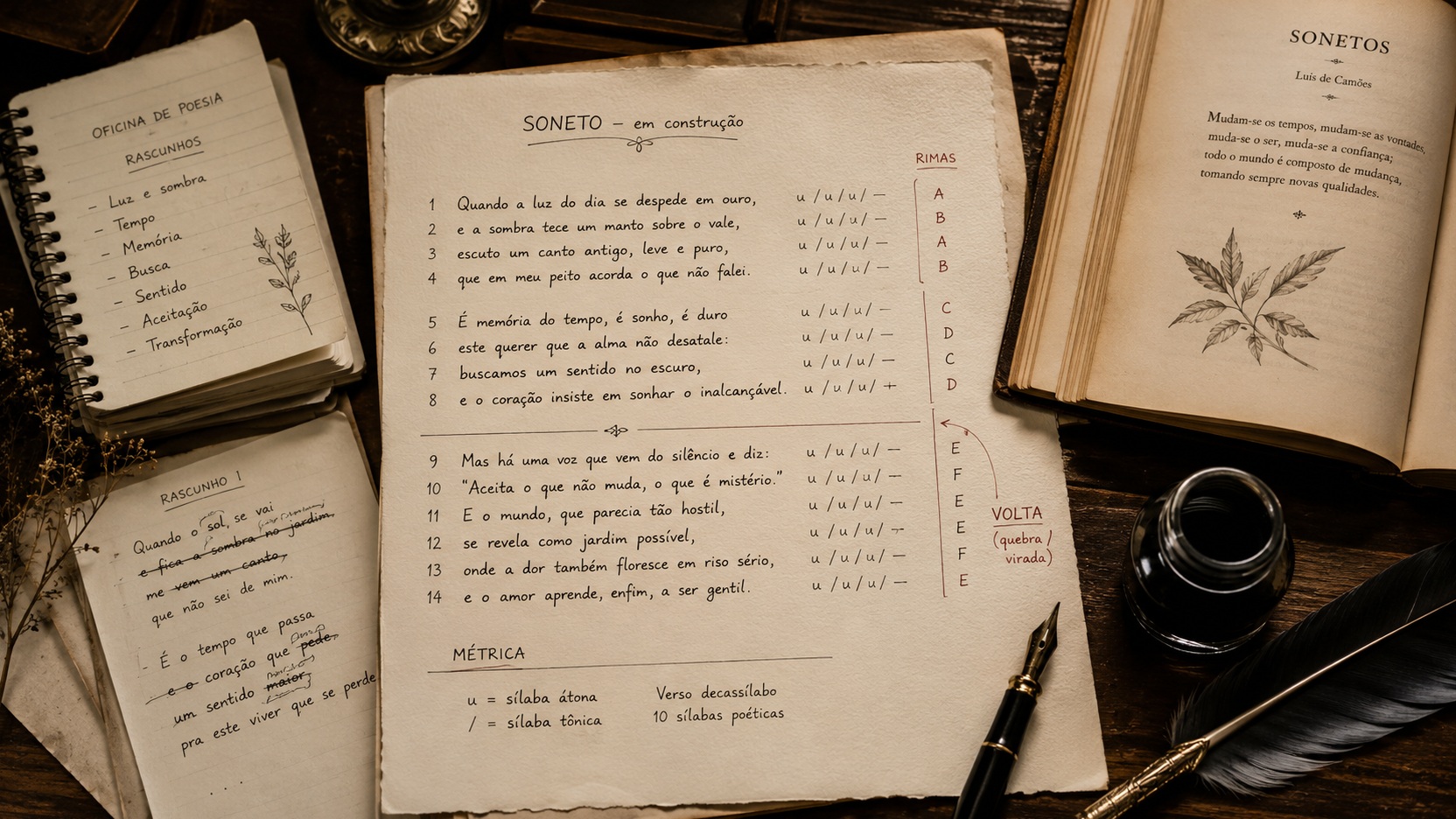

A poem can work very well on the page and still seem stiff, too fast, or directionless when it comes to voice. The problem is not always in the text. Often, what remains is to build your oral version: deciding where to breathe, what to hold, when to accelerate, which repetitions need to change weight and how much the body really needs to participate.
This is different from simply “declaiming” with more volume or emotion. The Poetry Foundation defines spoken words broadly as poetry intended for performance and highlights features such as repetition, rhyme, verbal play and elements of other arts. This does not mean that every poem needs to become spoken word, but it shows that, when the voice is part of the work, sound and presentation are no longer after details.
A practical way of working is to keep the poem and create, alongside it, a kind of performance score. It does not need to be a new version for publication. It is a script of decisions: breathing, pause, emphasis, tempo, change of tone, gaze and movement.
Start by listening to the poem before interpreting it
The first rehearsal doesn't have to be exciting. It needs to be informative.
Read the poem aloud more than once, preferably starting close to the rhythm of your everyday speech. The Academy of American Poets recommends reading aloud repeatedly to notice sounds, rhymes, sound groupings and changes in rhythm that may go unnoticed in silent reading.
At this stage, pay particular attention to the places where your voice falters. A sentence that is too long can require another breath. A seemingly secondary word can gain strength when pronounced. A visually beautiful passage can become confusing when the audience doesn't have the page in front of their eyes.
And don't turn every line break into an automatic break. Poetry Out Loud guides the performer to decide whether a break really calls for a pause and how long it should be; The Academy of American Poets also notes that syntax, punctuation, and verse arrangement can pull the reading in different directions.
Imagine, for example:
I promised to stay
until the last bus
A pause marked after “stay” creates a suspension that does not exist in the same way if the two lines are said almost without interruption. Neither reading is automatically better. The question is: which one corresponds to the meaning you want to produce?
Turn the poem into a voice score
After listening to the text without much interference, make a second pass with deliberate decisions. There is no need to invent complicated notation. Simple marks in the test copy will help.
- Mark the breaths that preserve meaning. Read until you notice where the air normally ends and check if this point coincides with a unit of thought. When your breath repeatedly interrupts an important phrase in the wrong place, try moving it — or, if the poem is yours, consider whether the text itself deserves revision.
- Choose a few words to receive emphasis. If all the words are highlighted, none will actually be highlighted.. Look for the core of each passage: an image, a verb, a negation, a change of direction.
- Set a base tempo before speeding up or slowing down. Changes in speed work best when they correspond to changes in the poem itself. Poetry Out Loud includes rhythm, intonation and tempo among the voice and articulation components and recommends a rhythm appropriate to the text, without confusing projection with shouting.
- Give a function to each repetition. A refrain can come back as confirmation, demand, irony, resistance or wear. You don't necessarily need to say it differently each time you appear, but you need to know why the repetition stays the same or changes.
- Use silence as part of the tempo of the poem. A short pause can organize a sentence; a longer pause may let an image linger in the ear. Instead of distributing silences for dramatic effect, test what happens to the meaning when they are removed or displaced.
- Decide what the body will do — including when it will do nothing. Posture, gaze and gesture must serve the passage. Planning that a certain stretch will be said to be practically immobile can be as concrete a choice as deciding to walk at another time.
The usefulness of this score is in separating intention from improvisation. You can still change something on stage, but you know what structure you are changing.
Breathing can reveal problems that the page hides
When you write, your eyes can go back a few words, reinterpret a break, and mentally reorganize a sentence. Whoever listens receives the poem at the time of speaking.
Therefore, the oral essay also functions as a review.
If you find yourself gasping for air in the same place over and over again, don’t immediately conclude that you need to “breathe better.” First check the construction. Perhaps the sentence is too long for the desired effect. Perhaps there is an expendable word. Perhaps the pause at that point would make the tension more interesting.
The opposite also happens. There are passages that are difficult to pronounce and deserve to remain difficult because sound friction is part of the poem. Adaptation should not polish every irregularity until it transforms the text into comfortable speech.
The useful question is: is this difficulty a choice or an accident?
When it is an accident, review. When it's a choice, rehearse until you can reproduce it consciously.
Make repetition accumulate meaning, not just volume
Repetition is a recurring feature in performance-oriented poetry. The Poetry Foundation's own definition of a spoken word includes it among its frequent characteristics.
But repeating in text and repeating on stage are not exactly the same experience. On the page, the reader can visually compare two occurrences. In the voice, each return arrives after what just happened.
Suppose the line “I will still come back” appears three times. The first occurrence may sound like certainty. After a break in the poem, the same phrase can function as insistence. In the end, it may seem like a question that the person cannot yet formulate.
It is not necessary to increase the volume with each return to demonstrate this progression. In recitation analysis materials, Poetry Out Loud draws attention precisely to performances capable of varying a chorus enough to avoid monotony without making gestures the center of the performance.
Sometimes the strongest decision will be to repeat three times in almost the same way. In this case, uniformity also needs to be deliberated.
Presence does not mean representing each verse with your body
A poem about a door doesn't need a hand opening an imaginary door. A verse about falling does not require the body to bend.
In Poetry Out Loud, physical presence, voice, interpretation and understanding are treated as related dimensions. The guidelines recommend naturalness and connection with the audience, but warn against excessive gestures, artificial voices and emotionality that attracts more attention than the poem.
For those who present their own text, the principle remains useful: the body supports speech; You don't need to illustrate it in its entirety.
Start in a comfortable position. Watch for repetitive movements caused by nervousness. Choose moments when looking at the audience helps you establish contact and those moments when looking down at the text preserves concentration or intimacy.
When performing with a microphone, clarity remains more important than strength. The Academy of American Poets recommends speaking clearly into the microphone and maintaining eye contact with the audience when possible; Poetry Out Loud also differentiates projection from simply speaking louder.
The result doesn't have to look theatrical. It needs to look intentional.
Rehearse your ear first, then your body
Recording the poem helps because it separates problems that, during the presentation, usually appear all at the same time.
First, just record the audio
Don't watch anything. Listen.
Where does your attention fall? Do any passages seem rushed? Do you hear the final words? Do the pauses help or give away that you are looking for the next verse? Has a repeat become predictable?
The audio shows what remains when facial expression and gestures disappear.
Then record it on video
Now check the body.
Observe especially movements that you didn't know you were doing: constant rocking, changing weight, hands looking for something, looking at the paper. Don’t try to “perform better”. Try to remove what competes with the poem.
Finally, test it with a person
Avoid just asking “did you like it?”. This question usually produces a general and unusable assessment.
Ask where the person lost the thread, what image remained, at what point they noticed a change, and whether any repetitions seemed overly the same. The objective is not to give the listener the artistic decision, but rather to discover what actually reached them.
In guidance published by the National Endowment for the Arts, former Poetry Out Loud champion Anita Norman also recommends testing the recitation with others and using criticism without abandoning one's own goals for the poem.
Know when to change the text and when to change just the performance
One of the benefits of rehearsing your own poem is being able to return to writing. Whoever interprets someone else's text needs to preserve the words; Those who present their own work may discover that the oral style requires real revision.
Change the text when the difficulty keeps appearing in different essays and is harming something you didn't want to harm: a syntax that becomes incomprehensible without the visual layout of the page, an unintentionally difficult sound sequence, or a repetition that prolongs the passage without adding tension.
Only change the performance when the poem already communicates what it should and the problem is in the execution: inadequate speed, emphasis on the wrong word, too long silence, constant volume or distracting gesture.
This distinction avoids two extremes. On the one hand, rewriting a good verse just because it requires rehearsal. On the other hand, trying to correct with exaggerated interpretation a section that has not yet been resolved on paper.
The final test is whether the voice reveals the poem
Before considering the stage-ready version, do one more reading without planned gestures and with moderate intensity. If the poem remains comprehensible, rhythmically alive and capable of sustaining its changes, the performance is working on a structure that already exists.
Then, add back only what really helps: a pause, an acceleration, a look, a change in volume.
The goal is not to find a “poet’s voice”. It's discovering how that specific poem asks to happen in time.
After preparing this performance version, go the other way and think about who is listening. The article How to listen to a poetry slam: rhythm, repetition, voice and performance... helps to observe how rhythm, pause, repetition and presence are perceived on the other side, by the audience.
This crossover is especially useful in the last essay: you stop asking just “how do I mean?” and also tests “what can someone hear when I say it like that?”.