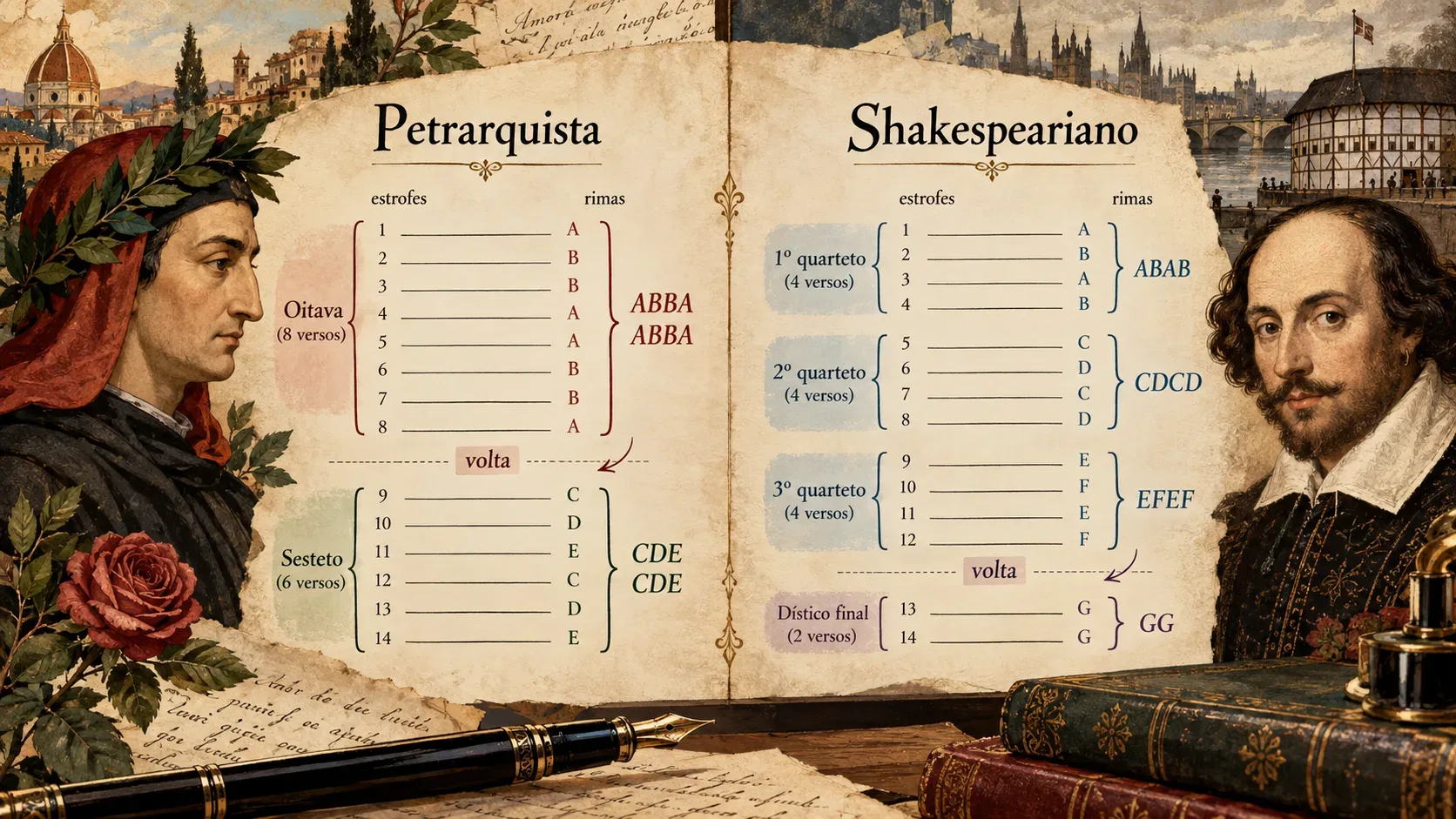
Writing a sonnet becomes much easier when you stop treating it like a rhyming puzzle and start treating it like a little thinking machine. The traditional form offers 14 verses and, in the Italian lineage that strongly marked poetry in Portuguese, these verses are usually organized into two quartets and two tercets. Within this space, the poem presents a situation, increases the pressure on it, and then changes direction. This change is the return.
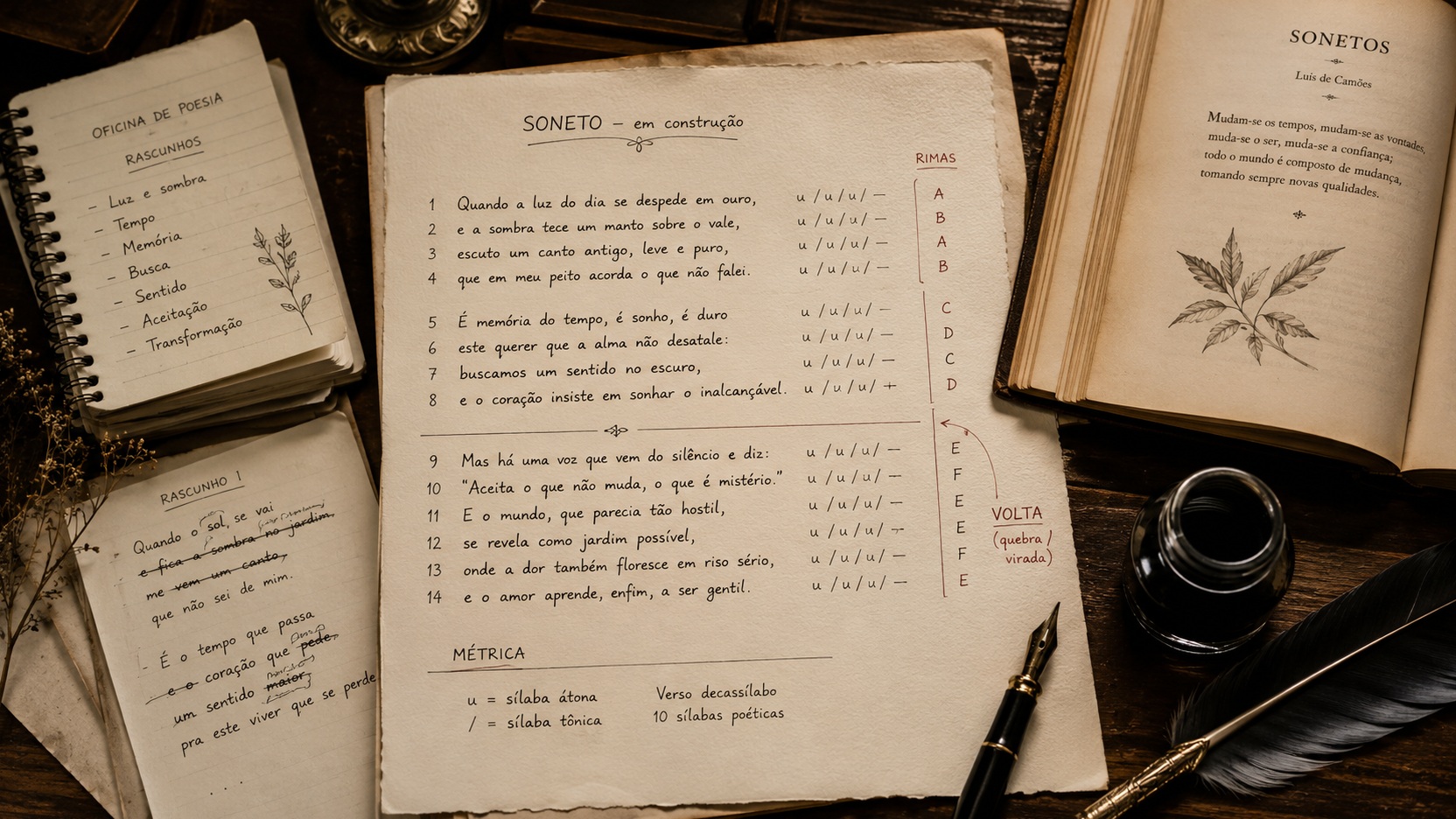
The decasyllable and regular rhyme are central choices in the sonnet tradition in Portuguese, but they are not the universal definition of the form. There are sonnets with other meters and there are modern uses that make the rhyme more flexible. For a construction workshop, however, it is worth starting with a deliberately clear rule: 14 lines in two quartets and two tercets, a rhyme scheme defined before the final version and a decasyllabic base. Restriction helps because it makes problems visible.
Start with the argument, not the first rhyme
Before writing any verse, summarize the movement of the poem in two or three sentences. Don't try to sound poetic. Write in prose what needs to happen.
Imagine a sonnet about someone who still keeps the key to a house that has already been demolished. The first half can show the object, the habit of carrying it and the memory of the place. The second half may reveal something that changes the reading: the key no longer opens a door, but the gesture of keeping it keeps the person trapped in a house that only exists in memory. The final decision may be to keep the key out of affection, not out of hope of returning.
This little argument already contains an architecture. Verses 1 to 4 present the key and the scene. Verses 5 to 8 complicate the situation by showing that the house no longer exists. Verse 9 opens the turn: the problem is not the loss of the house, but the way the lyrical self relates to the loss. Verses 10 to 14 develop this discovery and arrive at a consequence.
If you start with rhymes, you run the risk of inventing phrases just because they end in combinable words. If it begins with the movement of thought, the rhyme starts to serve the poem.
Choose an architecture that fits into 14 verses
In the Italian sonnet, two quartets form a block of eight lines and two tercets form a block of six. This does not mean that each stanza has an obligatory function, but the division offers an excellent working template.
In the first quartet, establish the image, question or conflict. In the second, develop, contradict or tighten this conflict. In the first tercet, make the poem change position. In the last one, explore the effect of the change without turning the final verses into a schoolboy explanation of what just happened.
A useful question is: what does the reader believe until verse 8 and what does he realize afterwards? If the answer is "the same", maybe there's still one lap left. The turn can be logical, emotional, temporal, spatial or point of view. The important thing is that there is a real difference between the before and after.
Draw the loop before cutting the metric
In many sonnets with a Petrarchan structure, the return appears in the passage from the eighth to the ninth verse. It does not need to be announced by "but," "however," "then," or "now," although these words may help in the draft. What characterizes the return is the change in reasoning or perception.
In the example of the key, verse 8 could end with the observation that the old house has become empty land. Verse 9 wouldn't need to say "but I understand." He could simply shift the focus: instead of looking at the terrain, the lyrical self looks at his own hand closed around the key. The scene changes and, with it, the problem changes.
This planning avoids a frequent defect: writing 14 coherent, rhymed and metered verses that remain in the same tone from beginning to end. The form is present, but the dramatic engine does not turn.
Set up the rhyme scheme as a map, not a prison
To begin with, a scheme like ABBA ABBA CDC DCD is practical because it clearly separates the block of quartets from the block of triplets. It's not the only one possible. The sonnet tradition itself admits variations in scheme, and the final part is usually more flexible than the first eight verses.
The lyrics represent a rhyming sound, not a specific word. If the first verse ends with an A sound, the other verses marked with A must return to that sound. In a consonant rhyme, the sound correspondence is more complete; in a toning or assonant rhyme, the approximation focuses on the vowels. For those who are practicing a classical sonnet, working with clear consonant rhymes usually facilitates the perception of the drawing.
Before writing the final verses, experiment with word families. For A, you can test endings such as present, absent, current, and different. For B, you can try place, return, save and change. The objective is not to use all these words, but rather to check whether the chosen family offers enough vocabulary for the subject.
If a rhyme only works with a word you would never use outside of that verse, be suspicious. The problem is not that the word is rare. The problem is that it appears without any semantic need, just to close the sound.
Make approximate verses first
With a defined argument, turn and rhyme map, write the 14 verses without demanding immediate metrical perfection. Try to keep each line close to the desired size, but allow for excesses and shortages. At this stage, you are still converting prose into units of verbal energy.
The prose phrase "I still keep in my pocket the key to the house that no longer exists" can produce a long and bad first verse. This is normal. The next work consists of discovering the core: pocket, key, absence, habit. Perhaps the final verse doesn't even contain the word "home" because the context has already made it visible.
The gain from this order is simple: when you start cutting syllables, you'll know what you can't cut. Without this nucleus, any reduction seems possible and the poem runs the risk of being technically correct and semantically empty.
Scansion: tell the verse as it is said
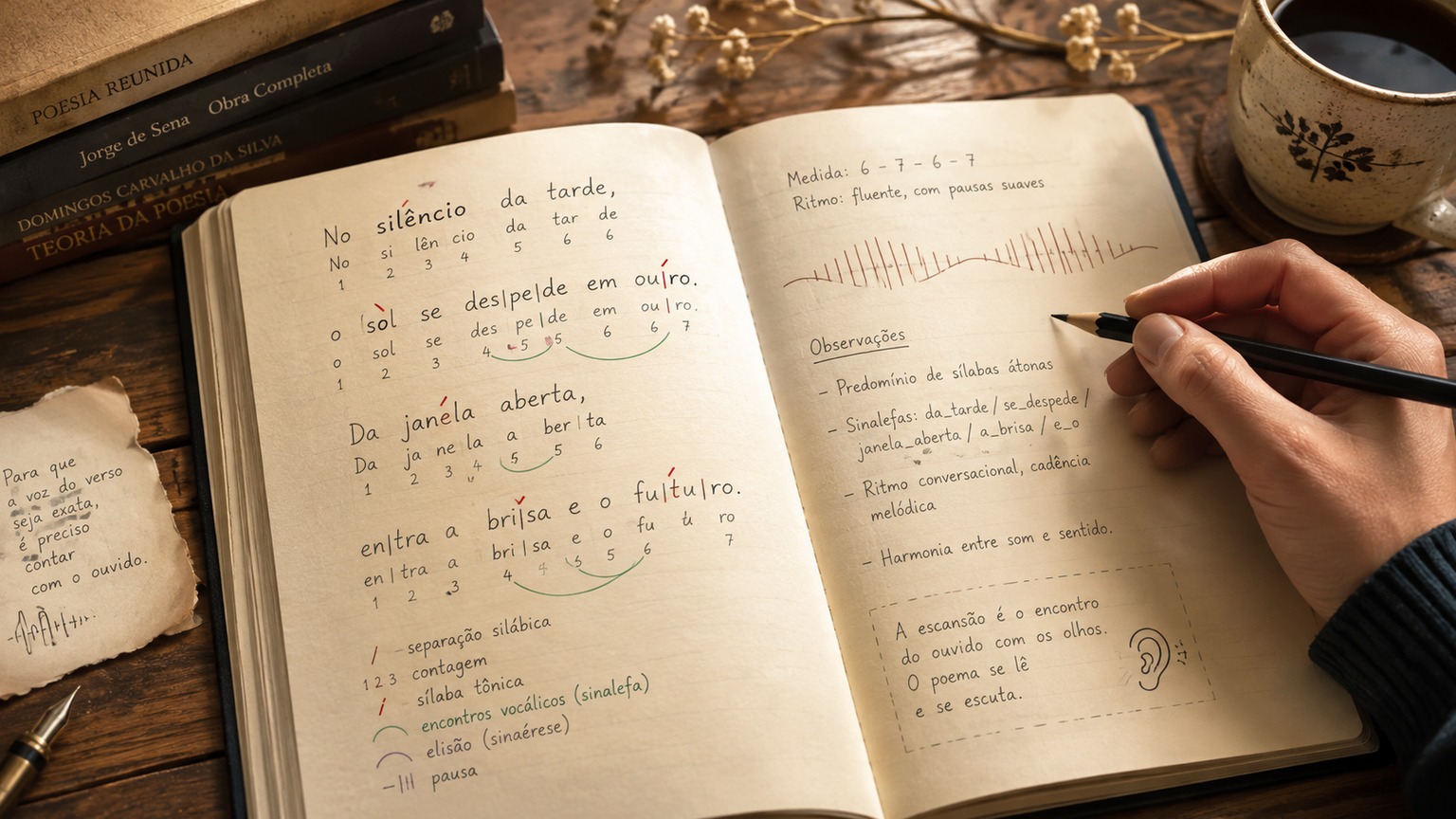
In Portuguese metrics, the syllabic division of the verse does not necessarily coincide with the grammatical division of the words. The count goes until the last stressed syllable of the verse. Unstressed syllables that come after it do not enter the measure. Furthermore, vowels in contact between words can merge during reading, a phenomenon that versification treats as signal or through processes close to sound contraction.
Consider the original verse: "The afternoon light falls on the path." A possible metric reading is: A / luz / da / tar / de / CAI / so / (bre o) / ca / MI(nho). The final syllable of "caminho" is after the last stress and is not included in the calculation; "bre o" can be pronounced as a single metric unit. The result is a decasyllable.
The score, by itself, does not act as an absolute wall against these sound connections. Therefore, scanning should not be done only with the eyes. Read aloud, at natural speed, and notice where the voice actually joins or separates the sounds.
This is one of the reasons why a verse that appears to have 11 or 12 syllables in school counting can end up being 10 in poetic reading, and also the reason why an apparently correct line on paper can sound artificial when the signal only exists if you override the diction.
Decasyllable is not just "ten syllables"
The decasyllable has ten metric syllables, but the rhythm depends on where the strong accents fall. In the Portuguese tradition, two very well-known designs are the heroic, with important supports in the 6th and 10th syllables, and the sapphic, with supports in the 4th, 8th and 10th. There are variations, and real poems don't need to sound like identical metronomes in every line.
For those just starting out, it's better to choose a dominant cadence than trying to memorize all the classifications. After closing the ten syllables, mark the naturally stressed words and read the verse. If each line requires a strange emphasis to fit the pattern, the account is closed, but the rhythm is not.
Return to the example "The afternoon light falls on the path". The reading naturally supports "cai" and "mi" of "path", creating a strong axis in the 6th and 10th positions. You don't need to speak like someone reciting a march; you just need to realize that the verse has supporting points.
Cut syllables without amputating the meaning
When a verse is long, the first temptation is to look for smaller synonyms. This can help, but it is often the least interesting tool when used alone. First, look for redundancies, explanations and words that repeat information already given by the image.
Compare the idea "The afternoon light falls slowly on the path" with "The afternoon light falls on the path". The second version is more compact, but loses the explicit notion of slowness. If slowness is important, an alternative is to redistribute the information: "The slow afternoon falls on the path." Now the quality is incorporated into "afternoon" and the verse can be worked metrically without carrying the entire adverb.
If the verse has too many syllables
Look first for dispensable articles, periphrases, doubled adjectives and auxiliary verbs that don't add nuance. Then try a more direct syntactic order. Only then consider swapping a long word for a short one. A natural signal can resolve a syllable; a forced signal only hides the problem.
If the verse has fewer syllables
Do not fill the hole with "so", "already", "well", "yet" or other automatic patch. Ask what concrete information is missing. Sometimes the verse needs a more precise image, a better verb, or a spatial relationship that the short version omitted. The additional syllable must buy meaning.
If the math adds up, but the verse sounds harsh
Read without marking the metric. If the sentence only works when you shift a natural word stress or make an awkward pause, rewrite. The meter should organize poetic speech, not force the reader to pronounce Portuguese in an improbable way.
Make the rhyme carry meaning
The best rhyme seems inevitable once the verse exists, even if it required a lot of work beforehand. To get close to this, treat the final word as a prominent position. It receives sound expectation and usually gains syntactic weight.
If the poem talks about memory and all the rhymes come from infinitives ending in "-ar", perhaps you have chosen a path that is too easy. If the four A lines end in abstract nouns just because they rhyme, the poem may take on a conceptual fog. Vary the functions of words when it benefits the sentence and, most importantly, check that each term belongs to the poem's field of experience.
A good test for a so-called filler rhyme is to remove the line and ask what is lost. If none of the argument, image or rhythm disappears, perhaps that line was written just to deliver the required ending. In that case, don't look for a better rhyme for the same void; look for a better need for verse.
Don't sacrifice syntax to sound "poetic"
Syntactic inversion is a legitimate resource and has a long history in poetry. The problem arises when the entire line contorts to leave the rhyming word at the end. The reader quickly realizes when the word order exists due to expressive necessity and when it exists due to rhyme engineering.
Read each verse as a possible sentence in Portuguese. It may be more condensed, more solemn, or more elliptical than everyday speech, but it still needs to produce a clear relationship between its terms. If you have to reread it three times just to figure out who did what, review it before blaming the difficulty on the fixed form.
Use the foursomes to build up pressure
The first eight verses are enough space to create recurrence. An image can be modified. A word can take on another meaning. A certainty can show a fissure.
In the key sonnet, the first quartet could show the object in the pocket and the memory of the door. The second could repeat the key in contexts that prove its practical uselessness: there is no lock, there is no wall, there is no address. Repetition stops being decoration and starts increasing the pressure on the question: why keep carrying this?
This pressure prepares the return. If the first tercet begins by looking at the hand that insists on pressing the key, the change seems like a consequence of what came before, not a trick inserted because "sonnets need it back".
Have triplets respond without explaining too much
The final part does not need to resolve the conflict as a moral. It needs to produce a new relationship with the material presented. Sometimes the answer is acceptance. Sometimes it's a bigger contradiction. Sometimes it's just an image that rearranges everything the reader has ever seen.
In the example of the house, the most predictable ending would be to say that "you have to leave the past behind". This explains the theme, but impoverishes the poem. A stronger ending can return the key to the concrete world: the lyrical self puts it in a drawer, gives it to someone, melts the metal, hangs it on a wall or decides to continue carrying it for another reason. Physical action allows the reader to complete the emotional movement.
Do three different reviews, not one infinite review
When first reviewing, ignore rhyme and meter for a few minutes. Just read the argument. Is there a starting image? Does the second quartet add anything? Does returning change the reading? Does the last triplet transform the situation or just summarize it?
On the second review, read the sound. Do the scansion, check the measurement, observe the accents and look for verses that require artificial pronunciation. Read the entire sonnet aloud, as one line can stand alone and disrupt the cadence when placed between others.
In the third review, look at the endings. Check the rhyme scheme, sound quality and weight of the final words. Check if any lines appear to have been written backwards, starting with the rhyme and then looking for a phrase to justify it.
Separating these revisions avoids a common cycle: you change a word because of the metric, lose the rhyme, fix the rhyme, break the meaning and, when you realize it, you no longer know what problem you were solving.
Diagnosis: why a "correct" sonnet may still not work
It has 14 verses, but there is no change
Formal correction does not replace movement. Locate the point at which the perception, argument, or image changes. If there are none, rewrite the transition between the eighth and ninth verses or consciously plan a return at another point.
The metric only works on paper
Redo the scan using your voice. Check the last stressed syllable and the vowel connections. If it is necessary to swallow sounds, shift accents or run in an unnatural way, the verse needs to be written differently.
The rhymes are right, but they seem chosen from a dictionary
Return to the semantic field. Change the entire rhyming family if necessary. A less showy ending, but with words that belong to the subject, usually produces a more convincing poem than a sequence of decorative rarities.
The poem is full of filler words
Mark each term entered just to complete measure or rhyme. Try replacing it with concrete information. If there is no information to add, the entire verse may need to be reconstructed.
The return was announced, but nothing really turned around
Words like "but" and "however" don't create a turn on their own. Compare content before and after. The second block needs to do something the first didn't do: respond, deny, shift, expand, reveal or invert.
When the sonnet is ready
A sonnet is not ready when you can prove that all the lines have ten syllables and that the letters in the rhyme scheme match. These controls are important, but they are the scaffolding. The poem is closer to completion when the form stops seeming like a series of separately resolved obstacles.
Read it again without counting. Quartets should naturally lead to triplets. The return must seem necessary after it happens, even if it surprises. Rhymes should be audible without drawing attention to the effort. The metric should support the reading without asking you to demonstrate it on each line.
If some formal decision is pushing the text away from what you wanted to say, don't immediately conclude that the idea "doesn't fit into a sonnet". Go back one step. Change the rhyme scheme, redo the loop, choose another decasyllabic cadence, or reconstruct the argument. The sonnet workshop works just like this: form puts pressure on language, and language responds until technique and thought start to seem the same thing.