
Finishing a poem with the feeling of “I didn’t understand” doesn’t mean that the reading went wrong. The problem usually begins when we expect the entire meaning to appear in the first passage, as if the poem were a riddle with a hidden password.
Reading guides from the Academy of American Poets draw attention to precisely this expectation: it is not necessary to understand everything on the first reading, and a poem does not need to have a single secret equivalence for each word or image. At the same time, this does not mean that any interpretation is valid. The text remains the reference.
A more productive way into the poem is to shorten the task. Instead of immediately asking “what does this mean?”, do four readings with different objectives. Each passage takes advantage of what the previous one left visible.
1. First reading: find out what's going on
On the first pass, resist the urge to explain the poem. Read until the end just looking for basic guidance.
Who seems to speak? Is anyone being called or watched? Is there a scene, memory, object, place or event? Does the poem begin one way and end another? Does the title change anything in the way you see the text?
No need to respond to everything. In very abstract poems, you may only be able to recognize an emotional situation or some images. This is already reading material.
Try to formulate a simple sentence, with almost no interpretation: “a person observes an empty house”; “someone addresses an absent person”; “the poem brings together images of water and the passage of time.”
This sentence does not need to reveal the “true meaning”. It only creates a floor.
If there is an unknown word, mark it. Only stop reading to research when it impedes basic understanding of the passage. Otherwise, finish the poem first. Close reading usually progresses best when observation and interpretation are not confused at the beginning.
2. Second reading: see where the poem concentrates energy
Now go back to the beginning and read more slowly. The question changes from “what happens?” to “what does the poem insist on making me notice?”.
Note words that are repeated, concrete images, contrasts, changes in tone, unexpected comparisons and terms that seem out of place. Also look for relationships: do two images belong to the same field? Does a word reappear modified? Does something that seemed positive at the beginning gain another value later?
Here is an important difference between reading and decoding. A window does not automatically mean freedom; rain does not automatically mean sadness; Night does not automatically mean death. An image gains strength by what it does in that specific poem.
So, before asking “what does this image symbolize?”, try smaller questions: where does it appear? What words is it linked to? Will she come back? Change? Contrasts with what?
It is this movement between observation and interpretation that characterizes much of what is called close reading: first locating concrete elements of the text and then looking for patterns, ruptures and relationships between them.
It's also a good time to consult the dictionary when a word really matters, or look up an explicit reference that you don't recognize. Research should clarify the poem, not replace it.
3. Third reading: listen to the poem and observe its form
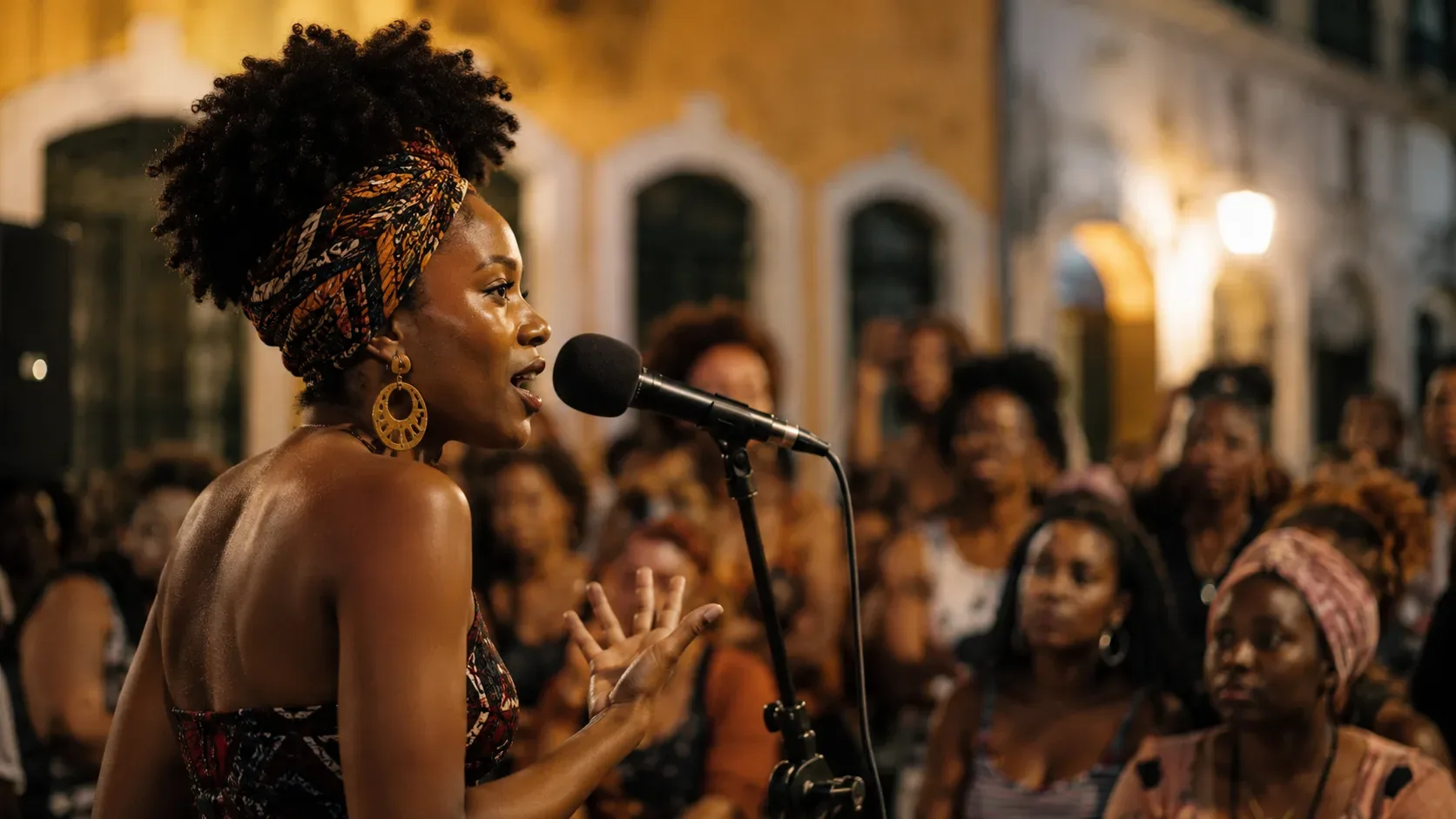
On the third reading, use your voice.
Reading a poem aloud can reveal things that go unnoticed in silence: repetitions of sounds, changes of rhythm, discrete rhymes, faster or slower sequences, and words that receive unexpected emphasis when pronounced. The Academy of American Poets recommends rereading it aloud precisely as a way to understand what is happening sonically before trying to explain why.
You don't need to know metrics to get started. Listen.
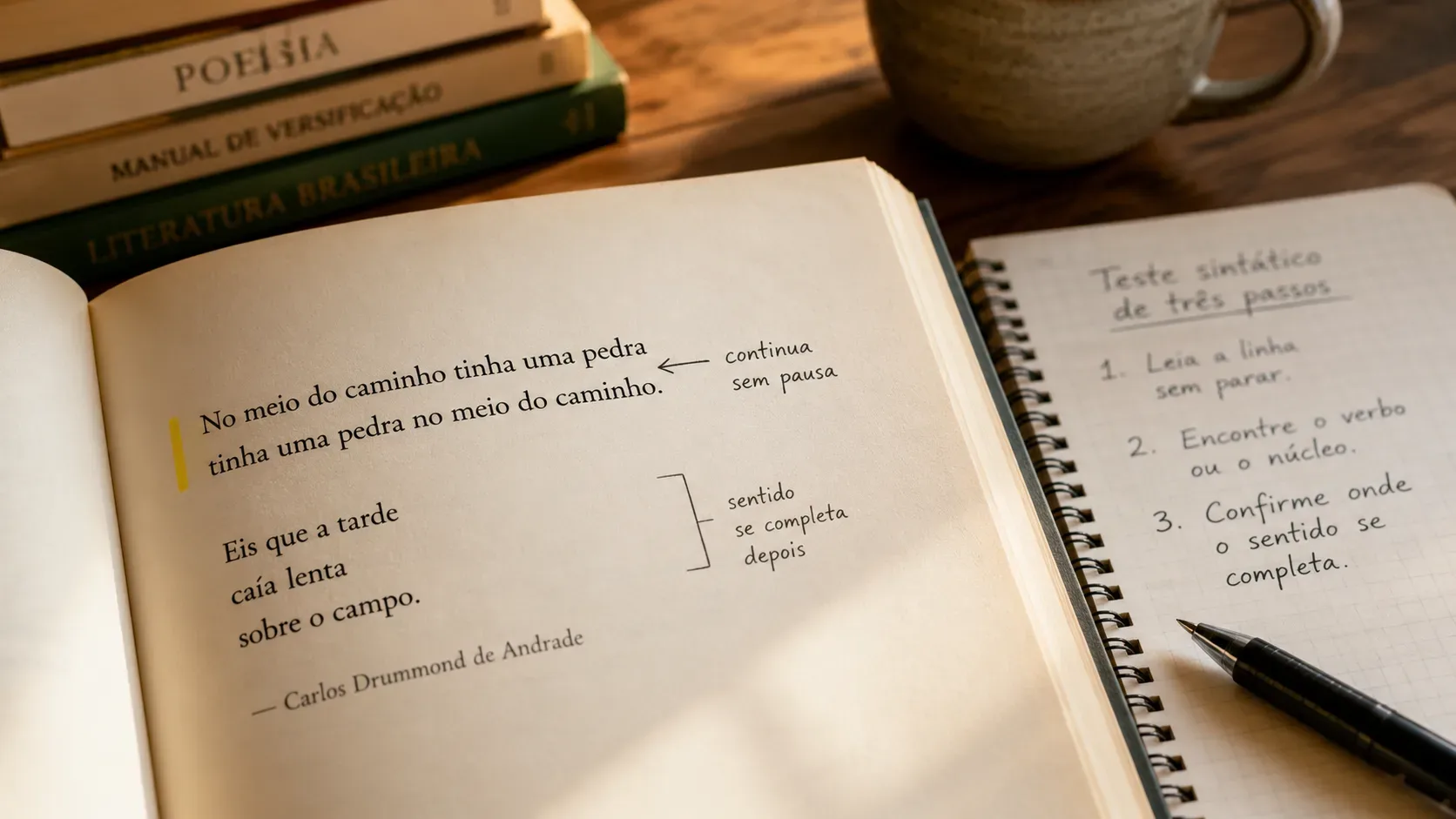
At the same time, look at the page. Are the verses long or short? Are there regular stanzas? Does a verse end with a sentence or cut the sentence off in the middle? Are any words isolated?
Form is not just packaging for content. Line length, breaks, rhythm, stanzas and rhymes are part of the poem's structure and can interfere with its effect and meaning.
There is a useful precaution: verse breaks do not necessarily mean that you must pause completely. In many poems, the phrase continues into the next line. An interesting experience is to read first, respecting mainly the syntax and punctuation, and then return, paying special attention to the place where each verse ends. The tension between phrase and verse can reveal another layer of the text.
Reading aloud is also not just a foreign technique or one linked to the study of metrics. In an extension proposal dedicated to the reading of modern poetry, FFLCH-USP brings together metaphor, rhythm and reading poems aloud as dimensions of working with the poetic text.
4. Fourth reading: formulate an interpretation that the poem can support
Just now try to answer the question that usually appears too soon: “after all, what is this poem talking about?”.
The difference is that you already have evidence.
A simple way to start is to mentally complete this sentence:
“The poem seems to explore ______ through ______.”
The first space can receive an idea, conflict or experience. The second needs to point to elements that you actually found: images, repetitions, changing tone, contrast, rhythm, form, word choice.
For example: “the poem seems to explore an absence through the repetition of domestic objects and the contrast between movement and stillness.”
This is still a hypothesis. Now test it.
Does it explain the beginning and the end? Does any important part contradict your reading? Can you point out two or three choices from the poem that support this hypothesis? Is there another interpretation that would also explain the same elements well?
Attentive reading does not require finding a single correct answer, but it also does not transform interpretation into unlimited opinion. A reading becomes more convincing when you can go back to the text and show where it came from.
It is also at this stage that historical context, biography, cultural references or critical texts can be useful. Some poems work well without external information; others gain clarity when we know the historical or cultural circumstance to which they respond. The Academy of American Poets itself recommends dosing this context, instead of arriving at the poem already loaded with ready-made explanations.
“But there are still things I don’t understand”
There probably will be.
This does not invalidate the four readings. A poem may continue to offer ambiguities even after careful analysis. In fact, the expectation of eliminating all uncertainty tends to impoverish the experience: some relationships can be perceived without each image being reduced to a definitive translation.
“Understanding” a poem, in this method, does not mean being able to rewrite it in prose and explain each verse.
It could mean noticing that there is a change in tone that you hadn't noticed before. Discover that a repeated word connects two distant parts. Listening to a rhythm that makes a passage more tense. Recognize two possible interpretations and know which excerpts support each one.
This is already entering the poem.
A minimal example
Imagine these verses, created just to demonstrate the method:
On the table, the orange is open.
The afternoon leaves the kitchen.
No one picks up the knife.
On first reading, there is an empty kitchen, a cut fruit and a knife left on the table.
In the second, more interesting relationships appear: something was interrupted; the word “abandon” attributes action to the afternoon; common objects remain while the person who used them does not appear.
In the third, reading aloud allows us to understand the weight of the three short sentences and the interruption created by the separate verses.
In the fourth, we could raise the hypothesis that the scene works on an absence through the traces of an everyday action. Perhaps another reading is possible. The important thing is that the interpretation did not arise from the automatic association “orange means X” or “knife means Y”. It was born from the relationship between what the poem placed before the reader.
This is the habit that the four readings try to create.
Next time a poem seems closed, don't immediately look for a ready-made analysis. Make one pass for the situation, another for the images and words, a third for sound and form, and a fourth to test a hypothesis.
Then, if you want, consult comments, interviews or studies. You'll come to them with something much more useful than a borrowed answer: questions of your own about the poem.