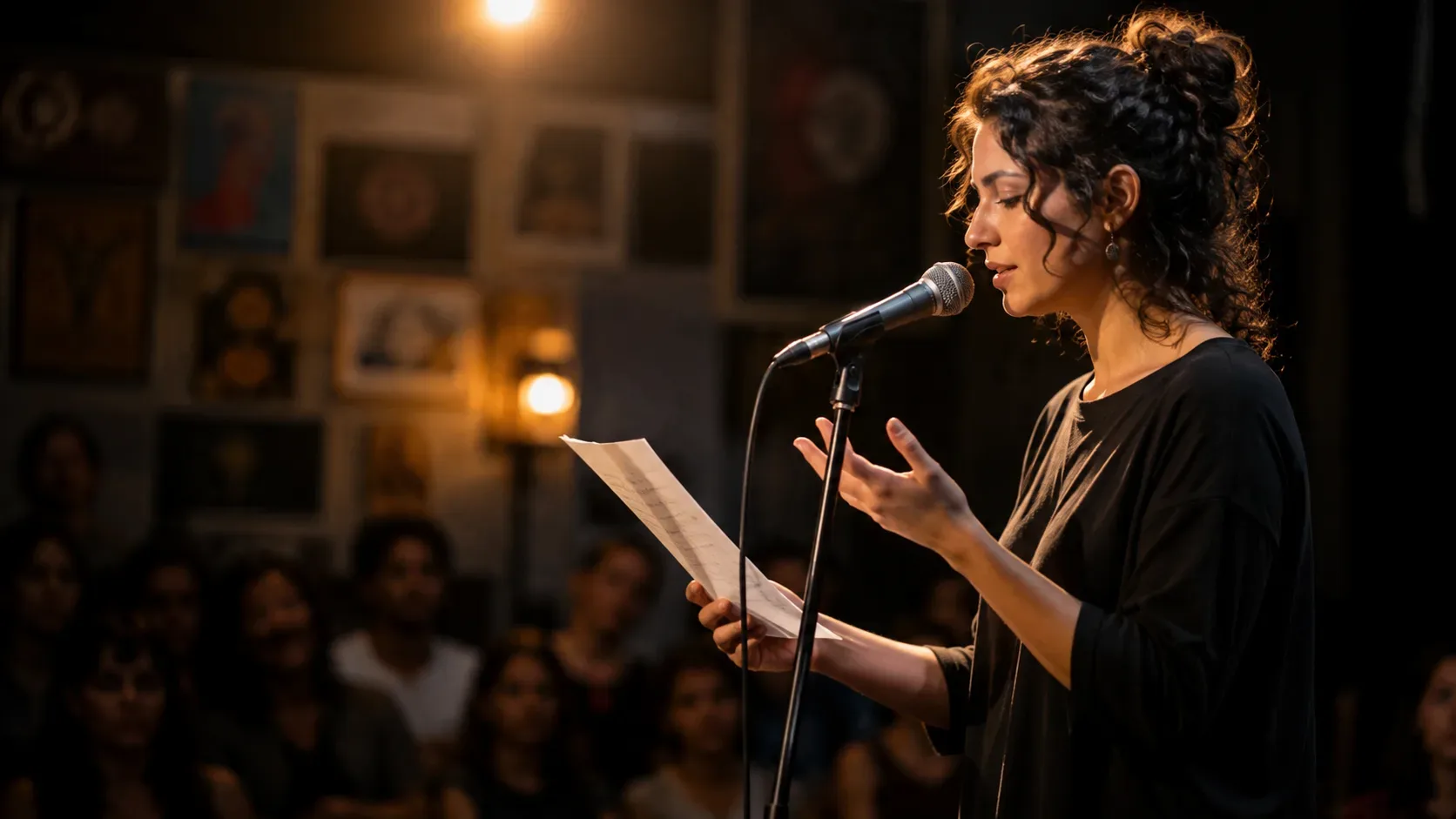
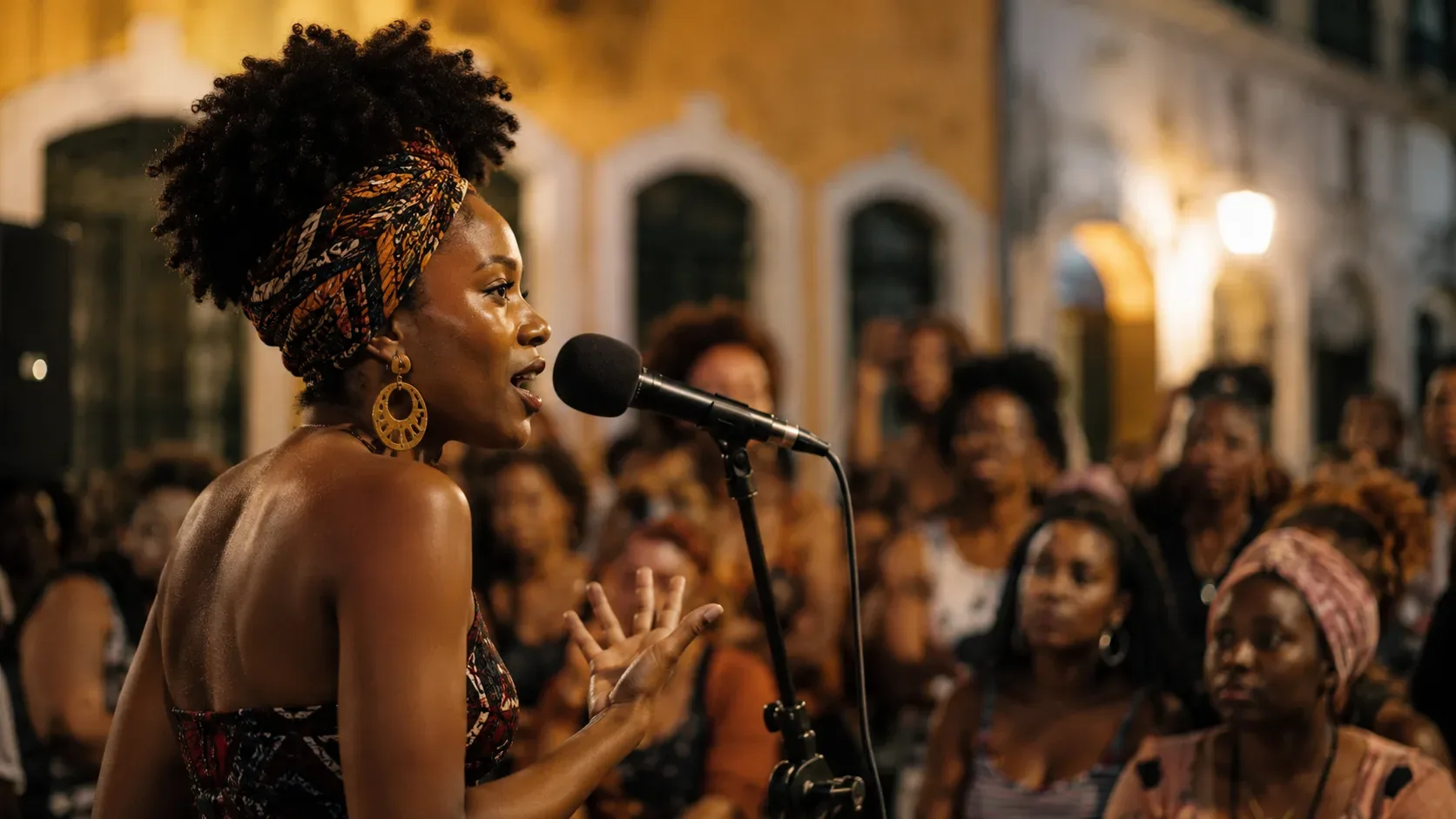
Listening to a poetry slam requires a slightly different attention than the one we use when reading a poem silently. The word remains at the center, but it does not arrive alone: rhythm, pauses, repetition, voice volume, gestures and presence in front of the public also produce meaning. In the slam tradition, performance and text are linked so strongly that many works are designed to function precisely in this transition from writing to voice.
Flipelô 2026 offers a good opportunity to experience this listening experience. The Pelourinho International Literary Festival takes place from August 5th to 9th, in Salvador, with free access to the activities. In the program for this Saturday, August 8th, two meetings linked to the Slam das Minas Bahia appear: at 10am, the soiree “As minas com a Palavra”, at Vila Literária, with Ludmila Singa, Má Reputação and NegaFyah; and, at 7pm, a Slam das Minas soirée at Casa das Editoras Baianas, at Solar do Ferrão. The same day also brings together open microphones and other poetic meetings.
There is an important caution here. Although “slam” also designates the poetry battle in which participants present authorial works in front of the public and jury, Flipelô's official schedule classifies the 7pm activity as a soiree. The page does not inform that there will be competition, grades or qualifiers. Therefore, it makes more sense to use the characteristics of poetry slam as a listening key than to assume that the encounter will follow all the rules of a traditional battle.
Rhythm: listening to the poem happening in time
When talking about rhythm in poetry, it's easy to think only about meter or rhyme. In a performance, however, the first rhythm that reaches those in the audience is that of the speech itself.
Pay attention to speed. Does the poet speed up several sentences and suddenly leave an isolated word? Do you maintain a regular cadence and then interrupt it? Lengthening a syllable, cutting a sentence or leaving a few seconds of silence changes the way an idea arrives.
This movement can organize the poem even when there is no regular meter. When recommending reading poetry aloud, the Academy of American Poets draws attention precisely to sounds, rhymes and passages whose rhythm differs from the rest of the poem. In performance, these changes stop being just a possibility of reading and become audible decisions made by those in front of the audience.
Therefore, do not try to understand each verse immediately. First notice the tempo. Are there passages that progress like a conversation? Others seem to hammer home an idea? At what point does the rhythm break? It is often at this break that the poem changes direction.
Repetition: the phrase returns, but does not return the same
Spoken poems often use reoccurring words, constructions, or phrases. Repetition can serve as a refrain, create anticipation, reinforce an image, or provide the audience with a point to return to as the rest of the text progresses.
Repetition is a central technique in oral and written poetry and also functions as a memory resource and construction of rhythmic patterns.
To hear it better, the most productive question is not just “what was repeated?”, but “what changed when it came back?”
The same sentence can appear first as an affirmation, then as irony and, at the end, as an accusation. It may remain verbally identical and change because the voice became quieter, because it came after a revelation, or because the audience now knows something they didn't know at the first occurrence.
This transformation is especially easy to miss when we try to mentally convert everything we hear into written text. In performance, a repetition is also a repetition of sound, of breathing, of expectation and, sometimes, of gesture.
Voice: don't just listen to what is said
Volume is just one of the dimensions of the voice. A presentation doesn't need to be shouted to be intense.
Note where changes in intonation, speed and intensity appear. Are there words almost whispered? A sentence addressed directly to the audience? A dryly pronounced passage after an expansive passage?
The voice can also produce characters and distances. The same person can narrate, remember, confront, imitate speech received in the past or address someone absent. Not every change literally indicates another character, but noticing these variations helps you recognize how the poem organizes different positions within a few minutes.
The slam format itself has historically reinforced the importance of this dimension: in the description of the Academy of American Poets, the evaluation of a traditional performance considers not only the content and style of the poem, but also the way in which it is performed.
This does not mean looking for the “most theatrical” performance. It means recognizing that a word spoken slowly and a word thrown quickly do not produce exactly the same experience.
Performance: the body is not just illustrating the text
At a poetry slam, looking only at the microphone can mean missing part of the poem.
Posture, direction of gaze, movements, immobility, approaching or moving away from the microphone and relationship with space can participate in the construction of meaning. Sometimes a gesture literally accompanies an image. At other times, the body creates tension with what is being said.
Research carried out in Bahia on the Slam das Minas deals precisely with the relationship between poetry, performance, body, memory and experience. Aline Nery dos Santos' thesis, defended at the Federal University of Bahia in 2023, studies the poetry and performances of Slam das Minas/BA and their relationship with resistance, memory and educational practices. A study published in REVELL also analyzes the body as part of the poetic performance in the Bahian collective.
For anyone listening, this changes a basic question. Instead of just thinking “what does this gesture mean?”, try observing when it happens. Does the body move throughout the poem or does it just stop? Did the poet hold her gaze and then look away? Is a verbal repetition accompanied by the same gesture or a different gesture?
The relationship between word and body is often more interesting than any isolated element.
And the audience is also part of the listening
Poetry slam developed as poetry performed in front of other people. In the traditional competitive format, members of the audience can judge the performances.
Even outside of a competition, the presence of the public changes the experience. Laughter, silence, clapping, exclamations and other responses produce an environment that does not exist in individual reading.
This is not to say that the loudest reaction necessarily indicates the best poem. An audience may respond quickly to a catchphrase while remaining silent when faced with a more difficult or painful passage. This silence also deserves to be heard.
An interesting question is to understand at which moments the collective response appears. Was it after an image? From a complaint? From a breach of expectations? Of a repeated verse? The reaction shows something about the circulation of the poem in that space, although it does not conclude its interpretation.
A simple way to hear your first slam
If you've never followed spoken poetry live, trying to analyze everything simultaneously can be more of a hindrance than a help. A simpler sequence works better:
- In the first moments, follow the sound. Notice cadence, speed and pauses before looking for an explanation for each verse.
- When something returns, keep the repetition. See if the phrase takes on another meaning in subsequent appearances.
- Notice changes in voice. Notice where volume, rhythm, or intonation changes and what happens in the poem at that point.
- Include the body in the reading. Movement, gaze and stillness can also mark transitions.
- After the end, recover what remained. It can be a phrase, image, sound or gesture. Start from this trace to reconstruct the path of the poem.
It is not necessary to technically identify each resource. The objective is to increase attention, not to turn the presentation into a literature test.
Why start from the Slam das Minas Bahia
Slam das Minas Bahia was created in Salvador in 2017. In an interview published in 2025, one of its creators, NegaFyah, related the emergence of the collective to the need to expand the presence and protagonism of women in poetry battles. The group's trajectory maintains a strong relationship with black and peripheral women and has surpassed the competition, also involving training, publication and other literary activities.
This story makes it especially interesting to observe how voice and body work there. Not because there is only one way to perform at Slam das Minas, but because the collective's own trajectory shows that orality, experience and public presence are relevant dimensions of its literary production.
At Flipelô, the August 8th program allows you to follow this poetry in the midst of soirees, poetic meetings and open microphones. It's a good context to notice a simple difference: reading poetry doesn't just happen when our eyes scan a page.
Sometimes, reading is also learning to listen.
For those who intend to follow the activities, the official schedule should be consulted again before traveling, as times and locations of in-person events may change.