
When you have no subject in mind, waiting for inspiration often increases the pressure. A poetry writing exercise does the opposite: it narrows the field of choice and creates a small, observable, repeatable task. Instead of “writing a poem,” you train one specific operation — producing a sensory image, changing the rhythm, testing a line break, or altering the speaker’s voice.
The 12 practices below are organized as a program, not as a collection of tips. They are divided into four areas — imagery, rhythm, line breaks, and voice — and can be done with a new poem or an existing draft. The point is to compare versions: the exercise matters less as a way to produce a “finished” text than as a way to reveal your choices.
How to use these exercises
Set aside 20 to 30 minutes per session. Work with a timer and avoid revising while you produce the first version. At the end, make a second pass focused only on the technical goal of the exercise. If you want to track progress, keep versions A and B and write one sentence about what changed.
- First 10 minutes: generate material without trying to “solve” the poem.
- Next 10 minutes: apply the technical constraint.
- Final minutes: read aloud, compare versions, and mark one discovery.
In poetic terminology, imagery uses language that engages the senses and creates mental images. A poetic line, meanwhile, does not end by accident: a break can respond to rhythm, meaning, pace, count, or emphasis. Those two principles support many of the imagery and line-break exercises below.
Area 1 — Imagery: turn ideas into sensory material
1. Five-sense inventory
Goal: move away from abstraction and produce concrete material.
Choose an ordinary place: a kitchen, bus stop, bedroom, hallway, or yard. Make five blocks of notes, one for each sense. Record only observable things: the temperature of metal, the smell of damp cloth, the sound of an engine, the aftertaste of coffee, the uneven color of a wall. Avoid explaining what these things “mean.”
Second pass: select three details from different senses and write 6 to 10 lines in which no emotion is named directly. If the draft says “sadness,” “longing,” “fear,” or another abstract emotion, replace it with a gesture, object, sound, or physical reaction.
Revision test: can the reader picture a scene before receiving an interpretation?
2. The unnamed object
Goal: train precision and avoid generic words.
Choose an ordinary object and forbid yourself from writing its name. Describe its shape, weight, surface, use, flaw, origin, sound, and relationship to the body. A glass might become “a cold cylinder holding light at the rim”; a key can appear through friction, the sound it makes in a pocket, and the mark it leaves in a palm.
Second pass: introduce an action. The object must fall, break, disappear, be handed to someone, or change function.
Revision test: did the image become specific without relying on decorative adjectives?
3. Metaphor at three distances
Goal: test comparison without settling for the first association.
Choose a base image — rain on a window, a worn shoe, an open fruit, an empty elevator. Write three comparisons: one close and logical, one less predictable, and one that initially seems incompatible. Then develop each one in two or three lines.
Second pass: remove the “prettiest” comparison and keep the one that creates more tension or discovery. Imagism valued the force of concrete, precise images; the usefulness of this exercise is noticing when a figure expands the experience instead of merely decorating it. See the Poetry Foundation’s overview of Imagism.
Revision test: does the metaphor change how you see the original image?
Area 2 — Rhythm: hear speed, pressure, and repetition
4. Elastic sentence
Goal: notice how syntax and length change rhythm.
Write a 25- to 35-word sentence about a simple action. Then create three versions: one with short sentences and interruptions; one with a long flow and few pauses; and one alternating short and long segments. Keep roughly the same content.
Second pass: turn each version into lines without changing the words. Read all three aloud.
Revision test: which version has a speed that best fits the scene? Does the rhythm reinforce the content, or contradict it in an interesting way?
5. Breath marking
Goal: use reading aloud as a diagnostic tool.
Read a draft slowly. Mark with a slash where your body asks for a pause, circle the words that receive spontaneous emphasis, and underline the places where your voice seems to “switch off.” Do not correct anything during the reading.
Second pass: rewrite only the places where breath and syntax seem to compete without purpose. Then read again. Workshops on public reading use the voice to locate lost musicality, pauses, and tonal shifts; here, reading aloud serves first as a way to revise the page.
Revision test: can you sustain the sonic path without stumbling in places that do not call for a stumble?
6. Repetition with variation
Goal: build rhythm through recurrence without mechanical repetition.
Choose a short phrase of 3 to 7 words to act as a refrain. Write four stanzas. In each one, repeat the phrase but change one element around it: tense, person, object, syntactic order, or final word.
Second pass: test removing one repetition. Sometimes rhythm becomes stronger when the reader begins to expect something that does not return.
Revision test: does each return accumulate meaning, pressure, or contrast?
Area 3 — Line breaks: make the line do work
7. Three line-break versions
Goal: understand the break as a choice of meaning and speed.
Write a short paragraph of 60 to 90 words. Make three lineated versions: in the first, break mostly at syntactic units; in the second, end lines on words you want to emphasize; in the third, use breaks that push the sentence into the next line.
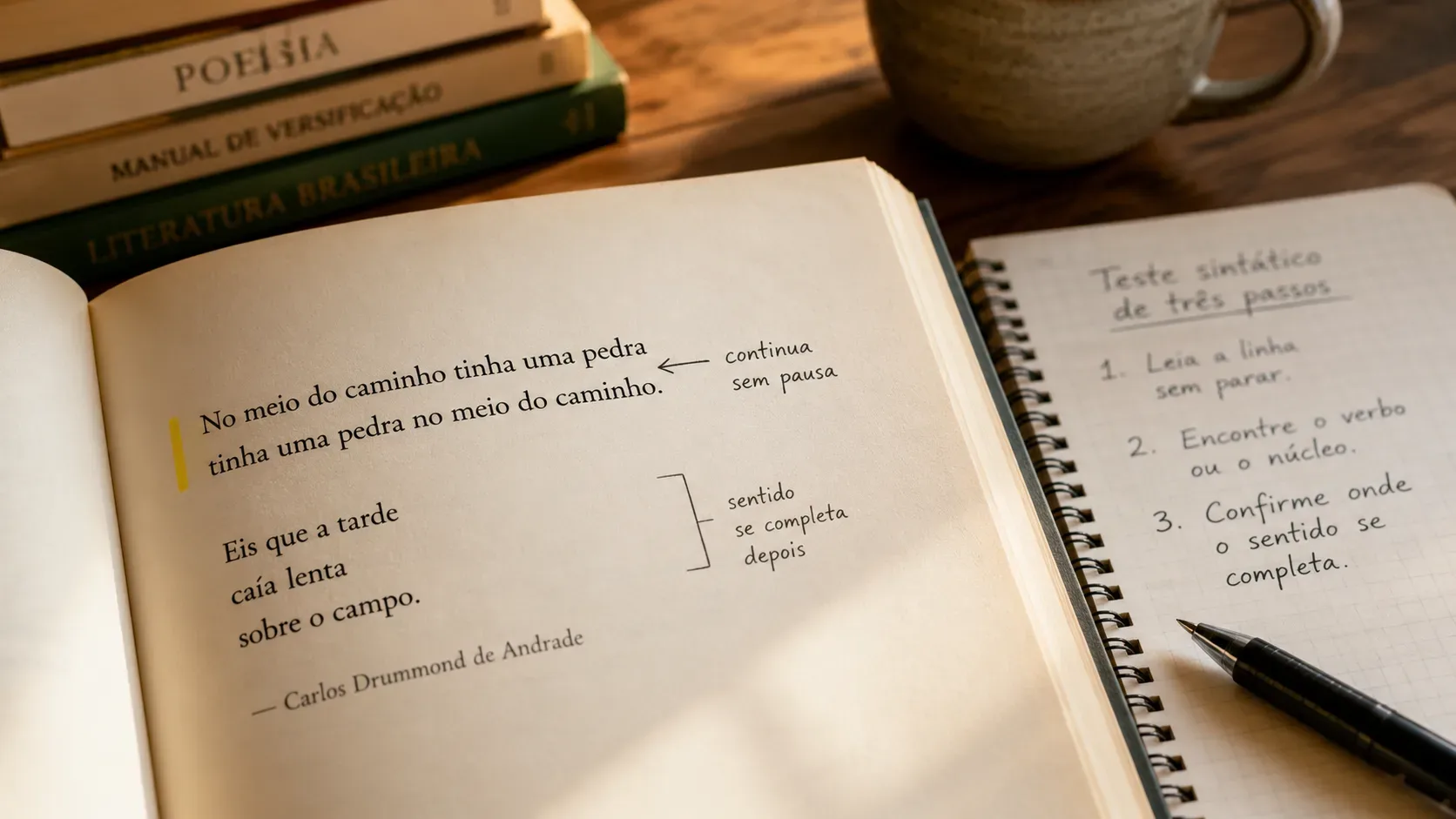
The continuation of a sentence across a line break is called enjambment. The Poetry Foundation also notes that line endings can gain weight and change reading speed. The exercise is about hearing those differences, not choosing one “correct” type of line.
Second pass: compare only the last five words of each line. Do they create tension, surprise, noise, or accidental emphasis?
Revision test: does the break add sonic or semantic information that would disappear in prose?
8. Internal pause and caesura
Goal: work with silence inside the line, not only at its end.
Choose eight lines from a draft. In four of them, introduce an internal pause through punctuation, a syntactic shift, or space. Then read the old and new versions. A caesura is a pause within a line and can reorganize weight and expectation.
Second pass: remove half of the pauses you added. Keep only those that change the listening experience or the logic of the line.
Revision test: does the silence have a function, or has it become graphic decoration?
9. Cut 30%
Goal: discover where the poem explains too much.
Take a draft of 80 to 150 words and cut roughly 30% without adding anything. Start with duplicated meaning, predictable connectors, explanations of images, adjectives that repeat what the noun already says, and sentences that only prepare the next sentence.
Second pass: restore no more than three removed elements, and only if their absence causes a real loss of meaning, voice, or rhythm.
Revision test: did what remains gain energy? Did any cut make the poem merely obscure? The goal is not to make every poem minimal, but to notice the cost of each word.
Area 4 — Voice: discover who speaks, to whom, and under what pressure
10. Speaker swap
Goal: separate the poem’s voice from the author’s automatic biography.
Choose a scene and write eight lines in the first person. Rewrite the same core as if another person in the scene were speaking. In the third version, give the speech to an object, animal, or place.
In critical terms, the speaker is the voice speaking in the poem and does not have to coincide with the poet. That distance opens possibilities for perspective, detail selection, and vocabulary.
Revision test: did changing the speaker alter only the pronouns, or also what can be perceived, desired, and omitted?
11. Persona with a secret
Goal: build a voice through desire and concealment.
Create a simple persona: the doorman of an empty building, a child waiting for someone, a driver at the end of a shift, a tree in a square, an astronaut in training. Define two things outside the poem: what this voice wants and what it refuses to say.
Write 12 to 16 lines without explaining the secret. A persona is an assumed speaker distinct from the poet; both the Poetry Foundation and the Academy of American Poets treat that separation as central to the technique.
Second pass: cut any line that states directly what the scene already lets the reader infer.
Revision test: does the voice reveal character through the way it speaks and through what it avoids saying?
12. The same voice under three pressures
Goal: notice that voice is not just a “beautiful tone,” but a set of choices.
Write a short poem as a message to a specific person. Then rewrite it twice: first as if the speaker had to persuade the recipient; then as if the speaker had to hide something from them. Keep the basic situation and observe what changes in syntax, repetition, vocabulary, speed, and degree of detail.
The Academy of American Poets describes voice as the comprehensive style of a speaker, including choices such as syntax, diction, and repetition. This exercise makes those choices deliberate.
Revision test: can the reader recognize the pressure of the situation without the poem naming it?
A four-week practice program
To avoid turning the exercises into a marathon, use three sessions per week. Do one exercise per session and reserve the fourth week for comparing versions and repeating the exercises that produced the most discovery.
- Week 1 — imagery: exercises 1, 2, and 3. Goal: replace abstraction with detail and test relationships between images.
- Week 2 — rhythm: exercises 4, 5, and 6. Goal: hear speed, pause, and repetition.
- Week 3 — line breaks: exercises 7, 8, and 9. Goal: make lineation, silence, and removal change the reading experience.
- Week 4 — voice: exercises 10, 11, and 12. Goal: experiment with different speakers, addressees, and pressures.
At the end of each week, choose one text to revise with tools from the previous area. For example: during the voice week, return to an imagery poem and change the speaker; during the line-break week, take a rhythmic text and test three lineations. Practice becomes cumulative when one technique interferes with another.
What to do when you still do not know what to write
Narrow the task even further. Instead of choosing a “theme,” choose a physical element and an action: a dripping faucet, a folded note, a cracked glass, a window that will not close. Then apply one constraint from the exercises. The combination object + action + constraint is often enough to start generating material without requiring a complete idea for a poem.
It is also useful to reuse the same subject in different exercises. Writing three times about the same kitchen, street, or memory is not a lack of creativity; it is a way to separate subject matter from technique. When imagery, rhythm, line breaks, and voice change, the same material can produce very different poems.
How to know whether the exercise worked
Do not use only “I liked it / I did not like it” as the measure. Ask what the constraint made visible. The exercise worked if you can identify a choice that previously went unnoticed: a more precise sensory detail, a necessary pause, a line-ending word that gained force, an explanation that could be removed, or a voice that changed the field of perception.
The final result may be a usable poem or only an experiment. In both cases, the practice has done its job when it leaves you with a reusable tool for the next text.