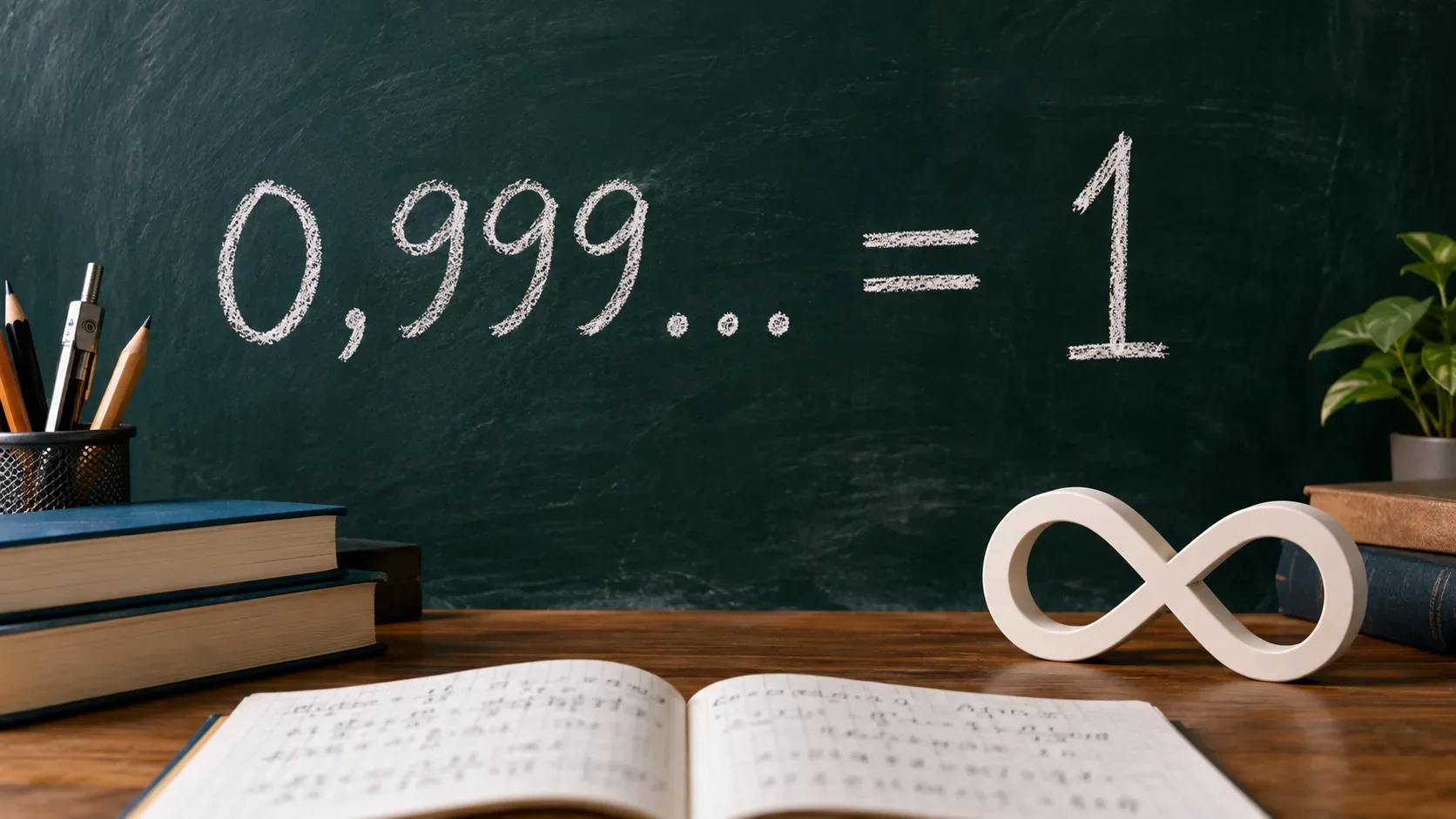
Yes: 0.999... is exactly equal to 1. It is not an approximation that remains “almost” 1. The confusion comes from mixing up two different ideas: the finite decimals 0.9, 0.99, 0.999, and so on, all of which are less than 1, and the infinite repeating decimal 0.999..., which represents the limit of that sequence. In the usual real-number system, that limit is 1.
The decisive point is the ellipsis. It does not mean “there are many 9s, but they eventually stop.” It means the pattern continues indefinitely. There is no last 9 hidden in some remote decimal place.
First: what does 0.999... mean?
An infinite decimal expansion is understood through the value approached by its finite approximations. In this case, consider:
- 0.9;
- 0.99;
- 0.999;
- 0.9999;
- and so on.
After n digits 9, the number can be written as 1 − 10−n. So the gap from 1 is 0.1 in the first term, 0.01 in the second, 0.001 in the third, and in general 10−n. That gap can be made smaller than any chosen positive real number. The limit of the approximations is 1, and that is the limit represented by the notation 0.999....
This distinction between the process of writing more digits and the value being represented is central. Research in mathematics education shows that resistance to the equality often persists precisely when the repeating decimal is interpreted as a very long finite decimal or as a process that never acquires a definite value.
Proof 1: the algebraic argument
Define:
x = 0.999...
Multiply by 10:
10x = 9.999...
Now subtract the first equality from the second:
10x − x = 9.999... − 0.999...
The infinitely repeating 9s in the decimal parts match term by term, so the difference is:
9x = 9
Therefore:
x = 1
Since x was defined as 0.999..., it follows that 0.999... = 1.
The argument is short, but one qualification matters: it works because 0.999... is already being treated as a well-defined real number. Multiplying and subtracting these expansions is legitimate under the standard interpretation of infinite decimals via limits. The proof does not rely on a “last 9”; on the contrary, it relies on there being no last 9.
Proof 2: using 1/3
We know that:
1/3 = 0.333...
Multiply both sides by 3:
3 × (1/3) = 3 × 0.333...
On the left, the result is 1. On the right, every repeating 3 becomes 9:
1 = 0.999...
This proof is intuitive because many people already accept without difficulty that 0.333... represents exactly 1/3. If 0.333... were merely an approximation to 1/3, then algebra with repeating decimals would no longer produce the exact fractions they represent.
Again, the fundamental idea is the same: an infinite decimal expansion is a representation of a number, not an unfinished attempt to write it.
Proof 3: geometric series and limit
The most explicit way to see what is happening is to rewrite the repeating decimal as an infinite sum:
0.999... = 9/10 + 9/100 + 9/1000 + 9/10000 + ...
This is a geometric series with first term 9/10 and ratio 1/10. For an infinite geometric series with |r| < 1, the sum is a/(1 − r). Therefore:
(9/10) / (1 − 1/10) = (9/10) / (9/10) = 1.
The same result appears by looking at the partial sums. With n digits 9:
sn = 1 − 10−n.
As n grows without bound, 10−n tends to zero. Thus:
lim sn = 1.
This third proof makes explicit what the first two use more compactly: the infinite decimal is defined by the limit of its finite truncations.
Where is the supposed “tiny remainder” before 1?
A common objection says: “If it starts with 0, something must still be missing before it reaches 1.” For 0.9, 0.1 is indeed missing. For 0.99, 0.01 is missing. For 0.999, 0.001 is missing. But in the infinite decimal there is no final stage at which a value such as 0.000...1 remains.
The notation “0.000...1” would require placing the digit 1 after infinitely many decimal places. In the usual decimal system, there is no decimal position “after all positions.” Every decimal place has a finite index: first, second, thousandth, millionth, and so on. There is no last position before that supposed 1.
If 0.999... were less than 1, the difference d = 1 − 0.999... would have to be a positive real number. But the truncations can come within 10−n of 1 for any n. Any proposed positive gap would eventually be larger than one of those remaining gaps, contradicting the idea that the complete infinite decimal is still separated from 1 by a positive interval.
“Tends to 1” does not mean “is different from 1”
One phrase causes a lot of confusion: “0.999... tends to 1.” More precisely, what tends to 1 is the sequence of truncations 0.9, 0.99, 0.999, .... Every finite term is less than 1. The notation 0.999..., however, denotes the limit of that sequence.
A limit does not have to differ from the values approaching it, and the fact that no finite term equals 1 does not prevent the limit from being 1. A simple example is the sequence 1/2, 3/4, 7/8, 15/16, ...: every term is less than 1, but the limit is still 1.
Can two different decimals represent the same number?
Yes. The equality 0.999... = 1 is a special case of a general property of decimal representation: every number with a terminating decimal expansion can also be written with an alternative expansion ending in infinitely many 9s.
- 0.5 = 0.4999...
- 0.25 = 0.24999...
- 2 = 1.999...
This does not mean there are two different numbers occupying the same point. It only means that the same quantity can have two decimal representations, just as 1/2, 2/4, and 50/100 are different notations for the same number.
The conceptual error: confusing infinity with “very large”
A string with a million, a billion, or any finite number of 9s is still less than 1. There will always be a final digit, and the difference will be positive. The symbol “...” changes the kind of object: it does not indicate an enormous number of digits, but repetition with no final term.
That is why asking “what is the last 9?” already starts from a false premise. There is no last 9. The repeating decimal does not end immediately before 1; it is a representation of 1 itself.
The three proofs at a glance
| Method | Core idea | What it clarifies |
|---|---|---|
| Algebra | Set x = 0.999..., multiply by 10, and subtract | Quickly shows that x = 1 |
| Fraction 1/3 | Use 1/3 = 0.333... and multiply by 3 | Connects repeating decimals to exact fractions |
| Series/limit | Sum 9/10 + 9/100 + ... or take the limit of the truncations | Formally explains why no “remainder” survives |
So what is the answer?
0.999... = 1 exactly. The notation does not represent a number “a tiny bit smaller” than 1. The numbers 0.9, 0.99, and 0.999 are finite approximations; 0.999... is the infinite expansion whose value, in the real-number system, is 1.
The best way to avoid the trap is to replace the question “when do the 9s reach 1?” with a better one: “what number is represented by this infinite expansion?” The three proofs give the same answer by different routes.
Sources and further reading
- Federal University of Sergipe — dissertation “O uso do conceito de séries para demonstrar a igualdade 0,999...=1”.
- Harvey Mudd College — Why Does 0.999… = 1?.
- The Mathematics Educator — Does 0.999... Really Equal 1?.
- ERIC — Prospective Teachers' Understanding of Decimals with Single Repeating Digits.