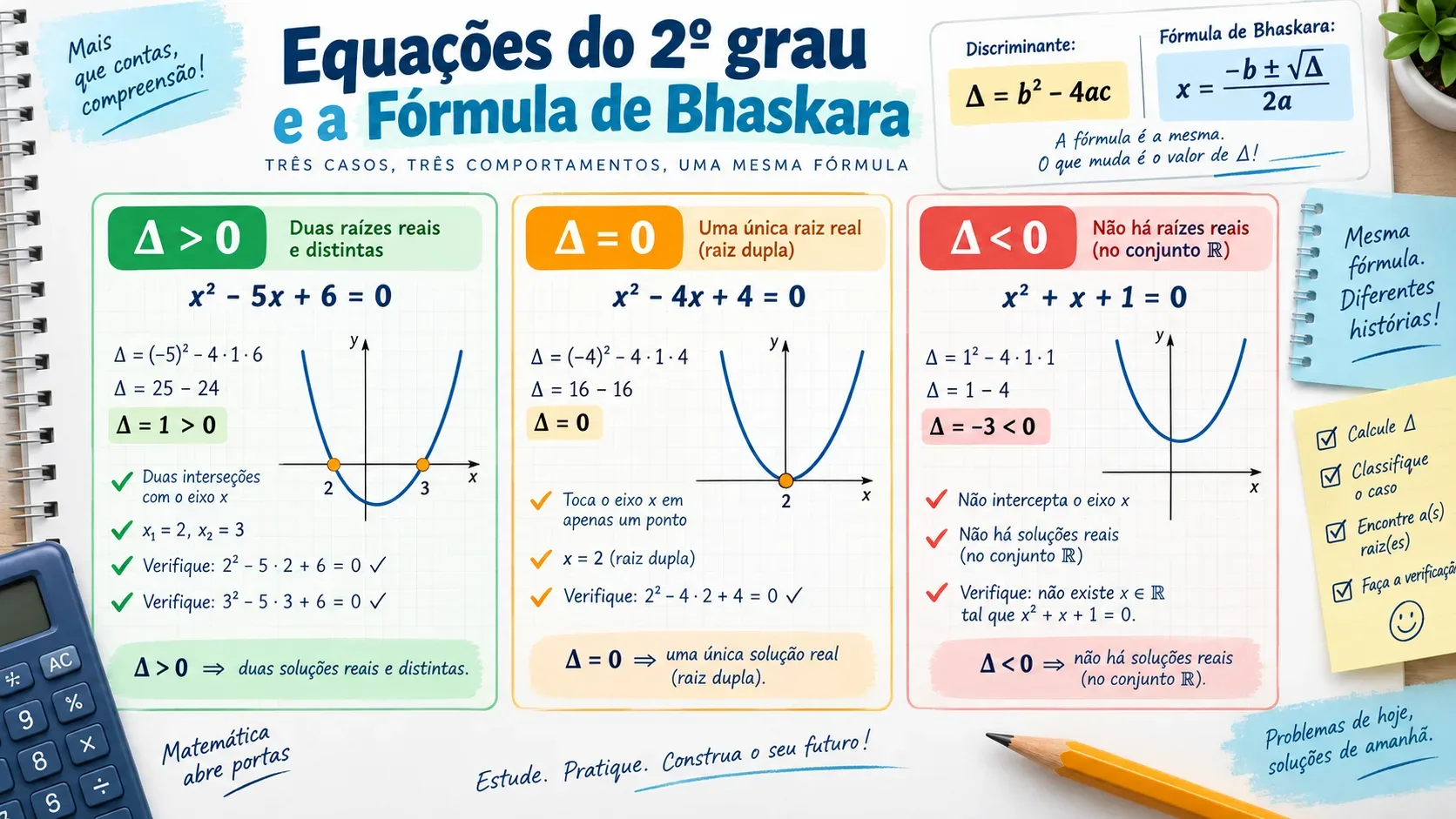
The sign of the discriminant determines the type of answer to a quadratic equation: if Δ > 0, there are two distinct real roots; if Δ = 0, there is one repeated real root; if Δ < 0, there are no real roots. The procedure is the same in all three cases: identify the coefficients, calculate the discriminant, and apply the quadratic formula when it yields roots in the number system being considered.
First, identify a, b, and c
Write the equation in the form ax2 + bx + c = 0, with a ≠ 0. The coefficient a multiplies x2, b multiplies x, and c is the constant term. A minus sign belongs to its coefficient: in x2 − 5x + 6 = 0, a = 1, b = −5, and c = 6. If a term is missing, its coefficient is zero. For example, in 2x2 − 8 = 0, b = 0.
Calculate Δ = b2 − 4ac. Then use x = (−b ± √Δ)/(2a), remembering that ± indicates the two signs, not multiplication. Putting negative coefficients in parentheses helps prevent mistakes.
How to interpret the discriminant
| Discriminant | Real solutions | Parabola on the graph |
|---|---|---|
| Δ > 0 | Two distinct roots | Crosses the x-axis at two points |
| Δ = 0 | One repeated root | Touches the x-axis at one point |
| Δ < 0 | No real roots | Does not cross the x-axis |
The table assumes real coefficients and real solutions. A negative discriminant does not mean that the equation is wrong or that the answer is x = 0: it means there is no solution in ℝ. When the number system is extended to complex numbers, the equation has two complex conjugate roots.
Example 1: positive discriminant and two roots
Solve x2 − 5x + 6 = 0.
- Coefficients: a = 1, b = −5, c = 6.
- Discriminant: Δ = (−5)2 − 4 × 1 × 6 = 25 − 24 = 1.
- Quadratic formula: x = (5 ± √1)/2 = (5 ± 1)/2.
- Roots: x1 = 3 and x2 = 2.
Check: for x = 3, 32 − 5 × 3 + 6 = 9 − 15 + 6 = 0. For x = 2, 22 − 5 × 2 + 6 = 4 − 10 + 6 = 0. Both substitutions give zero, as the equation requires. On the graph, the parabola crosses the x-axis at 2 and 3.
Example 2: zero discriminant and a repeated root
Solve x2 − 4x + 4 = 0.
- Coefficients: a = 1, b = −4, c = 4.
- Discriminant: Δ = (−4)2 − 4 × 1 × 4 = 16 − 16 = 0.
- Quadratic formula: x = (4 ± √0)/2 = 4/2 = 2.
The plus and minus signs produce the same result because √0 = 0. Thus x = 2 is a repeated root, not two distinct roots. Check by substitution: 22 − 4 × 2 + 4 = 4 − 8 + 4 = 0. You can also check by factoring: (x − 2)2 = 0. The parabola touches the x-axis at x = 2.
Example 3: negative discriminant and no real roots
Solve x2 + x + 1 = 0 over the real numbers.
- Coefficients: a = 1, b = 1, c = 1.
- Discriminant: Δ = 12 − 4 × 1 × 1 = 1 − 4 = −3.
- The formula would involve √(−3), which is not a real number. Therefore, there are no real solutions.
Check without guessing an x-value: x2 + x + 1 = (x + 1/2)2 + 3/4. For any real x, the square is nonnegative; adding 3/4 makes the result strictly positive. Thus the expression can never equal zero, and its graph never meets the x-axis. If the exercise asks for complex solutions, they are x = (−1 ± i√3)/2, with i2 = −1; this does not change the absence of real roots.
How to check without mixing up the three cases
- Move all terms so that the right-hand side is zero, and confirm that a ≠ 0.
- Write down a, b, and c with their signs. Calculate b2 first, then 4ac.
- Classify Δ before taking the square root. If Δ < 0, record that there are no real solutions when the domain is ℝ.
- When real roots exist, substitute each into the original equation. The result must be zero; otherwise, review the arithmetic and signs.
An additional check is to compare the roots with the graph: two intersections, one point of contact, or no intersection with the x-axis, depending on the sign of Δ. The graph illustrates the calculation but does not replace an algebraic check.
Common mistakes and quick practice
- Forgetting parentheses in (−5)2: the square of −5 is 25, not −25.
- Replacing −b with b: when b = −4, the numerator starts with 4.
- Thinking Δ = 0 means x = 0: the root is −b/(2a), which equals 2 in the second example.
- Treating Δ < 0 as one negative root: in this case there are no real roots.
Test your understanding: (1) 2x2 − 3x + 1 = 0; (2) x2 + 6x + 9 = 0; (3) x2 − 2x + 5 = 0. Their discriminants are 1, 0, and −16, respectively. The real-number answers are x = 1 and x = 1/2; x = −3 (repeated root); and no real roots. Check the first two by substituting the roots into the equations.
For a deeper explanation of the quadratic formula, the discriminant, and additional exercises, see OpenStax's open-access material on quadratic equations.