The rule “to divide by a fraction, multiply by its reciprocal” can look like a trick with no explanation. But it is not an arbitrary shortcut: it describes exactly what division is asking. There are at least three useful ways to see it — how many groups fit, undoing a scale factor, and algebra — and they all lead to the same result.
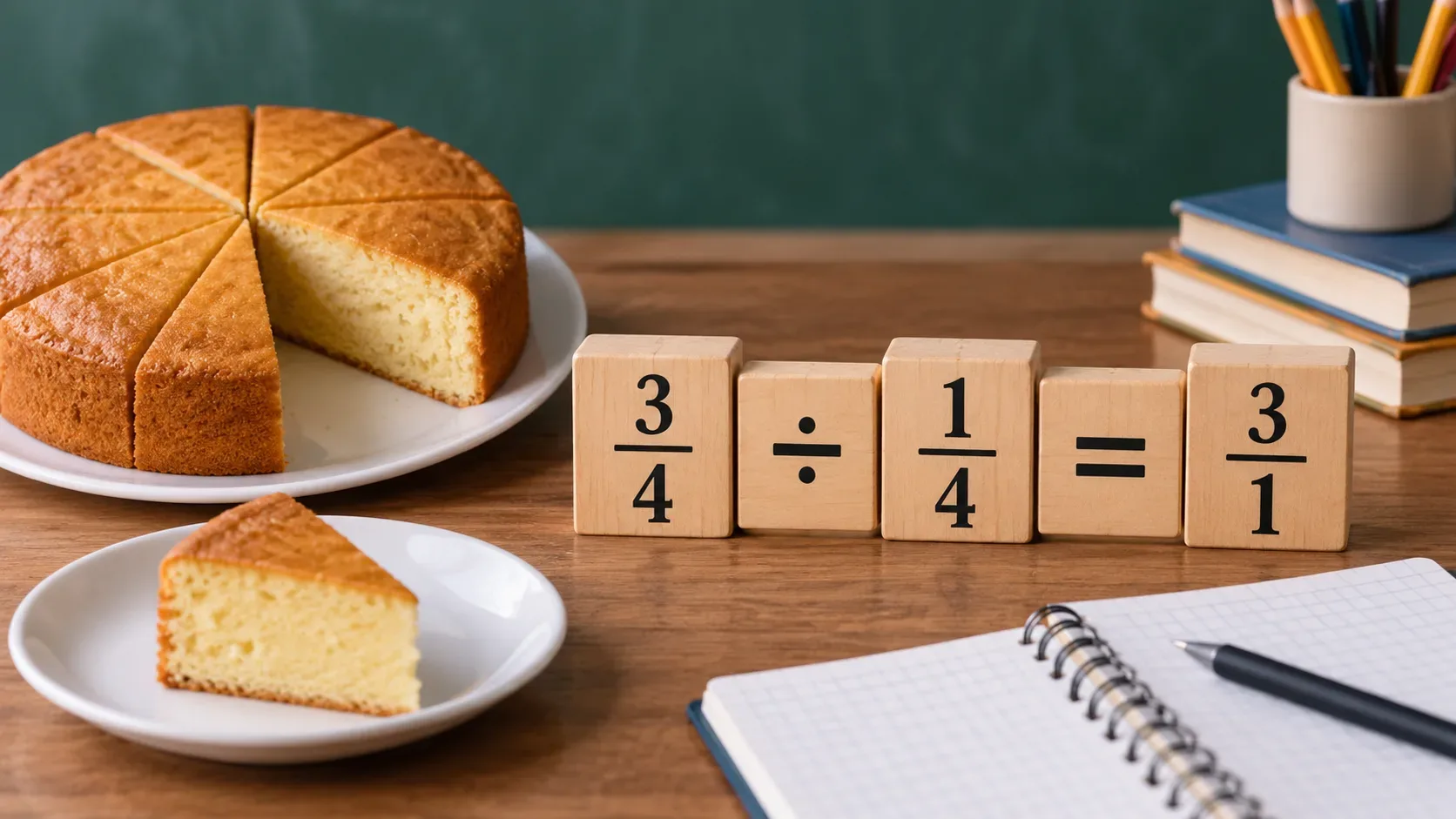
We will use the same example throughout: 3/4 ÷ 1/4. The answer is 3. The goal is to understand why.
1. How many 1/4-sized portions fit into 3/4?
One basic interpretation of division is: how many times does the divisor fit into the dividend? In 12 ÷ 3, we ask how many groups of 3 fit into 12. The same reasoning works with fractions.
In 3/4 ÷ 1/4, the question is: how many pieces of size 1/4 fit into an amount of 3/4? Three pieces fit: 1/4 + 1/4 + 1/4 = 3/4. Therefore, 3/4 ÷ 1/4 = 3.
This view also corrects a common intuition that “division always makes numbers smaller.” That is only true when dividing a positive number by a number greater than 1. When the divisor is between 0 and 1, we are asking how many small groups fit into the original amount, so the result can be larger.
2. Dividing by 1/4 undoes a scale factor of 1/4
Multiplying by 1/4 reduces an amount to one fourth of its size. If someone took a number and multiplied it by 1/4, what operation would undo that change? Multiplying by 4.
That works because 1/4 × 4 = 1. The number 4 is the multiplicative inverse, or reciprocal, of 1/4. So dividing by 1/4 has the same effect as multiplying by 4:
3/4 ÷ 1/4 = 3/4 × 4 = 3.
More generally, dividing by a fraction c/d means undoing multiplication by c/d. The number that undoes that multiplication is d/c, because (c/d) × (d/c) = 1, as long as c and d are nonzero.
3. Algebra shows where the rule comes from
We can turn the previous idea into a short derivation. Consider two fractions:
(a/b) ÷ (c/d), with b ≠ 0, d ≠ 0, and c ≠ 0.
Dividing by c/d means finding a number x that satisfies:
x × (c/d) = a/b.
To isolate x, multiply both sides by the reciprocal d/c:
x × (c/d) × (d/c) = (a/b) × (d/c).
Because (c/d) × (d/c) = 1, this becomes:
x = (a/b) × (d/c).
Therefore, (a/b) ÷ (c/d) = (a/b) × (d/c). The instruction to “invert and multiply” is simply a compact form of this equality.
Why is only the divisor inverted?
Because the divisor is the quantity we need to neutralize. In a division A ÷ B, we are looking for the number that, when multiplied by B, gives A. To cancel B, we use its multiplicative inverse. The dividend A does not need to be canceled; it is the quantity we want to preserve in the equation.
In the example, we want a number x such that x × 1/4 = 3/4. Multiplying both sides by 4 removes the 1/4 on the left and leaves x = 3.
The size of the divisor helps predict the answer
| Type of divisor | Example | What to expect |
|---|---|---|
| Greater than 1 | 3/4 ÷ 2 | The result is smaller: 3/8. |
| Equal to 1 | 3/4 ÷ 1 | The amount does not change: 3/4. |
| Between 0 and 1 | 3/4 ÷ 1/4 | The result is larger: 3. |
This prediction does not replace calculation, but it is a useful reasonableness check. If you divide a positive number by 1/4 and get something smaller than the original, it is worth checking the work.
A mental routine that avoids blind memorization
- Read division as a question: how many groups the size of the divisor fit into the dividend?
- Think about the inverse operation: what number must multiply the divisor to make 1?
- Use the reciprocal: for c/d, that number is d/c.
- Multiply: keep the first fraction and multiply by the reciprocal of the second.
- Check the size: if the positive divisor is less than 1, the quotient should be larger than the dividend.
Common mistakes and how to catch them
- Inverting both fractions: that is unnecessary. Only the divisor is replaced by its reciprocal.
- Inverting the first fraction: that changes the problem because it no longer preserves the original quantity.
- Assuming division always makes a number smaller: dividing by a positive fraction less than 1 can increase the result.
- Dividing by zero: it is undefined. If the divisor fraction equals 0, there is no multiplicative inverse.
- Using the rule without estimating: a quick prediction of the answer’s size can reveal calculation errors.
The three views describe the same idea
For 3/4 ÷ 1/4, the grouping view counts three quarter-sized portions; the scaling view undoes the factor 1/4 by multiplying by 4; and algebra cancels the divisor with its reciprocal. They are three languages for the same mathematical relationship.
So “multiply by the reciprocal” does not have to be memorized as a trick. It works because the reciprocal turns the divisor into 1, and dividing by a quantity means finding how many times that quantity fits into what we have.