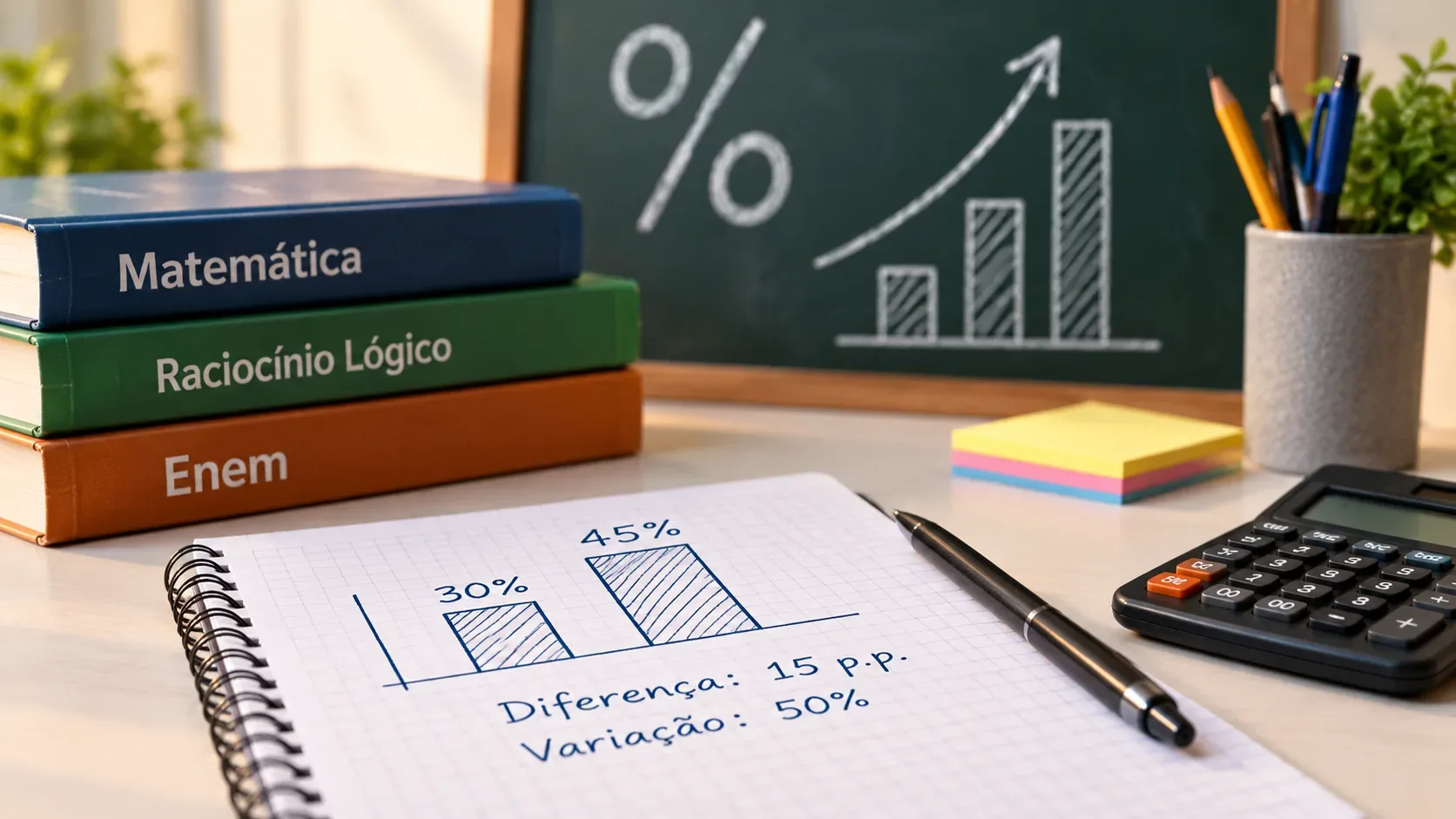
When a rate rises from 30% to 45%, two different answers can both be correct: it increased by 15 percentage points and, at the same time, had a 50% percent change. The difference depends on what the question is measuring. In Enem questions and in texts that use rates, this detail changes the operation and can change the correct answer choice.
The rule in one line
Percentage points measure the direct difference between two percentages. Percent change compares that difference with the initial value.
| What the question asks | Operation | Example: from 30% to 45% |
|---|---|---|
| Difference in percentage points | final rate − initial rate | 45% − 30% = 15 p.p. |
| Percent change | (final rate − initial rate) ÷ initial rate × 100% | 15 ÷ 30 × 100% = 50% |
The Brazilian Senate Communication Manual makes the same distinction: if a rate moves from 5% to 10%, the increase is 5 percentage points but 100% in relative terms, because the rate doubled.
Full example: a rate rises from 30% to 45%
First identify the two values: an initial rate of 30% and a final rate of 45%.
- In percentage points: 45 − 30 = 15. Therefore, the rate rose by 15 p.p.
- As a percentage: the difference of 15 is compared with the initial base, which was 30. So 15 ÷ 30 = 0.5; multiplying by 100%, the change is 50%.
There is no contradiction between the two answers. They answer different questions. “How many points?” looks at the distance between rates. “How many percent?” asks how large that distance is relative to the starting point.
The two formulas that solve most questions
If the initial rate is I and the final rate is F:
- Difference in percentage points: F − I.
- Percent change: (F − I) ÷ I × 100%.
The sign matters as well. A positive result indicates an increase; a negative result indicates a decrease. In percent change, the initial rate is the comparison base. That is why reversing the order changes the result.
There is one important exception: if the initial rate is 0%, the relative percent-change formula requires division by zero and therefore does not produce a finite percent change. The percentage-point difference is still defined. From 0% to 5%, for example, the change is +5 p.p.; under the usual formula, it is not correct to report a finite relative percent increase.
Common traps
“Up 20%” is not the same as “up 20 percentage points”
Imagine a rate of 40%. If it rises by 20%, the increase is 20% of 40%, or 8 percentage points. The new rate is 48%.
If it rises by 20 percentage points, the new rate is 60%. One case multiplies by the base; the other adds directly to the percentage.
A decrease is not the percentage mirror image of an increase
From 30% to 45%, the relative increase is 50%. But from 45% to 30%, the relative decrease is 15 ÷ 45 = about 33.3%. In both directions, the absolute difference is 15 p.p., but the base used for percent change is different.
Small rates can produce large relative changes
If a rate goes from 2% to 3%, the increase is only 1 percentage point, but the relative change is 50%, because 1 is half of the initial rate of 2. This combination often appears in news reports, surveys and indicators and can be misread when the base is ignored.
“10% on a 30% rate” also requires attention to the base
A 10% increase on 30% equals 3 percentage points, because 10% of 30 is 3. The rate becomes 33%. You should not automatically add 10 percentage points unless the question explicitly says “10 percentage points.”
How to recognize what the question wants
- If it says “how many percentage points”, subtract the two rates.
- If it asks “by what percent did it increase/decrease”, calculate the relative change using the initial rate as the base.
- If the text says “increased by 20%” or “decreased by 20%”, apply that percentage to the starting value: multiply by 1.20 for a 20% increase or by 0.80 for a 20% decrease.
- If it only gives “from A% to B%,” do not assume the requested unit: read the final question to see whether the answer should be in percentage points or relative percent.
- Check the unit in the answer choice. “15%” and “15 p.p.” are not two ways to write the same thing.
Why this fits the Enem
The Enem Reference Matrix includes percentages, ratios and proportions among the numerical knowledge areas in Mathematics and its Technologies. The exam is not only about carrying out an isolated calculation: it is about interpreting a situation, choosing the appropriate relationship between quantities and evaluating what the result means.
That is why a question may present a rate in a graph, table or text and ask for a comparison. The decisive point is identifying the base. Subtraction answers the distance between rates; division by the initial rate answers the relative change.
A quick method to solve without memorizing
- Mark the initial rate and the final rate.
- Circle the requested unit: percentage points or percent.
- First calculate the difference: final − initial.
- If the question asks for percent change, divide that difference by the initial rate and multiply by 100%.
- Check the direction: an increase should be positive; a decrease, negative.
- Run a plausibility check: if the rate doubled, the relative change should be 100%; if it was cut in half, the change should be −50%.
What to remember for the test
Use percentage points when directly comparing two rates. Use percent change when you want to know how large the change is relative to the initial rate. Thus, from 30% to 45% is +15 p.p. and +50%; from 45% to 30% is −15 p.p. and approximately −33.3%. The wording of the question and the comparison base determine which answer is correct.