
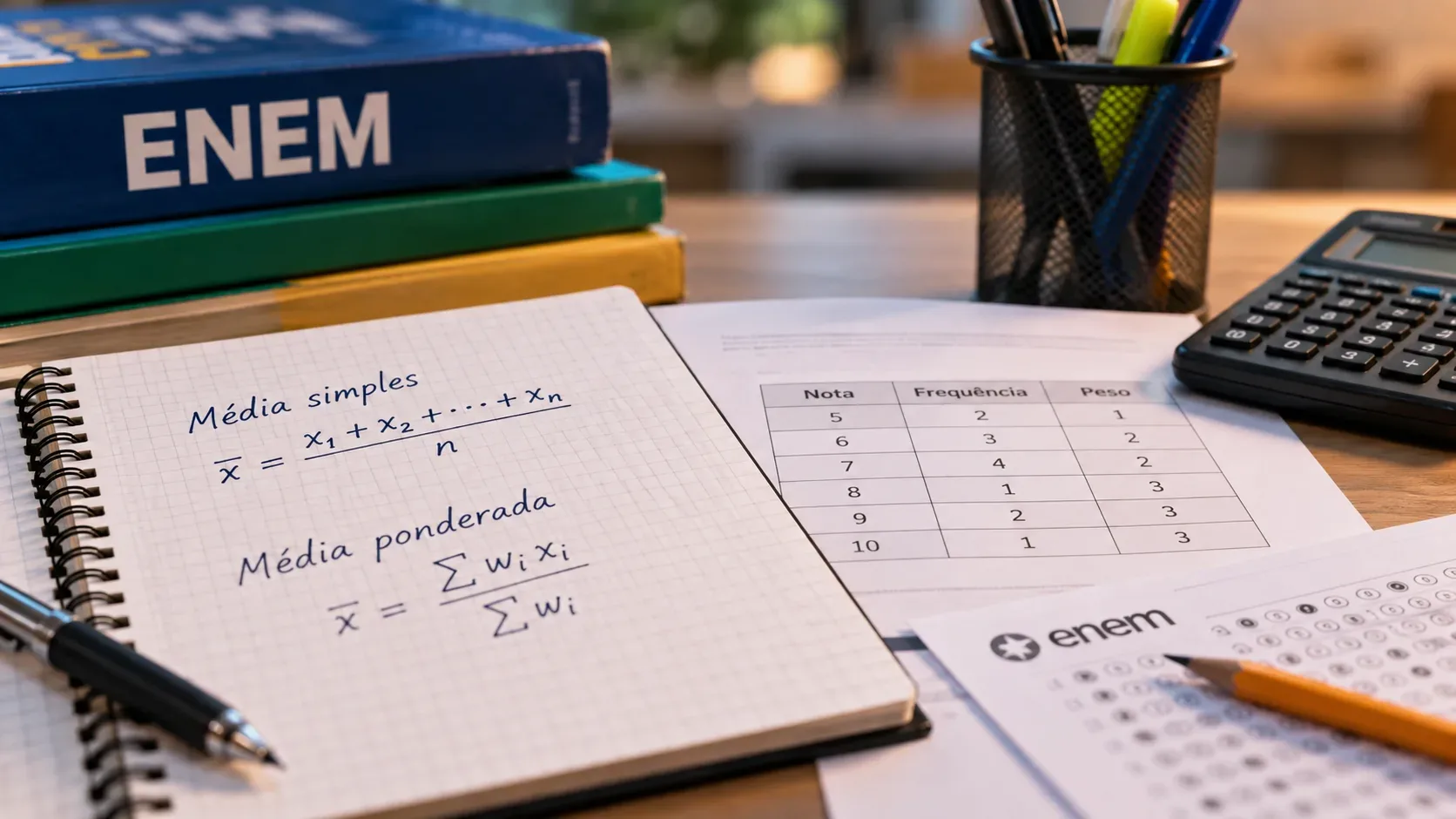
The safest way to choose between a simple mean and a weighted average is not to start with the formula. First, determine what each number represents. If every value corresponds to one observation with the same importance, a simple mean is usually enough. If a value appears several times, represents a larger group, or has a different level of importance, there is a weight — explicit or hidden — and the structure is a weighted average.
IBGE Educa defines the simple arithmetic mean as the sum of the values divided by the number of observations and explains that a weighted mean is used when some values have greater importance, indicated by a weight. In exam questions, the hardest part is often not the calculation but recognizing which quantity acts as the weight.
The essential difference: what counts once and what counts several times
In a simple mean, each observation participates once and with the same importance. For the values 6, 7, and 8, for example, the mean is (6 + 7 + 8) ÷ 3 = 7.
In a weighted average, each value is multiplied by a quantity that tells you how much it should contribute to the result. That quantity may appear as a weight, frequency, number of people, number of units, percentage, or another measure of participation. The general rule is:
weighted average = sum of (value × weight) ÷ sum of the weights.
If all weights are equal, the weighted average reduces to the simple mean. So the key question is whether the contributions are equal or different.
A 3-question flow to choose the mean before calculating
1. Does each number in the table represent a single observation?
If yes, and no value has priority over the others, think first of a simple mean. But if a row summarizes several observations, the quantity represented by that row must enter the calculation.
Example: a table shows score 5 with frequency 2, score 6 with frequency 3, and score 8 with frequency 5. The three scores do not represent three students; they represent ten students. Frequency is the weight:
(5 × 2 + 6 × 3 + 8 × 5) ÷ (2 + 3 + 5) = 68 ÷ 10 = 6.8.
Calculating (5 + 6 + 8) ÷ 3 = 6.33 ignores the fact that score 8 occurred five times and score 5 only twice.
2. Does the question assign different levels of importance?
Look for expressions such as “weight 2,” “worth 30%,” “twice as important,” “counts for 40%,” or “coefficient.” They directly indicate weighting.
If an assignment has weight 2, a test has weight 3, and the final exam has weight 5, with scores of 8, 7, and 9 respectively, the correct calculation is:
(8 × 2 + 7 × 3 + 9 × 5) ÷ (2 + 3 + 5) = 82 ÷ 10 = 8.2.
Weights do not need to add up to 10 or 100. What matters is using the same scale in the numerator and denominator. Weights 2, 3, and 5, for example, could be converted to 20%, 30%, and 50% without changing the result.
3. Are you combining averages from groups of different sizes?
This is one of the most hidden forms of weighting. If a class of 20 students has an average of 7 and another class of 30 students has an average of 8, the combined average is not simply (7 + 8) ÷ 2 = 7.5. The groups have different sizes, so the number of students acts as the weight:
(7 × 20 + 8 × 30) ÷ (20 + 30) = 380 ÷ 50 = 7.6.
An “average of averages” can only be taken directly when the groups have the same size or when the averages are explicitly meant to have equal importance.
Where the weight is often hidden in a table
| Situation | Clue in the wording or table | What acts as the weight |
|---|---|---|
| Values with frequency | A “frequency,” “number of occurrences,” or repetition column | The frequency of each value |
| Group averages | Each row summarizes a class, region, or category | The size of each group |
| Scores with different importance | “Weight,” “coefficient,” “worth x%” | The weight or percentage |
| Aggregated prices or rates | Values paired with quantities sold, people, or units | The quantity associated with each value |
A useful mental question is: “how many times, or with how much importance, does this value enter the dataset?” The answer usually reveals the weight.
Four common wording traps
1. Dividing by the number of rows in the table
A table with three rows may represent 3, 30, or 3,000 observations. The denominator of a weighted average is the sum of the weights, not the number of rows.
2. Treating frequency as another observed value
If the score is 8 and the frequency is 5, you do not average 8 and 5. The frequency means that the value 8 should count five times: 8 × 5.
3. Taking a simple average of averages without checking group size
Two averages automatically receive the same weight only if their groups have the same size or the problem assigns equal importance. Otherwise, each average must be weighted by the number of observations it summarizes.
4. Confusing a percentage with an observed value
When percentages express participation — for example 20%, 30%, and 50% — they are weights. If they add up to 100%, you can multiply each value by the percentage in decimal form and add the results. If the weights do not add up to 100, use the general formula and divide by their sum.
How to recognize the structure in Enem questions
The Enem Reference Matrix organizes the Mathematics assessment into competencies, skills, and knowledge objects used to build the exam. In a question involving tables, scores, frequencies, or groups, it helps to follow a disciplined reading process: identify the quantities, understand what each row represents, and only then choose the operation.
The three-question flow in this article is a problem-solving strategy, not an official Inep rule. Its purpose is to prevent a common mistake: automatically applying a simple mean just because the word “average” appears in the question.
Quick checklist before calculating
- Is there a frequency? It is usually the weight.
- Are there groups of different sizes? Group size is usually the weight.
- Are there weights, coefficients, or percentages? Use them in the weighting.
- Do all values have the same importance? A simple mean may be enough.
- Does your denominator represent the total number of observations or the sum of the weights? If not, review the structure.
In short, the difference between a simple mean and a weighted average is less about memorizing two formulas and more about modeling the information correctly. Before calculating, determine what counts once, what counts several times, and which quantity measures that participation.