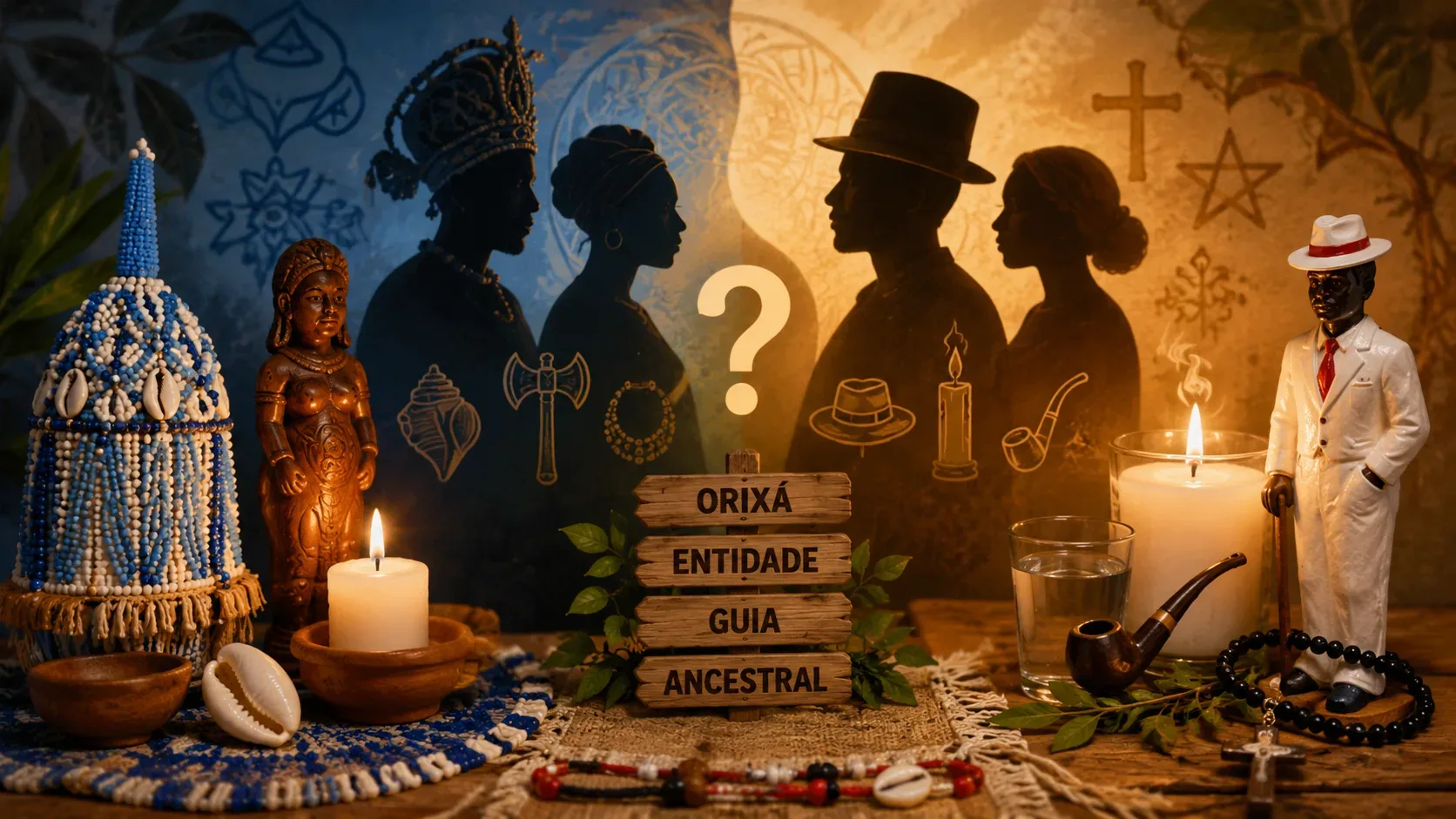
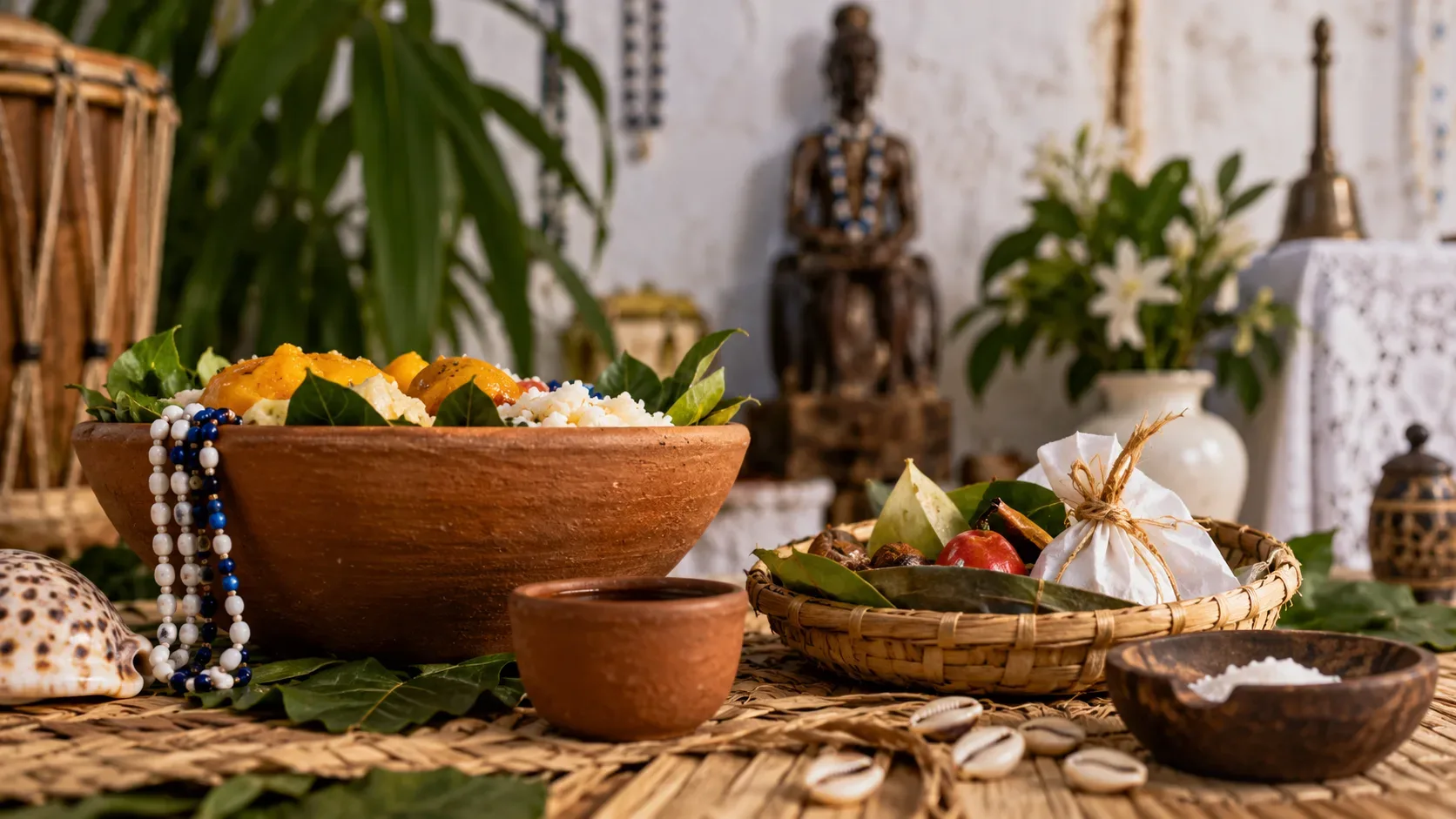
Ebó, offering, and despacho can overlap in some ways of speaking, but they are not a set of universal synonyms. The safest way to understand the terms is to treat them as layers: offering can work as a broad category for a ritual gift or delivery; ebó is a Yoruba-derived term used in specific contexts, especially in Candomblé and related traditions; and despacho can name different practices, moments, or forms of ritual forwarding depending on the tradition, temple community, and situation.
This distinction matters because web searches and dictionaries often bring the words so close together that they appear interchangeable. Ethnography, however, shows that meanings depend on who is speaking, which tradition is involved, and the ritual function of the action. A useful definition therefore needs to preserve the internal diversity of Afro-Brazilian religions rather than impose a single chart.
The short answer: think of overlapping categories, not synonyms
| Term | Possible broad use | Main caution |
|---|---|---|
| Offering | A general word for something given in a religious context. | It is too broad to automatically replace the ritual names used by each community. |
| Ebó | A Yoruba-matrix ritual category associated with exchange, care, balance, and transformation in different Candomblé contexts. | There is no single formula for ebó, and the term does not have exactly the same scope in every temple community. |
| Despacho | It may designate a ritual delivery, a propitiatory rite, or the act of forwarding certain materials, especially in Umbanda traditions and in historical uses across the Afro-Brazilian religious field. | Its meaning varies widely; in popular usage, the word has also accumulated stereotypes that do not adequately describe religious practice. |
Offering: the broadest category
Offering is the broadest of the three terms. In ordinary language and in academic texts, it can describe the giving of food, objects, or other symbolic goods within a relationship to deities, spirits, or sacred forces. Precisely because it is broad, it works well as a descriptive term when the more precise ritual name is not yet known.
But there is a difference between saying that a rite involves an offering and claiming that the rite is simply called “an offering.” A single tradition may distinguish several acts of giving according to purpose, recipient, liturgical moment, or ritual foundation. “Offering” can therefore explain the family of practices, but it may erase important distinctions if used as an automatic translation for every local term.
Ebó: more than “an offering” in the generic sense
Brazilian lexicography records ebó as a word of Yoruba origin, ẹbọ. In Candomblé studies, however, the term has a density that does not fit into a short dictionary definition. Luciana da Conceição Nascimento Novaes, in her analysis of what she calls the “technology of ebó,” describes the practice through the interaction of bodies, organic materials, temporalities, and relationships with Afronature. This approach makes clear that reducing ebó to an object deposited somewhere misses the processual dimension of the rite.
In other words, an ebó may include an offering, but the concept is not exhausted by the item that is offered. The emphasis may lie in the ritual operation as a whole: in the relationships it mobilizes, care, transformation, and the rearrangement of a situation. The precise scope of the term depends on the tradition and on the ritual foundations of the temple community, which is why isolated examples should not be turned into universal recipes.
For an academic introduction to this perspective, see “A tecnologia do ebó”, published in Revista de Arqueologia.
Despacho: a term that depends especially on context
Despacho is probably the word that requires the most context. In literature on Umbanda, it can appear in connection with propitiatory rites directed to Exu. In a classic study of Umbanda liturgy, Ordep Serra describes the so-called “opening despacho” and notes that in temples crossed with Candomblé, the same moment may receive names such as padê or padê de Exu. This shows that equivalence between words depends on the ritual system in which they are being used.
In other ethnographic records, “despacho” may emphasize the act of forwarding, removing, or placing ritual materials after a given stage. Popular usage also tends to call almost any religious composition found at crossroads, forests, rivers, or other public spaces a “despacho.” That social generalization should not be mistaken for a taxonomy accepted by every temple community.
The study “No caminho de Aruanda” is useful for seeing how the term appears within a concrete description of an Umbanda rite, without assuming that the same terminology applies to every tradition.
Why do dictionaries make everything look the same?
Dictionaries record usages that circulate in a language; they are not internal manuals for a religion. They may therefore bring “ebó,” “despacho,” “spell,” “padê,” and “offering” close together on the basis of historical, popular, or outsider usage.
A lexical study from the Federal University of Bahia shows exactly this problem by comparing religious vocabulary across different reference works. In the case of despacho, definitions appear that bring it close to padê, ebó, and actions directed to Exu. The existence of those entries documents the history of the word in Brazilian Portuguese, but it does not prove that practitioners from different traditions use all of those terms as equivalents.
For anyone researching religious vocabulary, the practical rule is simple: a dictionary helps show how a word circulates; ethnography and practitioners’ speech help show what it means in that ritual context. The UFBA study can be read in “Religiões e crenças na Bahia: aspectos do léxico espelhados nos dados do Projeto ALiB”.
Candomblé and Umbanda do not form a single ritual system
Speaking of “Afro-Brazilian religions” is useful for grouping traditions that share histories, matrices, and exchanges, but it does not mean there is a single doctrine. Candomblé and Umbanda have their own trajectories, ritual organizations, and vocabularies; within each one, there are also variations by nation, lineage, region, temple community, and generation.
This diversity explains why one temple may use a word in a way another temple does not recognize, or may prefer a different term for a similar function. Historical studies on the formation of Umbanda also show processes of legitimation, differentiation, and recomposition of practices within Brazil’s religious field. One example is “De macumba a umbanda: o processo de legitimação da religião dita genuinamente brasileira”.
A crossroads does not automatically turn an offering into a “despacho”
The popular association between “despacho” and crossroads is historically strong. Reginaldo Prandi notes that, with the expansion of Umbanda, the “despacho to Exu” became a familiar image in large cities and was often linked to crossroads. This helps explain why common usage began to apply the same word to many ritual objects seen in public space.
But location alone does not determine the ritual name. The same kind of place can have different meanings depending on the tradition, recipient, liturgical moment, and ritual foundation of the action. The more precise approach is to describe what is actually known — for example, “an offering placed in public space” — and use “ebó” or “despacho” only when the religious context supports that name.
Prandi’s article on the social history of Afro-Brazilian religions is available in Horizontes Antropológicos.
The burden of prejudice on the word “despacho”
Alongside ritual variation, there is a historical problem of language. Afro-Brazilian practices were described for a long time by authorities, the press, and part of intellectual production through a vocabulary of criminalization, superstition, and danger. This helped load words such as “macumba” and “despacho” with pejorative meanings that do not necessarily match how practitioners understand their rites.
Statements that treat any offering as “something evil,” a harmful spell, or a threat are therefore not merely imprecise: they repeat a long history of stigmatization of African-derived religions. This trajectory of persecution is discussed in “Chuta que é macumba: o percurso histórico-legal da perseguição às religiões afro-brasileiras”, published in Sankofa.
How to use the three terms more precisely
- Use “offering” as a broad term when you know there is a religious gift or delivery but do not know the specific ritual name.
- Use “ebó” when the tradition or source itself names the practice that way, without assuming every offering is an ebó.
- Use “despacho” with context: when possible, say which tradition, rite, or sense the word refers to.
- Do not infer the name from location alone. Crossroads, forests, rivers, or beaches do not function as automatic labels for a rite.
- Give priority to the vocabulary of the community being described. In religious topics, the community’s own term often carries distinctions that a generic translation loses.
In summary
“Offering” is the broadest category; “ebó” is a Yoruba-matrix ritual term with a more specific and contextual meaning; and “despacho” can name different practices or acts and has also been generalized in popular usage. The three words may touch in certain contexts, but treating them as fixed synonyms erases differences between traditions and between temple communities.
To determine which term is correct in a concrete case, the decisive question is not only “what was placed there?” but who names the practice, in which tradition, for what function, and at what ritual moment. That shift in the question replaces a universal chart with a reading that is more faithful to the diversity of Afro-Brazilian religions.