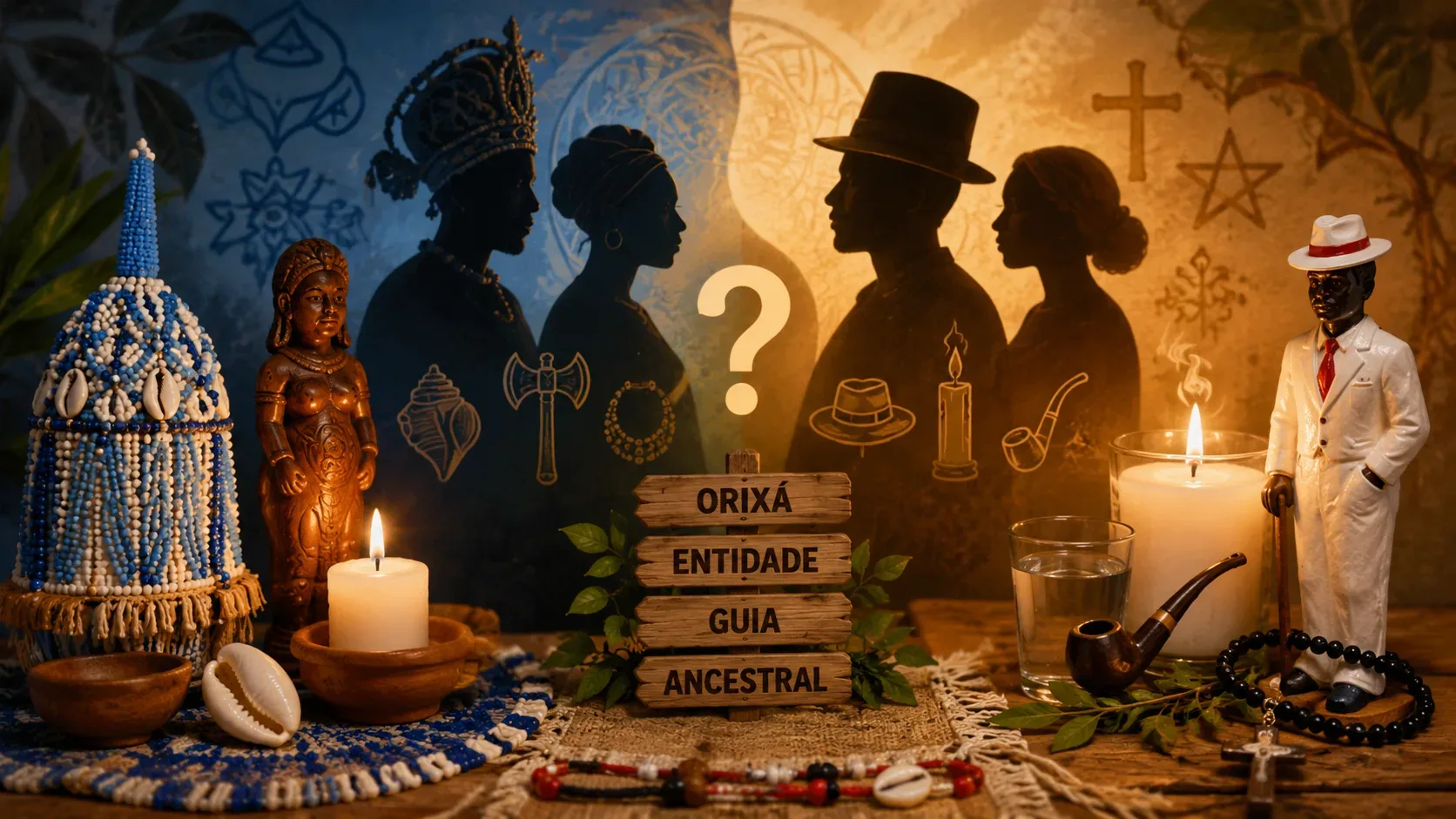
Short answer: no. Orixá, entity, guide and ancestor may appear close to one another in the vocabulary of Afro-Brazilian religions, but they are not a set of synonyms. In broad terms, orixá names a divinity; entity and spiritual guide are terms widely used in Umbanda for spirits that perform religious work; and ancestor is a broader category connected with the dead, memory, the continuity of a lineage or community and, in some settings, specific forms of ancestral worship. The exact meaning depends on the tradition, nation, lineage and individual house.
This caution is not merely about wording. An Iphan publication on terreiro communities in the Pampa explicitly distinguishes “divinities — Orixás” from “Umbanda entities,” described as messengers, protectors or spiritual guides, including pretos-velhos, caboclos and ciganos. Another Iphan mapping states that Umbanda worships “entities (or spiritual guides),” while Candomblé traditions may organize their pantheons with different vocabularies, such as orixás, inquices or voduns. The safest way to speak, therefore, is to identify which tradition and which house are being discussed first.
Quick comparison: what each term usually means
| Term | In Candomblé | In Umbanda | What to watch for |
|---|---|---|---|
| Orixá | A category of divinity especially in Nagô/Yoruba vocabulary, strongly associated with Ketu and related traditions. Other nations may use names such as inquice or vodun for their divinities. | Orixás may also hold a central place, but the way they are understood and the way lines, forces and worship are organized vary across currents. | Do not reduce an orixá to the “spirit of a dead person,” and do not assume that every terreiro uses exactly the same pantheon or terminology. |
| Entity | It is not a universal substitute for “orixá.” It can appear in broad usage or specific contexts, including houses with mixed practices and caboclo worship, but usage depends on the tradition. | A common term for spirits working through lines or falanges, such as caboclos, pretos-velhos and, in many houses, exus, pombagiras, boiadeiros, marinheiros, baianos and others. | “Entity” is a broad category. A house may prefer proper names, line names or other classifications. |
| Guide | It should not automatically be treated as a synonym for orixá. In some contexts, “guia” can also mean a ritual bead necklace. | “Spiritual guide” is often another way to refer to an entity that counsels or works with a medium. “Guia” can also name a ritual necklace, depending on context. | Check whether the speaker means a spirit/entity or a liturgical object. |
| Ancestor | Ancestry is fundamental, but ancestor and orixá are not interchangeable categories. There are specific traditions and rites related to the dead and ancestors, including terms such as egum/egungun in Yoruba-related contexts. | Many entities are understood as ancestral spirits or linked to forms of ancestry, but that does not make “ancestor” an automatic synonym for every entity. | The word may refer to a family forebear, a collective ancestor, a ritually recognized deceased person or a broader idea of continuity and memory. |
Orixá: a divinity is not the same as a “disembodied spirit”
In Nagô/Yoruba Candomblé usage, orixá is a category of divinity. A SciELO study on mortuary rites in Candomblé summarizes an important distinction: orixás are connected with the structure of nature and the cosmos, while ancestors are connected with human history and social structure. That distinction helps avoid the simplistic claim that “an orixá is just a dead ancestor.”
This does not mean that ancestry and divinity never intersect in historical, theological or anthropological narratives. Some traditions and interpretations describe certain orixás as divinized ancestors. The safer editorial point is different: in Brazilian ritual vocabulary, “orixá” functions as its own category of divinity and should not automatically be replaced by “ancestor.”
It is also important not to turn “Candomblé” into a single block. Iphan inventories document Ketu, Angola and Jeje houses, among other identities. The divinities themselves may receive different names: in Angola Candomblé, for example, the term inquice is used; in Jeje traditions, vodun. Correspondences between pantheons exist in particular settings, but they do not justify erasing each tradition’s names and ritual foundations.
Entity and guide: why these terms appear so often in Umbanda
In Umbanda, “entity” is a recurring term for spirits that manifest or perform religious work through lines, falanges and distinct forms of activity. The Iphan material cited in the brief describes Umbanda entities as messengers, protectors or spiritual guides and mentions pretos-velhos, caboclos and ciganos. An academic study on geodiversity symbolism in Afro-Brazilian religions likewise notes that, traditionally in Umbanda, these spirits are called guides and act within lines related to orixás.
For that reason, in Umbanda vocabulary, “entity” and “spiritual guide” may overlap substantially. Even so, not every house organizes its lines in the same way, and not all use the same names or theological explanations. A community’s preferred self-description should take precedence over a generic glossary.
Are caboclos and pretos-velhos orixás?
In the most common distinction used by the consulted sources, no. Caboclos and pretos-velhos appear as Umbanda entities or spiritual guides, while orixás are treated as divinities. A house may establish relationships between particular lines and particular orixás, but “working under the line of” or “working in the force of” an orixá does not automatically turn an entity into that orixá.
Ancestor: a broad word, not a fixed fifth column in the pantheon
“Ancestor” requires care because it can describe different relationships. It may mean a family forebear; a deceased person recognized by the community; a collective ancestry connected to peoples, territories and memories; or a specific ritual category. In Candomblé, studies of death and ancestry show that the dead and the ancestors receive their own ritual treatment and are not simply interchangeable with orixás.
In Yoruba-related settings and connected traditions, terms such as egum and egungun appear. They should not be used as universal equivalents of “ancestor” for every form of Candomblé, because practices, names and rites vary. The key point for a beginner is that ancestry is central without erasing the distinction between divinities and the dead.
Umbanda also uses the language of ancestry very strongly. Pretos-velhos and caboclos, for example, may be presented as ancestral spirits or as figures that condense collective memories and experiences. That helps explain why “entity,” “guide” and “ancestor” sometimes appear close together. Their proximity, however, does not make them perfect synonyms.
Exu shows why context is indispensable
Few examples make the difference as clear as Exu. In Yoruba-derived Candomblé, Exu is an orixá: a divinity associated with communication, crossings and mediation. In Umbanda, several currents call certain spiritual entities or lines of work exus. A SciELO article on representations of Exu draws attention precisely to these reinterpretations and distinguishes the Exu-divinity of Candomblé from Umbanda readings in which Exu appears as an entity.
Statements such as “Exu is an entity” or “Exu is an orixá” are therefore only complete when they specify in which tradition. Using one definition to correct the other without naming the context creates confusion and can disrespect a house’s internal language.
“Guia” can mean a spirit — and also a ritual object
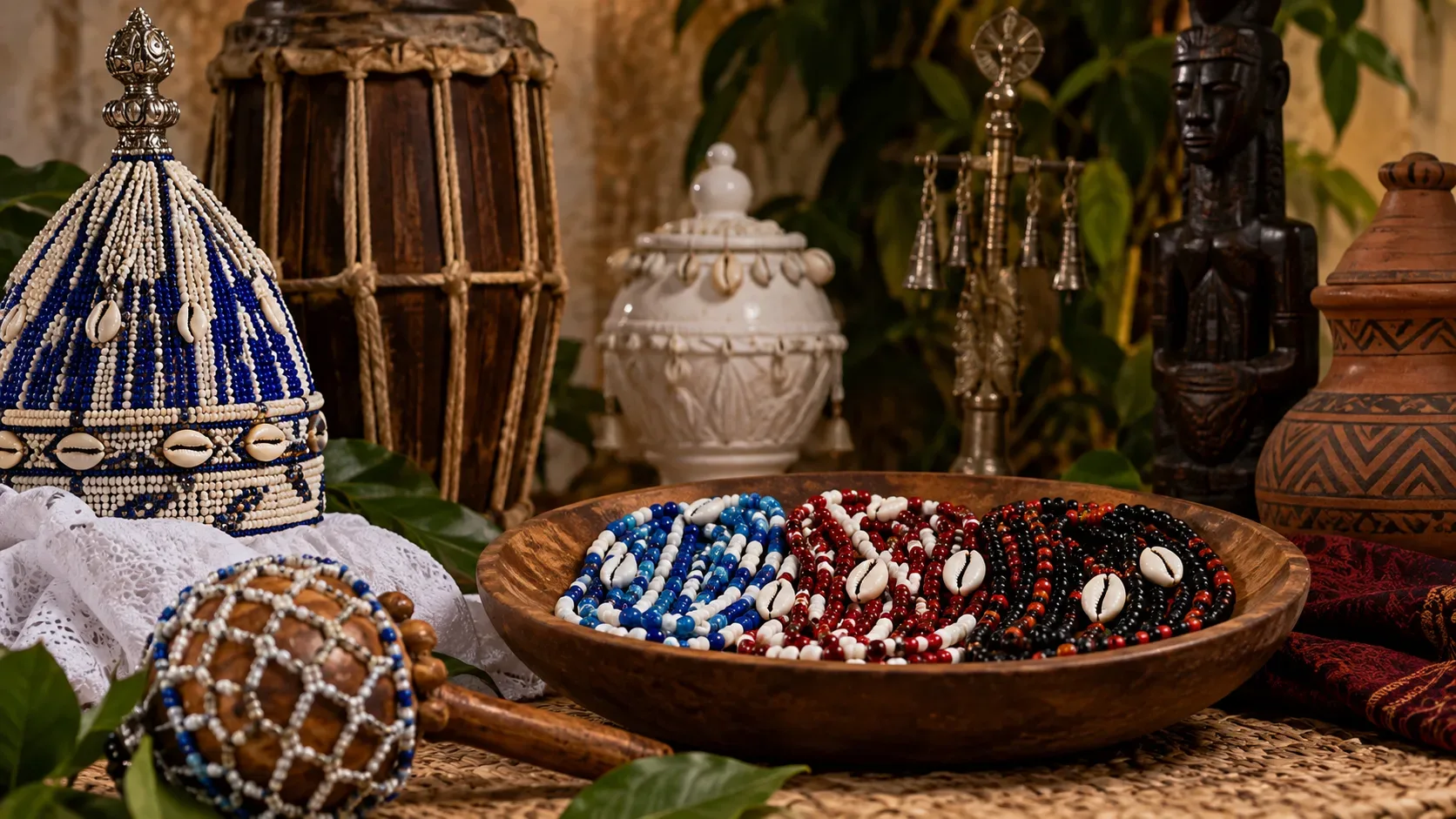
There is also a practical ambiguity: “guia” can mean a spiritual guide, but it can also name a ritual necklace or strand of beads. The collection of Brazil’s National Center for Folklore and Popular Culture records Candomblé objects classified as “guia” and titled “fio-de-contas,” showing that the word does not have a single spiritual or material referent.
So if someone says “my guia,” the right response is not to guess. Context may point to a spiritual entity, a relationship of religious guidance or a consecrated necklace. This is a good example of why glossaries need to record uses rather than merely translate one word into another.
How to use the terms without erasing differences between houses
- Name the tradition before the definition. Prefer “in this Umbanda house...” or “in Ketu Candomblé...” when the information is specific.
- Do not use orixá, entity, guide and ancestor as a chain of equivalents. They may relate to one another, but they describe different categories and relationships.
- Respect self-identification. If a community calls a particular being, line or object by a specific name, that use should take priority when describing that community.
- Do not universalize one house. Umbanda, Candomblé and other African-derived or Afro-Brazilian religions show historical, regional and liturgical variation.
- Do not translate everything as “spirit.” That erases distinctions among divinity, deceased person, guide, entity and other religious categories.
In summary
For a first reading, the most useful distinction is: orixá is a category of divinity; entity and spiritual guide are terms especially common in Umbanda for spirits engaged in religious work; ancestor is a broader category related to the dead, memory and continuity. The practical boundaries and names change among traditions, nations, currents and individual houses. Instead of looking for a universal equivalence, the better method is to ask: “who is using this term, in which tradition and in what context?”
Sources for further reading
- Iphan — Peoples and Traditional Communities of the Pampa: distinguishes orixás as divinities from Umbanda entities/guides.
- Iphan — Mapping of African-derived religious houses in Rio Grande do Sul: documents distinctions among nation, Umbanda and other lines, as well as variation between terreiros.
- Mercator / SciELO — Symbolism of geodiversity in Afro-Brazilian religions: discusses orixás, entities and guides in Umbanda.
- Mediações / SciELO — Mortuary rites in Candomblé and the (re)construction of Black ancestry: distinguishes orixás and ancestors and discusses egum/egungun in a specific context.
- Anais do Museu Paulista / SciELO — Museological crossroads: shows how Exu takes on different meanings in Candomblé and Umbanda.