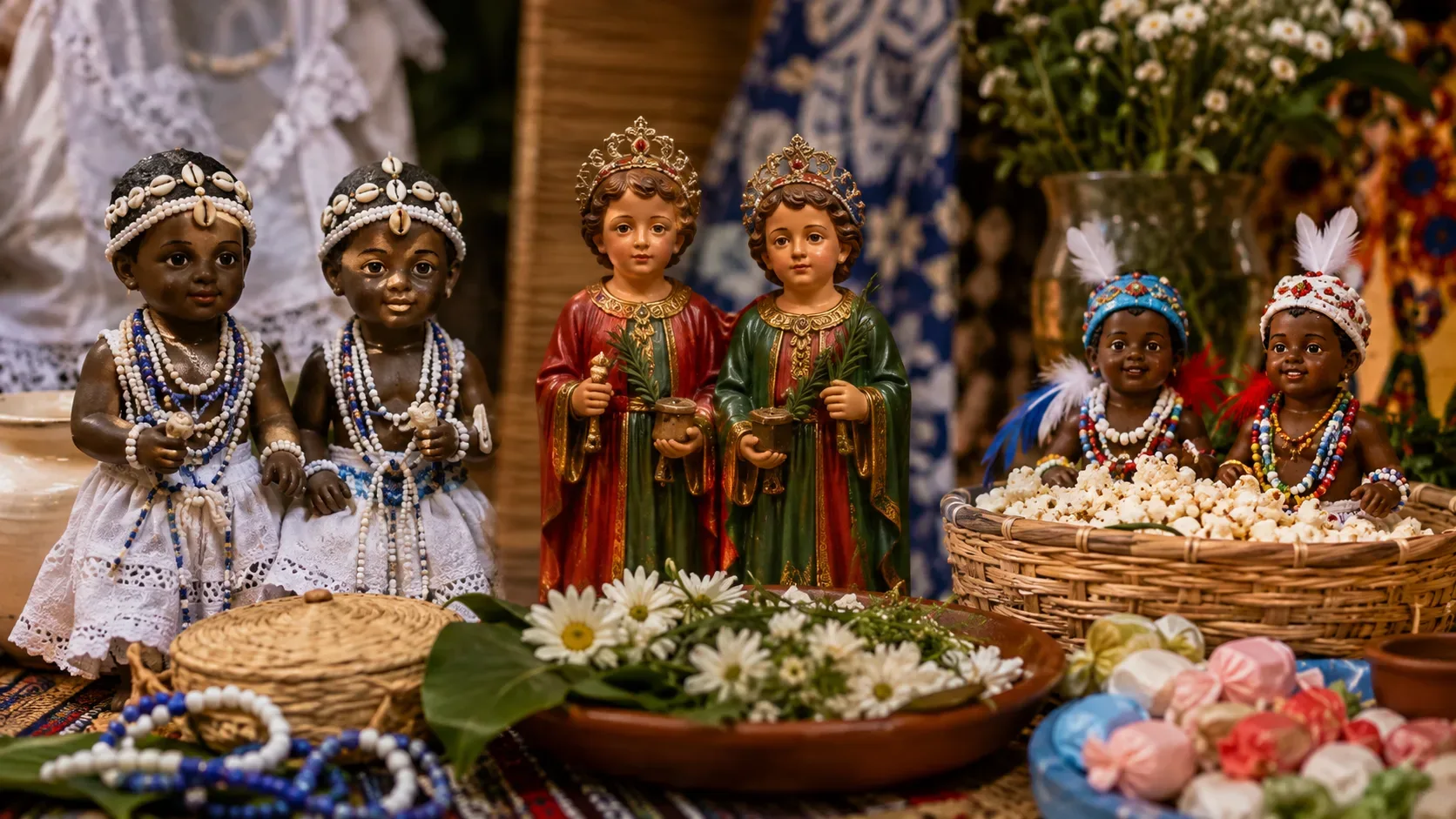
No: Ibeji, erês, and Cosmas and Damian are not simply different names for the same religious reality. They may appear close to one another in Brazilian festivals, altars, calendars, and narratives, but they belong to different traditions and categories. The historical connections among these repertoires are real; turning those connections into an automatic equivalence is what erases important differences.
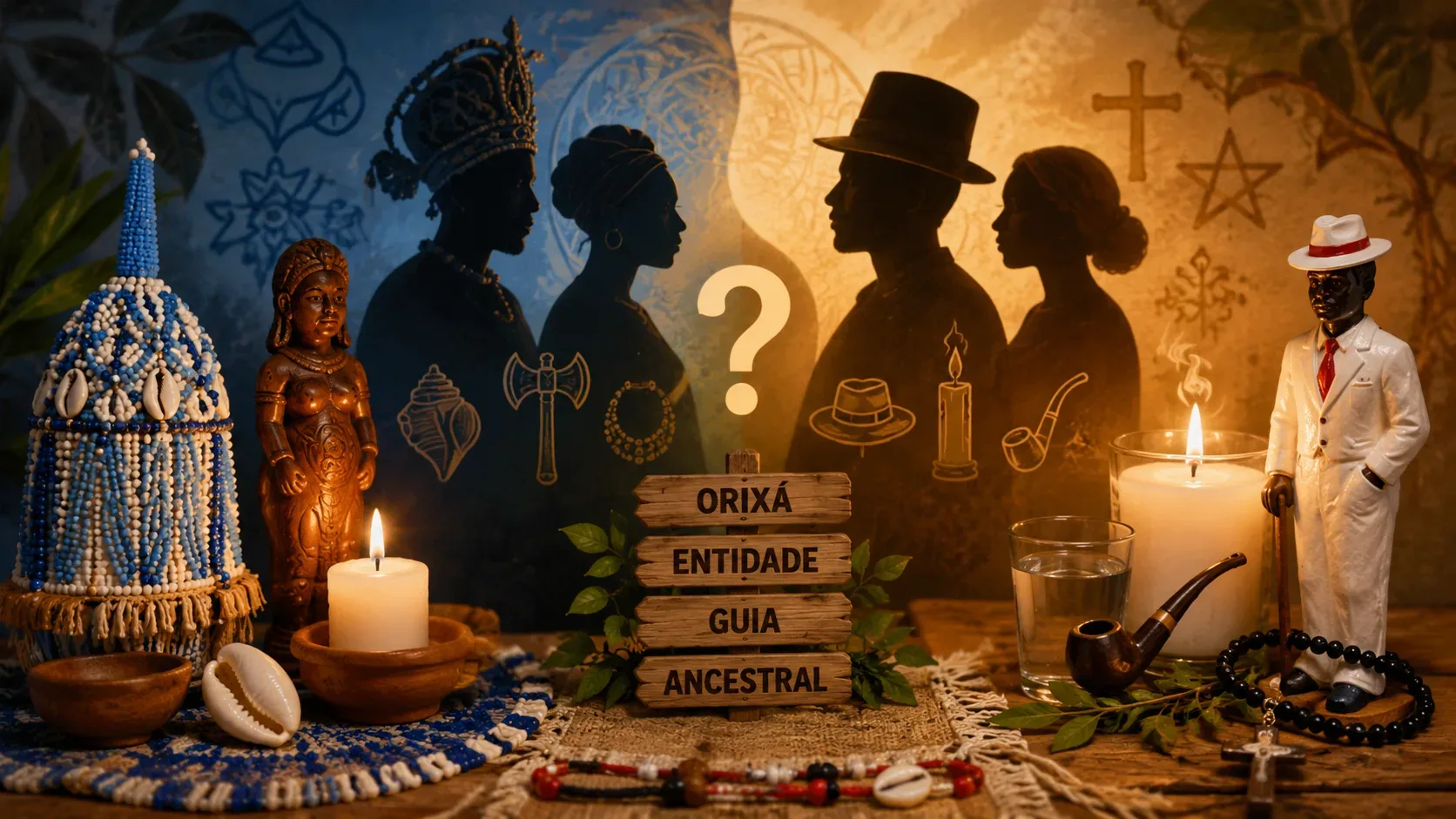
The safest approach is to separate four levels: divinity/orisha, ritual manifestation or state, child entity in Umbanda, and Catholic saints. Meanings also vary among nations, houses, and lineages. Anthropologist Morena Freitas, in her study of Umbanda's ibejadas, stresses precisely that terms such as ibejada, erê, and Child may overlap in some contexts but should not be treated as interchangeable by default. The study is available through SciELO.
Quick map: concept, tradition, function, and relationship to the saints
| Concept | Where it commonly appears | What it designates | Relationship to Cosmas and Damian |
|---|---|---|---|
| Ibeji / Ibejis | Yoruba-derived traditions and Candomblé houses with Nagô/Ketu references, among other Afro-Brazilian contexts | Divine twins/orishas associated with twinhood and the sacred world of childhood | Historically brought into correspondence with the twin saints in Brazil, but that correspondence does not turn Ibeji into Catholic saints |
| Erê | Candomblé, with meanings that can vary by house, nation, and ritual context | May name a childlike manifestation or condition associated with trance and the person's relationship with the orisha; some traditions use the term more broadly | It is not, by definition, Cosmas or Damian; local associations may exist without creating a universal identity |
| Ibejada / Children | Umbanda, under different naming conventions | Child entities in the Umbanda pantheon, often associated with joy, play, sweetness, and festive foods | Children's giras may be held on dates connected to Cosmas and Damian and may dialogue with references to Ibeji, but the entities are not automatically the saints or the orishas |
| Cosmas and Damian | Catholicism and popular devotions | Christian twin saints venerated as martyrs; Catholic tradition also associates them with caring for the sick | They form the Catholic side of the historical connection; the Catholic Church commemorates them liturgically on September 26 |
Ibeji: sacred twinhood is not the same as Catholic sainthood
In repertoires of Yoruba origin, Ibeji is linked to divine twins and to the symbolic force of twinhood. In Brazil, this universe entered into a relationship with devotion to Cosmas and Damian, who are likewise represented as twin brothers. That resemblance encouraged religious, iconographic, and festive connections, but without eliminating the difference between an orisha or divine pair in an Afro-Brazilian tradition and Christian saints.
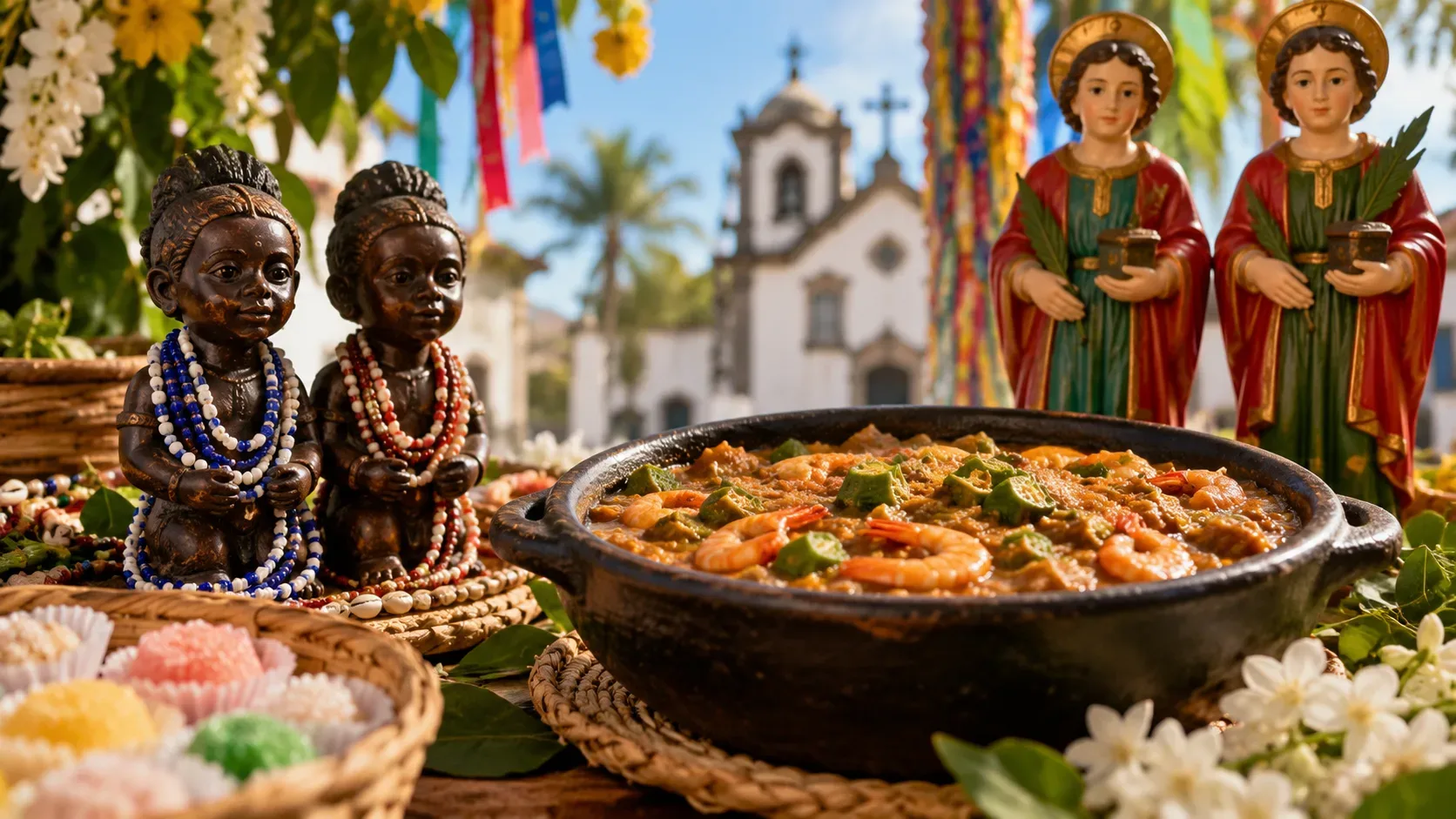
The official recognition of the Caruru of Saint Cosmas and Saint Damian as intangible cultural heritage in Bahia describes this connection itself: the Bahia state government notes that devotion to the twin saints acquired particular features in Afro-Bahian culture when it encountered the cult of the Ibejis. The same text emphasizes that the celebration brings together Catholic and Afro-Brazilian practices and takes diverse forms. See the Bahia government record.
Erê: the term changes meaning by house and context
Erê is one of the terms most distorted by overly simple explanations. In ethnographic studies of Candomblé, it may appear in connection with a childlike state or manifestation in the course of trance, related to the initiated person and the orisha. In other contexts, the term takes on a broader meaning and may name childlike manifestations more generally.
That is why saying “erê is the same as Ibeji” or “erê is an Umbanda child” may fit a very localized conversation, but it does not work as a rule for every house. Terminology depends on tradition, lineage, and the way each community organizes its ritual categories.
In Umbanda, ibejadas or Children form a category of their own
In Morena Freitas's study, ibejadas are child entities in Umbanda, present in the same religious universe as caboclos, pretos-velhos, exus, and pombagiras. In giras devoted to them, sweets, fruit, cakes, play, and other sensory elements have a central role. The author also shows that names vary: ibejada, ibeijada, bejada, erê, and Children may appear in different usages.
The practical conclusion is not to choose “the correct term” in the abstract, but to ask: correct in which tradition, in which terreiro, and for which ritual function? In an Umbanda house, a Child may have a particular name, mode of manifestation, and relationship. That does not justify concluding that the entity is literally a Candomblé Ibeji or one of the Catholic saints.
Cosmas and Damian: Catholic saints with a distinct Brazilian history
In Catholic tradition, Cosmas and Damian are twin saints and martyrs. Catholic memory associates them with caring for the sick without payment, and the Church commemorates them liturgically on September 26. Vatican News presents the Catholic tradition about the saints.
In Brazil, especially in popular and Afro-Brazilian devotional circuits, the calendar may take another form. In Bahia, the feast and caruru of Saint Cosmas and Saint Damian are marked on September 27. This difference in dates helps show that Brazilian devotion is not merely a copy of the liturgical calendar: it was recreated through contact with other cosmologies, foods, domestic rites, and community celebrations.
Why calling everything “the same thing” erases differences
- It mixes different religious categories: orisha, entity, ritual manifestation, and saint are not interchangeable words.
- It erases the authority of communities: a definition valid in one house may not apply in another.
- It confuses historical relationship with identity: two figures can be placed in correspondence without becoming ontologically identical.
- It reduces syncretism to a fixed chart: these connections were historically produced and can change in meaning by region, tradition, and context.
- It hides internal diversity: Candomblé and Umbanda are not homogeneous blocks, and their vocabularies are not fully uniform either.
Where does Doum fit in?
Doum appears in many Brazilian devotions as a third child figure alongside Cosmas and Damian. Studies of this religious universe point to relationships with narratives about a sibling born after the twins and with Brazilian ways of mediating Yoruba and Catholic repertoires. Doum's presence is another sign that Brazilian religious history produced its own combinations, rather than simple one-to-one equivalences.
How to speak more precisely
A few formulations help avoid generalizations:
- Instead of “Ibeji is Cosmas and Damian,” prefer: “Ibeji was historically brought into correspondence with Cosmas and Damian in Afro-Brazilian and popular practices.”
- Instead of “erê is an Umbanda child,” prefer: “erê has meanings that vary; in many Candomblé contexts it is connected with childlike manifestations and trance.”
- Instead of “ibejada is Ibeji,” prefer: “in Umbanda, ibejada may name child entities; its relationship to Ibeji depends on the tradition.”
- When information comes from a specific community, say so: “in this house,” “in this lineage,” “in this terreiro.”
Frequently asked questions
Are Ibeji Catholic saints?
No. Ibeji belongs to religious repertoires of Yoruba and Afro-Brazilian origin. The connection with Cosmas and Damian is historical and cultural, not a mandatory doctrinal identity.
Is an erê the spirit of a child?
There is no single answer valid for every tradition. In Candomblé contexts, erê may be connected with a childlike ritual manifestation or state related to trance; in other usages, the term can be broader. You need to know which house and tradition are being discussed.
Is ibejada a synonym for erê?
The terms sometimes overlap in use, but anthropological research shows that they are also used to mark differences, especially between Umbanda and Candomblé contexts. It is therefore unsafe to treat them as universal synonyms.
Why do Cosmas and Damian appear on September 26 and 27?
The Catholic Church commemorates them liturgically on September 26. In Bahia and in Brazilian popular traditions, the feasts of Cosmas and Damian and the caruru are associated with September 27. These religious and cultural calendars overlap, but they are not identical.
In short
The best answer to the opening question is: no, Ibeji, erês, ibejadas, and Cosmas and Damian are not the same thing. They are connected through a Brazilian history of encounters, correspondences, devotions, and re-creations. Respecting that history requires holding two ideas at once: the connections are real, and so are the differences.