Fio de contas, guia, and brajá do not form a perfectly interchangeable vocabulary. The terms may overlap in everyday speech, but their meaning depends on the tradition, the religious house, the object’s function, and the ritual context. The same is true of colors: they may communicate affiliation, a deity, a spiritual line, status, or other relationships, but there is no single chart that can decode every necklace used in Afro-Brazilian religions.
The short answer: the names overlap, but they are not universally equivalent
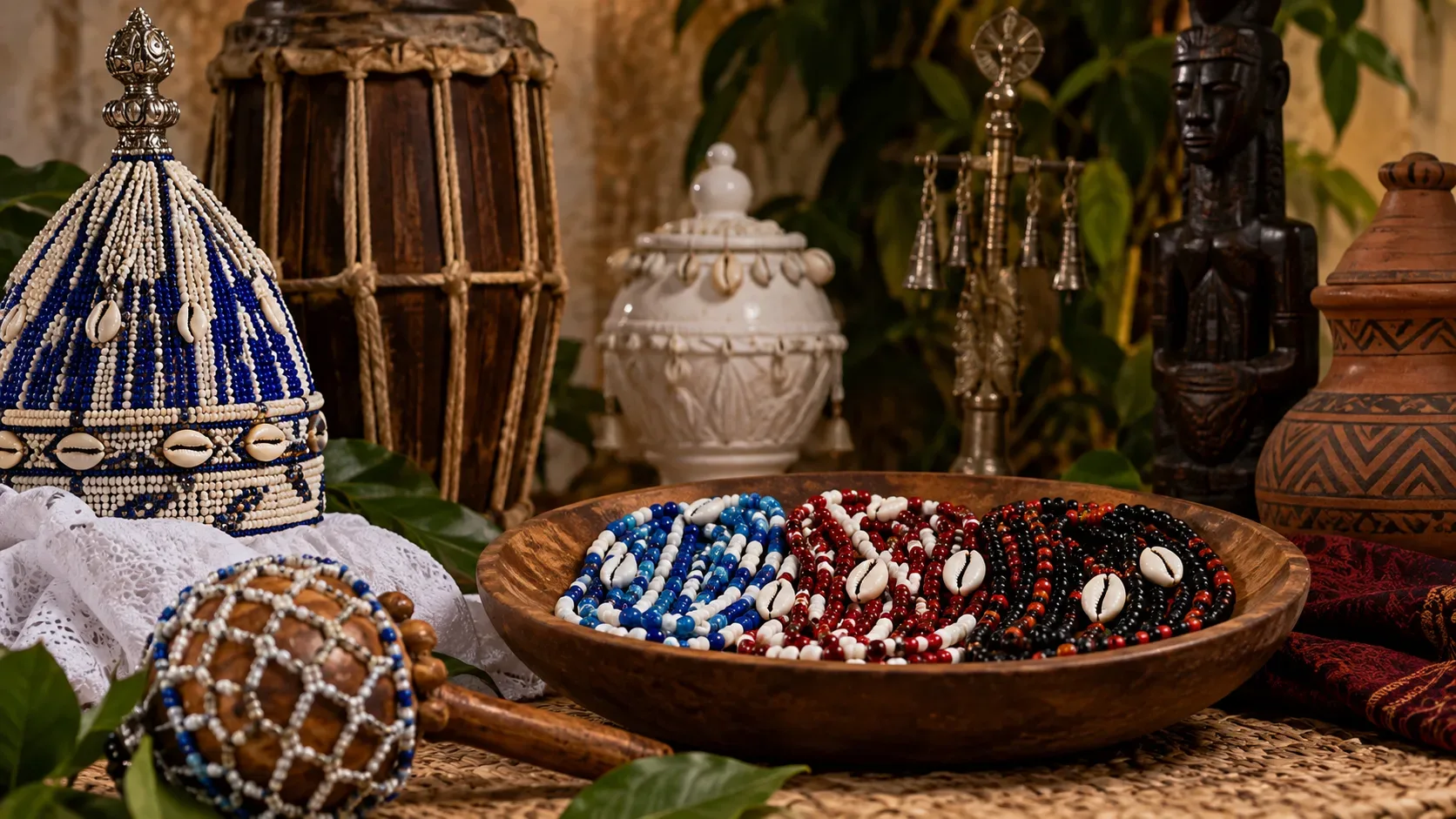
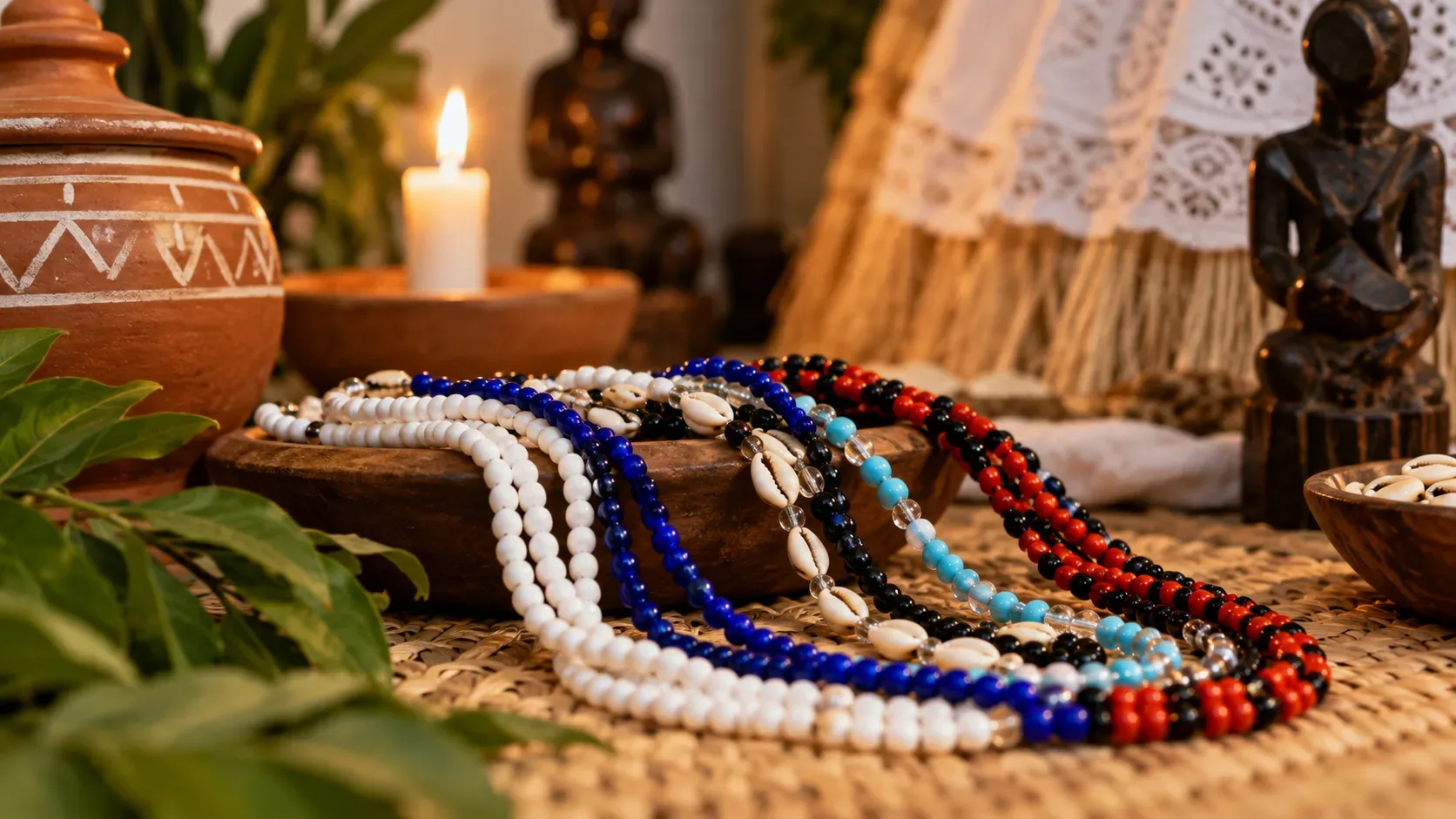
Fio de contas is a broad descriptive expression for ritual necklaces made with beads and other materials. In research on Candomblé, these necklaces appear as objects that accompany a person’s religious trajectory and may communicate relationships with orixás, belonging to a terreiro, and aspects of initiation. Roberto Conduru’s research on Afro-Brazilian jewelry emphasizes precisely the diversity of materials, colors, types, and meanings found in these necklaces.
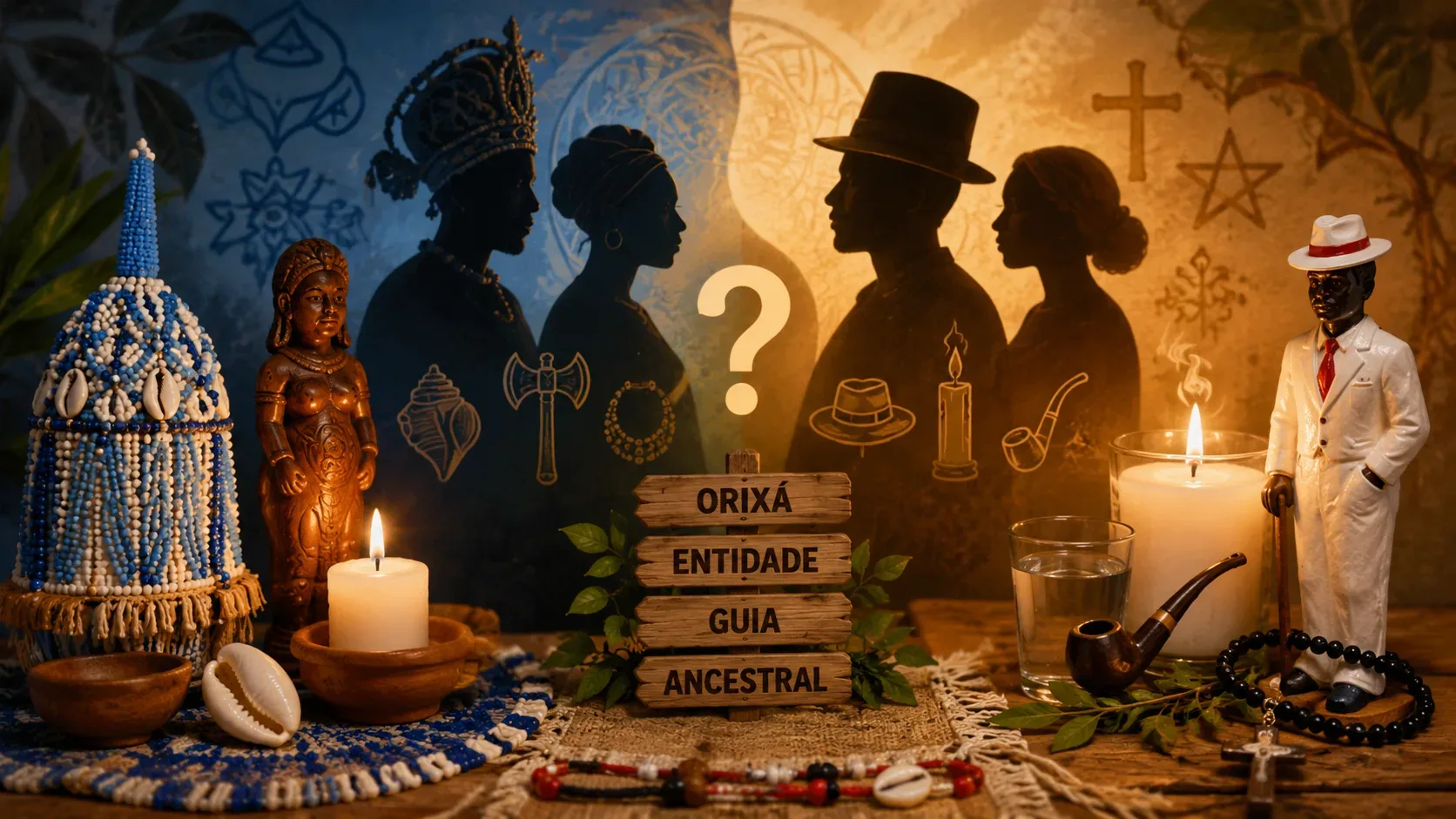
Guia is a very common name in Umbanda for the ritual necklace. Research from the Federal University of Pelotas, based on Umbanda terreiros in Pelotas, describes guias as necklaces connected to identification within the house and to religious functions attributed by practitioners. The word can also be ambiguous outside the immediate context because, in Umbanda, guia may also refer to a spiritual entity; for clarity, expressions such as “guia necklace” or “beaded guia” can distinguish the object.
Brajá, in turn, should not be treated as a simple synonym for any guia or fio de contas. A doctoral thesis from the State University of Southwest Bahia on sacred necklaces in Yoruba-matrix Candomblé describes the brajá as a specific form of cowrie-shell necklace, with interlaced rows and its own associations of use. The same research records differences among houses regarding which orixás and people may use it — a strong example of why terminology must be contextualized.
| Term | General use | What it may indicate | Interpretive caution |
|---|---|---|---|
| Fio de contas | A broad expression for ritual bead necklaces; especially common in literature on Candomblé. | Relationship with deities, belonging, initiatory trajectory, ritual function, and religious identity. | Form, material, number of strands, and meaning vary across traditions and houses. |
| Guia | A very common Umbanda name for the ritual necklace. | Spiritual line, entity, orixá, house identity, and locally recognized religious functions. | Do not automatically confuse it with guia meaning a spiritual entity; the codes are not unique. |
| Brajá | The name of a more specific form in Candomblé contexts, often made with cowrie shells. | It may be linked to particular deities, seniority, position, or specific uses depending on the house. | It is not a generic label for every bead necklace, and its rules are not universal. |
What a bead necklace can communicate
A careful reading starts with the idea that the necklace is more than a set of colors. In Candomblé, academic research describes bead necklaces as objects that can mark religious relationships over time. Conduru notes that changes in necklaces may accompany a person’s experience and that, for initiates, details in a piece can communicate information that someone seeing it only as ornament may miss.
Luciano Lima Souza’s thesis expands this point: the ilequés studied in Yoruba-matrix Candomblé combine colors, numbers, materials, deities, belonging to a house, and degrees of initiation. This means that two visually similar necklaces need not carry the same reading, and two necklaces related to the same deity need not be identical.
In Umbanda, context is equally decisive. The UFPel study treats guias as objects of identification within the terreiro and shows that knowledge about them is learned through religious life in the house. A color or combination may therefore make sense within one community without functioning as a mandatory code for all forms of Umbanda.
Why colors vary across traditions
There are at least four reasons for this variation. The first is the internal diversity of Afro-Brazilian religions. Candomblé is not a single homogeneous practice: nations and lineages preserve their own repertoires. Conduru explicitly mentions color codes from different nations, including Kêtu, Jêje, and Angola, when discussing collections of bead necklaces.
The second reason is the history of each house. Knowledge transmitted across generations, relationships among terreiros, priests’ trajectories, and local adaptations help explain why a color association can be important in one place and appear differently elsewhere.
The third is that color does not work alone. Material, transparency, bead design, sequence, number of strands, cowrie shells, special elements, and composition may all participate in meaning. The UESB thesis shows that the necklaces form a complex visual system; reducing them to “color X = deity Y” removes much of that complexity.
The fourth is the specific function of the necklace. Not every necklace using a particular color necessarily serves the same role. A piece connected to an initiatory stage, an entity, a deity, a position within the house, or a particular occasion may draw on different codes. The object can only be read adequately when its context is known.
Why a universal color chart is usually misleading
Online charts are attractive because they promise a quick answer: one color, one name. The problem begins when local recurrences are turned into general rules. Even within a defined research sample, ethnographic studies record variation.
In the UESB thesis, for example, different interlocutors describe combinations and uses that do not completely coincide. The research also records the historical reworking and adaptation of colors, materials, and forms. The practical conclusion is not that “any color means anything,” but that meaning is traditional and contextual, not universal.
Finding a blue, red, white, or multicolored guia therefore does not allow an outside observer to identify with certainty the orixá, entity, nation, or status of the person wearing it. An association may recur in one branch and be different in another.
Brajá: a case that shows how form, name, and tradition intersect
The brajá is especially useful for understanding the problem with synonyms. In Luciano Lima Souza’s research, it is described as a cowrie-shell ilequé with interlaced rows that create a scale-like appearance, connected to specific uses and symbolism. Yet the testimonies collected in the thesis do not fully agree on which orixás use it in each house.
In other words, the name identifies a more specific category than “bead necklace,” but that category does not erase differences in religious foundations. Calling every fio de contas a brajá loses precision; claiming a single list of who “may” use a brajá also goes beyond what comparative evidence supports.
How to interpret a necklace without reducing a tradition to a color key
- Start with the tradition and the house. Ask whether the context is Umbanda or Candomblé and, when relevant, which nation, lineage, or terreiro.
- Look at the whole object, not only its color. Material, number of strands, design, special pieces, and mode of use may matter as much as the palette.
- Distinguish broad names from specific ones. Fio de contas can work as a broad description; guia is especially common in Umbanda; brajá can name a specific form in certain Candomblé contexts.
- Avoid inferring hierarchy or affiliation from appearance alone. Without knowing the local code, the inference may be wrong and may expose religious dimensions that were not offered for public interpretation.
- Use color charts only as records of a particular source or tradition. A responsible chart should say which house, nation, author, or historical context it describes.
So what is the essential difference?
Fio de contas is the broadest of the three terms; guia is a very common Umbanda designation for the ritual necklace; and brajá tends to indicate a more specific form whose construction and use depend on religious context. In every case, the object belongs to systems of belonging and meaning that cannot be reduced to a universal color legend.
If two sources assign different colors to the same orixá or use different names for similar-looking necklaces, that does not automatically prove that one is “wrong.” They may be describing different traditions, houses, periods, or functions. The most reliable step is always to identify who is speaking, from which tradition, and in what context.
Sources for further reading
- Roberto Conduru, “Pérolas da liberdade: joalheria afro-brasileira” (UERJ) — discusses bead necklaces, diversity, religious identity, and codes from different nations.
- Francisco Moreira da Costa, “Identidade por um fio: colares e fios-de-contas no culto aos Orixás” (Unicamp) — documentation on the production, uses, and meanings of bead necklaces in Candomblé.
- Luciano Lima Souza, “Os colares sagrados da memória” (UESB) — a thesis on tradition, identity, colors, materials, hierarchy, and types, including the brajá.
- Hélcio Fernandes Barbosa Júnior and Denise Marcos Bussoletti, “Fiando guias do conhecimento...” (UFPel) — research on narratives and guias in Umbanda terreiros in Pelotas.