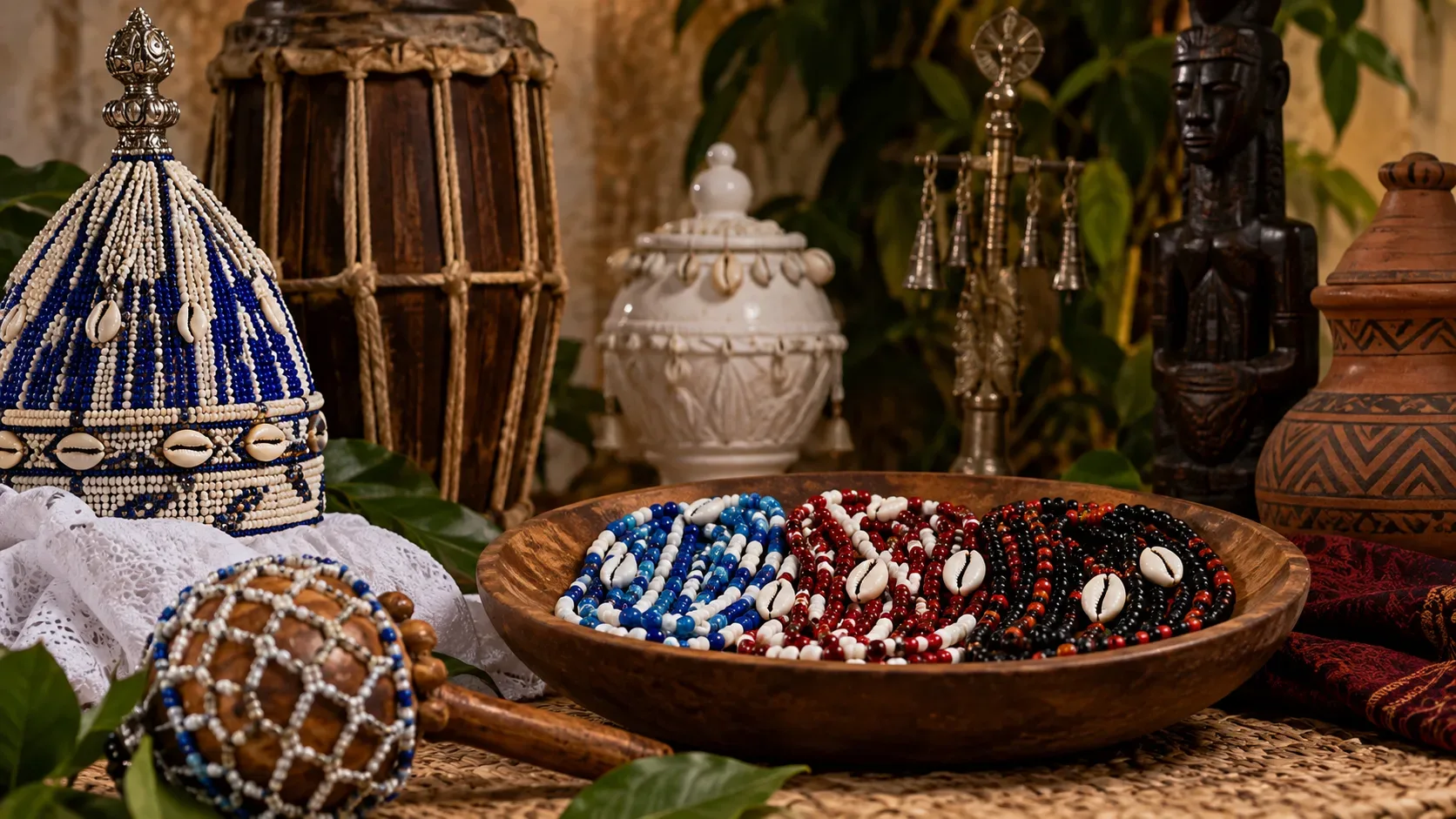
In Candomblé, “nation” does not mean a modern nation-state or an African ethnicity preserved unchanged. The term identifies a ritual tradition historically formed in Brazil from African and Afro-diasporic repertoires: ways of naming and worshipping divinities, liturgical languages and vocabularies, music, initiation, offices, and terreiro genealogies. Ketu, Jeje, and Angola therefore point to different matrices — they are not three names for the same thing.
At the same time, these boundaries have never been completely impermeable. Heritage documentation records arrangements such as Jeje-Nagô and Nagô-Vodum and stresses that “nation” labels are relative and historically constructed. This history of contact helps explain why traditions can show affinities without allowing orisha, vodun, and nkisi to be translated as perfect equivalents.
What “nation” means in Candomblé
The word acquired specific uses in the Atlantic world of slavery and, within terreiros, became a category of ritual belonging. Rather than indicating only “where someone came from,” it came to organize ways of practicing religion: song repertoires, sacred language, names and classifications of divinities, rhythms and protocols, initiation terminology, offices, and ways of transmitting knowledge.
The IPHAN dossier on the Bembé do Mercado itself draws attention to the relative nature of these classifications and to historical combinations among Nagô, Jeje, and Angola matrices. In other words, “nation” is a useful key for recognizing differences, but it should not be treated as a pure ethnic box frozen since Africa.
| Nation | Historical matrix most commonly associated | How divinities are named | Ritual language references | Reading caution |
|---|---|---|---|---|
| Ketu | Nagô/Yoruba traditions | Orishas | Yoruba-based vocabulary and songs | Ketu is not synonymous with all Yoruba religion or all Nagô Candomblé |
| Jeje | Gbe-speaking peoples, including Fon, Ewe, Mahi, and other groups | Voduns | Gbe-based repertoires, with Fon/Ewe references and internal variation | Jeje is a broad diasporic category with subdivisions and histories of its own |
| Angola | Bantu matrices from West-Central Africa | Inquices, also rendered from nkisi (plural minkisi) | Vocabularies with a strong Kimbundu and Kikongo presence | “Bantu” names a broad linguistic-cultural family; Angola, in Candomblé, is a Brazilian tradition with Bantu roots |
Ketu: a Nagô/Yoruba tradition, not a label for all Candomblé
Ketu refers to a historical and geographic reference within the Yoruba world and, in Brazil, became one of the most widely used names for Candomblé traditions with Nagô/Yoruba roots. In this tradition, divinities are called orishas, and the ritual repertoire preserves Yoruba-based lexicon, formulas, and songs.
IPHAN’s National Inventory of Linguistic Diversity records the connection between the Yoruba language and Ketu-nation Candomblé houses. This does not mean, however, that Brazilian ritual is an intact reproduction of a single African religion: Candomblé took shape in Brazil through recomposition, alliances, disputes, the circulation of people, and transmission across lineages.
It is therefore more accurate to say that Ketu preserves and reworks Yoruba heritages within a specific Afro-Brazilian tradition than to imagine a straight, unchanged line between an African society and any contemporary terreiro.
Jeje: a diasporic category linked to voduns and the Gbe world
“Jeje” likewise does not simply correspond to an African nationality. Historical and anthropological scholarship shows that, in Brazil, the term came to gather populations from a Gbe-language region — including Fon, Ewe, Mahi, and others — and acquired meanings of its own in the diaspora. A classic study published in Mana and available through SciELO discusses precisely why “Jeje” should be understood as a historical and transnational construction, not as the transparent name of a single people.
In Jeje traditions, divinities are called voduns. There are subdivisions and local histories, such as Jeje-Mahi, Jeje-Mina, and other designations. Contact between Jeje and Nagô communities was also intense in both Africa and Brazil, which helps explain composite formations and self-definitions.
This makes it misleading to summarize Jeje as “Ketu with different names.” Even when researchers or communities recognize affinities between particular divinities and ritual functions, Jeje traditions preserve vocabulary, histories, classifications, and forms of worship with their own logic.
Angola: Bantu roots and a religious vocabulary of its own
In Candomblé, Angola names a tradition with Bantu roots in West-Central Africa. “Bantu” is not the name of a single people: it refers to a broad family of languages and societies. In Brazil, repertoires especially connected with Kimbundu and Kikongo were reworked in Angola and Congo-Angola Candomblé houses.
The divinities are called inquices, a Portuguese form related to nkisi. Studies of ritual language in Candomblé document the differentiated presence of Yoruba in Ketu traditions, Gbe languages in Jeje traditions, and Kimbundu/Kikongo in Angola traditions. A recent overview of these terreiro languages is available through SciELO. Work produced from within Congo-Angola Candomblé experience and cosmology also uses nkisi/minkisi as categories in their own right, as shown in this article from the Brazilian Journal on Presence Studies.
As with Ketu and Jeje, “Angola” in the name of the nation should not be read as though a terreiro reproduced a national religion of today’s Republic of Angola. It is an Afro-Brazilian formation that preserves, reorganizes, and updates Central African heritages.
Why orisha, vodun, and nkisi are not interchangeable words
The three terms come from different linguistic and religious histories. Orisha belongs to the Yoruba world; vodun to the Gbe world; and nkisi/inquice to Bantu matrices. Automatically translating one into another erases how each tradition organizes its sacred beings, narratives, relationships, names, songs, and protocols.
This does not mean denying every correspondence. IPHAN heritage research identifies affinities among divinities of different nations based on attributes, elements of nature, tools, offerings, or ritual positions. The decisive word, however, is correspondence, not identity. An association made in a particular terreiro, study, or historical context does not create a universal table of equivalences.
For that reason, schemes of the form “this orisha = this vodun = this nkisi” should be used, if at all, with great caution and with an indication of the tradition or house that establishes the relationship. Without that context, equivalence tends to turn different cosmologies into simple translations of names.
What “nation” can change in terreiro practice
- Language and ritual repertoire: songs, greetings, formulas, and vocabularies preserve different linguistic references, even though they have been transformed in Brazil.
- Religious terminology: the names of divinities, offices, initiation stages, spaces, and ritual objects differ.
- Music and protocol: sequences, rhythms, ways of playing, and ways of organizing ceremonies may vary among nations and also among houses within the same nation.
- Transmission genealogy: a house’s identity depends on its ritual lineage, on who initiated whom, and on how foundations were transmitted.
- Organization of the pantheon and sacred relationships: changing one name for another is not enough, because each tradition may group, narrate, and relate its divinities in its own way.
These differences do not justify creating a “universal manual” for each nation. Candomblé is transmitted in concrete communities, and houses that identify with the same nation may differ in liturgical details, pronunciation, calendar, repertoire, and interpretation.
How to compare Ketu, Jeje, and Angola without homogenizing them
- Start with the house’s self-definition. If a terreiro identifies itself as Ketu, Jeje-Mahi, Nagô-Vodum, Angola, or Congo-Angola, that identification should be taken seriously.
- Use the vocabulary of the tradition itself. Speaking of voduns in a Jeje house and inquices in an Angola house is not pedantry: vocabulary carries history and religious organization.
- Avoid universal “equivalence” charts. Correspondences may exist, but they need context.
- Do not confuse circulation with the absence of boundaries. Terreiros and priests have exchanged knowledge over time; this does not make all foundations interchangeable.
- Consider lineage and region. The same word can have different uses in Bahia, Maranhão, Pernambuco, Rio de Janeiro, São Paulo, or other terreiro networks.
Common questions
Are Ketu, Jeje, and Angola three different religions?
In common usage, they are described as ritual nations or traditions within Candomblé. This formula recognizes a shared Afro-Brazilian history while also acknowledging profound differences. Some communities place greater emphasis on the autonomy of their tradition; for that reason, naming the specific nation is more careful than using Ketu as the default for all Candomblé.
Can a terreiro include elements from more than one nation?
History documents contact, borrowing, and composite identities such as Jeje-Nagô and Nagô-Vodum. This does not mean that any combination is interchangeable or that every house “mixes everything.” The legitimate way to describe a terreiro depends on its own history, lineage, and self-definition.
Is one nation more “pure” or more “original”?
That hierarchy does not help explain the formation of Candomblé. All these traditions were constituted in the diaspora under concrete historical conditions, preserving and reworking African heritages. “Purity” tends to erase the very processes of reconstruction and transmission that made these traditions possible in Brazil.
Can I say that an orisha, a vodun, and an nkisi are “the same divinity”?
As a general rule, no. It is more precise to say that correspondences may be established in particular contexts. If a house, lineage, or specific study relates two or three divinities, that relationship should be presented as contextual rather than as a universal translation.
The main point
Ketu, Jeje, and Angola are names of traditions that organize different memories, ritual languages, genealogies, and cosmologies within the field of Candomblé. Understanding “nation” as ritual tradition — rather than as a racial label, a modern country, or a simple list of synonyms — makes it possible to recognize both historical contact and the differences that each community keeps alive.