When someone looks for the “correct order” of the xirê, the most accurate answer is that there is no universal sequence that applies to all Candomblé. Xirê is a way of organizing praise, songs, drumming, dance and salutations within a religious celebration, but the way those references are ordered is transmitted and maintained by specific traditions. For that reason, a sequence practiced in one Ketu house should not be treated as a rule for every Ketu house — much less for Jeje, Angola, Efon, Ijexá or other traditions.
This variation is not a sign of improvisation or lack of foundation. On the contrary, it reflects the history, lineage, ritual language, set of divinities worshipped and precepts of each terreiro community. A PUC Minas master's dissertation focused on Ketu Candomblé summarizes this point by recording that xirê has a sequential order “according to each house” and that different terreiros may preserve their own arrangements. The study also notes that a sequence adopted for research cannot be turned into an order valid for every house. See the PUC Minas dissertation.
What xirê is, in general terms
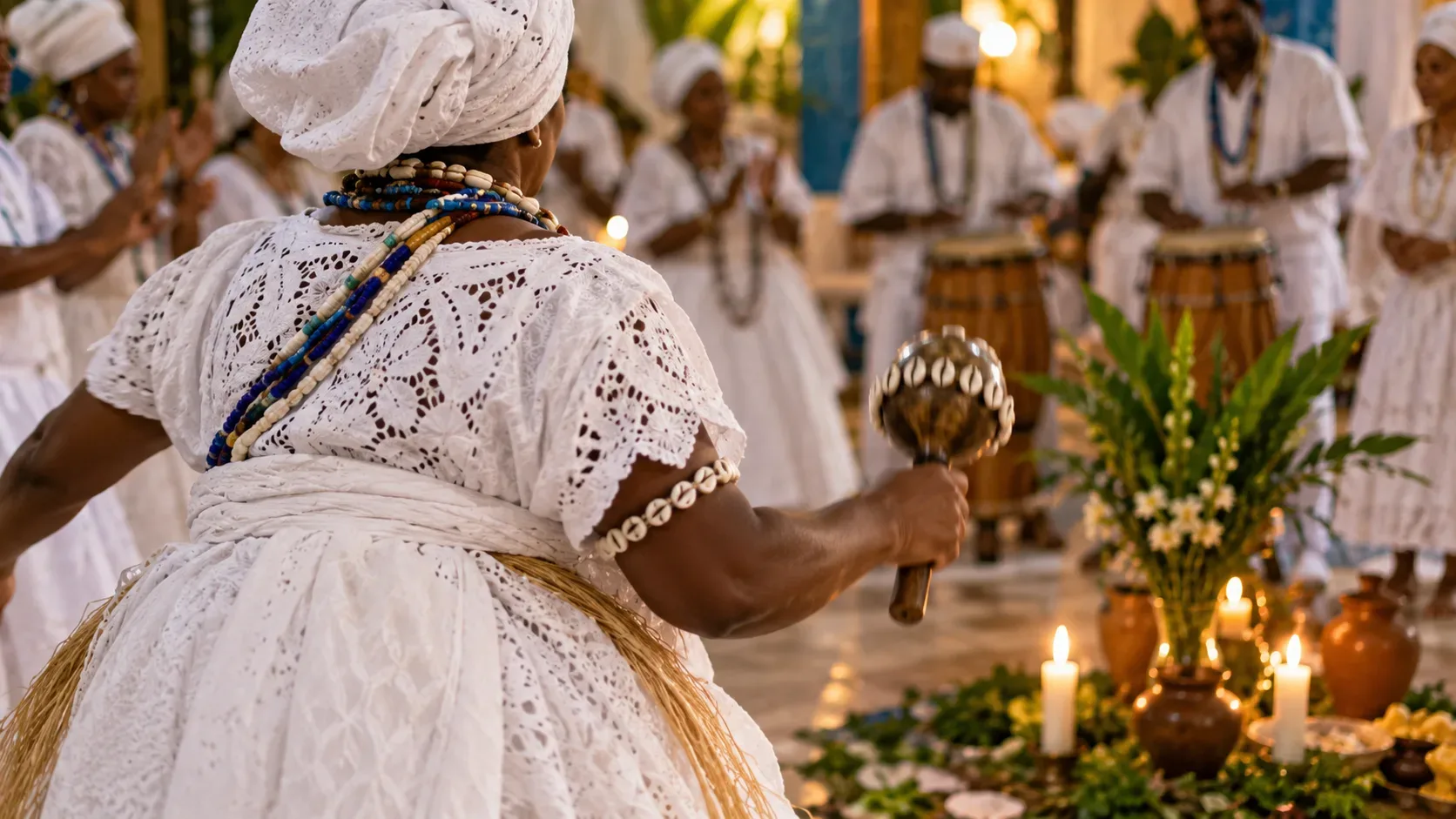
In descriptions of Yoruba-rooted Candomblé, xirê (also written siré) is associated with celebration, dancing and the act of playing or rejoicing. In Brazilian religious usage, the term can refer to the sequence in which divinities are praised through songs, rhythms, movements and salutations during a celebration.
This broad definition helps explain the function of xirê without reducing the ceremony to a list of names. The sequence works as a kind of ritual grammar: it guides the development of the celebration and helps members of the community recognize moments, relationships and precedence. Learning it, however, is not simply a matter of memorizing an order. Research on terreiros emphasizes the role of oral transmission, observation, community life and hierarchy in passing on knowledge. See Unilab research on oral tradition in Candomblé.
Why the order can change from one nation to another
“Candomblé” is a broad name for Afro-Brazilian religious traditions that took shape in Brazil from different African matrices. The Ancestralidades project, for example, lists Jeje, Nagô, Angola and Congo among the best-known nations, as well as mixed forms. These traditions are not merely variations of the same list: they have their own histories, vocabularies, musical repertoires and forms of organization. See the Candomblé entry at Ancestralidades.
It is therefore important to avoid automatically equating all systems. In Nagô/Ketu contexts, the language of orixás is central; in Jeje traditions, voduns hold a central place; in Angola/Congo traditions, inquices appear. In Brazil these traditions have interacted and houses may share historical connections, but that does not justify turning the vocabulary or ordering of one tradition into a universal standard.
The history of recognized terreiros also shows how houses identify with specific lineages. Fundação Joaquim Nabuco describes Casa Branca do Engenho Velho as a house that identifies with the Ketu/Nagô nation and records its influence on the formation of other terreiros. Ilê Axé Opô Afonjá is likewise presented as a Ketu-rite, Nagô-nation terreiro. These links help explain continuities among related houses, but they do not erase the particularities maintained by each community. Read about Casa Branca at Fundação Joaquim Nabuco and see the entry on Ilê Axé Opô Afonjá.
Why two houses of the same nation may also use different orders
Even within the same nation, there is no single central authority that standardizes every house. Each terreiro has its own history, religious affiliation, elders who transmitted its foundations and a body of decisions consolidated over time. The PUC Minas dissertation specifically notes that the autonomy of temples produces differences among terreiros even when they share a cultural base within the same tradition.
Factors that can influence the sequence include:
- lineage and ancestry of the house: the form received from elders tends to guide the terreiro's continuity;
- the pantheon actually worshipped: not every house worships exactly the same set of divinities in exactly the same way;
- cosmological and mythic relationships: some sequences may emphasize kinship, precedence or associations recognized within that tradition;
- local history: migration, contacts among terreiros and the trajectories of religious leaders can shape a house;
- internal precepts and etiquette: the sequence also helps organize gestures of respect, positions, songs and moments recognized by the community.
This helps resolve an apparent contradiction: xirê can vary among houses while remaining highly stable within a particular house. Internal stability allows the sequence to be recognized and transmitted; diversity among houses prevents that stability from becoming a supposed general law of Candomblé.
Is there at least a “most common” sequence?
Recurring sequences do appear in studies of Ketu Candomblé, and many descriptions place Exu in an opening position — sometimes in a moment before the xirê proper — and Oxalá at the close. Yet even within Ketu, the intermediate positions can change. The PUC Minas study compares different arrangements and warns that models used by researchers should not be treated as valid for every house.
For that reason, a list found in a book, website, video or social network should be read as a situated example: it may correspond to one house, lineage, region or to the analytical choice of an author. The problem begins when the example loses its context and is presented as “the order of Candomblé.”
It is also inappropriate to apply a list formulated for Ketu directly to Jeje or Angola. In such cases, more than the position of divinities in a sequence may change: terminology, repertoire, references and the ritual logic mobilized by the house can also differ.
What the order actually teaches
The order of the xirê is not merely a way to answer “who comes before whom.” It can reveal how a community organizes memory, hierarchy and relationships between the sacred and collective life. Academic discussion of educational practices in Candomblé emphasizes that learning in the terreiro takes place by listening, watching, repeating and living within rules of etiquette and a pedagogy of its own. Read the discussion in Religião & Sociedade via SciELO.
This matters because it reduces the risk of treating xirê as a “ritual playlist.” Music, dance, positions in space, respect for elders and forms of greeting belong to a larger whole. Outside that context, a sequence of names offers only a fraction of what the community recognizes as religious knowledge.
What can vary and what should not be universalized
| Aspect | What may happen | How to interpret it |
|---|---|---|
| Sequence of praise | It can change across nations and houses | The order should be understood in the context of the specific tradition and community |
| Names of divinities | Orixás, voduns and inquices belong to different traditions | Do not swap the terms as if they were perfect synonyms |
| Divinities included | The set worshipped may not be identical in every terreiro | Avoid closed lists presented as a universal canon |
| Songs, rhythms and salutations | Repertoires and forms of performance depend on tradition and house | Do not use material from one lineage to correct another |
| Etiquette and participation | Guidance for visitors can vary | When visiting a terreiro, follow the instructions of that house |
How to discuss xirê without erasing Candomblé's diversity
A responsible formulation begins with specificity. Instead of saying “the order of the xirê is this,” it is better to say “this is an order documented in a particular house, lineage or study.” When a source refers to Ketu, that scope should remain visible; when it describes a particular house, the name of the house should not disappear in a generalization.
It is also useful to distinguish public information from internal foundations. Not everything that structures life in a terreiro is intended for external description. Oral tradition continues to play a central role in transmitting knowledge, and the relationship between the person who teaches, the person who learns and the time of initiation is part of that process. A public-facing article can therefore explain the general logic and the existence of variation without reproducing songs, salutation formulas, procedures or content that a community treats as restricted.
In short: there is no “official order” for every house
The central point is simple: xirê has an order, but not one single order for all Candomblé. The sequence gains meaning within a tradition and a house, where it is transmitted through people, memory, practice and hierarchy. Different nations carry their own repertoires and languages; houses within the same nation can preserve distinct arrangements because of their histories and lineages.
Lists can therefore be useful for studying a specific context, but they should not become a ruler for judging every terreiro. To know the order of a particular house, the most appropriate source is the community itself and its religious leadership — not a generic chart taken from another axé.