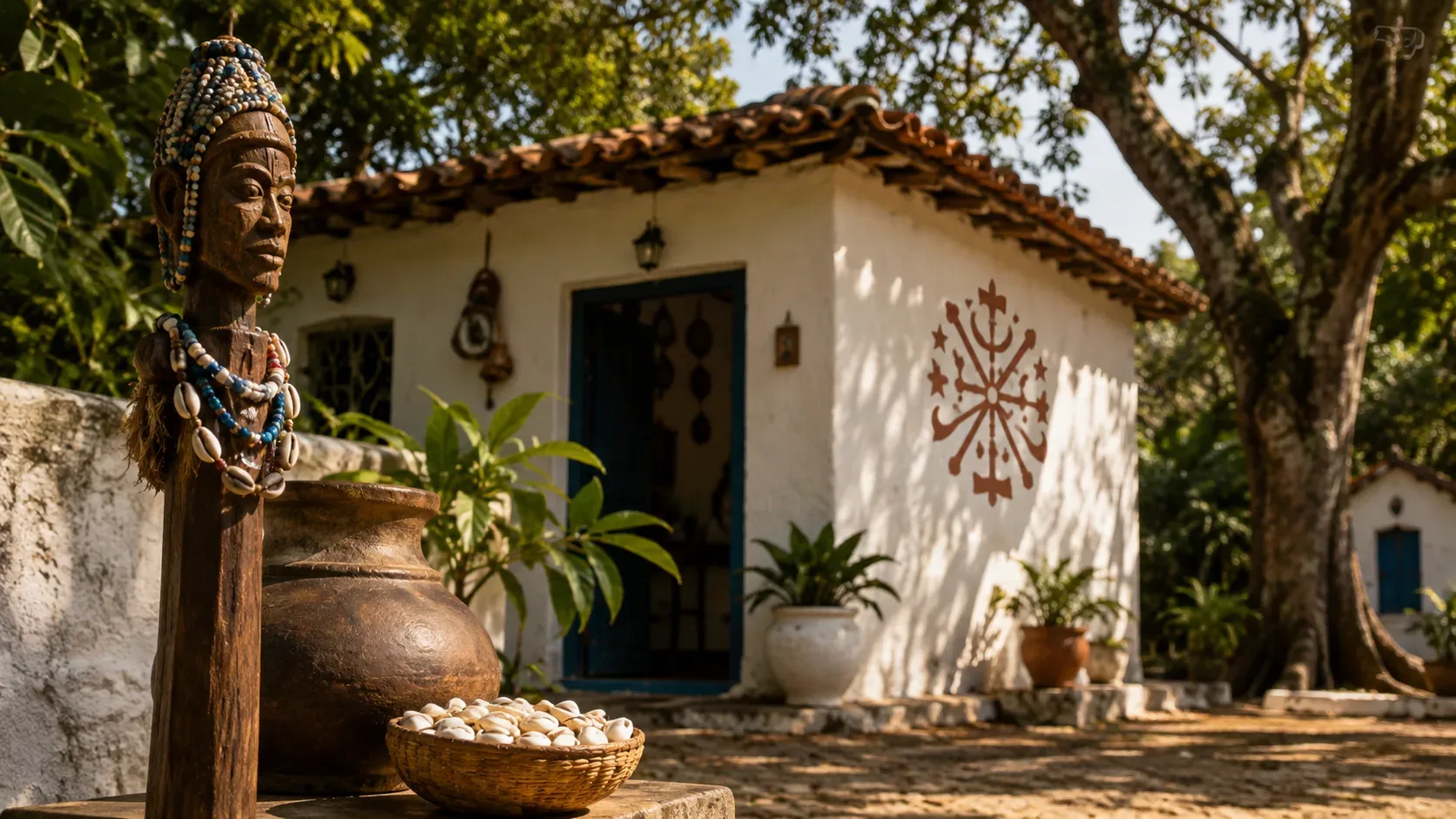
The 2026 heritage listing of Terreiro Zoogodô Bogum Malê Hundó formally recognizes, at Bahia state level, the heritage value of a religious territory linked to the Jeje-Mahi tradition. The act was made official in the State Gazette on July 31, 2026 and entered the property in the Register of Listed Immovable Assets maintained by the Instituto do Patrimônio Artístico e Cultural da Bahia (IPAC). On the page where it provides the decree, dossier and boundary map, IPAC highlights Bogum's historical, religious, cultural and social importance and presents it as a reference point for the preservation of knowledge and practices associated with the Fõ/Fon and Mahi peoples from the region of present-day Benin.
What was listed in 2026
Decree No. 24,703 of July 30, 2026, published the following day, identifies the listed asset as Terreiro Zoogodô Bogum Malê Hundó, of the Jêje-Mahi tradition, at Rua Manoel do Bonfim, Ladeira do Bogum, no. 35, Engenho Velho da Federação, Salvador. The decree orders its inclusion in IPAC's Register of Listed Immovable Assets.
This matters because Brazil's tombamento is a legal instrument for protecting material heritage. IPAC explains that it places a movable or immovable cultural asset under a special public-protection regime aimed at preservation. In Bogum's case, the legal act applies to the territorial and real-estate cultural asset identified by the decree; it does not mean that the religion, liturgy or community becomes state property.
The decree is the document that creates the legal effect. The dossier explains and supports the heritage values attributed to the site. The boundary map, published separately by IPAC, is the appropriate reference for checking the spatial limits of protection. Reading the three together helps avoid confusing an address, a historical narrative and a legal perimeter.
Why Bogum was recognized as heritage
In the official summary accompanying the 2026 documents, IPAC describes Bogum as one of Bahia's oldest and most representative Candomblé temples in the Jeje-Mahi tradition. The public justification combines four dimensions: historical, religious, cultural and social.
- Historical: the terreiro is presented as a long-standing reference for the Jeje presence in Bahia and the continuity of Afro-diasporic memories.
- Religious: the Jeje-Mahi tradition is characterized by the worship of voduns and should not simply be treated as another name for a Ketu house.
- Cultural: its value is not limited to buildings; it also involves knowledge, ritual languages, forms of transmission and distinctive ways of organizing sacred space.
- Social: the terreiro is also recognized as a community and a point of reference in Engenho Velho da Federação and in religious networks extending beyond the neighborhood.
IPAC's own wording is significant: Bogum appears not merely as an old building, but as a place where material heritage and living practices are connected.
Jeje-Mahi and voduns: what the documentation supports
IPAC's official page states that the Jeje-Mahi tradition preserved at Bogum is linked to knowledge and values inherited from Fõ/Fon and Mahi peoples associated with the territory of present-day Benin. It also explains that, unlike the Ketu tradition centered on orixás, Jeje-Mahi cosmology has voduns as its central divinities, historically connected with the region of the former Kingdom of Dahomey.
To interpret this vocabulary without erasing internal differences, it is also useful to consult Ordep Serra's anthropological report on Terreiro do Bogum, a historical document that predates the 2026 state listing. It records terms, offices, sacred spaces and liturgical references used to describe the terreiro. Because it is a source distinct from the 2026 dossier, its details should be cited as anthropological documentation associated with Bogum, not automatically as literal wording from the new dossier.
| Term | How to read it in the Bogum context | Source and caution |
|---|---|---|
| Jeje-Mahi | An Afro-Brazilian religious tradition related to Gbe and Mahi matrices and to the worship of voduns. | IPAC's 2026 summary uses this identification explicitly. |
| Vodun | The designation for central divinities in Jeje cosmology; it is not simply a synonym for “orixá.” | IPAC contrasts Jeje-Mahi and Ketu precisely to mark this difference. |
| Mawu, Lissa, Bafono Deca, Ajonsu | Names of divinities and liturgical references recorded in the historical anthropological report. | Spellings may vary among authors, periods and the community's own usages. |
| Zandró and boitá | Terms associated in the report with a vigil and an internal rite/procession connected to the liturgical calendar. | They are examples of vocabulary documented by anthropological research, not a universal glossary of Jeje Candomblé. |
The foundation date requires an important caveat
IPAC's dossier page, updated in 2026, says Bogum was founded in the eighteenth century, around 1719. That is the wording of the institute's current official presentation and should be attributed to IPAC when repeated.
At the same time, earlier historical documentation does not offer a fully settled chronology. Ordep Serra's anthropological report draws attention to documentary uncertainties and to the difficulty of fixing the terreiro's establishment to a precise date. Other academic works also record different chronologies. The safest editorial formulation is therefore to separate layers of evidence: “IPAC presents Bogum's origin as dating to around 1719” is verifiable; “the terreiro was definitively proven to have been founded in 1719” is stronger than the available sources support without qualification.
Physical space is also part of religious memory
One benefit of a heritage reading is recognizing that, in a terreiro, built space, vegetation, circulation routes, altars, trees and ritual uses can form an inseparable cultural whole. The historical anthropological report on Bogum describes the site as marked by symbolic references and cyclical liturgies that give religious meaning to the territory, including buildings, open areas and sacred trees.
This helps explain why heritage protection should not be reduced to the façade of a building. At the same time, the exact legal reach of the 2026 listing must be checked against the boundary map published by IPAC. The dossier provides context and justification; the polygon is the technical document for delimitation.
An official document and oral tradition are not the same thing
Bogum itself shows why different types of sources need to be separated. Terreiros are communities in which orally transmitted memory plays a decisive role, in part because much religious knowledge was never produced for circulation as a public archive. A heritage dossier may record testimony, community traditions and interpretations, but the presence of a narrative in official documentation does not automatically turn it into an event proven by written records contemporary with the events described.
There are clear examples of this distinction in Bogum's historiography. The etymology of the name “Bogum”, for example, has competing interpretations; Serra's report records hypotheses and controversies instead of presenting a single linguistic origin as certain. Foundation dates and some origin narratives likewise need labels such as “according to tradition,” “according to IPAC” or “according to the anthropological report,” depending on the source.
This caution does not diminish oral tradition. It simply preserves the nature of each kind of evidence: community memory, anthropological research, administrative documentation and a legal act serve different purposes.
How to read the set of documents published by IPAC
- Start with the decree. It contains the listing decision, the identification of the asset and its inclusion in the Register of Listed Immovable Assets.
- Use the dossier to understand cultural value. It is the contextual document that brings together historical and heritage arguments, references and culturally relevant elements.
- Check the boundary map for limits. This prevents readers from inferring the protected perimeter only from the street address or narrative description.
- Identify the source of each claim. Dates, etymologies, lineages and practices may come from documents, bibliography, interviews or oral tradition.
- Do not homogenize Candomblé. IPAC's emphasis on Jeje-Mahi and voduns is precisely a reason to preserve differences of language, cosmology, ritual and history among nations and houses.
What the listing means, in short
The 2026 listing places Terreiro do Bogum under Bahia state heritage protection as an immovable cultural asset. Its significance goes beyond the age of the site: official recognition connects the place with the continuity of the Jeje-Mahi tradition, the worship of voduns, Afro-Bahian memory and the persistence of a religious community within Salvador's urban fabric.
The most accurate reading is therefore twofold. The decree defines legal protection; the dossier and technical documentation explain why the territory is culturally relevant. Where chronologies, etymologies or origin narratives diverge, the best practice is to keep attribution to the source explicit rather than turning memory or hypothesis into documentary certainty.
Main sources: IPAC — dossier page and listing documents; IPAC — general concepts of material heritage and tombamento; Bahia State Gazette, July 31, 2026, reproduction of Decree No. 24,703; Ordep Serra — anthropological report on Terreiro do Bogum.