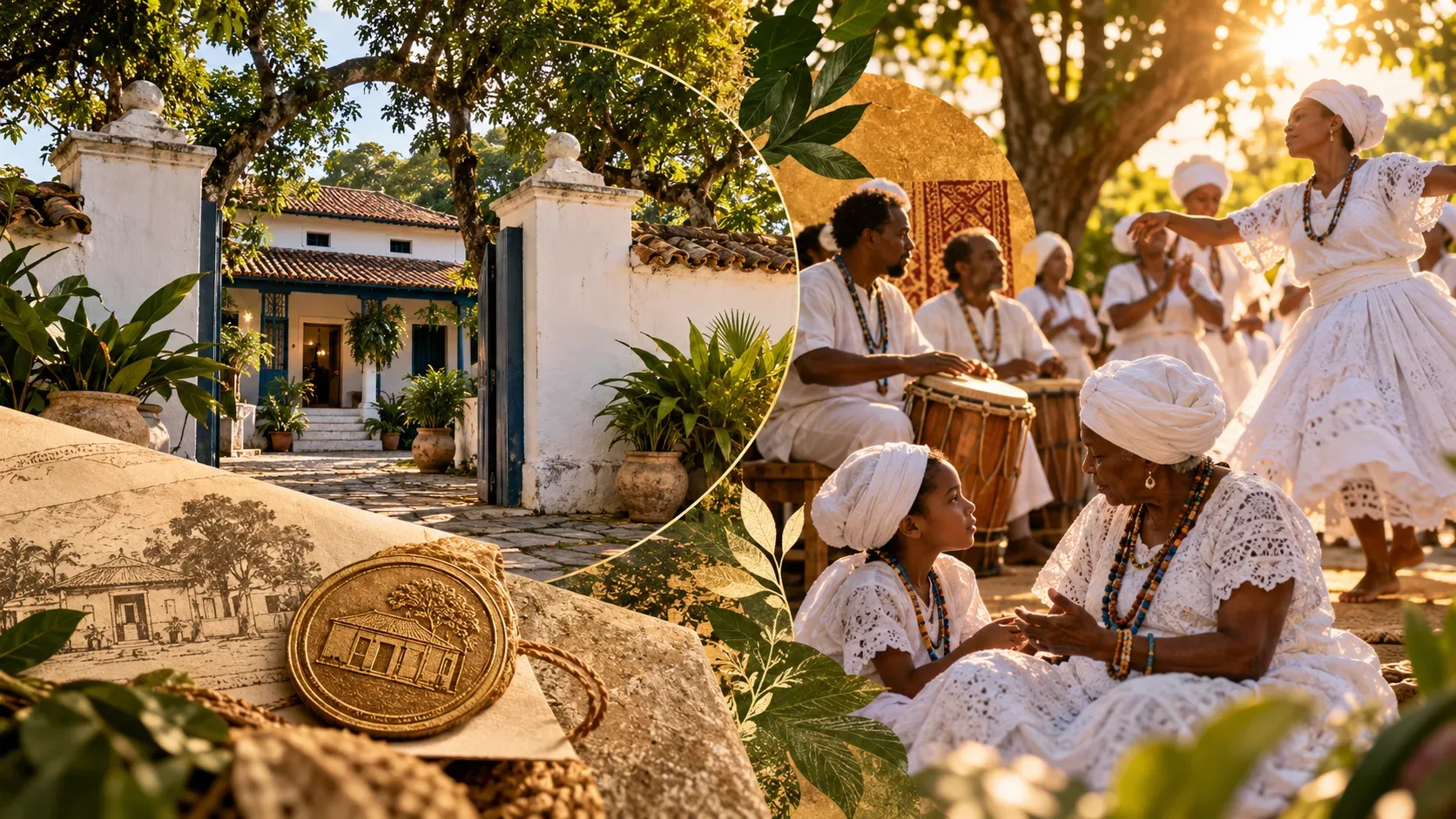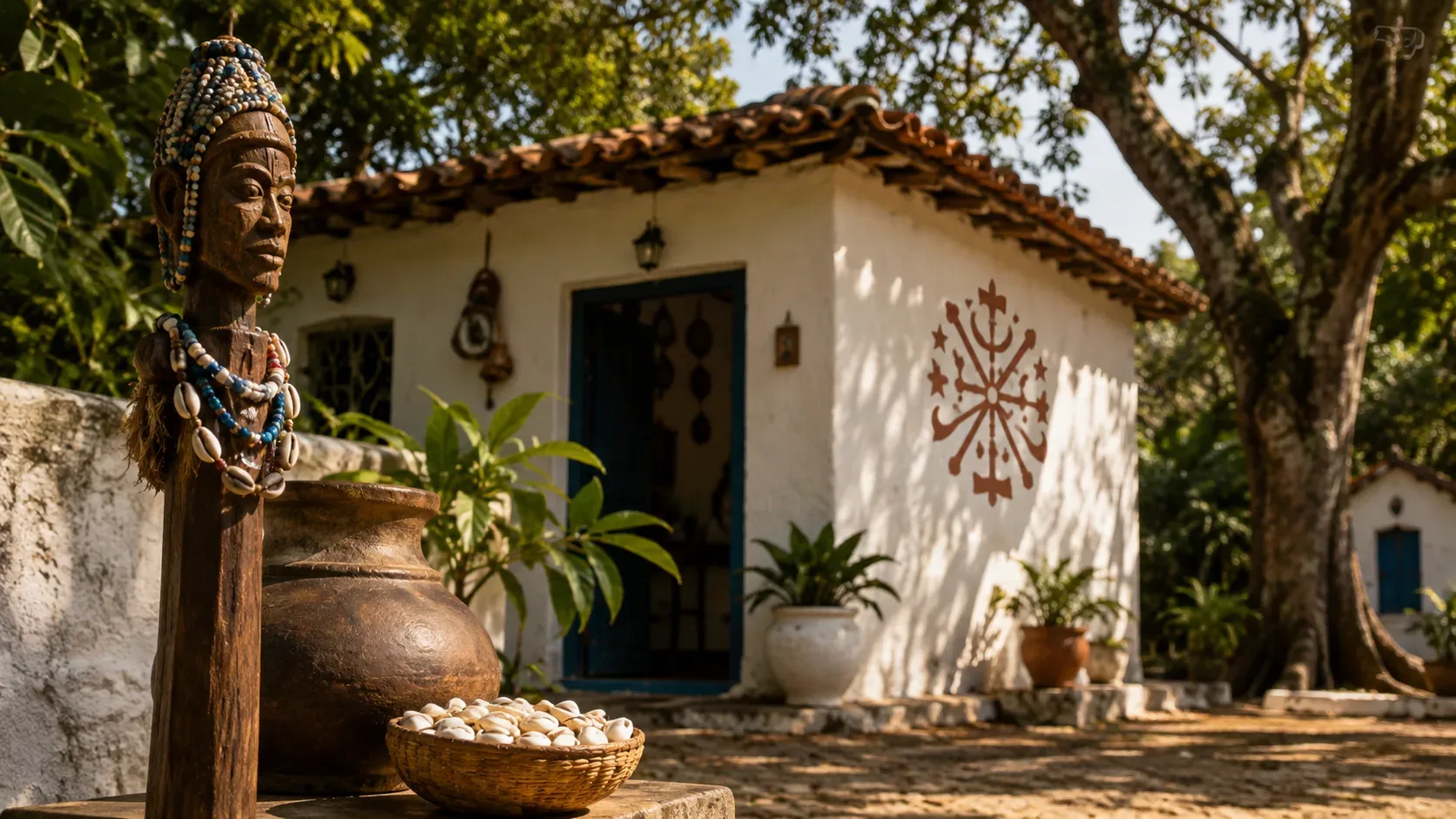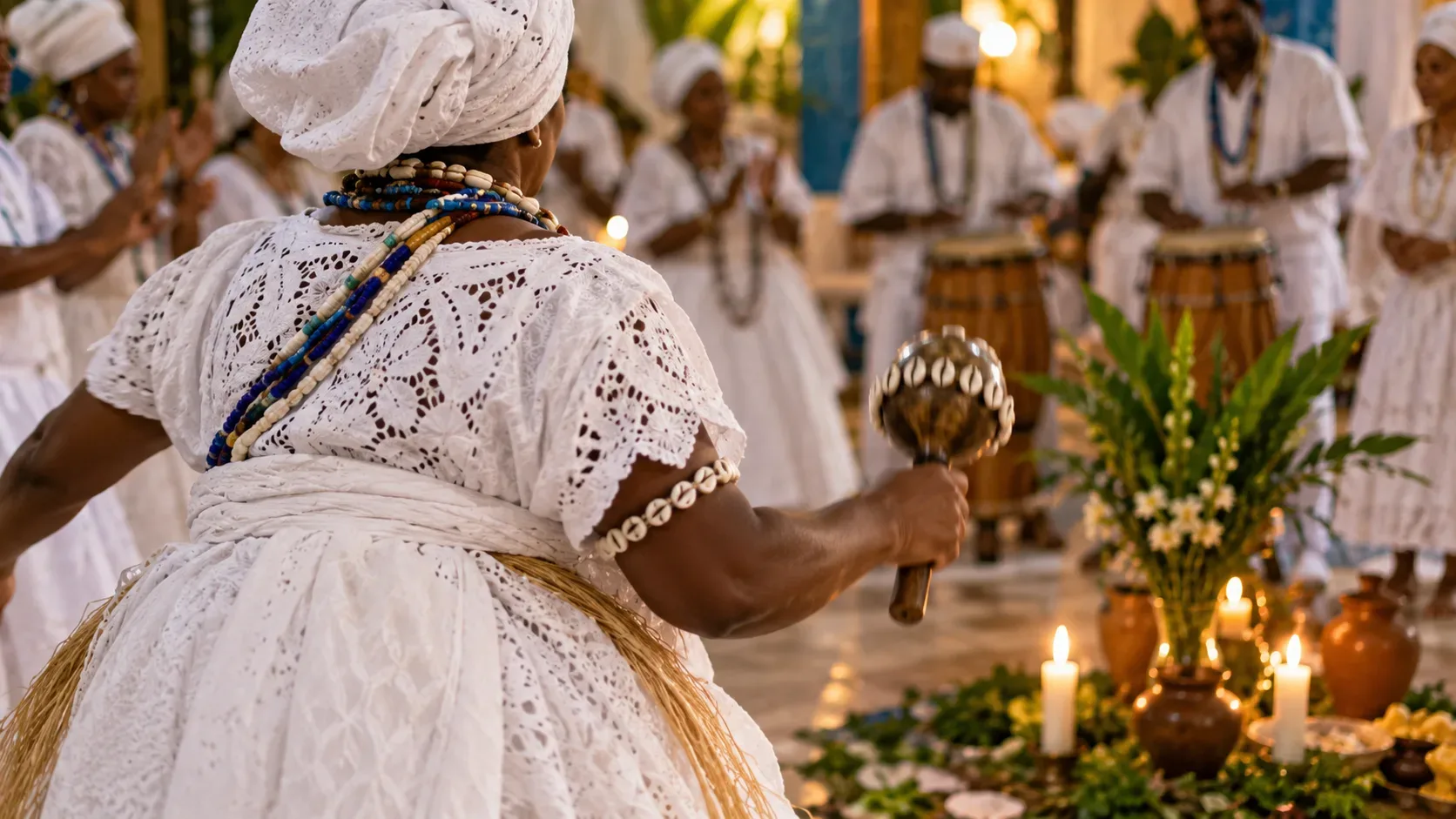
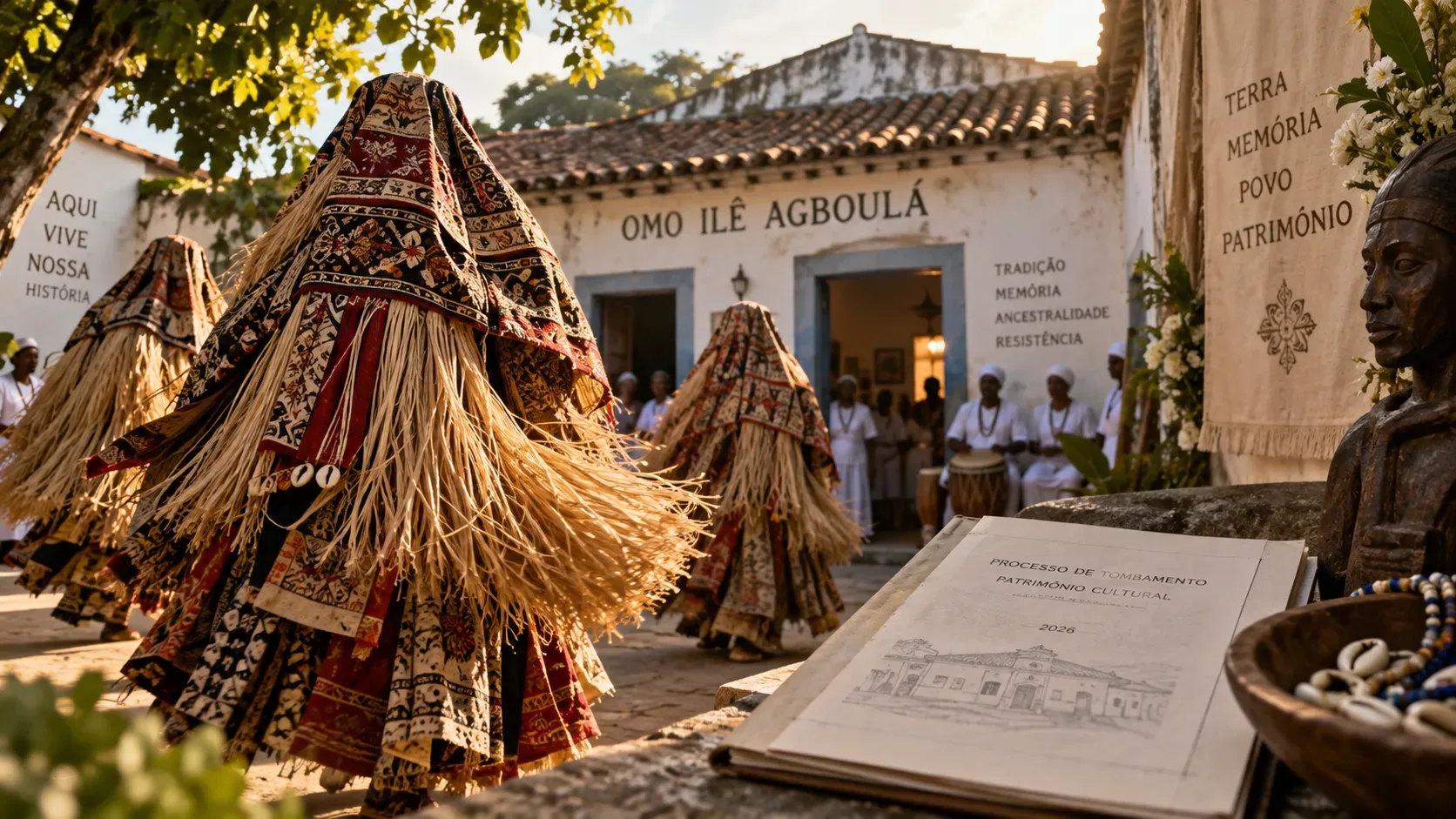
The Bahia state heritage listing of Omo Ilê Agboulá, formalized by the state government on July 22, 2026, recognizes more than a building. In its public presentation of the process, the Bahia Institute of Artistic and Cultural Heritage (IPAC) describes the house, on Itaparica Island, as Brazil’s main reference for the Egúngun ancestral tradition and as the home of the country’s oldest continuously active community dedicated to ancestor worship. That is the key point: heritage protection applies to a living religious territory whose significance comes from the continuity between place, community, memory and tradition.
To understand the scope of the listing without turning oral tradition into an artificially precise chronology, it helps to separate three layers of evidence: the 2026 administrative act, historical records assembled in heritage-protection proceedings, and memories transmitted by the community itself. Official documents make this distinction at several points.
What the 2026 heritage listing recognizes — and what it does not mean
IPAC itself defines heritage listing, or tombamento, as an instrument for protecting material heritage: public authorities place a cultural asset under a special legal regime in order to secure its preservation. This brings restrictions and oversight over interventions in the protected asset, but it does not transfer ownership to the state. In its frequently asked questions, IPAC expressly states that ownership remains with the owner after a property is listed.
For Omo Ilê Agboulá, IPAC’s 2026 dossier page presents the dossier, the listing act and the protected-area plan together. Material protection therefore has to be read alongside the cultural justification: IPAC emphasizes the house’s central role in the Egúngun tradition, the community’s continuity, and the maintenance of its activities and ritual collection. The listing does not turn the terreiro into a museum, does not make restricted spaces or rites public, and does not replace the community’s religious authority.
This distinction also avoids a common mistake: reducing the terreiro’s value to its architecture. In living religious heritage, buildings, courtyards, green areas, objects, ritual circulation and community relationships can form an interconnected system of meaning. Material protection exists precisely because the physical setting sustains practices, memories and bonds that cannot be captured by a purely architectural reading.
Why Omo Ilê Agboulá is a reference point for the Egúngun tradition
In its 2026 summary, IPAC states that Omo Ilê Agboulá is Brazil’s main reference for the Egúngun ancestral tradition. The opinion issued in the federal listing process by the National Historical and Artistic Heritage Institute (Iphan), which documents the same house in an earlier layer of protection, stresses the specificity of this tradition: it is centered on ancestors and has its own religious organization, spaces and bodies of knowledge.
The federal document also places the Egúngun tradition in Bahia within a historical network of terreiros on Itaparica and records Omo Ilê Agboulá as a direct descendant of that lineage. This helps explain why the house’s history cannot be reduced to a single foundation date. The age of the tradition and community, the institutional formation of the house, and the occupation of its current address are different historical questions.
That is why IPAC’s wording is careful: according to the Institute, oral tradition and historical studies place the first invocation of Babá Agboulá in the late nineteenth century, while the institution was formally organized between the 1920s and 1930s. The federal opinion, in turn, records 1934 as the foundation year of the house linked to the Daniel de Paula family. These dates do not need to be forced into false equivalence: they describe different stages of a history transmitted through memory, religious practice and administrative documentation.
Historical milestones that the documentation allows us to reconstruct
| Period | What the documentation records | How to read the evidence |
|---|---|---|
| Late nineteenth century | IPAC attributes the first invocation of Babá Agboulá in this period to oral tradition and historical studies. | It is historical memory explicitly presented as oral tradition supported by research, not as an exact civil-record date. |
| 1920s and 1930s | IPAC places the institution’s formal organization in this period. | It marks the institutional consolidation of the house without erasing an earlier tradition. |
| 1934 | Iphan’s federal opinion records the terreiro as founded in 1934 and linked to the Daniel de Paula family lineage. | This is a milestone used in the federal process for the formal history of the house. |
| 1940 | The federal opinion records a police action against the then-existing headquarters, including repression of leaders and seizure of ritual objects. | It is documentary evidence of persecution faced by Afro-Brazilian religions and helps explain later territorial changes. |
| 1942 | The headquarters was moved to a more secluded area known as Barro Vermelho. | The process relates the move to the need for privacy and protection of religious rites. |
| 1960 | The community moved to Alto da Bela Vista, where the headquarters that became the main subject of heritage protection is located. | This is the territorial milestone for the terreiro’s current configuration. |
| 2002 | Iphan opened the federal heritage-listing process for Omo Ilê Agboulá. | It shows that national recognition resulted from a long technical process involving historical, anthropological, architectural and territorial documentation. |
| 2017 | Iphan records Omo Ilê Agboulá among terreiros listed at the federal level. | This is a national layer of protection that predates the 2026 Bahia state listing. |
| 2019 | Bahia’s Secretariat of Culture reported the opening of IPAC’s state listing process and mentioned provisional protection in the field of intangible heritage. | This is an important stage in the state-level trajectory before the definitive 2026 decision. |
| July 22, 2026 | The Bahia state government formalized the state heritage listing of Omo Ilê Agboulá. | This is the new layer of state heritage protection and the endpoint of the process highlighted by IPAC in 2026. |
The changes of location are part of the heritage story
The federal process is particularly important for understanding why territory and privacy are central themes. The opinion records police repression against the headquarters in 1940 and states that two years later the community moved to a more secluded area. In 1960, the house became established at Alto da Bela Vista.
The same document describes pressures around the property and concern about safeguarding the privacy of sacred areas. In other words, the heritage value does not come only from the physical survival of an old building. It also lies in the community’s ability to reconstruct and maintain a religious territory in the face of persecution, displacement and urban change.
This perspective gives the listing contemporary meaning: protecting the terreiro is not about preserving a frozen image of the past, but about creating legal conditions for a place of memory and worship to continue existing with territorial integrity and respect for its religious function.
Territory, ritual and privacy: documentation has limits
The federal opinion describes buildings and areas that structure life in the terreiro and records the importance of environmental elements and restricted spaces. At the same time, the process makes clear that heritage recognition should not be confused with unrestricted exposure. The technical record acknowledges the need for privacy in religious practice and notes that an initial plan to include certain movable assets and ritual materials in the federal listing was withdrawn because there was not a sufficient inventory at that point.
This matters when reading the 2026 state listing. A heritage dossier can document values, historical trajectories and territories without exhausting the house’s religious knowledge. Official recognition does not give the public an automatic right to access rites, objects, restricted areas or information that the community regards as protected. Cultural heritage protection and respect for religious secrecy are not opposing goals.
Oral tradition and documentary records are not the same — and do not need to be
The clearest example appears in IPAC’s own summary. The Institute does not present the late nineteenth century as a civil-record foundation date: it attributes the first invocation of Babá Agboulá to oral tradition and historical studies. It then distinguishes that memory from the institutional organization that took place between the 1920s and 1930s.
- Administrative fact: the Bahia state heritage listing was formalized on July 22, 2026.
- Historical and technical record: heritage proceedings document milestones such as 1934, the 1940 repression, the 1942 move and the occupation of Alto da Bela Vista from 1960 onward.
- Oral tradition: preserves memories about ancestry, religious lineage and episodes that predate the available administrative record.
Separating these categories does not downgrade oral tradition. On the contrary, it prevents oral memory from being forced into a type of evidence it does not claim to be. For heritage rooted in African and Afro-Brazilian traditions, oral transmission can be constitutive of the cultural asset itself. Sound documentary reading identifies the provenance of each claim while preserving those differences.
The 2026 state listing was not the house’s first heritage recognition
Omo Ilê Agboulá had a substantial heritage-protection history before 2026. The federal process opened in 2002 resulted in Iphan listing the site, which the federal institute itself records as having occurred in 2017. In 2019, Bahia’s Secretariat of Culture reported the opening of IPAC’s state listing process. In addition, IPAC currently includes the “Terreiro de Culto Baba Egum Omó Ilê Agboulá” in its Special Register of Knowledge and Ways of Doing, an instrument for intangible cultural heritage.
This shows why registration and material heritage listing are not synonyms. Intangible registration recognizes cultural references, knowledge and practices; material listing protects physical assets and territories. In Omo Ilê Agboulá’s case, the two approaches come close because physical space and the continuity of tradition are inseparable in the community’s experience, even though each instrument has its own legal and administrative effects.
What the 2026 listing adds to the understanding of the house
The Bahia state act consolidates, within the state heritage-protection system, an interpretation already visible in earlier processes: Omo Ilê Agboulá is significant not only because of age, but because of continuity, religious centrality, community memory and resistance. IPAC presents the house as a national reference for the Egúngun tradition and as a continuously active ancestral community.
The most useful contribution of the dossier is therefore a layered reading. The state protects a material asset and its territory; historical documentation records persecution, displacement and strategies of continuity; oral tradition preserves references that predate administrative records; and the community remains the authority over its religious knowledge and rites. Reading the 2026 listing this way avoids two reductions: treating the terreiro as merely a historic building, or treating oral tradition as though it were a civil archive of exact dates.
Sources consulted
- IPAC — Dossiers and newly listed heritage assets in 2026.
- IPAC — General concepts of material heritage and heritage listing and Frequently asked questions.
- Iphan — Opinion in Process No. 1505-T-02 on Omo Ilê Agboulá.
- Bahia Secretariat of Culture — opening of the state listing process in 2019.
- IPAC — Special Register of Knowledge and Ways of Doing.