The best-known rule about what seems simple: indicative for facts and subjunctive for hypotheses. It helps at first, but fails precisely when the Spanish uses the subjunctive for information that could be perfectly true. The difference is not just knowing whether something happened or not. It is also important to know whether the speaker is affirming this information as a central part of the message or whether he treats it as something already known, accepted or placed in the background.
The New Spanish Language Grammar, from RAE and ASALE, describes this alternation from two axes. On the one hand, there are hypothetical concessive constructions, in which aunque is approximately equivalent to “even in the case that” and favors the subjunctive. On the other hand, there are factual constructions, in which the situation is taken as true. And it is in this second group that the indicative and subjunctive can alternate with an informative change of perspective.
First filter: is the situation hypothetical?
When the clause introduced by aunque presents a possibility whose realization is not being affirmed, the subjunctive is the natural choice. In Aunque llueva mañana, we will go to the park, the speaker does not inform us that it is going to rain. The meaning is “even if it rains tomorrow, we will go to the park”. Rain is an eventuality and not a statement.
This value frequently appears when the main clause projects the situation into the future or establishes a decision regardless of what happens. In Te llamaré aunque no haya nadie, the absence of people is not taken as a fact; it is a possibility that will not prevent the connection. The same mechanism appears in orders, promises, predictions and other prospective constructions.
For this reason, a first practical question works well: is the content after aunque being presented only as a possibility? If the answer is yes, the subjunctive is usually the clearest way to go.
Second filter: if it is factual, am I stating the information?
The difficulty begins when the content is factual. Academic grammar notes that, in factual concessives with aunque, both moods can appear. The main difference becomes how the information is placed in the speech.
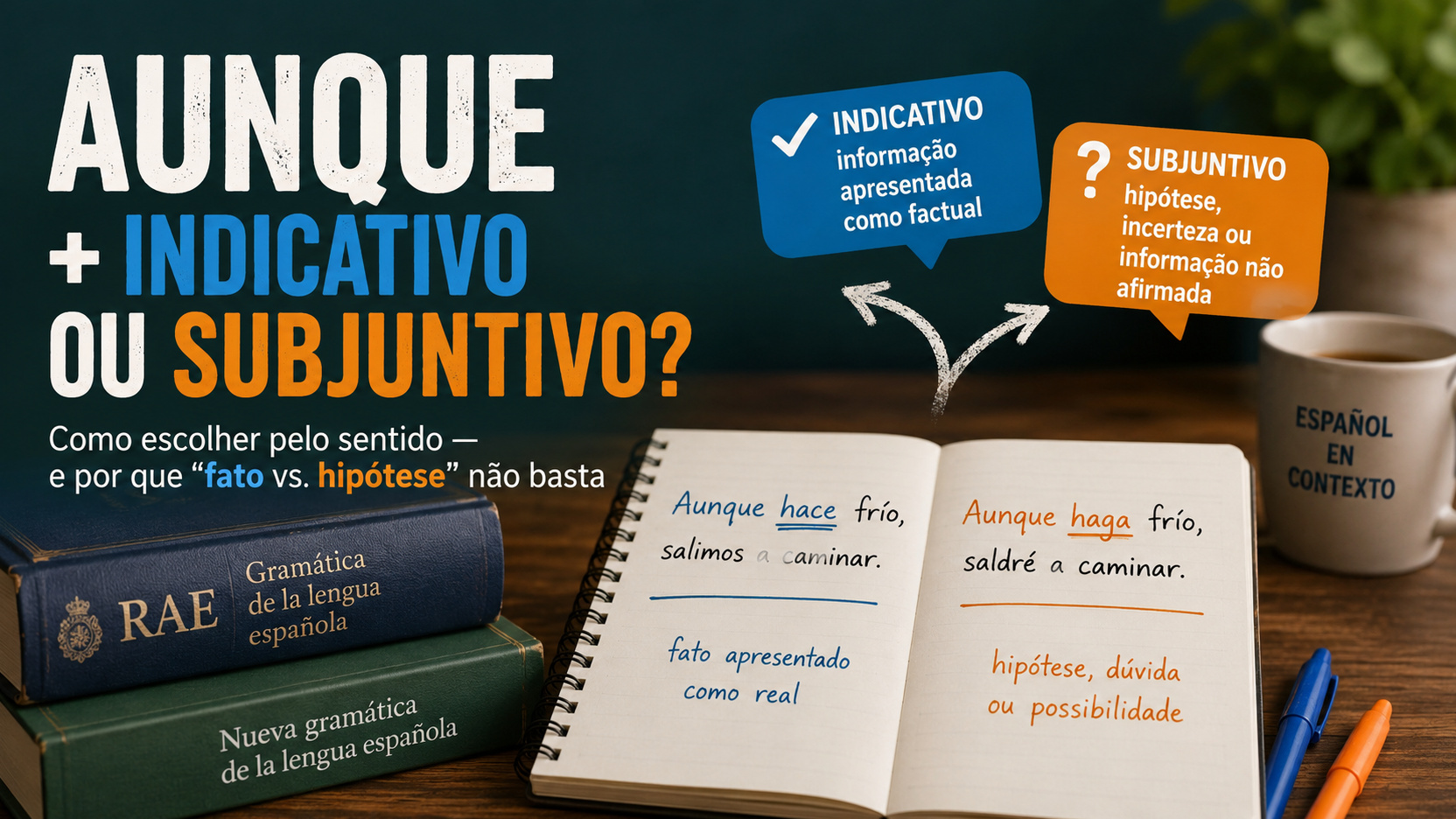
With the indicative, the speaker tends to present the content as a statement. Compare: Even though it's cold, we go out walking. Here, hace frío does not function as a simple hypothetical scenario. The speaker presents the fact that it is cold and adds that, despite this, people go out for a walk.
The indicative, therefore, does not just mark “reality” in an abstract way. It can also give the excerpt introduced by aunque a more assertive value, as information that the speaker is actually putting into the conversation.
This explains why some constructions with aunque + indicative approach an adversative value. In Es simítico, aunque habla excessive, the second excerpt sounds like information added by the speaker himself: he is friendly, but he talks too much.
Third filter: is the information already given or shared?
The subjunctive can also appear when the situation is factual, but the speaker does not want to present it as new information. The RAE describes this use as thematic or presupposed: the content remains in the background of the conversation, as something that the interlocutor already knows, has just said, experienced or that the speaker decides to treat as known.
Imagine a dialogue. One person says: Carlos is tired. The other responds: Although you're tired, you have to finish the work. The subjunctive estar does not mean that the second person doubts Carlos' tiredness. On the contrary: she can fully accept this information and just remove it from the center of the discussion. The meaning is close to “even if you are tired, that doesn’t change the obligation”.
RAE grammar also draws attention to the so-called controversial subjunctive in replies. It appears when the speaker takes up an argument from the interlocutor to admit this point and, at the same time, deny that it is decisive. In this type of context, the subjunctive does not weaken the truth of the fact; weakens its relevance to the conclusion.
Why “indicative = fact” is not enough
Consider two very similar sentences: Even if it's expensive, I'll buy it. Even if it's expensive, I'll buy it.
In the first, es caro presents the high price as an affirmation of the speaker. He informs or reaffirms that the product is expensive and, despite this, says he will make the purchase.
In the second, if expensive can have a hypothetical reading: “even if it is expensive, I will buy it”, without stating yet what the price will be. But the same phrase can appear in a factual context.
If the interlocutor has just said that the product is expensive, Aunque sea caro, lo compraré can be equivalent to “yes, even though it is expensive, I will buy it”. The fact is accepted, but treated as background or as an insufficient argument to change the decision.
This is why an isolated sentence does not always allow classifying the subjunctive as “doubt”. The context may show that the speaker knows perfectly well that the information is true.
The contrast between hace and haga frío
The pair Aunque hace frío, salimos a caminar and Aunque haga frío, saldemos a caminar is useful because it shows two differences at the same time.
In Aunque hace frío, we go out walking, the indicator makes the temperature a statement of information. The phrase can be said looking out the window or after noticing the cold: it's cold, and we still go out.
In Aunque haga frío, saldvamos a caminar, the future saldremos favors a prospective reading: maybe it will be cold, maybe not, but the decision to walk remains. Here the subjunctive naturally matches the hypothesis.
But don't conclude that haga always equates to “maybe”. If everyone already knows that it is cold, someone can also say Aunque haga frío, let's go out and use the subjunctive to treat the cold as a known circumstance that does not change the decision. The mode depends on how the speaker frames the information, not just the actual temperature.
New information and background information
The distinction between new information and background information is one of the most useful keys to understanding alternation. Nueva Grammar itself explains that the indicative in factual concessives tends to have an assertive value, while the subjunctive can make the sentence function as part of the informative transfer shared between speaker and listener.
This does not mean that all new information necessarily requires an indicative nor that all shared knowledge necessarily requires a subjunctive.. This is an interpretative tendency, not a mechanical table. Spanish allows the speaker to choose how they want to present the content: as something they are stating or as something that can already be taken as the basis of the conversation.
This choice is especially visible when two forms are grammatically possible. In Aunque has approved the exam, tendrás que estudiar más, the speaker presents the fact of having been approved in an assertive way. In Aunque hayas aprobado el Examen, tendrás que estudiar más, the approval may continue to be completely factual, but it is treated as information already assumed, known or secondary to the conclusion “you will have to study more”.
Where the translation into Portuguese can hide the difference
For those who think first in Portuguese, the difficulty increases because translations such as “although”, “despite” and “even though” do not always maintain the same opposition so that Spanish constructs with aunque. Two different Spanish phrases can end up translated very similarly.
Therefore, translating first and choosing the mode later is usually a fragile method. It's safer to ask what the speaker is doing with that information within the conversation.
If the idea is “I don’t know if this will happen, but it doesn’t change the result”, the subjunctive tends to emerge naturally. If the idea is “this happens or has happened, and I am reporting this fact”, the indication gains strength. If the idea is “this is true, you already know this, and yet I don't consider it decisive”, the subjunctive may also be the most natural choice.
A decision method in three questions
1. Is it just a possibility?
If the sentence with aunque does not state that the situation occurs or will occur, treat it as a hypothesis. While the full context always matters, this is typical subjunctive terrain: Aunque llueva, we will; Just call me, don't change your opinion; Even if it proves difficult, we will try.
2. If it's factual, do I want to state it as part of the message?
When the situation is real and the speaker wants to present it as effectively stated information, the indicative is a natural option. Aunque is tired, continues working informs that he is tired and adds that he continues working.
3. Am I resuming or downgrading already known information?
If the factual content is already in the conversation, is presupposed or is used only as a concession that does not change the conclusion, the subjunctive may appear. Even though you're tired, finishing doesn't have to mean “maybe you're tired”. It can mean “even if you're tired, as we already know, that doesn't change what needs to be done.”
When the future favors the subjunctive
The presence of future, imperative and other prospective contexts tends to favor hypothetical readings. This helps to understand why constructions like Llamaré aunque no haya nadie sound so natural: the main clause is designed for a moment when it is not yet known whether there will be someone.
The important thing is not to turn this tendency into a blind rule of verb tense. The future helps to create the prospective scenario, but the choice remains linked to the way the content of aunque is interpreted in the discourse.
When the indicative after aunque sounds almost like “but”
In some contexts, it introduces additional information that limits or corrects what came before. In these cases, the indicative is common because the prayer has assertive force. It's a good film, although it lasts about three hours, there's no doubt about its duration. The speaker affirms this fact and uses it as a caveat.
This reading shows that aunque is not just a fixed piece equivalent to a single Portuguese conjunction. Depending on the position, intonation, verbal mode and context, he can construct a more integrated concession or a reservation close to “but”, “only” or “despite that”.
How to interpret real examples without memorizing a table
When you find aunque in a news story, conversation, book or exercise, don't stop at the verb. Read what came before and what comes after. Ask if the prayer introduces new information, revisits something already accepted or creates a scenario that might come true.
This contextual reading explains cases that a two-column rule cannot resolve. The same objective fact can appear in the indicative or subjunctive because the speaker can present it in two different ways. What changes is not necessarily external reality; changes the informative status that content receives in the sentence.
The best rule, therefore, is not “indicative = fact” and “subjunctive = hypothesis”. It's this: first find out if there is a chance. If there is not, observe whether the speaker is affirming the information or treating it as already known, accepted or argumentatively secondary. After aunque, the verb mode is also a choice of perspective.