
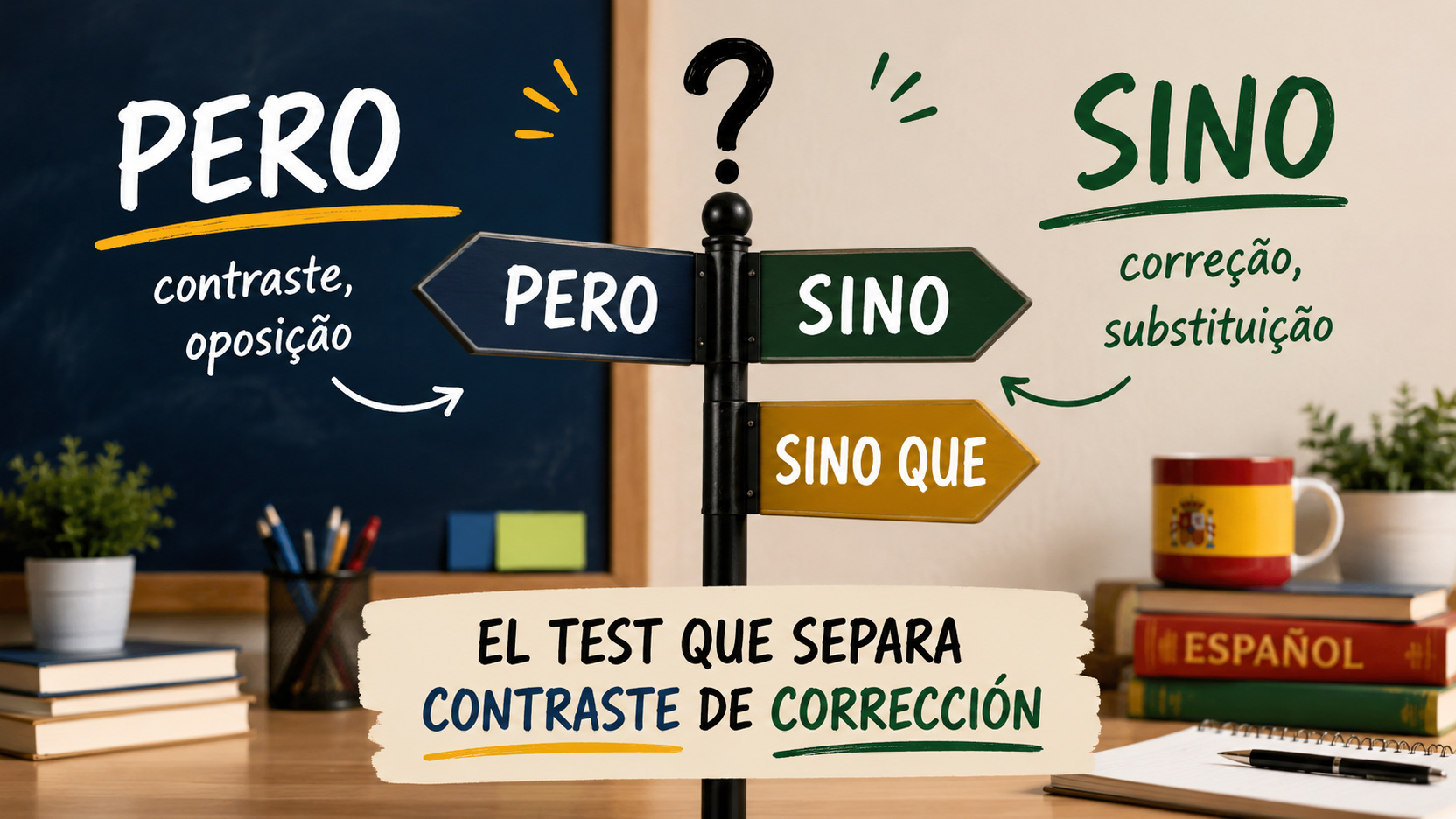
If you automatically translate the Portuguese word “mas” as pero, you will often be right, but you will be wrong precisely in the cases where Spanish uses sino. The decision does not depend only on whether there is a negation before the conjunction. The key is meaning: does the second part merely contrast with the first, or does it correct and replace something that was denied?
The practical rule is this. If both pieces of information can remain true at the same time, use pero. If the second piece of information corrects the denied element and puts something else in its place, use sino. When that correction introduces a clause with a conjugated verb, the most common form is sino que.
Negation alone does not decide between pero and sino
The most common mistake is to memorize “after no, use sino.” That does not work. Pero can normally appear after a negative sentence when the second member adds contrasting information without erasing the first.
No tengo coche, pero llego puntual.
Here, “I do not have a car” remains true. “I arrive on time” does not replace the car with something else; it simply creates a contrast between a possible expectation and the actual result. That is why pero is used.
Compare it with:
No tengo coche, sino moto.
Now the logic has changed. The speaker rejects “car” and corrects the information with “motorcycle.” In Portuguese, this is equivalent to “não tenho carro, mas sim moto.” That is why sino is used.
The same distinction appears in another pair:
No fui al cine, pero vi una película en casa.
No fui al cine, sino al teatro.
In the first sentence, not going to the cinema and watching a movie at home are compatible facts. In the second, “al teatro” replaces the denied destination “al cine.”
The 10-second test: contrast or correction?
Does the second part correct what was denied?
Read the sentence up to the negation and ask: is what follows saying “not X, but rather Y”? If the answer is yes, sino is the natural candidate.
No quiero té, sino café.
No es azul, sino verde.
No trabaja en Madrid, sino en Sevilla.
In all these cases, the second term takes the place of the first. Tea is replaced by coffee, blue by green, Madrid by Seville. The first term is not merely limited; it is rejected for that situation.
Can both pieces of information remain true?
If the answer is yes, the relationship tends to be one of contrast, restriction, or broken expectation. In that case, pero is the normal choice.
No quiero café, pero acepto agua.
No habla mucho, pero entiende todo.
No es rico, pero vive bien.
The second part does not correct what came before. It adds something that may surprise, limit a conclusion, or create opposition, but the first statement remains valid.
This is why a negative sentence can still require pero. In a teaching discussion from the Centro Virtual Cervantes, the example “No he corrido, pero estoy sudada” appears precisely to illustrate this problem. Not having run remains true; being sweaty adds unexpected information. The negation is present, but there is no replacement.
When to use sino without que
Sino works very well when the corrective element is a word, a group of words, or a construction without a conjugated verb that replaces the denied term.
No llamó Ana, sino Marta.
No compró el libro nuevo, sino el usado.
No vino por trabajo, sino por vacaciones.
No salió para discutir, sino para escuchar.
The RAE grammar notes that sino can introduce terms of different types, including nominal, adjectival, and clausal elements. For learners, the most useful point is to notice the parallelism: the sentence denies one possibility and presents another as the relevant correction.
In Portuguese, “mas sim” is often a good clue. “Não foi Ana, mas sim Marta” maps directly to “No fue Ana, sino Marta.” The clue helps, but the meaning test is more reliable than a word-for-word translation.
When to use sino que
Sino que appears when the correction happens at the level of a clause with a finite verb. Instead of replacing only a noun, adjective, place, or infinitive, the second member brings in a new clause.
No estudia, sino que trabaja.
No vendí el coche, sino que se lo presté a un amigo.
No es que no quiera ayudarte, sino que hoy no tengo tiempo.
In all three sentences, the second clause corrects the interpretation denied earlier. The practical idea is the same as with sino: “it is not X; the correct information is Y.” What changes is the form of the second member.
That is why a useful teaching rule is: correction with a simple term or infinitive, sino; correction with a clause containing a conjugated verb, normally sino que.
Sino que does not require the indicative
Another oversimplification that causes errors is the idea that sino que is always followed by the indicative. The verbal mood depends on the construction in which the clause appears.
Yo no quiero que me devuelvas el dinero, sino que lo uses para el viaje.
Here, the subjunctive is tied to the pattern quiero que and to the desired content. Sino que organizes the correction between the two members, but it does not choose the verbal mood on its own.
Compare it with:
No es que esté enfadado, sino que está cansado.
In this type of structure, the first part can use the subjunctive in no es que..., while the second presents the chosen explanation as factual. The important point is not to turn sino
que into an automatic rule for verbal mood.
The Portuguese word “mas” hides two different relationships
For Brazilian learners, the difficulty arises because “mas” covers situations that Spanish distributes between pero and sino. Two very similar Portuguese sentences can require different connectors.
“Não quero café, mas aceito água.”
No quiero café, pero acepto agua.
The water does not correct the coffee; it adds an accepted alternative. Both pieces of information coexist.
“Não quero café, mas chá.”
No quiero café, sino té.
Now tea replaces coffee at the point being denied. The meaning is “not coffee, but rather tea.”
This distinction is more useful than memorizing isolated equivalents. Before translating “mas,” identify the logical relationship the sentence is trying to express.
Why “there is a no” is an insufficient rule
A study by Iandra Maria da Silva, published by the Centro Virtual Cervantes and developed with intermediate Spanish students in a course at the Federal University of Santa Catarina, began precisely with difficulties involving pero and sino. The activity worked with occurrences taken from journalistic texts from Spanish-speaking countries and highlighted an important pedagogical difference: pero limits or adds a new aspect without excluding the previous idea, while sino operates in an exclusive or substitutive way in corrective use.
This difference explains sentences that seem confusing when we look only at the presence of no. In “No es barato, pero funciona muy bien,” the first evaluation remains in
force and the second creates a contrast. In “No es barato, sino carísimo,” the second evaluation corrects the first and replaces it with a more appropriate one.
The decisive question, therefore, is not “is there a negation?” The question is “does the second member preserve the first information and contrast with it, or does it reject an element in order to put another in its place?”
A diagnosis with minimal pairs
No vive en Madrid, pero trabaja allí
The person does not live in Madrid, but works there. Both facts can be true at the same time. Use pero.
No vive en Madrid, sino en Toledo
Toledo replaces the denied location. Use sino.
No estudia por la mañana, pero trabaja por la tarde
The second piece of information does not correct the first. It adds a contrast between two activities and times of day. Use pero.
No estudia por la mañana, sino por la noche
The morning period is denied and replaced by the night period. Use sino.
No dijo que vendría, sino que llamaría
The second clause corrects the content attributed to the statement. Because the corrective member is a clause with a conjugated verb, use sino que.
No dijo que vendría, pero llamó después
The link is one of contrast between two facts: he did not say he would come, and he called later. Nothing is being replaced. Use pero.
What about the no solo... sino también structure?
There is an important use of sino that is not simply “not X, but rather Y.” In the correlation no solo... sino también, the relationship is additive: the second member adds information and reinforces the first.
No solo estudia español, sino que también practica con hablantes nativos.
The RAE records this value of sino in correlation with no solo. For the choice between pero and sino when translating “mas,” it is useful to treat this construction as a pattern of its own. If the sentence already has no solo, the expected continuation is normally sino or sino que, often accompanied by también.
Do not confuse sino with si no
Sino is one word when it functions as the adversative conjunction discussed here. Si no is two words: si is the conditional conjunction and no is the negation.
No quiero té, sino café.
Si no quieres té, pide café.
In the first sentence, sino corrects the choice. In the second, si no means “if not.” The difference in spelling corresponds to a real difference in structure and meaning.
The final rule for deciding without translating mechanically
When you encounter “mas” in Portuguese, stop before choosing the Spanish word. If the second part merely contrasts, restricts, or breaks an expectation and the first remains true, use pero. If the second part corrects something that was denied and presents the replacement, use sino. If that correction comes as a clause with a conjugated verb, normally use sino que.
This test also solves the most misleading case: a negative sentence does not force sino. What matters is the function of the second part. Contrast preserves the first information; correction replaces it.