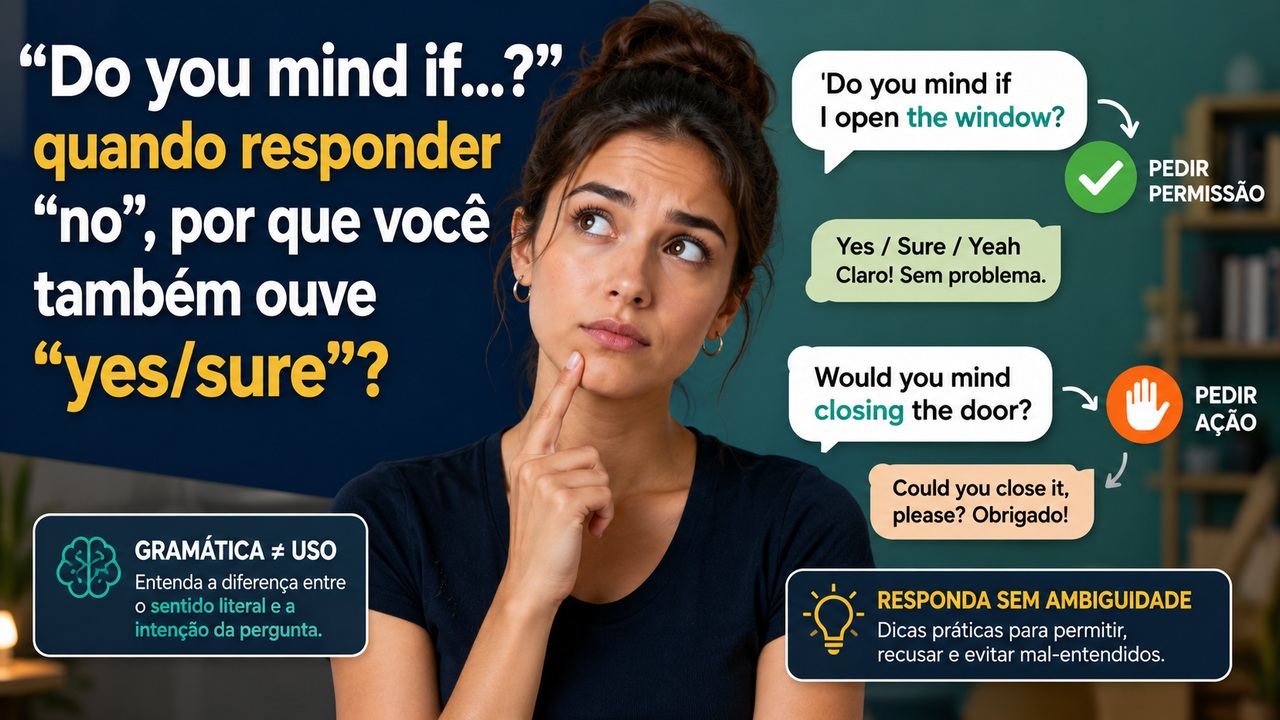
If someone asks "Do you mind if I open the window?", the answer that follows the literal logic to allow is "No, not at all" or another way that makes it clear that you don't mind. Even so, in spoken English you can also hear "Sure", "Yeah, sure" or "Of course" with a sense of permission. The apparent contradiction exists because the phrase works on two layers: the literal question is about discomfort, but the practical intention is usually "Can I do this?".
The most important point is not to turn this construction into a mechanical yes or no rule. When clarity matters, the best response is one that makes the intention explicit: "No, go ahead" to allow; "I'd rather you didn't" to refuse; and "Sure, I'll do it" when the person asked you to do an action.
The question has a literal and a pragmatic layer
The verb mind, in this usage, means something close to "to care", "to be bothered" or "to have an objection". Therefore, "Do you mind if I sit here?" can be read literally as "Do you mind if I sit here?" If the answer is "No", the literal meaning is "No, I don't care", therefore the action is permitted.
But conversations are not exercises in formal logic. Many questions in English have a grammatical form and at the same time perform another communicative function. "Can you pass the salt?", for example, is formally a question about ability, but usually functions as a request. "Do you mind if I...?" follows a similar logic: asks about discomfort and, at the same time, asks for permission.
This mismatch explains why a person may respond to the implicit intention instead of responding to the verb mind. If she understands the question as "May I...?" or "Is it OK if I...?", a response like "Sure" could mean "Of course, you can". Literal grammar does not disappear, but the conversation privileges the objective recognized between the participants.
Do you mind if I...? It's a request for permission
The construction "Do you mind if I + verb" is used to politely ask whether the person speaking can do something themselves. "Do you mind if I sit here?" In practice, it means "Can I sit here?" "Do you mind if I ask you something?" means "Can I ask you something?".
With do, it's natural to use the present tense after if: "Do you mind if I open the window?" With would, a traditional and very common way is to use the past tense: "Would you mind if I opened the window?". The past here does not necessarily indicate a past action; it helps create distance and politeness.
To allow without ambiguity
The answer most aligned with the literal form is "No, not at all". It amounts to "No, it doesn't bother me at all." "Not at all" also works on its own. If you want to make the result impossible to interpret in reverse, add the permission: "No, go ahead", "Not at all, go ahead" or "No problem, go ahead".
"Sure" and "Of course" are also often understood as a positive response to implicit permission. Still, "Sure, go ahead" is better than "Sure" alone when the context might raise doubt. The "go ahead" complement explicitly informs that the person
you can continue.
To refuse without sounding like a yes/no prank If you really care or don't want to allow the action, "Yes" is logically possible in the sense of "Yes, I do mind", but may sound abrupt or create confusion if it comes alone. Forms such as "Actually, I'd rather you didn't", "I'm afraid I'd prefer you didn't" or "Sorry, please don't" make the refusal clear without depending on the interpretation of an isolated word.
The useful contrast is simple: to allow, say there is no problem and authorize the action; To refuse, say that you prefer the person not to do that. Communication is safer when the response contains practical consequences.
Why do you hear sure, yeah and even yes if logic asks for no?
Because the interlocutor does not always answer the question literally. It often responds to the request for permission behind it. "Do you mind if I look around?" can be rendered conversationally as "Can I look around?". In this framework, "Sure" means "Sure, you can" or "Sure, go ahead".
This usage is not just an invention of apprentices. English educational materials record "Do you mind if...?" along with responses such as "Sure, no problem", which shows that the affirmative response to communicative intention is a recognized convention. At the same time, reference grammars recommend negative responses such as "No, not at all" when responding directly to the verb mind.
The two things can coexist because there are two possible targets for the response. One is "Do you object?". The other is "May I do this?". "No" naturally answers the first; "Sure" naturally responds to the second.
"Yes" alone deserves more care. It can literally mean "Yes, I care" or, in certain conversations, function as a "yes, I can" directed at the permission intention. Because the same word can point to opposite results, it is a poor choice when there is not enough intonation, gesture, or context to disambiguate.
Would you mind + -ing? usually asks the other for action
Now the structure changes and who should act. In "Would you mind closing the door?", the speaker wants the interlocutor to close the door. In practice, it is a polite request similar to "Could you close the door, please?".
Here, "No, not at all" continues to make literal sense: "No, I wouldn't mind closing." But a pragmatic response like "Sure" is also natural, because it means "Sure, I'll do it." To make everything explicit, "Sure, I'll close it" is excellent.
If you cannot fulfill the request, a response like "Sorry, I can't right now" is clearer than trying to resolve the situation with just yes or no.
Not to be confused with Do you mind me/my + -ing?
There is an important difference between "Would you mind closing the door?" and "Would you mind me closing the door?" In the first, the interlocutor is the one who must close. In the second, the speaker asks if the interlocutor is bothered by her closing the door.
The pronoun makes it clear who will perform the action. Forms with "me" are very common in speech; Possessive forms, such as "my closing the door", are more formal. For the learner, the
practical point is to identify the agent: without a subject expressed before -ing, the request is normally for the interlocutor to act; with "me/my", the action belongs to the speaker.
A better mental matrix than memorizing in
Do you mind if I open the window?
The intention is to ask permission for me to open the window. If you allow it, "No, go ahead" is unequivocal. "Sure, go ahead" also works because it responds to implicit permission. If you don't allow it, "I'd rather you didn't" prevents the inversion.
Would you mind if I opened the window?
The intention is still to ask permission for me to open the window, but the way is more indirect and polite. The response logic is the same: "No, not at all" allows; "I'd rather you didn't" refuse.
Would you mind closing the window?
Now we ask you to close the window. "Sure, I'll close it" accepts the request. "Sorry, I can't right now" refuses or postpones. The answer needs to tell you whether you will do the action, not just whether the idea bothers you.
Would you mind me closing the window?
The question is again about permission for my action. "No, go ahead" allows it. "Actually, I'd rather you didn't" refuse.
Do you mind? alone can be a sign of irritation
"Do you mind?" Isolated does not have to be a polite request for permission. Depending on the context and intonation, it can mean something close to "Do you mind?", "Can you stop?" or "Excuse me!", with irritation at someone's behavior.
If a person occupies a place that another considers theirs, makes noise or invades space, "Do you mind?" can act as a complaint. In this case, trying to apply the "no = permission" rule doesn't help, because the communicative function has already changed. The context tells whether the expression is opening a request, asking for an action, or reprimanding someone.
How to respond without ambiguity in practice
If you want to allow an action after "Do you mind if I...?", use a response that combines no objection and authorization, such as "No, not at all. Go ahead". If you prefer a shorter, more natural form, "Sure, go ahead" also clearly communicates permission.
If you want to refuse, don't depend on "Yes". Say "I'd rather you didn't", "I'm afraid not" or "Sorry, please don't" depending on the degree of formality and the situation. These phrases directly inform the expected result.
If the question is "Would you mind + -ing?" and you agree to do the action, respond with a commitment to action: "Sure, I'll do it", "Of course" or "No problem". If you can't, explain: "Sorry, I can't right now."
In written text, bad video calls, customer service or any context in which gesture and intonation are not available, it is even more worth avoiding isolated yes and no. The complete sentence takes the guesswork out of which part of the question the answer refers to.
The rule that's really worth remembering
Don't just memorize "Do you mind = answer no". Memorize the question hidden behind the structure. If someone wants permission, make it clear whether they can or cannot. If someone wants you to do something, make it clear whether you will or won't do it.
This way, the grammar no longer seems inverted. "No, go ahead" answers the literal question about inconvenience. "Sure, go ahead" responds to the implicit request for permission. Both can work, but the safest answer is always the one that includes the practical consequence and does not force the other person to decipher a solitary yes or no.