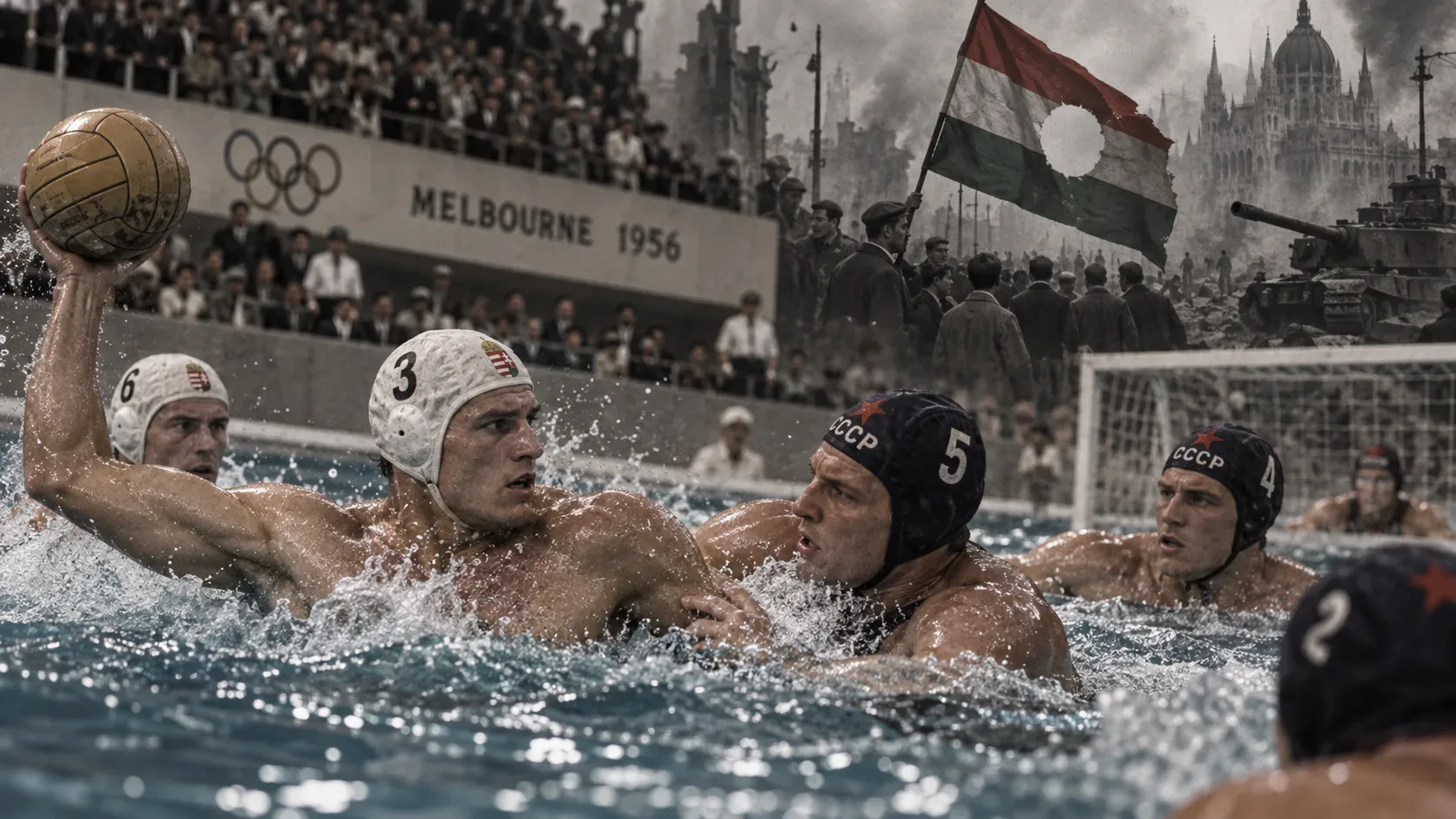
On December 6, 1956, Hungary and the Soviet Union entered the pool at Olympic Park in Melbourne carrying far more than points in an Olympic water polo competition. Just over a month earlier, Soviet forces had crushed the Hungarian Revolution. When the game ended before regulation time, with Hungary leading 4–0 and Ervin Zádor leaving the water with blood on his face, one photograph turned that afternoon into one of the Cold War’s most enduring sporting symbols.
Seventy years later, the episode is still known as Blood in the Water. But the story becomes clearer when we separate what happened in Hungary, what was at stake in the Olympic tournament, what occurred in the pool, and what public memory later added. The match was brutal and politically charged, but it was not literally a “battle” between two states, nor was it technically a knockout semifinal.
What happened before Melbourne
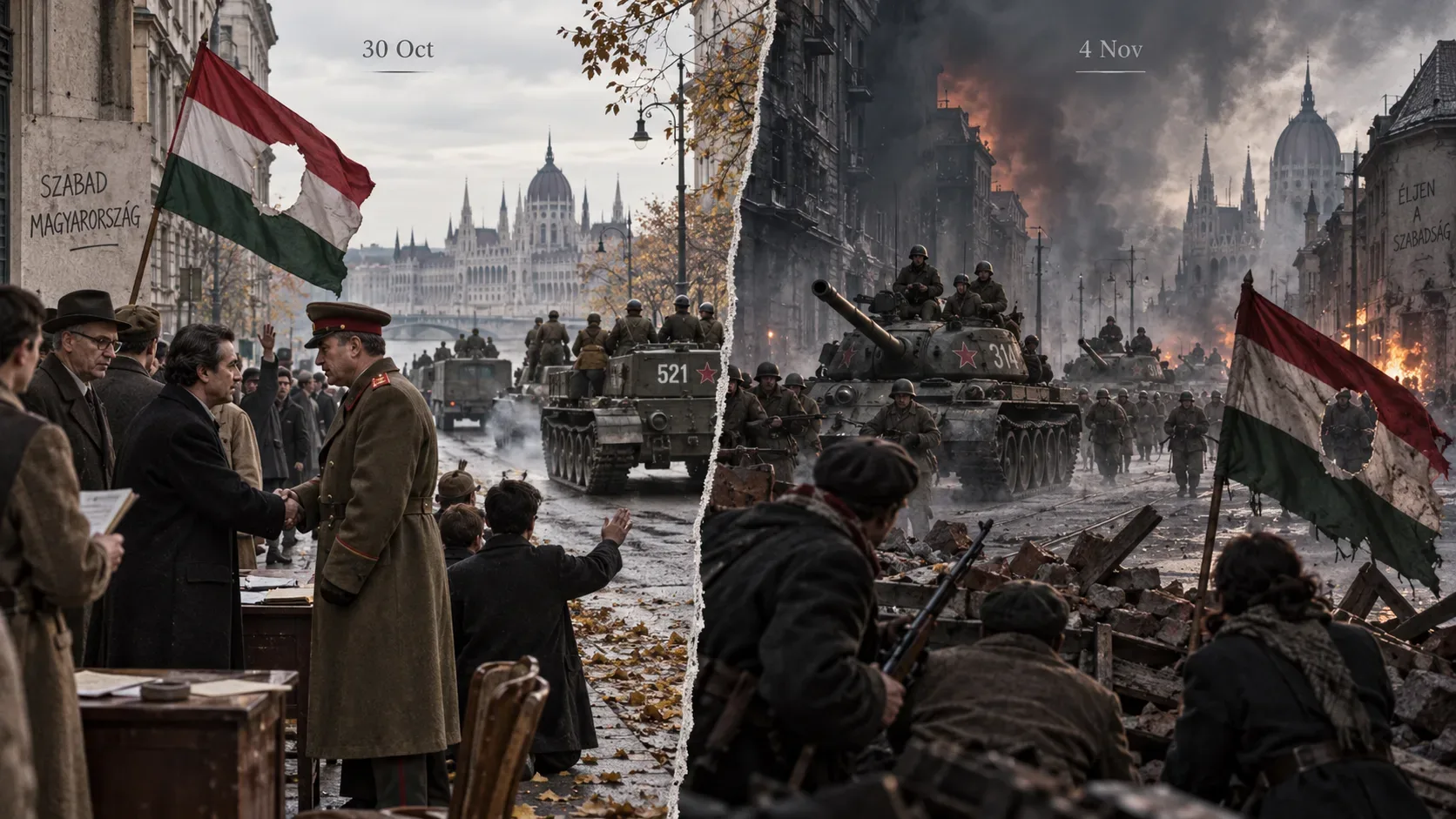
The Hungarian Revolution began on October 23, 1956, with demonstrations that quickly expanded into opposition to the communist government and Soviet presence. For several days, troop withdrawals from Budapest and political changes encouraged hopes for greater autonomy. On November 4, however, the Soviet Union launched a large-scale military offensive to suppress the uprising and overthrow Imre Nagy’s government.
The Melbourne Games opened on November 22. That put Hungarian athletes in an extraordinary position: they were competing on the other side of the world while receiving fragmented news from a recently invaded country and from relatives who remained there. Later accounts by members of the water polo team describe this atmosphere of uncertainty and anger. The political context was not created by the match; it was already present when the athletes reached Australia.
Why Hungary vs. USSR was not exactly a semifinal
One of the most repeated simplifications about Blood in the Water is to call it a “semifinal.” The label conveys the importance of the contest, but it does not match the official 1956 tournament format. Ten teams played a preliminary stage; six advanced to a final round-robin group, with relevant preliminary results carried forward.
Hungary vs. the Soviet Union on December 6 was part of that final group. It was crucial to the standings, but it did not automatically eliminate the loser. Hungary still had to play Yugoslavia the next day. This detail matters because it shows how memory transformed a final-league match into an almost cinematic knockout confrontation.
The December 6 match: score, tension, and early termination
Competition records show a 4–0 Hungarian victory. The goals are credited to Antal Bolvári, Dezső Gyarmati, György Kárpáti, and Ervin Zádor. The game featured heavy physical contact, provocation, and fouls in an already hostile atmosphere in the stands, where support for Hungary was strong.
Near the end, Zádor was struck in the face and left the pool with a bleeding cut. The image of him injured circulated widely in the press and became the visual frame most closely associated with the episode. As crowd agitation increased and the risk of confrontation outside the water grew, the referee stopped the match before regulation time expired. The 4–0 result stood.
It is wise not to treat every detail in later retellings as equally certain. Athlete memories, press reports, and documentaries added quotations, taunts, and descriptions of what happened underwater, but not all of those elements have the same level of contemporary documentation. The verifiable core is strong: an extreme political context, a rough game, a 4–0 Hungarian lead, Zádor’s injury, and an early end.
What happened the next day
On December 7, Hungary defeated Yugoslavia 2–1. That result confirmed the Hungarian Olympic gold medal. Yugoslavia took silver and the Soviet Union bronze. The Soviet match was therefore central to Hungary’s campaign, but the gold medal was not awarded that afternoon; it was secured in the closing game of the final group.
Zádor, injured, did not play against Yugoslavia. After the Games, several Hungarian athletes chose not to return home. That personal and political aftermath helped fix Melbourne 1956 in memory as something larger than an ordinary sports tournament.
How “Blood in the Water” became a symbol
The phrase draws its power from the combination of three elements: the temporal proximity to Soviet repression, the real violence of the match, and the photograph of a bleeding Hungarian athlete. Together, they compressed a complex international crisis into an immediately legible image.
This also helps explain why public memory became more dramatic than some official records. The organizing committee’s official report later summarized the water polo tournament and described the general standard of play as clean and fast without making Hungary vs. USSR the center of its narrative. Photographs, testimony, and later journalism moved in the opposite direction by emphasizing the exceptional match.
So saying that “the Hungarian Revolution became Blood in the Water” does not mean the game replaced the history of the revolution. It means sport provided an international stage on which the crisis was interpreted in real time and later remembered through one powerful scene.
What the episode shows — and what it does not prove
- It shows that the Games were not isolated from the Cold War. International politics affected boycotts, delegations, crowds, and the meanings attached to competition.
- It shows that the match carried symbolic value for the Hungarians. Defeating the Soviet team soon after the repression had extraordinary emotional weight.
- It does not turn every Soviet player into an individual representative of Moscow’s military decision. Athletes operated within state systems, but they remained individuals in a sporting contest.
- It does not make the match a reenactment of the revolution. What happened in Budapest involved tanks, deaths, political repression, and a change of government; the match was a violent sporting event that gained meaning from that context.
- It does not remove the need for sporting accuracy. The famous contest was part of the final round-robin group, not a formal knockout semifinal.
Timeline: from revolution to Olympic gold
| Date | Event | Why it matters |
|---|---|---|
| October 23, 1956 | Hungarian Revolution begins | Protests and an uprising challenge the government and Soviet influence. |
| November 4, 1956 | Major Soviet offensive | The military crackdown reshapes the context in which Hungarian athletes reach the Games. |
| November 22, 1956 | Melbourne Games open | The Olympics begin less than three weeks after the Soviet offensive. |
| November 28 to December 7 | Olympic water polo tournament | Ten teams compete through preliminary and final stages. |
| December 6, 1956 | Hungary 4–0 Soviet Union | Zádor leaves the pool bleeding and the match is stopped early. |
| December 7, 1956 | Hungary 2–1 Yugoslavia | Hungary confirms the gold medal. |
Why the story still matters 70 years later
In 2026, the 70th anniversary is an opportunity to look beyond the most famous image. The episode helps explain how a sporting event can become an archive of political memory: a match acquires meanings from what happened before it, who watches it, how the press records it, and how later decades retell it.
Blood in the Water remains striking precisely because the photograph of Zádor does not explain everything. It opens a door to a larger history: the Hungarian Revolution, Soviet repression, the experience of displaced athletes, the structure of the Olympic tournament, and the later construction of a Cold War symbol.
Sources and further reading
- U.S. Department of State, Office of the Historian — documents on the suppression of the Hungarian Revolution
- Olympedia — men’s water polo tournament at Melbourne 1956
- Olympedia — Hungary 4–0 Soviet Union, December 6, 1956
- Olympedia — Hungary 2–1 Yugoslavia, December 7, 1956
- Smithsonian Magazine — historical account and Ervin Zádor’s testimony
- LA84 Foundation — official report of the Melbourne 1956 Games