In 2026, the Hungarian Revolution of 1956 turns 70, and one question still appears contradictory: if Moscow announced a willingness to withdraw troops and negotiate, why did the Soviet Army return to attack Budapest on November 4? The answer lies less in a promise broken overnight than in a genuine change of decision inside the Kremlin between October 30 and 31.
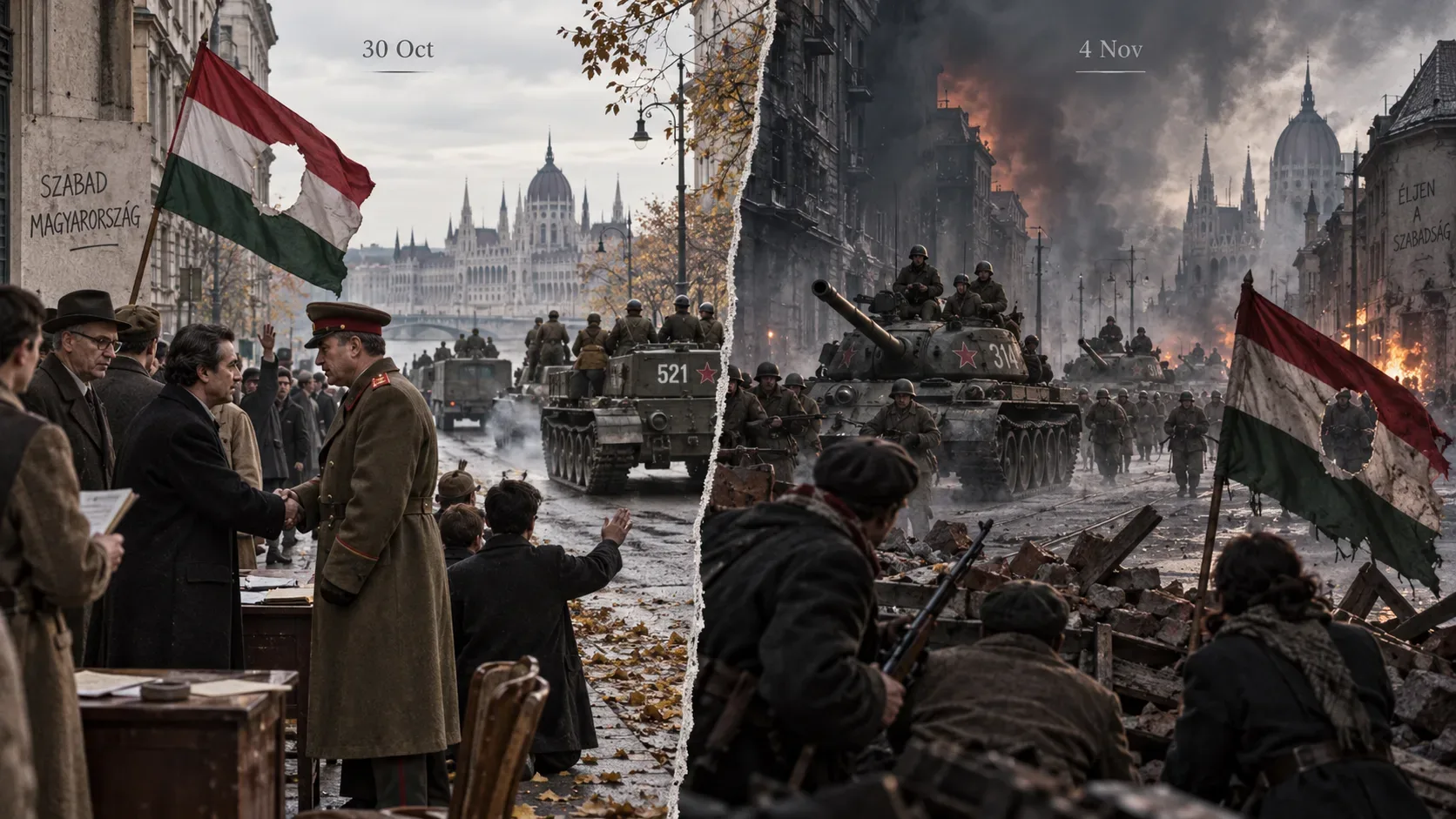
On October 30, the Soviet government published a declaration acknowledging problems in relations among socialist states, ordering Soviet units to leave Budapest when the Hungarian government deemed it necessary, and accepting negotiations over the presence of Soviet troops in the rest of Hungary. The withdrawal from the capital actually began. The next day, however, the Presidium of the Communist Party of the Soviet Union reversed its assessment: the leadership concluded that the revolution now threatened not only the Hungarian government but Hungary's place in the Soviet political and military system.
The short answer: the October 30 withdrawal was real, but it was not an unconditional exit from Hungary
Three points that are often blended together in accounts of the crisis need to be separated. First, Moscow agreed to withdraw its forces from Budapest. Second, it declared itself ready to negotiate the presence of Soviet troops on Hungarian territory. Third, it did not announce an immediate, automatic and complete withdrawal from Hungary.
The Soviet statement of October 30, reproduced in the Foreign Relations of the United States (FRUS) documentary collection, said that the continued presence of Soviet units could worsen the situation and that Moscow was prepared to discuss the issue with the Hungarian government and the other members of the Warsaw Pact. That same day, Marshal Georgy Zhukov told the U.S. ambassador in Moscow that the order had already been given for Soviet forces to leave the capital.
The movement was not confined to rhetoric. On October 31, the U.S. Legation in Budapest reported that the Soviet withdrawal from the city had begun and, at that moment, appeared substantial. That contemporary record, also published in FRUS, is an important reason not to treat the October 30 announcement simply as a deception planned from the outset.
October 30: Moscow was still seeking a political way out
Internal Soviet Presidium notes show that a political option was still under discussion on October 30. According to Vladimir Malin's records, preserved and published by the National Security Archive, Soviet leaders discussed withdrawing troops from Budapest and, if necessary, from Hungary itself. Khrushchev summarized the alternatives as a military path, based on occupation, and a peaceful path, based on withdrawal and negotiations.
That opening had limits. The Soviet leadership still expected Imre Nagy to stabilize the country without dismantling the socialist framework or removing Hungary from Moscow's strategic orbit. The October 30 public declaration combined concession with conditions: it acknowledged the need for more equal relations among socialist countries, but it also reaffirmed the defense of Hungary's “socialist achievements.”
On the same day, Nagy announced the end of one-party rule and the restoration of parties that had participated in the postwar coalition. For the revolutionaries, this institutionalized changes demanded in the streets. For the Kremlin, the speed of the transformation deepened doubts about whether any formula remained that could preserve a Communist government allied with the Soviet Union.
October 31: the Kremlin reverses course
The reversal appears directly in the notes from the October 31 Presidium meeting. Khrushchev proposed that the leadership reassess the situation, stop the withdrawal of troops from Hungary and Budapest, and take the initiative in “restoring order.” Malin's notes record an argument combining bloc security, prestige and the perception of weakness: a full Soviet withdrawal would be read by the United States, Britain and France as a retreat and might encourage further losses in Eastern Europe.
This is the decisive point in the chronology. The decision to return to military intervention was taken on October 31, before Imre Nagy's formal declaration of neutrality on November 1. Hungary's withdrawal from the Warsaw Pact therefore cannot be treated as the original cause of the reversal. It deepened and confirmed, in Soviet eyes, a scenario the leadership already feared.
The same notes show that Moscow was already discussing the creation of a new Hungarian government aligned with the Soviets, associated with János Kádár, as part of the political solution that would accompany military action. The operation would therefore be more than the entry of troops: it required an alternative Hungarian authority that could present the intervention as assistance requested by an allied government.
Why did Moscow reverse the withdrawal?
The documents point to a combination of factors rather than a single trigger.
- Collapse of one-party control: within days, revolutionary councils, restored political parties, armed groups and new local authorities sharply reduced the old Communist apparatus's control.
- Fear of losing Hungary as a strategic ally: Moscow's problem was not only who would govern in Budapest, but whether Hungary would remain inside the Soviet security system in Europe.
- Bloc prestige: the October 31 notes show Khrushchev feared that a withdrawal would be interpreted as weakness and encourage pressure elsewhere in Eastern Europe.
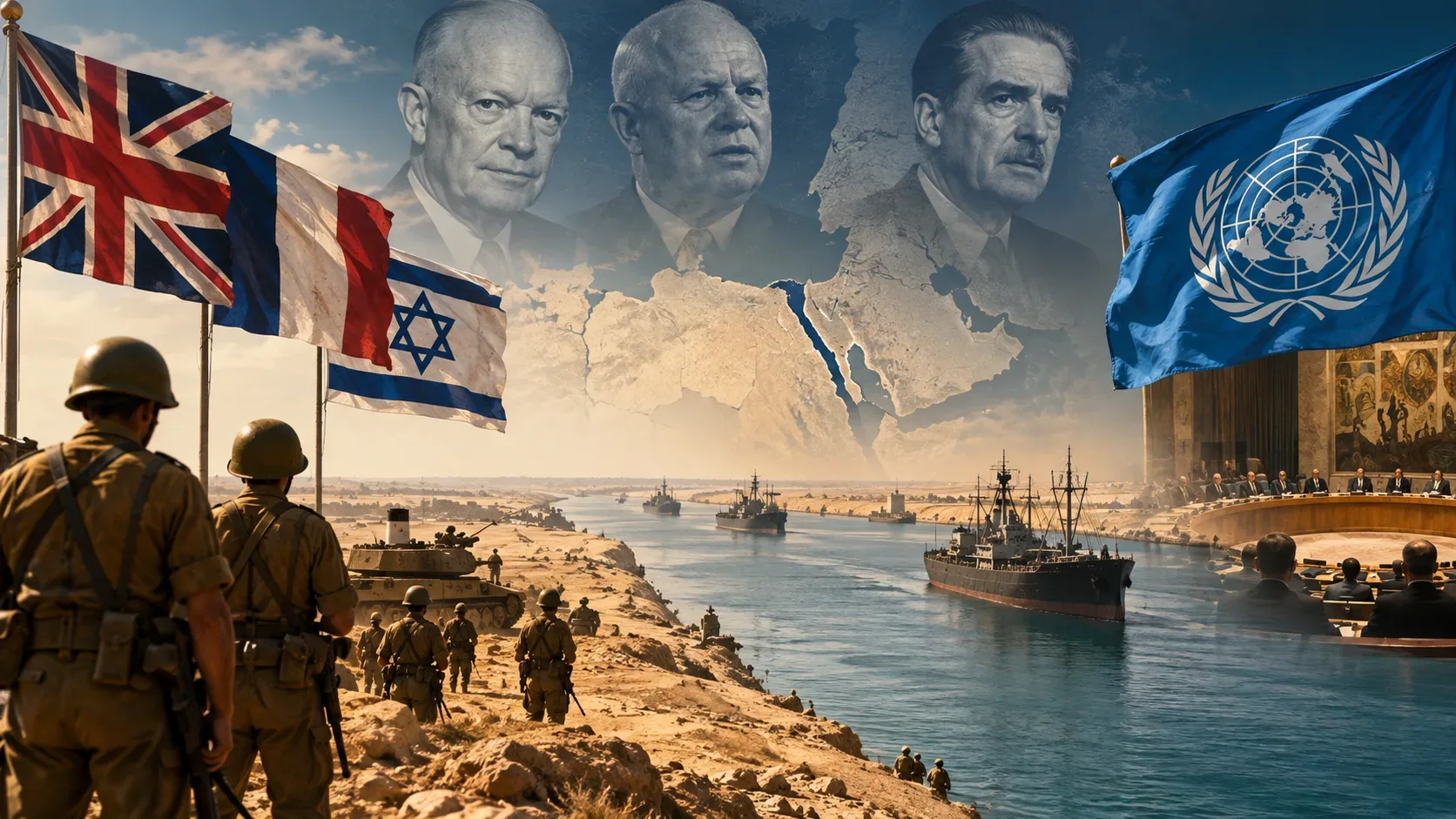
- The Suez Crisis: the conflict in Egypt entered Soviet calculations, but not as simply as the claim that “Suez caused the invasion.” On October 30, Khrushchev used the British-French difficulties in Egypt as a reason to avoid a similar occupation. The next day, the same international context appeared in arguments about preventing the West from adding a Hungarian loss to Moscow's wider strategic setbacks.
- Pressure within the socialist camp: the notes record that the Chinese delegation favored keeping troops in Hungary. That helps explain the environment of the debate, but the documents do not justify reducing the Soviet decision to a Chinese order or veto.
November 1: neutrality and the Warsaw Pact come after the Soviet decision
On November 1, as new Soviet units were already being reported inside Hungary, Nagy summoned Soviet ambassador Yuri Andropov, protested the troop movements, announced Hungary's withdrawal from the Warsaw Pact and declared the country's neutrality. The message was sent to the United Nations and is preserved as document A/3251.
The sequence matters. Hungarian neutrality was a response to a military situation that was already changing and, at the same time, made explicit the strategic rupture Moscow wanted to prevent. For the Soviet leadership, the danger was no longer only a more autonomous form of national communism; it now formally included the loss of a member of the Warsaw Pact.
November 2–3: negotiations and military preparations at the same time
Over the following days, two realities coexisted. On one side, Soviet and Hungarian representatives discussed troop withdrawal. On the other, Soviet military movements, reinforcements and the encirclement of Budapest indicated that the armed option was advancing.
On November 3, the UN Security Council was told that Soviet-Hungarian military negotiations were under way. U.S. diplomatic records show Soviet officials continuing to refer to a mixed commission on withdrawal while diplomats in Moscow increasingly suspected that the talks also served to buy time. The documentary trail can be followed in the November 3 FRUS record and the account of the Security Council meeting.
On the night of November 3–4, the contradiction reached its peak. The Hungarian military delegation led by Defense Minister Pál Maléter went to Tököl to continue negotiations on Soviet withdrawal. The later UN Special Committee report on Hungary recorded that Maléter and the other delegates were arrested at Soviet headquarters. The episode is documented in the United Nations A/3592 report.
November 4: the second intervention
In the early hours of November 4, Soviet forces opened their offensive against Budapest and other centers of resistance. A U.S. Legation teletype recorded heavy artillery fire on the outskirts of the capital at about 5 a.m. and Hungarian broadcasts announcing the occupation of the city; the document is available in FRUS.
At the same time, János Kádár appeared at the head of a new government backed by Moscow. The combination of military force and political replacement ended Nagy's attempt to build a neutral, multiparty Hungary. That same day, the Security Council referred the issue to the General Assembly through Resolution 120, and the Assembly adopted Resolution 1004 (ES-II), calling for an end to the intervention and the withdrawal of Soviet forces.
Documented chronology: October 30 to November 4
| Date | What happened | What it shows |
|---|---|---|
| Oct. 30 | Moscow publishes a declaration on relations among socialist states, accepts withdrawal from Budapest and negotiations over the Soviet presence in Hungary. | The leadership still considered a political accommodation, although one conditioned on preserving socialism and the alliance. |
| Oct. 31 | The withdrawal from Budapest is observed, but the Soviet Presidium internally reverses course and decides to restore control by force. | The decision changed before Nagy's formal neutrality declaration. |
| Nov. 1 | Nagy protests new troop movements, leaves the Warsaw Pact and declares neutrality. | The strategic break becomes explicit and reinforces Soviet fears of losing Hungary. |
| Nov. 2–3 | Withdrawal talks continue while Soviet forces position themselves around Budapest. | Diplomacy and military preparation proceed in parallel. |
| Night of Nov. 3 | Pál Maléter's delegation goes to Tököl to negotiate and is arrested. | The talks are no longer functioning as a route toward negotiated withdrawal. |
| Nov. 4 | A large-scale Soviet offensive begins and Kádár takes the lead of a Moscow-backed government. | Moscow chooses to keep Hungary in the bloc through military force and political replacement. |
What this sequence changes in the interpretation
The chronology avoids two simplifications. The first is the claim that the October 30 declaration was necessarily a fraud from the beginning. Contemporary evidence shows an actual withdrawal from Budapest and a real Kremlin debate over a negotiated solution. The second is the claim that Nagy “provoked” the invasion by declaring neutrality. The Soviet decision to reverse the withdrawal already appears in the October 31 notes.
What changed was Moscow's assessment of what could still be preserved through negotiation. As long as the Kremlin believed Nagy could stabilize Hungary within some form of allied socialism, partial withdrawal and negotiations remained an option. Once the leadership concluded that the revolution could destroy Communist monopoly rule and remove the country from the Soviet security system, that tolerance ended.
That is why the period from October 30 to November 4 is central to understanding 1956: it was neither a straight line of repression nor merely a diplomatic trap. It was a compressed sequence of concession, partial withdrawal, strategic reassessment, military preparation and attack, documented by Soviet internal records as well as diplomatic and United Nations sources.