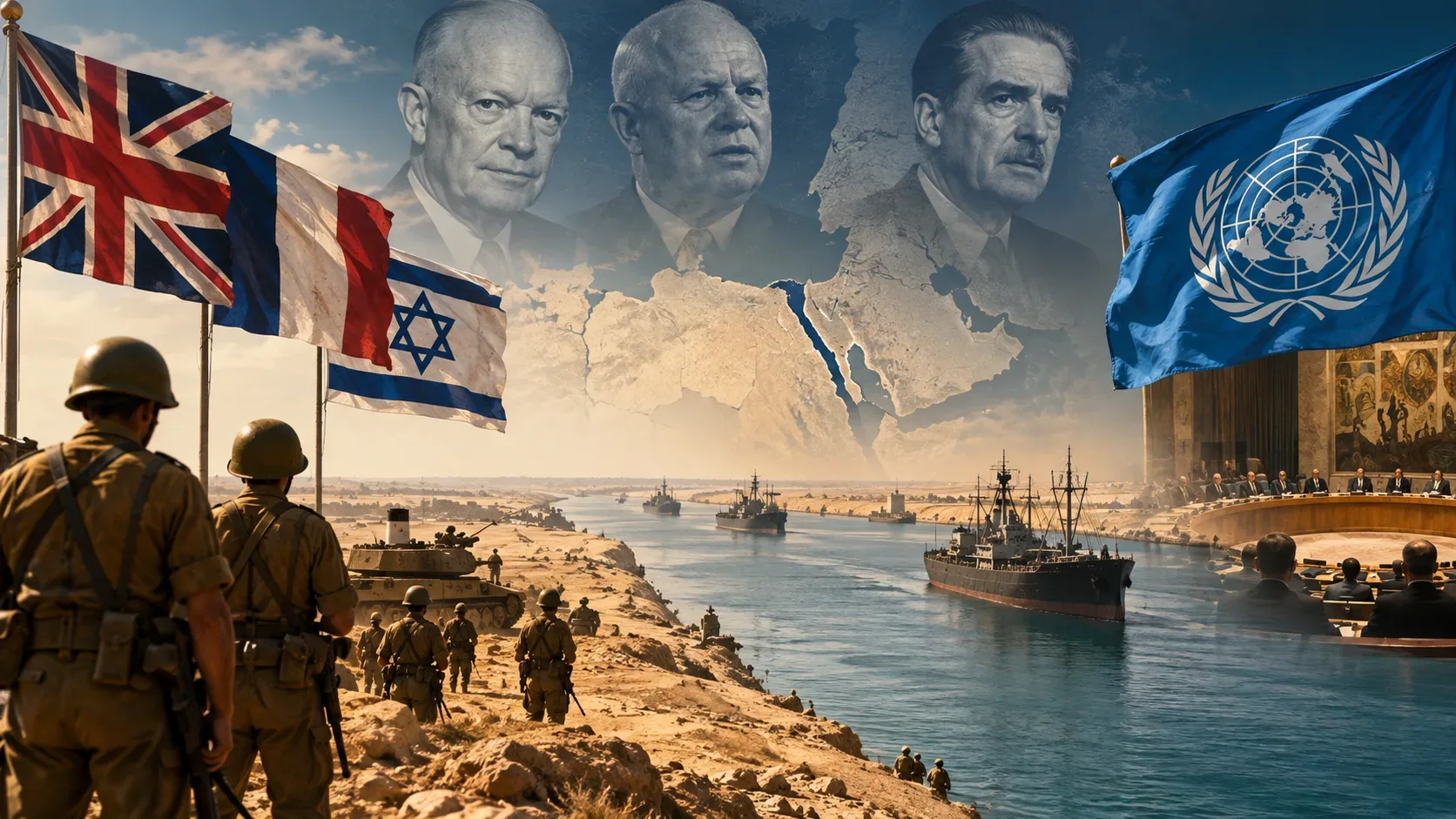
In 2026, 70 years have passed since the central events of the 1956 Suez Crisis. The short answer to “why did the invasion stop?” is that Britain and France were not defeated militarily at the Canal: they halted the operation because the political, financial and strategic cost of continuing rose rapidly. U.S. opposition, pressure from the United Nations General Assembly, the creation of an international emergency force and Soviet threats of escalation converged at a moment when sterling was under severe pressure. Israel, in turn, withdrew later under additional resolutions and international pressure.
Short answer: why the invasion ended
The attack grew out of coordinated action by Israel, Britain and France against Gamal Abdel Nasser's Egypt. Israel entered Sinai on October 29, 1956; Britain and France issued an ultimatum the next day and then began attacking Egyptian positions. The military operation was still under way when London and Paris accepted a ceasefire on November 6.
- The United States publicly opposed the invasion, backed UN resolutions and raised the financial cost for London by withholding the support the British government hoped for to stabilize sterling during the crisis.
- The United Nations bypassed the Security Council deadlock through an emergency special session of the General Assembly, demanded a ceasefire and withdrawal, and created the United Nations Emergency Force (UNEF), the UN's first peacekeeping force.
- The Soviet Union sent threatening notes to Britain, France and Israel. U.S. intelligence judged the threats strong but imprecise: they suggested the possibility of Soviet military action but did not prove a decision to intervene unilaterally.
- Britain's financial weakness turned the dispute with Washington into an immediate constraint. Sterling was under speculative attack and British gold and dollar reserves were being drained.
These pressures did not carry equal weight or operate in the same way. For Britain, the U.S. position and the sterling crisis were especially important. Soviet threats increased the danger of escalation. The UN provided the institutional exit that turned a ceasefire into a supervised withdrawal.
How the crisis began
On July 26, 1956, Nasser announced the nationalization of the Suez Canal Company. Historically tied to British and French interests, the company operated the waterway linking the Mediterranean and the Red Sea. The nationalization came after the United States and Britain withdrew support for financing the Aswan High Dam, and Nasser presented the move as an assertion of Egyptian sovereignty and a source of revenue for the project.
Washington tried to negotiate a diplomatic settlement. London and Paris, however, feared that a stronger Nasser would accelerate the erosion of European influence in the Middle East and North Africa. France also regarded the Egyptian government as a supporter of the Algerian rebellion. Israel had its own security disputes with Egypt. Between August and October, British and French governments maintained military preparations and held secret consultations with Israel, culminating in a coordinated plan: an Israeli offensive into Sinai would create the situation in which Britain and France would demand that both sides withdraw from the Canal; an Egyptian refusal would provide the pretext for Anglo-French intervention.
Timeline in eight milestones
| Date | What happened | Who pressured whom |
|---|---|---|
| July 26, 1956 | Nasser nationalizes the Suez Canal Company. | Egypt directly challenges British and French interests and broadens the dispute over control and sovereignty of the Canal. |
| October 29 | Israel invades Sinai and advances toward the Canal. | The offensive begins the military phase of the plan coordinated with Britain and France. |
| October 30–31 | Britain and France issue an ultimatum to Egypt and Israel and, after Egypt rejects it, begin air attacks. | Washington protests; at the Security Council, Britain and France block resolutions opposing the operation. |
| November 1–2 | The General Assembly meets in its first emergency special session and adopts Resolution 997 (ES-I), calling for a ceasefire and withdrawal. | The center of diplomatic pressure shifts from a Security Council paralyzed by vetoes to the General Assembly. |
| November 4–5 | The Assembly requests a plan for an emergency force and establishes the command that would become UNEF. | The UN creates a practical alternative for supervising the ceasefire and reducing the argument that withdrawal would leave a military vacuum. |
| November 5 | British and French forces land in the Port Said area. The same day, Moscow sends notes containing strong threats. | The USSR raises the perceived risk of escalation; the United States rejects a joint U.S.-Soviet military intervention and insists on the UN route. |
| November 6–8 | Britain and France order a ceasefire; the halt in fighting takes hold under international supervision. | U.S. pressure, Soviet risk, the weight of UN resolutions and Britain's financial vulnerability converge. |
| December 22, 1956 and March 8, 1957 | The Anglo-French withdrawal is completed in December; Israel completes its withdrawal in March. | UNEF assumes responsibilities on the ground and the UN continues pressing for the withdrawal of the remaining foreign forces. |
Who pressured whom — and by what means
United States → Britain and France
The Dwight Eisenhower administration regarded the invasion as a strategic mistake. Besides fearing Soviet intervention, Washington wanted to avoid making Western condemnation of the Soviet crackdown in Hungary look hypocritical while NATO allies were attacking Egypt. The United States backed UN resolutions against the invasion and pressed London and Paris to accept the November 6 ceasefire.
For London, the decisive instrument was not an American military threat but the combination of diplomatic isolation and financial vulnerability. Sterling was under heavy speculative pressure, and the Bank of England was spending dollar reserves to defend the fixed exchange rate. Chancellor of the Exchequer Harold Macmillan knew that Britain would find it difficult to sustain sterling without U.S. and multilateral support.
There is, however, an important documentary nuance. An editorial note in the Foreign Relations of the United States collection records that Macmillan later wrote that on November 6 he was told the United States would not agree to the necessary International Monetary Fund procedure until Britain accepted a ceasefire. The same note states that documentation of the British request and U.S. response was not found in State Department files, partly because IMF matters fell under the U.S. Treasury. The financial pressure is therefore well documented, but the story of Eisenhower pressing a single financial “switch” oversimplifies a more complicated process.
Soviet Union → Britain, France and Israel
On November 5, Soviet premier Nikolai Bulganin sent severe messages to Western leaders and Israel. U.S. documents from the time characterized the notes as strong threats of military action, but imprecise ones. A November 6 intelligence estimate was explicit: the messages did not show a definite Soviet decision to act unilaterally, but they were designed to imply that Moscow might do so.
That distinction matters because it avoids two extremes. It is wrong to treat the Soviet threat as empty rhetoric with no effect: in a conflict involving U.S. allies, Egypt and Soviet interests, the risk of wider escalation had to be taken seriously. But it is also an exaggeration to say that the USSR alone “forced” London and Paris to retreat through an unambiguous nuclear threat. The retreat took place under several simultaneous pressures.
United Nations → all parties
The Security Council was blocked because Britain and France, as permanent members, could veto resolutions against their own operation. The issue then moved to the General Assembly through the mechanism known as Uniting for Peace. Resolution 997 (ES-I) of November 2 called for a ceasefire, a halt to troop movements and withdrawal behind the armistice lines.
Over the following days, the Assembly authorized Secretary-General Dag Hammarskjöld to prepare an international force. Resolutions 1000 and 1001 established the command and approved the UNEF plan. Its first elements reached Egypt in mid-November. The mission supervised the withdrawal of British, French and Israeli forces and then operated as a buffer between Egypt and Israel.
UNEF was not the first peace presence in UN history — observer missions already existed — but it was the United Nations' first peacekeeping force, composed of international military contingents to supervise the ceasefire and withdrawal.
Sterling's role: financial pressure without the simple myth
The Suez Crisis was also a British currency crisis. Sterling still operated at a fixed parity of US$2.80, and confidence in London's ability to defend it deteriorated. The closure of the Canal and oil pipelines heightened concerns about petroleum supplies and dollar needs, while investors and companies shifted the timing of payments and sterling positions.
The IMF has described the episode as the first major speculative attack of the postwar era. On December 10, 1956, after the ceasefire and during the withdrawal process, the Fund approved a drawing of about US$561 million for Britain and a stand-by arrangement of roughly US$739 million. The potential total package reached US$1.3 billion, an enormous sum at the time.
For that reason, the formula “the United States threatened to break sterling and the war ended” captures part of the reality but loses the sequence. Sterling was genuinely vulnerable; London depended on American and multilateral confidence; and Washington did not rush to provide the desired support while the invasion continued. At the same time, the ceasefire decision occurred within a wider setting of UN condemnation, allied pressure, Soviet risk, and logistical and political problems. The financial factor was particularly powerful because it converted a strategic disagreement into an immediate limit on British autonomy.
Why Suez became a symbol of imperial decline
The crisis did not “end the British Empire” in a week. Decolonization was already under way, Britain and France remained military and nuclear powers, and both retained overseas interests for years. What Suez did was make a change visible that could previously be obscured: two former European imperial powers could still launch a major military operation, but they could not sustain it when the leading Western ally opposed them and when the postwar financial and diplomatic system turned against them.
For Britain, the shock was especially severe. The UK National Archives describes Suez as an episode that seemed to mark the end of Britain's days as a world power. The crisis also contributed to Anthony Eden's political fall; he resigned in January 1957. U.S. official history treats Suez as a contributing factor in his resignation, not the sole explanation.
For France, the crisis intersected with the Algerian War and frustration over the limits of relying on U.S. leadership. The political defeat of the joint operation did not erase French power, but it reinforced the perception that the old imperial toolkit faced far greater obstacles in the postwar international system.
In the Middle East, the outcome shifted the center of gravity as well. Nasser's political prestige and the appeal of Arab nationalism rose, while the United States increasingly perceived a “vacuum” left by declining British and French influence. In January 1957, Eisenhower introduced the doctrine that bears his name, conceived in part as a response to the new regional balance after Suez.
Immediate consequences and later interpretations
| Immediate consequence | Broader historical interpretation |
|---|---|
| Britain and France stop the operation and leave Egypt by December 22. | Shows that European military capability no longer meant strategic freedom from U.S. opposition. |
| Israel remains longer in Sinai and completes its withdrawal on March 8, 1957. | Shows that the postwar Arab-Israeli conflict remained politically unresolved despite a ceasefire. |
| Egypt retains national control of the Canal. | Strengthens Nasser's image as a symbol of Arab nationalism and anti-colonialism. |
| UNEF is created and deployed. | Establishes a major precedent for the use of UN peacekeeping forces. |
| The Washington-London relationship suffers a temporary rupture. | Exposes Britain's dependence on U.S. leadership and the U.S.-led financial system, even though the alliance recovers quickly under Harold Macmillan. |
| The USSR threatens intervention while suppressing the Hungarian Revolution. | Cold War rivalry and decolonization become intertwined: Moscow seeks anti-colonial political capital while Washington tries to prevent the conflict from pushing Arab states toward the Soviet sphere. |
Three shortcuts that distort the history
- “Britain and France lost the military battle.” That is not the best description. The operation was halted before achieving its strategic goals because the external cost of continuing became unsustainable.
- “The USSR alone made the invaders retreat.” Soviet threats increased the risk, but U.S. intelligence documents record uncertainty about Moscow's real intention. The effect came from the combination with U.S. and UN pressure.
- “Suez was the exact day the empire ended.” It is more accurate to treat it as a symbolic watershed and an accelerator of existing trends. European imperial power did not disappear in November 1956, but its limits became difficult to deny.
What Suez still reveals 70 years later
The Suez Crisis remains important because it separates three things that are often confused: local military victory, political success and international power. Britain, France and Israel held military advantages over Egypt on the battlefield, but that was not enough to produce a sustainable political outcome. The United States showed that financial and diplomatic power could constrain allies; the Soviet Union showed how the threat of escalation could alter calculations without necessarily firing a shot; and the UN created a new mechanism for turning diplomatic pressure into an international presence on the ground.
That is why Suez became one of the great symbols of the transition from a European imperial world to an order shaped by Cold War bipolarity, decolonization, Arab nationalism and multilateral institutions. The crisis did not cause that transformation by itself, but it made its limits and new hierarchies impossible to ignore.
Sources for further reading
- Office of the Historian, U.S. Department of State — The Suez Crisis, 1956
- Foreign Relations of the United States, 1955–1957, Volume XVI: Suez Crisis
- United Nations — First United Nations Emergency Force (UNEF I), background
- United Nations — Stories from the UN Archive: UN's first peacekeeping force
- International Monetary Fund — Northwest of Suez: The 1956 Crisis and the IMF
- The National Archives (UK) — Spotlight On: Suez Crisis