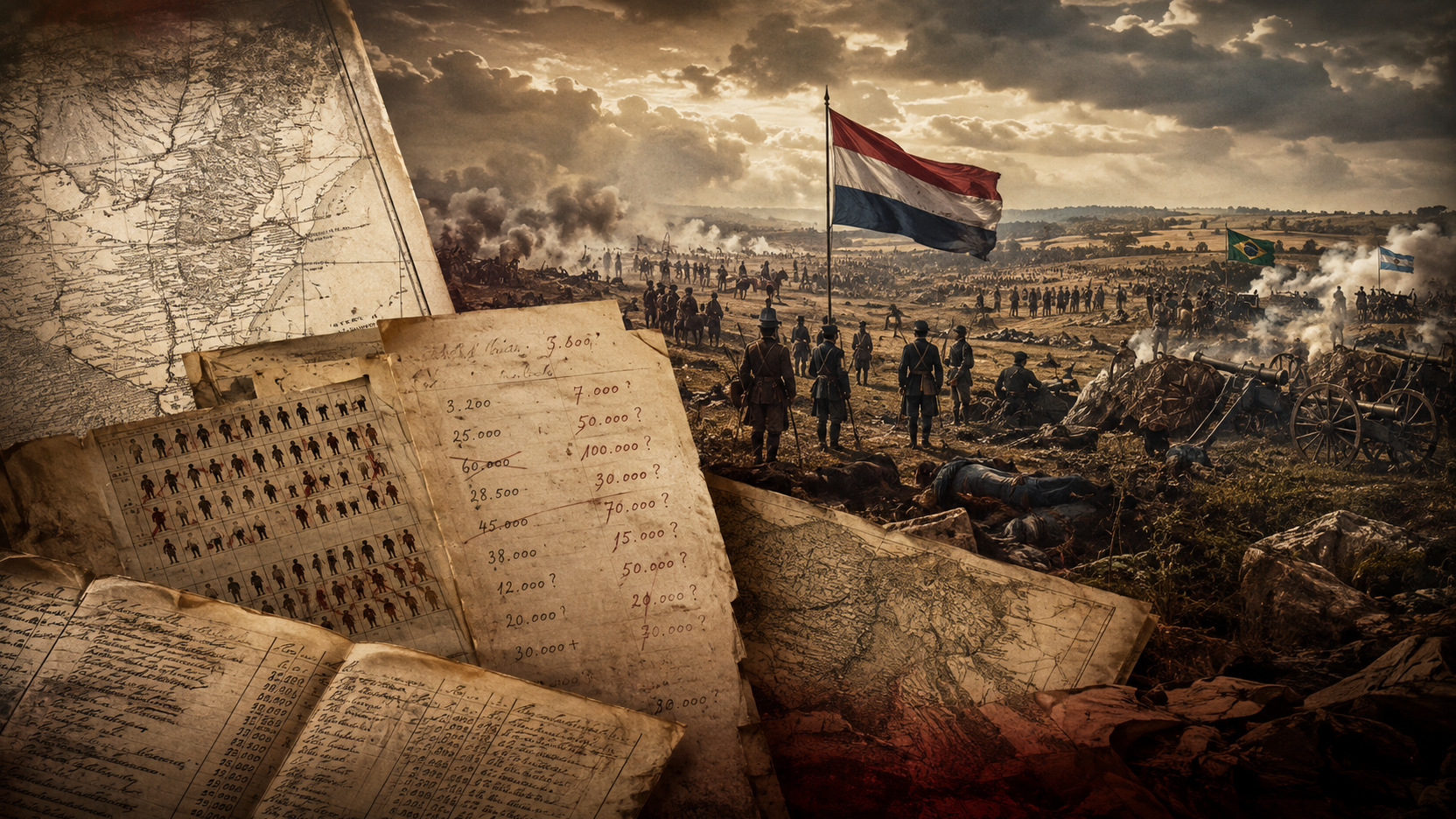
The question seems to ask for a number, but the historically more responsible answer is another: there is no definitive total of deaths in the Paraguayan War. There are estimates of very different orders of magnitude because researchers do not start from the same censuses, do not correct documentary gaps in the same way and are not always measuring the same thing. In some works, "population loss" includes dead, missing, displaced, emigrated and people who were no longer counted after territorial changes.
A well-known academic synthesis, by historian Leslie Bethell, speaks of around 200,000 lives lost throughout the war, in combat or due to illness and deprivation. This number is useful as an order of magnitude, but should not be presented as a closed score. When the focus shifts to Paraguay, which suffered the greatest proportional devastation, the demographic debate opens up a much wider range: from interpretations that place the loss below 20% of the pre-war population to reconstructions that point to something closer to 60% to 69%.
The short answer: there is no closed total
Simply saying that "300,000 died", "400,000 died" or "90% of Paraguayans died" gives a precision that the sources do not allow. The safest formulation is that the war killed hundreds of thousands of people in the Southern Cone, with Paraguay bearing the heaviest share of the destruction, but the exact total remains disputed.
The number of around 200,000 deaths for the entire conflict appears in a summary by Bethell. Other reconstructions produce greater results, especially when they adopt a pre-war Paraguayan population of approximately 420 thousand to 450 thousand inhabitants and a very small surviving contingent at the end of the conflict. Vera Blinn Reber's interpretation, published in 1988, estimated much smaller Paraguayan losses, between 8.7% and 18.5% of the pre-war population.
The distance between these conclusions does not arise from a simple disagreement about how many soldiers fell in battle. It starts before: how many people lived in Paraguay in 1864?
The first problem is at the starting point
For a long time, an estimate circulated that Paraguay would have had around 1.3 million inhabitants before the war. This number was associated with a supposed 1857 census and helped produce narratives of population losses approaching 80% or 90%.
Modern demographic research has shown a decisive problem: this 1857 census cannot be treated as a real and reliable census. Reber drew attention to the lack of documentation proving its achievement and the incompatibility of the total of 1.3 million with the possible growth since the 1846 census. If the starting point is inflated, the number of "disappeared" when comparing before and after the war is also inflated.
The 1846 census is much more important for the debate, but it also does not resolve everything. John Hoyt Williams estimated, from this, a population of approximately 240 thousand people that year and projected values for 1864. Thomas Whigham and Barbara Potthast considered that the 1846 survey undercounted some areas and groups and proposed a pre-war population of approximately 420 thousand to 450 thousand inhabitants.
Therefore, before counting deaths, historians already need to choose how to correct an incomplete census and which growth rate to apply for almost two decades.
The second problem is at the arrival point
There is also no simple and complete post-war census that would serve as a perfect snapshot of Paraguay in 1870.
Whigham and Potthast worked with documentation from a census carried out in 1870-1871 by the provisional government. The preserved records led to a count of 116,351 inhabitants in part of the available material. The authors considered that there were districts, children, displaced people and other people not captured and adjusted the surviving population to somewhere around 150 thousand to 160 thousand.
Jan Kleinpenning questioned the trust placed in this survey. The country was devastated, there was displacement and administrative disorganization, and other post-war figures, such as an 1873 estimate of 221,079 inhabitants, created difficulties in accepting without reservations the lower reconstruction of 1870.
The discussion, therefore, is not "which census is right?". It is how much of each document can be used, which gaps need to be corrected and how much uncertainty remains even after these corrections.
Population loss is not synonymous with death
This is the point that most distorts comparisons made outside the specialized literature.
If a population falls from an estimated value before the war to another after it, the difference cannot automatically be converted into "deaths". Part may correspond to death in combat, epidemics, hunger and exhaustion. But it can also include displacement, escape to neighboring countries, prisoners still absent, deserters, people not
registered and inhabitants of areas that changed territorial control.
Reber herself separated military losses, cholera, yellow fever, other diseases, migration and territorial loss in her model. And Bárbara Boggiano's more recent research is equally thoughtful: the absence of draft-age men at the end of the war may reflect death, but also active service, imprisonment, desertion, or deployment.
Therefore, an estimate of "population loss" should not appear in a headline as if it were a direct body count.
What the main estimates say
The extreme estimate based on the supposed 1857 census
The most dramatic traditional version started from a pre-war population of over 1.3 million and reached losses close to 80% or 90%. The problem is in the documentary base. The supposed census of 1857 is not accepted by modern historical demographics as a reliable census, and the growth required to reach 1.3 million from 1846 would be implausible.
As a result, numbers such as 1.2 million Paraguayans dead or the claim that 90% of the entire population died should not be used as established fact.
Reber: losses between 8.7% and 18.5%
Vera Blinn Reber, in 1988, frontally attacked traditional estimates. She worked with a pre-war population of close to 300,000 inhabitants and concluded that the loss attributable to the conflict would be between 8.7% and 18.5%.
Applied to a population of 300 thousand, this range corresponds approximately to 26 thousand to 56 thousand people. But not all of this total was presented by Reber as death. His calculation included components of migration and territorial loss, as well as military casualties and disease.
The merit of the study was to show how an inflated initial population could produce an artificial statistical catastrophe. The limitation is that his growth and mortality hypotheses were criticized by other researchers, who found them difficult to reconcile with the scale of conscription, military collapse, and man shortages observed during and after the war.
Whigham and Potthast: 60% to 69% loss
In 1999, Thomas Whigham and Barbara Potthast reopened the debate with the newly located 1870 census and a revision of the 1846 census. They estimated that Paraguay had between 420,000 and 450,000 inhabitants at the start of the war.
Comparing this level with the surviving population reconstructed for 1870, they reached a loss of approximately 60% to 69% of the population. In arithmetic terms, a reduction of this order is equivalent to something like 252 thousand to 311 thousand people in relation to the initial population adopted.
This result helps to understand why so many texts transformed the estimate into "around 300 thousand Paraguayan deaths". But this conversion requires care: the demographic issue itself involves deaths and people absent for other reasons. The value is best read as the magnitude of population collapse associated with the war, not as a
nominal list of deaths.
Kleinpenning: something close to half the population
In 2002, Jan Kleinpenning criticized the weight given to the 1870 census, but did not return the very low estimates. Accepting part of Whigham and Potthast's corrections for the pre-war population and using other post-war data, he considered a loss between 43.1% and 51.5% plausible.
If this percentage is applied only to visualize the order of magnitude on a base of 420 thousand to 450 thousand inhabitants, the result would be approximately between 181 thousand and 232 thousand people. Again, this is estimated population loss, not a direct count of deaths.
The position is important because it shows that criticism of the 60% to 69% scenario does not necessarily lead back to the less than 20% scenario. Between the two extremes there is a reconstruction in which Paraguay lost approximately half of its population.
Boggiano: new records favor high loss scenarios
The debate gained a new element with the work of Bárbara Boggiano, accepted by the Latin American Research Review. The author uses administrative records from 45 districts of draft eligible men in late 1867 and early 1868 and connects them to projections based on previous censuses.
In the 42 districts in which it was possible to construct a comparable denominator, 10,628 males aged 12 and over were observed out of a projected male population of 100,692. That's approximately one man observed for every nine expected.
The data does not mean that the other eight were dead. The author herself emphasizes that absence can also represent military service, prison, desertion or displacement. Still, the male shortage is so great that it is difficult to reconcile it with interpretations of low demographic loss. The new material therefore does not produce a "final death toll" but strengthens the plausibility of high-loss scenarios.
Combat explains only part of mortality
The Paraguayan War took place before antibiotics, in precarious sanitary conditions and with the displacement of large contingents through humid regions, rivers and improvised camps. Cholera, malaria, smallpox, pneumonia, dysentery and other infections killed on a massive scale.
Research on Brazilian Army hospital records reinforces that infectious diseases accounted for a huge portion of deaths among allied troops. Historiography has suspected this for a long time, but medical records, field hospital books and military reports allow us to better observe the weight of the epidemics.
This changes the interpretation of the total. A person can die "in war" without having been killed in combat. And, in the case of the Paraguayan civilian population, the border is even less clear: hunger, loss of crops, lack of draft animals, displacement, epidemics and exhaustion were consequences of a society mobilized and progressively destroyed by the conflict.
Why civilians are the hardest to count
Military deaths leave, at least in part, administrative traces: lists of units, hospitals, casualties, promotions, pensions and campaign reports. Even these records are incomplete, but they exist.
For civilians, the problem is much greater. There was no modern national death registration system capable of continuously documenting deaths from hunger, disease or displacement across the entire territory. Families were dispersed, localities were evacuated, people crossed borders and the state administration collapsed.
In addition, the same person may appear in different sources as "absent", "refugee", "prisoner" or simply not appear at all. Decades later, the historian needs to reconstruct the difference between temporary absence, permanent migration and death without having an individual record for each case.
Allied losses are not a simple number either
Brazil, Argentina and Uruguay won the war, but also suffered relevant losses. Bethell notes that Brazil mobilized approximately 140,000 men and had at least 50,000 combat deaths, in addition to deaths from disease; he considers some estimates that reach 100 thousand Brazilians dead in total to be exaggerated. For Argentina, it cites an estimate of 18,000 deaths in combat, in addition to losses from internal disturbances associated with the conflict and cholera epidemics.
These numbers also vary depending on the author and what is included. Adding an estimate of Brazilian military deaths, another for the Paraguayan population and a third for Argentine epidemics, without checking whether the concepts are compatible, creates an apparently accurate, but methodologically fragile, total.
This is why the aggregate war toll tends to vary so much: it is often the sum of estimates constructed using different criteria.
So, which number deserves to appear in a summary?
For a short and responsible answer, it is best to separate three levels of certainty.
In the war as a whole, "around 200 thousand dead" is an academic synthesis known and defensible as an order of magnitude, but not as a definitively proven total. Wider reviews admit that the number may have been substantially higher.
For Paraguay, the old idea of a pre-war population of 1.3 million and losses close to 90% has no reliable census basis. This number should be treated as part of the history of the controversy, not as a current conclusion.
Among modern studies, the track remains open. Reber proposed losses below 20%; Whigham and Potthast estimated 60% to 69%; Kleinpenning considered something around 43% to 52%. Boggiano's new work does not turn this dispute into a single number, but it does provide independent evidence of an extreme shortage of men at the end of the war and finds this pattern more compatible with high-loss scenarios than with low-loss scenarios.
What really explains the divergence
Estimates change because each author needs to solve four problems without perfect data: estimating how many people there were before the war, estimating how many remained after, separating death from displacement and other absences, and deciding which indirect deaths should be attributed to the conflict.
When two researchers choose different population bases, growth rates, and corrections, hundreds of thousands of people can appear or disappear from the account without either of them having found a new battleground.
The Paraguayan War was, in any case, an exceptional human and demographic catastrophe. The historically soundest point is not to memorize a single total, but to understand what each number is measuring. The more accurate an estimate seems, the more necessary it is to ask which census it came from, who was left out of it, whether the difference represents dead or absent, and what effects of disease, famine and displacement were included.
It is this reading that allows us to escape the two most common errors: repeating as fact the extreme number of 90% and, in the opposite sense, treating a low estimate as if it closed a debate that the most recent documentation continues to reopen.