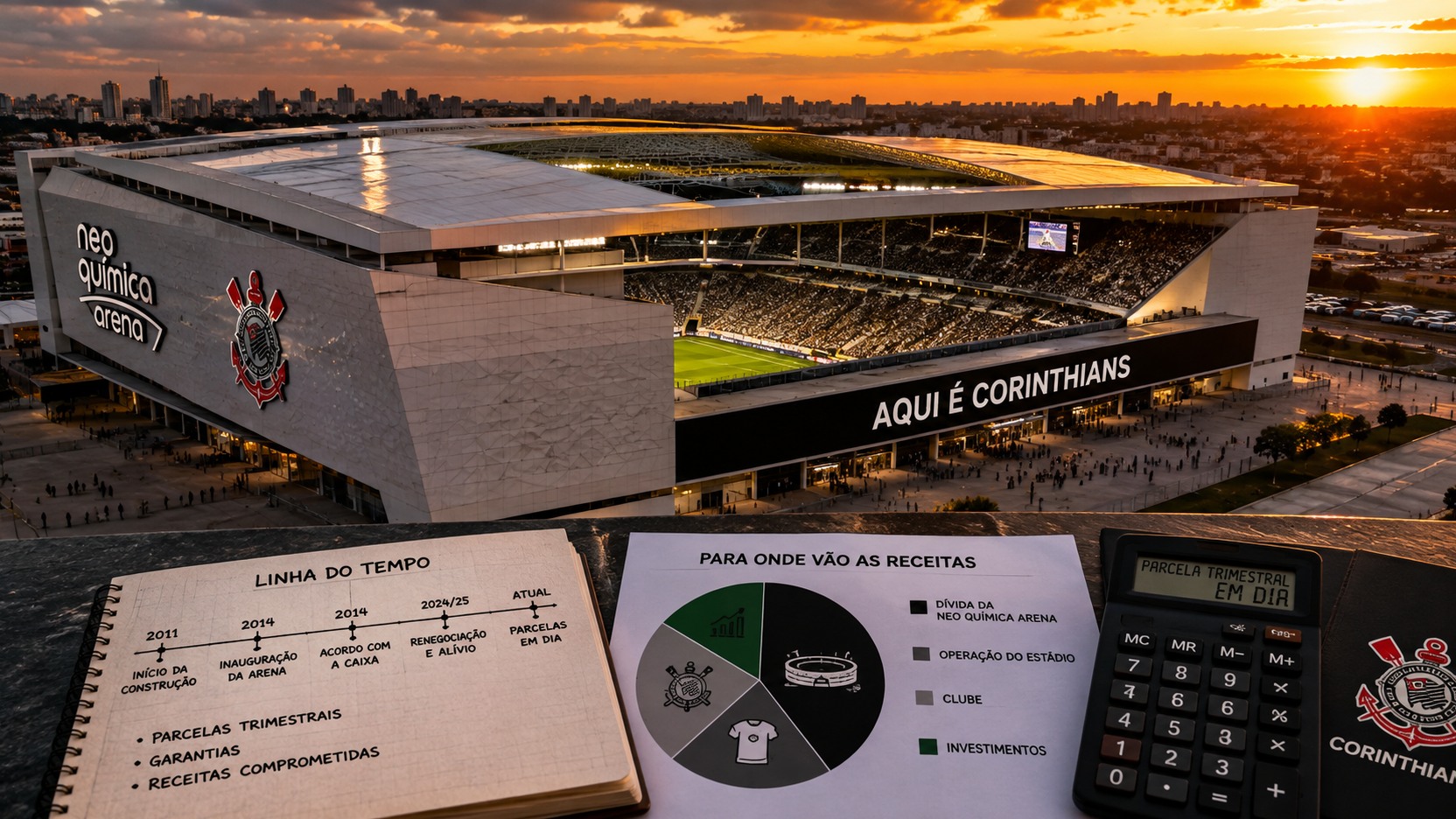

Short answer: Corinthians is working with both targets, but they do not measure exactly the same thing. The R$151 million figure belongs to the club's full-year 2026 budget and represents projected revenue from transfers of player registration rights plus FIFA solidarity-mechanism proceeds. The €25 million net figure became management's target for the mid-year transfer window after sales expected earlier in the season were postponed and the deficit widened. Money from the same deals can contribute to both targets, but the figures should not be treated as synonyms.
What the R$151 million target measures
Corinthians' Deliberative Council approved the 2026 budget on December 15, 2025. The plan projected a R$12 million annual surplus and included R$151 million in revenue from transfers of registration rights and proceeds from FIFA's solidarity mechanism. This is therefore a full-year budget line, fixed in Brazilian reais and designed for the entire fiscal year, not for one specific transfer window. The reference is the approved 2026 budget as reported by ge.
This also makes the line broader than a list of direct sales of players currently in the squad. The solidarity mechanism can generate revenue for training clubs when a player they developed is transferred later in his career. FIFA explains that the solidarity contribution distributes part of a transfer fee to the clubs responsible for a player's training. As a result, this type of inflow can help Corinthians meet the R$151 million budget line without being, strictly speaking, the sale price of a player currently owned by the club.
What the €25 million net target measures
The euro figure emerged as the club monitored its finances during the season. In June, Corinthians disclosed a cumulative R$168 million deficit through April, about 130% worse than budgeted for the period. Management said the budget had expected R$75 million net from player transactions early in the year, but those sales were postponed to preserve the squad and seek higher valuations. In the same set of financial comments, management reiterated an expectation of approximately €25 million net from the mid-year window. These figures were detailed by ge in its analysis of the April financial statement.
That is why the €25 million figure is better understood as an operational cash-generation and net-transfer target for the window than as a second version of the annual budget. In May and June, ge was already describing the amount as a transfer-window need tied to balancing the accounts while keeping the team competitive. See the reports from May 17 and June 20.
There is an important caveat: reports use the word “net”, but the publicly cited documents do not provide a deal-by-deal reconciliation of every deduction included in that calculation. It is therefore unsafe to take the headline value of a transfer and assume 100% of it counts toward the net target. Third-party participation, the club's share of economic rights, contingent bonuses and other contractual components can make the amount attributable to Corinthians different from the headline number.
Why R$151 million and €25 million look like the same target
The confusion is understandable because, during 2026, converting €25 million into reais produced figures very close to R$151 million. On May 17, ge converted €25 million to about R$144.1 million. On June 20, the same euro amount was worth roughly R$147.3 million. By August 27, it was close to R$150 million. The gap is driven by exchange rates: R$151 million is a budget figure fixed in reais; €25 million is a foreign-currency target whose real-equivalent moves with the exchange rate.
So numerical proximity does not prove accounting identity. It simply made two metrics with different scopes look interchangeable in headlines.
Direct comparison of the two figures
| Criterion | R$151 million | €25 million net |
|---|---|---|
| Origin | 2026 budget approved in December 2025 | Financial monitoring and monthly statements during 2026 |
| Period | Full 2026 fiscal year | Mainly the mid-year transfer window |
| Currency | Brazilian real, fixed in the budget | Euro, with a variable conversion into reais |
| Scope | Transfers of registration rights + FIFA solidarity mechanism | Expected net proceeds from deals in the window |
| Management purpose | Deliver the revenue assumed in the annual plan | Replace postponed inflows and relieve cash pressure during the season |
| Can they overlap? | Yes. The same sale can contribute to both objectives, but the amount counted under each metric does not have to be identical. | |
How André's potential sale should be counted
Midfielder André's negotiations brought the two targets back into the same discussion. On August 27, ge reported that Corinthians was considering a sale to ease its finances and that the club owned 70% of the player's economic rights. On August 31, the move to Nottingham Forest was still not completed; ge reported that Corinthians was in no rush to formalize the deal because the player's release was planned only for the end of the year. See the August 27 financial context and the August 31 update.
This is why comparing the total headline proposal directly with R$151 million or €25 million is not enough. To understand how much an André sale would actually contribute to each target, at least three components need to be separated:
- Fixed portion: this is the most direct component to compare with expected revenue, provided only Corinthians' own share is considered.
- Bonuses and targets: contingent amounts should not be treated as guaranteed money before the contractual triggers are met.
- The club's ownership share: if Corinthians does not own 100% of the player's economic rights, the gross announced transaction value is not automatically the amount retained by the club.
In addition, income received through FIFA's solidarity mechanism can help the annual R$151 million budget line without being part of André's sale. That is another reason not to collapse the two figures into one calculation.
Would an André sale alone meet the target?
Based on the information available on August 31, it is not possible to say that it would. The deal had not been formally completed, negotiations included fixed and potentially variable components, and Corinthians owned 70% of the player's economic rights. To declare either target met, the final agreement and the amount actually attributable to the club would need to be known.
The correct test is not “is the total transfer package larger than R$151 million?” or “does the package reach €25 million?”. The test is: how much of the deal enters the full-year budgeted revenue line, and how much represents effective net proceeds for the transfer window?
Which number to use for each question
- If the question is “how much revenue did the 2026 budget assume for this line?”, use R$151 million.
- If the question is “how much did management say it needed to generate on a net basis in the mid-year window?”, use €25 million.
- If the question is “did a specific sale meet the target?”, do not use the headline transfer value alone: check Corinthians' ownership share, the fixed portion, the bonuses and the amount that will actually be recognized for the relevant metric.
Conclusion
There is no real contradiction between R$151 million and €25 million. The first is the full-year budget target, fixed in reais and covering transfer-related revenue plus FIFA solidarity proceeds. The second is the operational net target associated with the transfer window, denominated in euros and reinforced after early-season sales did not happen and the deficit widened. Because exchange rates brought €25 million close to R$151 million, the figures came to look equivalent — but their origin, time period and calculation base are different.