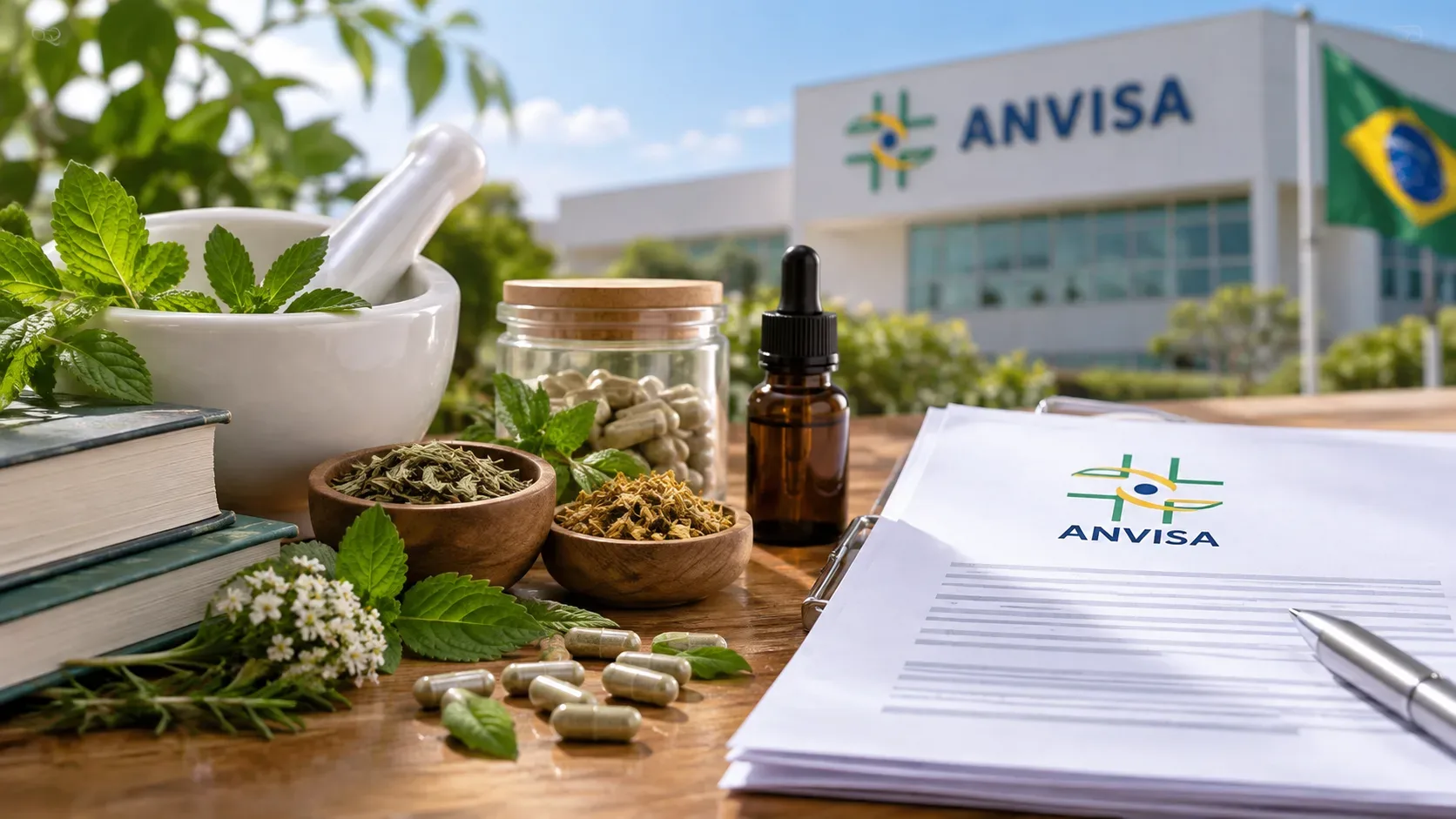
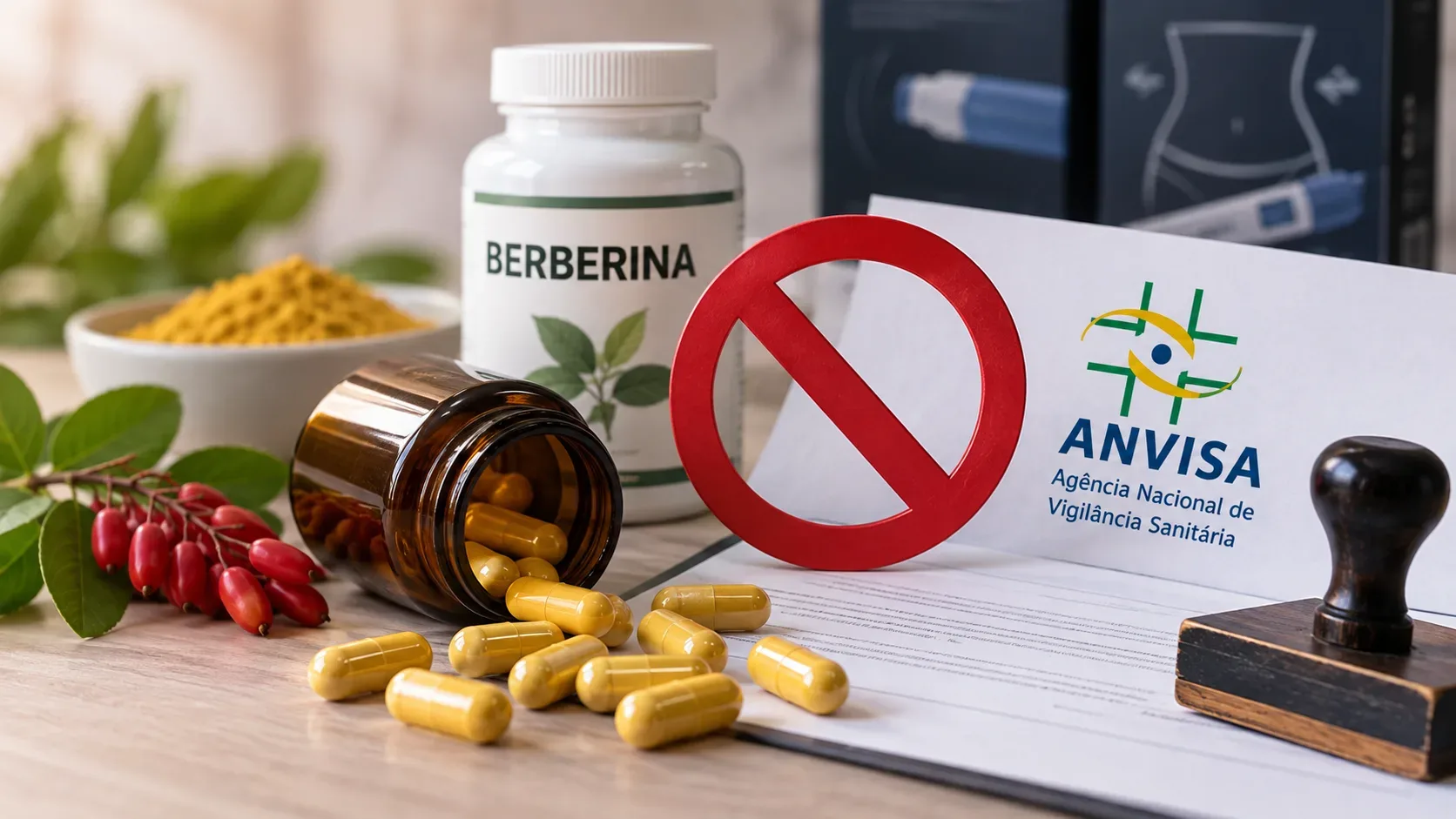
On September 11, 2026, Brazil’s health regulator Anvisa ordered the seizure of all lots of berberine-based products that lacked registration, notification or listing with the Agency. The measure also prohibited their manufacture, import, distribution, advertising, sale and use. According to Anvisa, the products had been marketed as “Natural Ozempic”.
The central issue is regulatory: the decision targets irregular products and does not authorize berberine to be treated as a substitute for a medicine. A marketing nickname does not create equivalence with Ozempic, does not prove effectiveness for weight loss or diabetes and does not change the rules that apply to supplements and medicines in Brazil.
What Anvisa ordered on September 11
Resolution RE No. 3,547 of September 9, 2026, published in the Federal Official Gazette on September 11, contains a specific entry for “BERBERINA”, covering all lots, with the company unidentified and the product type classified in the act as a medicine.
The stated reason was evidence that berberine-based products were being advertised and offered for sale without registration, notification or listing with Anvisa. The act orders:
- seizure;
- prohibition of sale and distribution;
- prohibition of manufacture and import;
- prohibition of advertising;
- prohibition of use.
The resolution adds that the measures apply to individuals, companies and media outlets that sell or advertise the products. In its enforcement notice, Anvisa summarized that unregularized berberine-based products were being sold as “Natural Ozempic”.
“Natural Ozempic” is a marketing nickname, not a regulatory category
Ozempic is the brand name of a semaglutide medicine. Anvisa maintains specific registrations and therapeutic indications for semaglutide medicines and requires evidence of quality, safety and efficacy for their registration. In other words, calling another product “Natural Ozempic” does not transfer the evidence, indications or regulatory status of a registered medicine to that product.
This distinction matters because the expression suggests an equivalence that Anvisa’s decision does not recognize. The enforcement action concerns products that lacked the required regulatory status, not a “natural generic” version of Ozempic.
Why a supplement cannot be treated as a medicine
Anvisa explicitly states that food supplements are not medicines. Their purpose is to complement the diet of healthy people with nutrients, bioactive substances, enzymes or probiotics. They cannot carry indications for preventing, treating or curing diseases.
The Agency also states that benefit claims on supplements must be previously authorized and that advertising cannot promise, for example, weight loss or disease treatment. Anvisa’s official page on misleading supplement advertising includes “weight loss” among prohibited claims.
Supplement composition in Brazil is not unrestricted either: constituents used to provide nutrients, bioactive substances and enzymes must be authorized by Anvisa. The Agency maintains a list of authorized ingredients and states that constituents outside the list should not be used without evaluation and approval.
What the measure does not prove about all berberine
The September resolution is a sanitary enforcement measure. For the case described in the act, it establishes that berberine-based products were being advertised and sold without the required regulatory status and orders their removal and prohibition. That is different from a clinical review capable, by itself, of answering every question about berberine’s efficacy, safety, dosage or possible uses in every context.
Two shortcuts in interpretation should therefore be avoided:
- “Anvisa prohibited these products, so all berberine in every context is necessarily ineffective or toxic.” The resolution does not present that broad scientific conclusion; its focus is the regulatory irregularity of the products covered by the measure.
- “If research on berberine exists, any capsule sold as a supplement can be used as a medicine.” That does not follow from the evidence either. In Brazil, regulatory status, composition, claims and product classification must comply with Anvisa’s rules.
There is an earlier precedent that reinforces this caution. In 2022, Anvisa prohibited a “Berberis vulgaris food supplement” because it used a constituent that was not authorized in foods. The history shows that simply labeling a product a “supplement” does not automatically make an ingredient acceptable.
How to read berberine ads without being misled by a medicine-like name
The best filter is to separate the sales name from the product’s actual regulatory situation. Before buying or using a product, be skeptical of pages that associate berberine with terms such as “Natural Ozempic”, “pen replacement”, “diabetes control”, “fat burner” or rapid weight-loss promises.
Warning signs include:
- promises to treat, prevent or cure diseases;
- weight-loss claims presented as guaranteed outcomes;
- direct comparison with a prescription medicine;
- no clearly identified manufacturer or regulatory information;
- sales based mainly on testimonials, before-and-after photos or influencer authority.
The dosage form does not settle the issue either. Capsules, tablets and powders can exist as food products, but a medicine-like appearance does not equal medicine registration.
What to do if you already bought a product covered by the measure
Because Resolution RE No. 3,547/2026 prohibits the use of unregularized berberine-based products covered by the action, the prudent course is not to use them. Keep the packaging, lot number, proof of purchase and screenshots of the offer, since these details can help identify the product and support a report.
Anvisa provides channels to report suspected or irregular supplements. If the product is being used to replace treatment for diabetes, obesity or another condition, any change to prescribed medicines should be discussed with the responsible health professional; a product sold as “natural” should not take that place on its own.
Bottom line: the warning is about regulatory status and therapeutic promises
The September 11 action does not create a new category called “Natural Ozempic”. It does the opposite: it identifies unregularized berberine-based products sold with that appeal and orders seizure and broad prohibitions. The correct reading avoids extrapolation in both directions: an enforcement action is not a universal scientific verdict on all berberine, and research or ingredient popularity is not a license to market or consume it as if it were a medicine.
For consumers, the practical rule is simple: a therapeutic promise requires much more than an attractive label. Regulatory status, authorized composition, approved indications and evidence appropriate to the product category are separate parts of the same check.