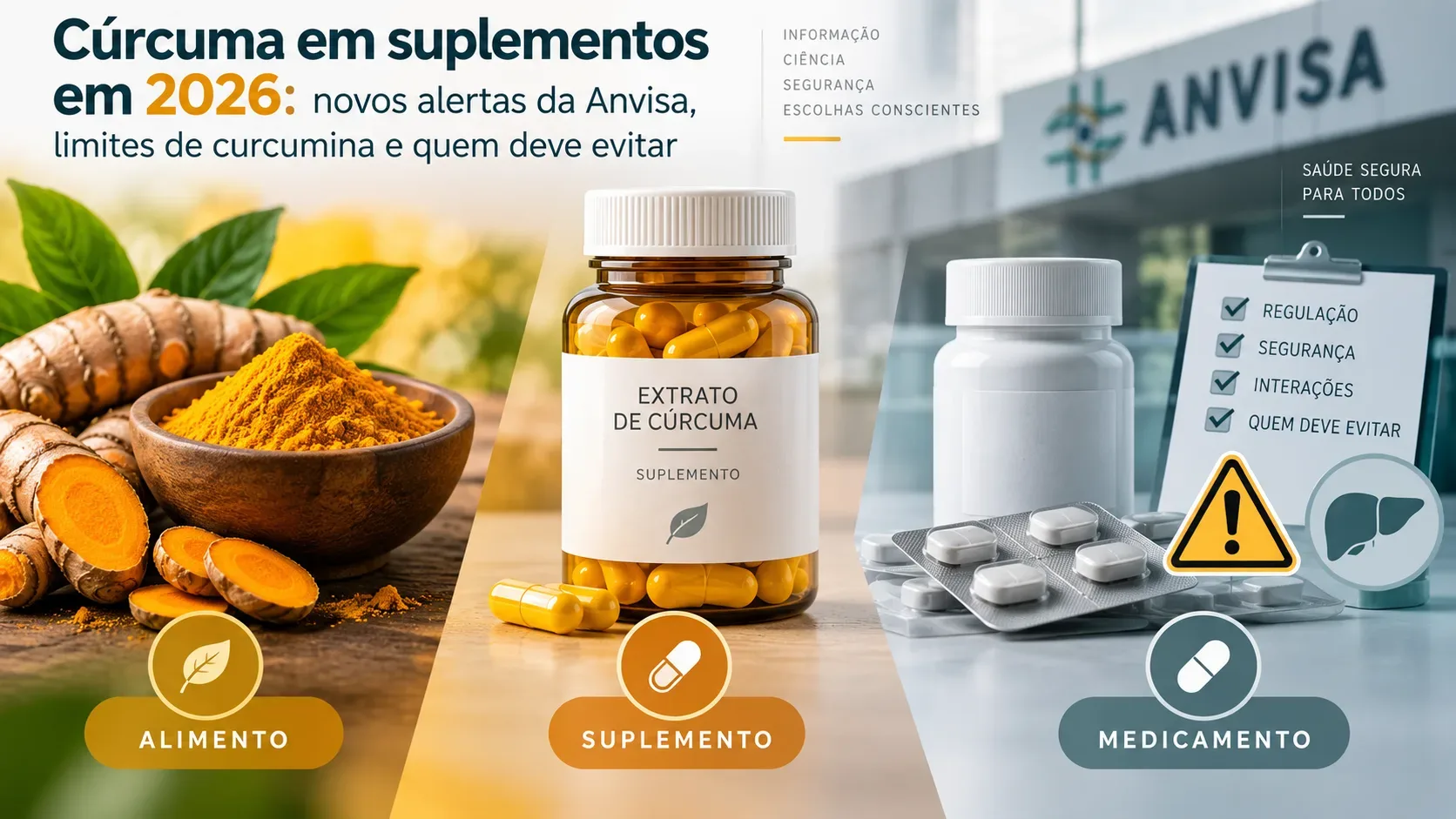
In 2026, Brazil's health regulator Anvisa changed how dietary supplements containing turmeric-derived ingredients must be framed and labeled. The update followed a pharmacovigilance alert about rare but potentially serious liver injury associated mainly with concentrated extracts and formulations that increase curcumin bioavailability. The key is to separate three different things: turmeric used as food, turmeric extract used in a supplement, and medicines containing derivatives of the plant.
What Anvisa changed in 2026
In March 2026, the Agency published a warning about liver injury risk in people using medicines or supplements containing turmeric or curcuminoids. In April, Anvisa Normative Instruction No. 438/2026 amended IN No. 28/2018, which sets out permitted constituents, use limits and labeling requirements for dietary supplements.
| Issue | 2026 rule | What it means in practice |
|---|---|---|
| Curcumin | For the >19-year adult group, the supplement must provide at least 80 mg and must not exceed 130 mg in the daily recommended intake. | Those figures are now interpreted as total curcuminoids, not curcumin alone. |
| How the amount is calculated | The calculation includes curcumin, demethoxycurcumin and bisdemethoxycurcumin. | A product cannot treat those components as if each were outside the same regulatory limit. |
| Tetrahydrocurcuminoids | They were added as an authorized constituent, with a maximum of 120 mg for adults >19 years. | The rule does not allow tetrahydrocurcuminoids and turmeric rhizome extract to be combined in the same product. |
| Warning label | A specific safety warning becomes mandatory on supplements containing these constituents. | The label must identify groups that should not consume the product and direct people with illnesses or those taking medicines to seek medical advice. |
| Transition period | The rule allowed six months for compliance, counted from its entry into force on April 22, 2026. | During the transition, products without the new wording on-pack could still be manufactured or imported if the warning was made available through customer service and the company's website; units produced during that period may be sold until their expiry date. |
One important nuance: the 80-to-130 mg range is a regulatory criterion for supplements that provide curcumin as a bioactive substance. It is not a universal intake recommendation, and 130 mg should not be read as a toxicity threshold below which every individual is automatically protected.
Turmeric in food, supplements and medicines is not the same thing
1. Turmeric as food
The 2026 alert was not aimed at ordinary culinary use of turmeric. Anvisa explicitly said that turmeric used as a food seasoning is outside the pharmacovigilance alert. The regulatory concern centers on products delivering extracts or curcuminoids in forms that are more concentrated and, in some cases, more bioavailable than normal dietary exposure.
2. Turmeric extract in a dietary supplement
Dietary supplements are the category directly affected by IN No. 438/2026. The authorized constituent is an extract of Curcuma longa rhizomes used as a source of curcumin, within Anvisa's stated limits and conditions. The 2026 update also made total curcuminoids explicit for limit calculations and added a mandatory safety warning.
3. Medicines containing turmeric derivatives
Medicines follow their own regulatory framework and should not be confused with supplements. In its March alert, Anvisa said safety warnings would be added to the package leaflets of specific medicines containing concentrated turmeric extracts. That does not turn a supplement into a treatment, nor does it mean a food product has the same dose, indication or level of control as a medicine.
Who should avoid turmeric supplements under the new warning
The Anvisa-required warning says these supplements should not be consumed by pregnant people, breastfeeding people, children, people with liver disease, biliary disease or gastric ulcers. People with other illnesses or those taking medicines are directed to consult a doctor before use.
The 2026 warning does not provide a list of specific drug classes that interact with curcumin. It is therefore not appropriate to turn the rule into a generic list of “forbidden medicines” without considering the actual medicine, dose, clinical condition and product involved.
Why a liver warning was issued
Anvisa's pharmacovigilance alert was prompted by international assessments and adverse-event reports linking concentrated turmeric or curcuminoid products with cases of liver inflammation and injury. The Agency characterizes these events as rare but potentially serious and highlights formulations that markedly increase curcumin absorption as a particular concern.
This safety signal does not mean everyone who takes a turmeric supplement will develop liver injury. Nor can it precisely predict who will react, because some reported cases are compatible with an idiosyncratic pattern — a reaction that is difficult to predict from dose alone.
Which symptoms require stopping the product and seeking care
Anvisa advises users to stop the product and seek medical evaluation if symptoms compatible with possible liver injury appear, including:
- yellowing of the skin or eyes;
- very dark urine;
- severe, unexplained fatigue;
- nausea;
- abdominal pain.
Suspected adverse events can be reported through Anvisa's surveillance channels: VigiMed for medicines and e-Notivisa for supplements.
How to read the milligram figure on the label
The 2026 change closes an important interpretation gap: for the regulatory curcumin limit, what counts is the sum of the three main curcuminoids. In practice, looking only at a prominent “curcumin” number on the front of a package is not enough; the full composition and daily recommended intake matter.
It is also essential to separate a regulatory limit from clinical evidence. The IN states how much a supplement in this category may provide to the authorized population group; it does not prove a benefit for a specific disease and does not turn the maximum value into a therapeutic dose. The 2026 process itself was driven by post-market safety concerns and uncertainty around concentrated or absorption-enhanced products.
What to check before using a turmeric supplement in 2026
- Identify the product category. A culinary spice, a dietary supplement and a medicine should not be treated as equivalents.
- Read the daily recommended intake. Compare the declared amount with the limits that apply to total curcuminoids, not just a single front-label number.
- Look for the safety warning. In 2026 there was a labeling transition period; during that period, the information could also be supplied through customer service and the manufacturer's website.
- Do not use the supplement if you belong to one of the groups for whom the regulation advises against consumption.
- If you have a medical condition or take medicines, bring the label or ingredient list to a health professional. The regulatory instruction is to seek medical advice, not to assume that “natural” means risk-free.
- Do not use a supplement as a substitute for diagnosis or treatment. Anvisa's update is a safety measure, not validation of therapeutic claims.
What the evidence can — and cannot — tell us
The 2026 evidence supports a practical conclusion: ordinary culinary turmeric should be separated from concentrated extracts; supplements have their own limits and warning requirements; and people in higher-risk groups need additional caution. At the same time, the hepatotoxicity reports do not provide a precise individual risk rate and do not justify claiming that every dose above a specific number will cause liver injury.
For readers who want the primary sources, Anvisa published an overview of the 2026 changes, the March safety alert and the full text of IN No. 438/2026.