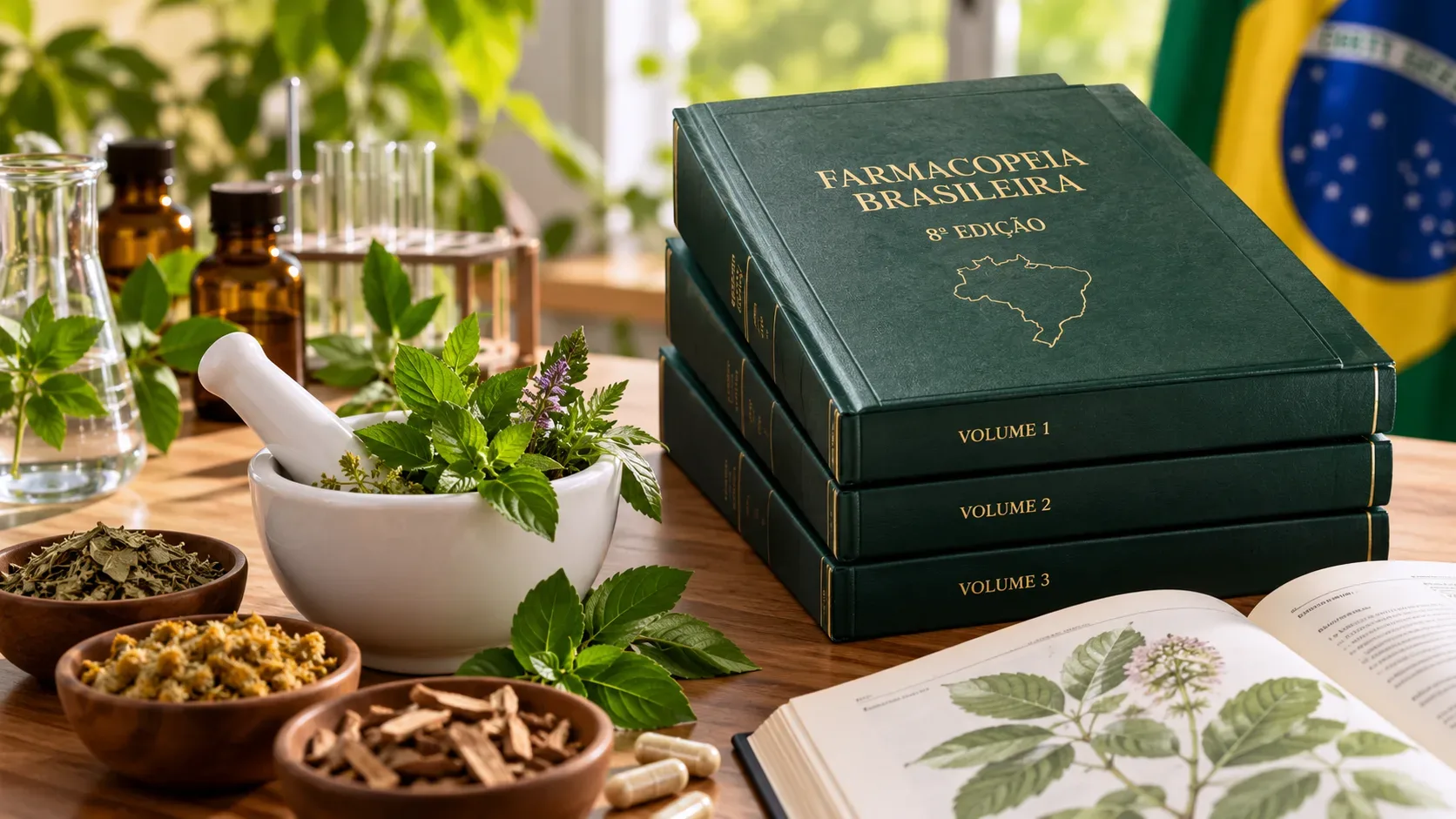
The Brazilian Pharmacopoeia, 8th edition, took effect on July 1, 2026. For people working with medicinal plants and herbal medicines, the most important point is the scope of the compendium: it updates official standards for quality, authenticity, and purity, but a pharmacopoeial monograph is not, by itself, proof that a plant or preparation is clinically effective for a specific indication.
Anvisa defines the Brazilian Pharmacopoeia as the country's official pharmaceutical code, used to establish minimum quality requirements for ingredients, medicines, and other products. The 8th edition was approved by Anvisa Resolution RDC No. 1,026/2026 and is available free of charge in digital format. See the official Brazilian Pharmacopoeia page and RDC No. 1,026/2026.
What changed in the 8th edition for medicinal plants
Across the Pharmacopoeia as a whole, Anvisa reported 19 additions, 122 revisions, and 203 errata. Within that package, several changes directly affect the medicinal-plants volume and methods used for their quality control.
Six new monographs for plants and derivatives
RDC No. 1,026/2026 added six new monographs identified with medicinal-plant codes:
- cipó-cabeludo, leaf (PM-153-00);
- colônia, leaf (PM-154-00);
- plantago, leaf (PM-155-00);
- solidago, aerial part (PM-156-00);
- avocado tree, fluid extract (PM-157-00);
- cipó-cabeludo, fluid extract (PM-158-00).
This means the edition now provides official specifications for the identity and quality of these raw materials or preparations in the pharmacopoeial context. It does not mean, by itself, that each one has an approved therapeutic indication or demonstrated clinical efficacy.
Twelve medicinal-plant monographs were revised
The edition also revised monographs for prune (fruit), aloe (leaf), hawthorn (leaf and flower), devil's claw (root), guava (leaf), jucá (bark), jucá (fruit), kola nut (seed), two quebra-pedra monographs (aerial part), prune (fluid extract), and hawthorn (fluid extract).
When a monograph is revised, users should work with the current version because methods, identification criteria, limits, or other specifications may have changed. For laboratories, manufacturers, pharmacies, or quality-control research, automatically comparing a test report with a revoked edition can lead to the wrong conclusion about compliance.
Errata and general methods matter too
Among the 203 errata in the 8th edition are seven medicinal-plant monographs: cannabis (inflorescence), macela (flower), pomegranate (pericarp), senna (fruit), boldo (tincture), horse chestnut (tincture), and horse chestnut (fluid extract). The edition also introduces a new total-polyphenols determination, revises sensory examination and microscopic inspection of herbal drugs, and corrects texts such as fluid extract and testing for foreign oils in vegetable oils.
These details matter because a Pharmacopoeia is not merely a list of plants. It also contains general methods that individual monographs may reference. A change to a general method can alter how a specification is performed even when the plant name remains the same.
How to find and read a monograph without getting lost
The safest approach is to start with the exact raw material or preparation, not just the plant's common name.
- Confirm the current edition. The 8th edition replaced the 7th edition on July 1, 2026, subject to transition rules in RDC No. 1,026/2026.
- Choose the right volume. Volume II contains a dedicated medicinal-plants section, while general methods are in Volume I.
- Search by name and plant part. Leaf, root, fruit, bark, aerial part, tincture, and fluid extract are not interchangeable.
- Check the monograph code. The code helps distinguish different texts and identify revisions or errata.
- Read the definition before the tests. It establishes the material to which the requirements apply.
- Review identification and quality sections. Depending on the monograph, these may include macro- or microscopic description, identification tests, purity, assay, limits, or other requirements.
- Follow references to general methods. If the monograph points to a Volume I method, the current version of that method governs the procedure.
For laboratory analysis, the right question is not “is this plant in the Pharmacopoeia?” but rather: “does the material I have correspond exactly to the monograph and meet the current specifications and methods?”
What the Pharmacopoeia does not demonstrate
| What the Pharmacopoeia can support | What it does not prove by itself |
|---|---|
| Identity of the material described in the monograph | That the plant treats a specific disease |
| Minimum quality, authenticity, and purity criteria | That a dose is clinically effective |
| Analytical methods and acceptance criteria | That benefits outweigh risks for every patient |
| Standardization for quality control and inspection | That every commercial product containing the same plant is equivalent |
This separation also appears in Brazil's current regulatory framework for herbal medicines. RDC No. 1,004/2025 requires the technical dossier to contain quality documentation and, separately, a safety-and-efficacy or safety-and-effectiveness report. For herbal medicines, the rule provides for proof through nonclinical and clinical studies or through specific simplified-registration pathways. Therefore, being covered by a Brazilian Pharmacopoeia monograph does not replace the evidence package required for a therapeutic claim.
The Brazilian Pharmacopoeia and the Herbal Medicines Formulary are not the same document
In 2026, Anvisa updated both documents, which makes confusion understandable. The Brazilian Pharmacopoeia reached its 8th edition; the Herbal Medicines Formulary of the Brazilian Pharmacopoeia reached its 3rd edition.
| Document | Main role | How to use it |
|---|---|---|
| Brazilian Pharmacopoeia, 8th edition | Standards for quality, authenticity, purity, and methods | Analytical control of raw materials, herbal drugs, derivatives, and other covered items |
| Herbal Medicines Formulary, 3rd edition | Official or pharmacopoeial herbal formulations | Check the formulation, preparation method, indication, directions for use, and warnings described in the compendium |
| RDC No. 1,004/2025 and related rules | Regulatory requirements for registration or notification | Assess quality, safety, efficacy or effectiveness documentation and the applicable regulatory pathway |
According to Anvisa, the 3rd edition of the Herbal Medicines Formulary contains 85 monographs covering 85 species and 236 formulations. It also harmonized definitions with the new herbal-medicine regulatory framework. That is a different function from the one performed by the 8th edition of the Pharmacopoeia.
An example of correct interpretation
Consider the fluid extract of avocado tree, included as a new monograph in the 8th edition. The legitimate conclusion is that an official pharmacopoeial text now exists to characterize and control the quality of the preparation covered by that monograph. The conclusion that cannot be drawn from that fact alone is that “avocado extract works for a particular disease.” To make an efficacy claim, one would need to examine the indication, preparation, dose, product, and the applicable clinical evidence or regulatory pathway.
The same reasoning applies to an established monograph: meeting a pharmacopoeial specification is important for reproducible quality, but analytical quality is not the same thing as clinical benefit.
Checklist for using the 8th edition safely
- Use the current edition and check for revisions or errata.
- Identify the species, plant part, and type of preparation.
- Read the full monograph, including references to general methods.
- Do not turn a quality criterion into a therapeutic claim.
- When the question concerns indication, dose, safety, or efficacy, consult the appropriate regulatory or clinical source, not only the Pharmacopoeia.
- For marketed products, also verify the applicable regulatory status and the information approved for that specific product.
Anvisa summarizes this distinction by stating that herbal medicines are characterized both by knowledge of efficacy and risks and by consistency of quality, with those components supported by different types of evidence and controls. See also Anvisa's official page on medicine concepts and definitions and its notice on the entry into force of the new Brazilian Pharmacopoeia compendia in 2026.
This article is for informational purposes and does not replace professional assessment, directions for use, or a regulatory analysis of a specific product.