Searching “Maria Clara”, “João Pedro” or another name composed in the IBGE tool Names in Brazil requires essential care: the published result does not represent the frequency of the complete combination.
Although the 2022 Census allowed registering a first name or a compound name in the field intended for the name, the dissemination methodology considered only the technically reported first name, the part before the first space. Therefore, the tool does not inform how many people are called exactly “Maria Clara” or “João Pedro”.
This distinction changes the entire interpretation. Searching “Maria” shows people whose first name is Maria, regardless of whether their second name is Clara, Eduarda, Luísa or any other. Likewise, a search for “Clara” does not reveal how many people have Clara as their second name: it counts people whose first name is Clara.
The current edition of the tool was launched on November 4, 2025 and uses the list of residents from the 2022 Demographic Census, whose reference date is August 1, 2022. The results can be explored by frequency, period of birth, sex and geographic areas, such as Brazil, Federation units and municipalities.
What the IBGE really counts as a name
To understand the result, it is necessary to separate three concepts:
| Concept | Example | How to interpret |
|---|---|---|
| First name | Maria | Initial part used in calculating the published frequency |
| Composite name | Maria Clara | Two or more first names used together in the person's record |
| Last name | Souza | Element consulted separately in “surname” mode |
In the 2022 Census, the census taker was instructed to record the first name or compound name in the “name” field. Other surnames should be registered in another field. In the treatment carried out for disclosure, however, IBGE separated the content of the “name” field in the first blank position and kept only the first element.
Visual example: what happens to “Maria Clara Souza”
Full name entered: Maria Clara Souza
↓
Field for name: Maria Clara
↓
Field for surname: Souza
↓
Element considered in name frequency: Maria
Therefore:
- the frequency of Maria includes this person;
- Clara's frequency does not necessarily include her;
- the frequency of Maria Clara as a combination is not presented;
- the search for Souza must be done in the surname option.
Maria's result cannot be crossed or subtracted from Clara's result to find out how many people are called Maria Clara. The tool discloses aggregated data for each first name, not individual combinations of first names.
How to search for a compound name step by step
1. Access the official tool
Enter the page Names in Brazil Demographic Census 2022 and select the name query, not the surname query. The platform also offers rankings and visualizations on frequency and territorial distribution.
2. Identify the first element of the compound name
Before searching, separate the name:
- Maria Clara → search Maria;
- João Pedro → search João;
- Ana Júlia → search Ana;
- Luiz Felipe → search Luiz.
This result will answer the question:
How many residents in the census had this term as their first name?
It will not respond:
How many residents had exactly this compound name?
3. Check the spelling
IBGE treated different spellings as different names. Thus, forms such as Ana and Anna, Ian and Yan or Luis and Luiz were counted separately.
Diacritical signs, such as accents, cedilla and tilde, were not considered in the collection destined for this database. Therefore, names such as Antônio, Cauã, Luís and Luísa were treated without these signs. When analyzing the results:
- a change of letter can create another entry;
- an accent should not be interpreted as a separate statistical variant;
- two similar spellings should not be added together without first explaining that they are different records.
For example, the result for Luiz does not automatically include people classified as Luis. Adding the two frequencies can be useful for your own analysis of variants, but the value obtained is no longer a number published directly by IBGE and needs to be identified as the author's calculation.
4. Read the national frequency first
The frequency is the number of residents of the consulted universe associated with that first name. When the selected location is Brazil, the number represents the national total that exceeded the minimum disclosure threshold.
The position in the ranking informs the placement of the name in relation to the other names in that group. It does not show how many people use a given combination of first names, nor does it indicate that the name is equally common in all regions.
5. Compare quantity and geographic concentration
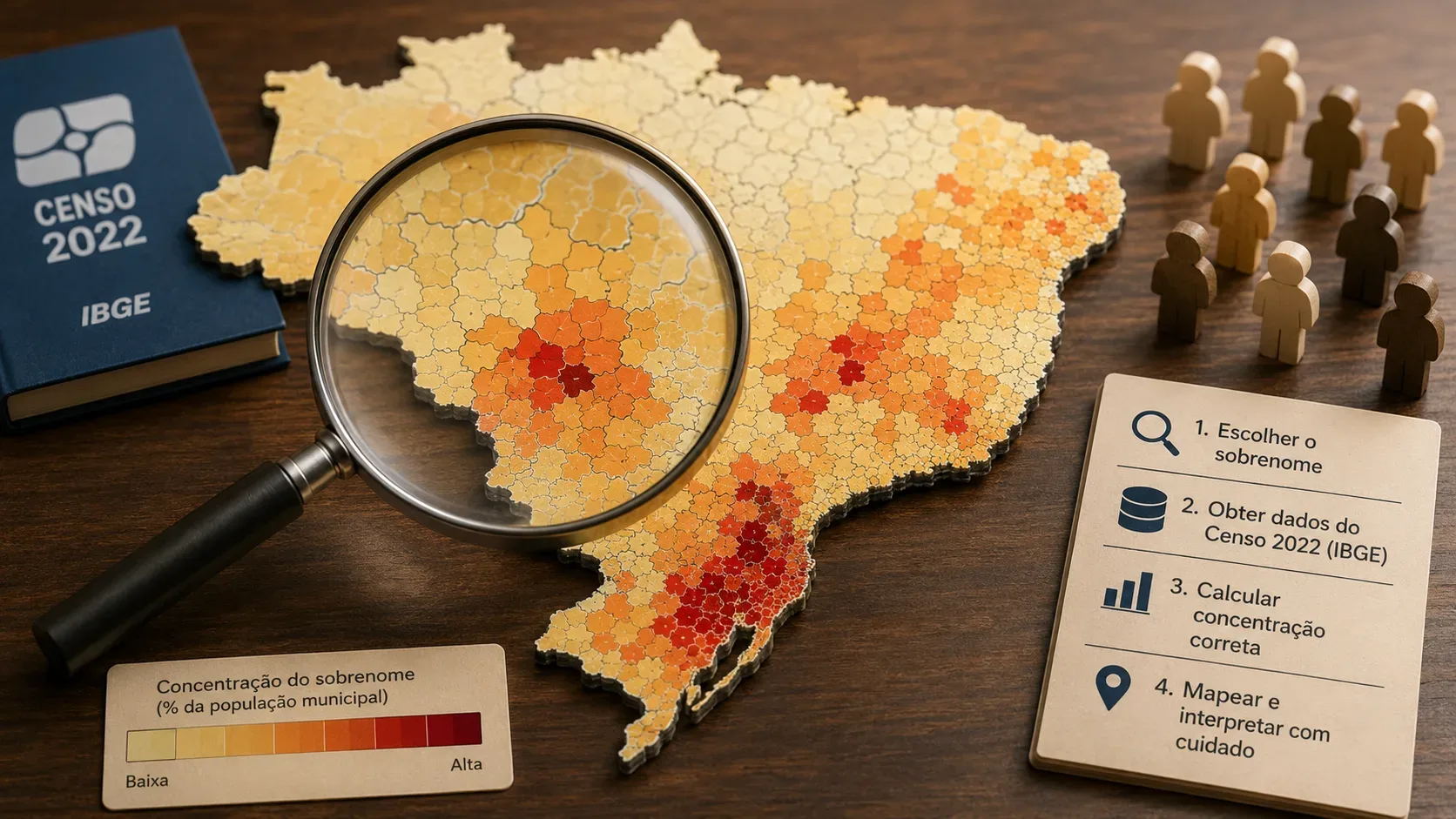
The tool allows you to observe the occurrence and concentration of names in states and municipalities.
These two readings are not equivalent:
- Absolute quantity: number of people with the name in that location.
- Local concentration or participation: weight of that name in relation to the local population.
A populous state may have the most people named Maria, but another state or municipality may have Maria as a larger portion of its population. Therefore, it is not enough to just look at the darkest region on the map or the largest number in the table: you need to check which indicator is being displayed.
6. Interpret the timeline as birth period
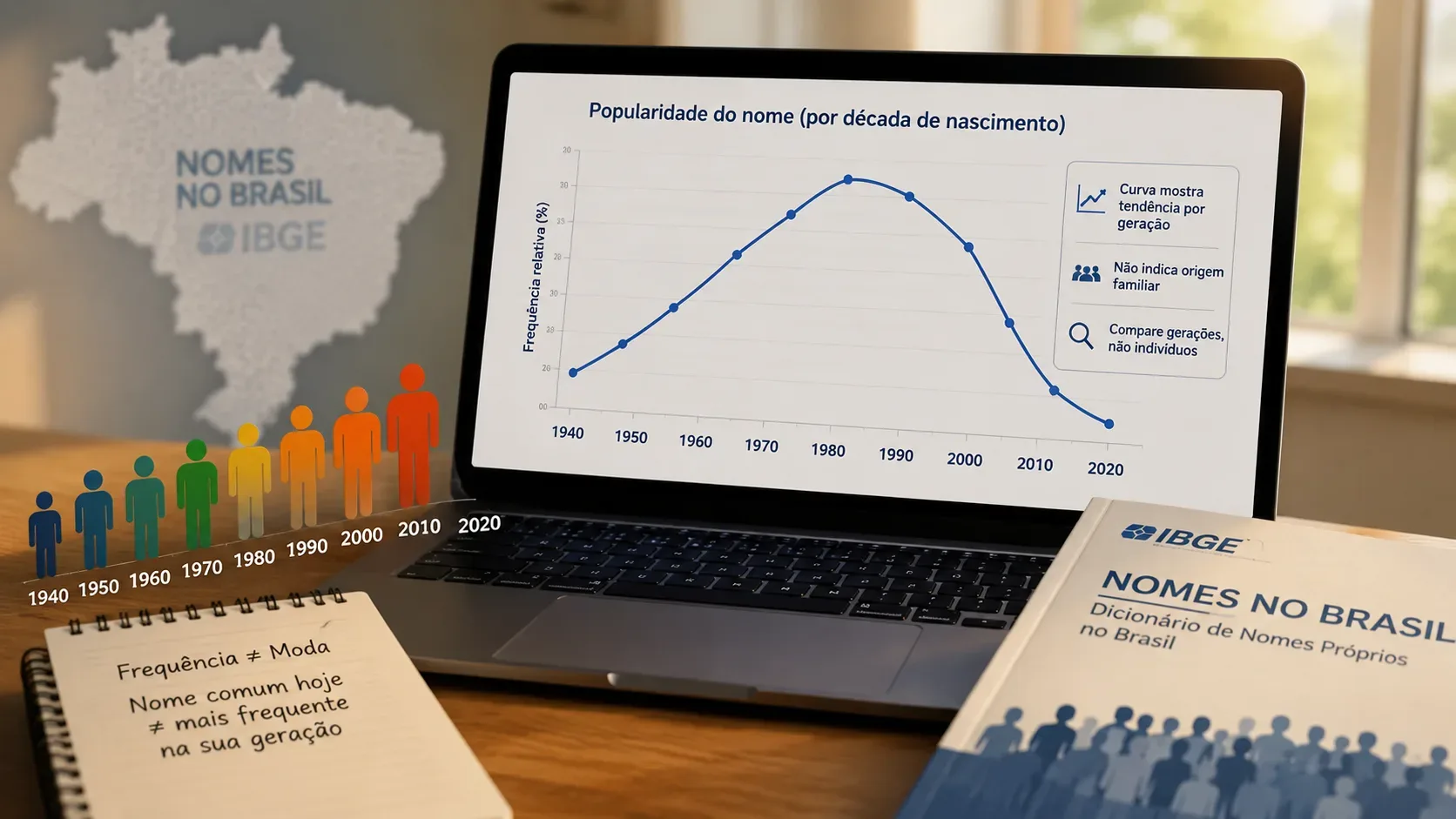
The time series groups the people registered according to their period of birth. It helps to observe in which generations a given first name appears most frequently.
This line is not a complete history of the records made by the registry offices in each decade. It represents people who were in the census population in 2022 and were grouped by the time they were born.
The difference is important because people born in older decades who died before August 1, 2022 do not appear in the database. Therefore, a smaller curve in older generations does not alone prove that few children received the name in that period. It also reflects the composition of the surviving and resident population at the date of the Census.
In state and municipal areas, population movements throughout life can also influence the observed distribution. The municipality shown is the place where the person was registered, and not necessarily the place where they were born or given their name.
7. Use the median age as a summary, not as a typical age for everyone
The platform may also display the median age of people associated with a name.
The median divides the group into two parts: half of the people are below this value and half are above. It doesn't mean that most people are exactly that age.
A name with a high median may be more present among older generations. A name with a low median may have gained popularity more recently. Still, the median does not explain why the name was chosen nor does it allow us to predict the age of a specific person.
What each type of result means
| Result displayed | Correct reading | Wrong interpretation |
|---|---|---|
| Frequency of Mary | Residents whose first name is Maria | People named exactly Maria Clara |
| Clara's Frequency | Residents whose first name is Clara | People who have Clara in any position |
| Ranking | Position of first name in selected clipping | Ranking of all compound names starting with the term |
| Map | Distribution of residents associated with the name | Place of historical or family origin of the name |
| Birth period | Generations of residents registered in 2022 | Total birth records made in the decade |
| Median age | Point that divides the group's ages in half | Age of most people |
| Name not found | Input below limit or different spelling | Proof that no one owns the name |
Why some names or locations don't appear
To protect statistical confidentiality, IBGE established minimum disclosure frequencies.
| Cut | Minimum frequency displayed |
|---|---|
| Brazil | 20 occurrences |
| Federal Unit | 15 occurrences |
| Municipality | 10 occurrences |
The same filters are applied to each period when the result is divided by decade. A name may appear in the national total, but not in a certain state, municipality or period because it was below the limit in that cutoff.
This also explains why:
- the sum of the states may be smaller than the total for Brazil;
- the sum of municipalities may be less than the total of a state;
- the sum of visible decades may not reproduce all records of the name;
- an area with no displayed value does not necessarily represent zero frequency.
A municipality with nine occurrences, for example, will not have the result published, although there are residents with that name. The absence on the screen means data not presented within that section, and not proven non-existence.
The map does not reveal family origin, ancestry or ethnicity
The geographic distribution shows where residents associated with the name were registered on August 1, 2022. It does not identify the historical origin of each person's name, the birthplace of ancestors, or a family relationship between residents of different regions.
Thus, a concentration of a given first name in a region can generate cultural or historical hypotheses for further research, but does not prove it:
- kinship;
- ancestry;
- nationality of origin;
- ethnic belonging;
- religion;
- migration of a specific family.
The same limit applies to surnames. Two people with the same surname may or may not share a genealogical relationship, and the tool was not built to identify individual family ties.
Five common mistakes when searching for names in Brazil using IBGE
1. Treat the first name as if it were the entire compound
João's frequency is not João Pedro's frequency. It brings together João Pedro, João Carlos, João Gabriel, people registered only as João and other combinations starting with the same term.
2. Search for the second name alone
The result for Pedro does not show how many people are called João Pedro. It represents those who had Pedro treated as their first name in the disclosed database.
3. Add two results
Adding Maria and Clara counts two different groups and can produce conceptual duplications. The operation does not reconstruct the set of people named Maria Clara.
4. Confusing census population with baby records
The tool portrays existing residents on the Census reference date, grouped by period of birth. To exclusively study names given to newborns in a given year, it is necessary to resort to civil registry statistics or registry databases appropriate to this question.
5. Interpret concentration as origin
A name more concentrated in a state may reflect local customs, population movements or the age structure of residents. The map alone does not tell you which of these factors produced the pattern.
Checklist to check before sharing the result
Before writing that a name is “common”, “regional” or “ancient”, check:
- Did I search only the first element of the compound name?
- Did I make it clear that the number does not represent the complete combination?
- Am I looking at a quantity or a local proportion?
- Is the selected section Brazil, state or municipality?
- Does the decade refer to the birth of the registered residents?
- Have I considered the minimum disclosure limits?
- Did I check possible spelling variants?
- Did I avoid inferring kinship, ancestry or ethnicity?
- Did I register that the data is referenced on August 1, 2022?
Frequently Asked Questions
Is it possible to find out exactly how many people are called Maria Clara?
Not for the publication of Names in Brazil from the 2022 Census. The published methodology only considers the first name reported. The result for Maria includes different compound names starting with Maria, but does not separate them.
Can I look for Maria and Clara and cross-reference the numbers?
No. The results are aggregated frequencies of first names. They do not inform which people simultaneously belong to a combination of two given names.
Is the second given name counted as the last name?
Not necessarily. Name and surname were recorded in separate fields. A second given name provided as part of the compound name should not be treated as a surname simply because it does not appear in the frequency of the first name.
Why doesn't my name appear?
It may have been below the minimum of 20 national occurrences, been registered with another spelling or not been classified as a first name in the publication. In states and municipalities, specific limits of 15 and 10 occurrences, respectively, are also applied.
Does the tool show where a name came from?
No. It shows the distribution of census residents, and not the etymological or genealogical origin of each occurrence. Information presented about meaning and etymology, when available, must be separated from statistical frequency and does not prove a person's ancestry.
The IBGE tool is valuable for knowing the presence of first names in the Brazilian population. Your reading becomes more useful when the question is formulated correctly: instead of “how many people have this compound name?”, ask “how many people in the census had this first name, and how were they distributed by generation and location?”
Save this checklist for future reference, and when searching for surnames, also consult related content on the limits of family inferences.