Does your name not appear in the IBGE search? This does not prove that it is exclusive, that there is only one person with that spelling or even that its frequency is zero in Brazil.
The result may have been affected by the way the name was registered, the treatment applied to compound names, the geographic or temporal scope selected and, mainly, the minimum disclosure limits adopted to preserve statistical confidentiality.
The Names in Brazil tool uses information from the list of residents from the 2022 Demographic Census. The reference date is August 1, 2022; therefore, it offers a census portrait of that date, not a continuously updated civil registry. Technical Note 01/2025 explaining the methodology was dated November 4, 2025.
Before interpreting an empty result as a sign of rarity, follow this decision tree.
What the IBGE name search really shows
The base was formed from the names and surnames reported for household residents on the reference date of the 2022 Census. According to the technical note, the disclosure covers the national territory, the 27 Federation Units and the 5,570 municipalities, with results organized by sex, period of birth and geographical area.
In practical terms, the tool allows you to observe:
- the published frequency of a first or last name;
- your position in rankings;
- differences between Brazil, states and municipalities;
- distribution by sex reported at collection;
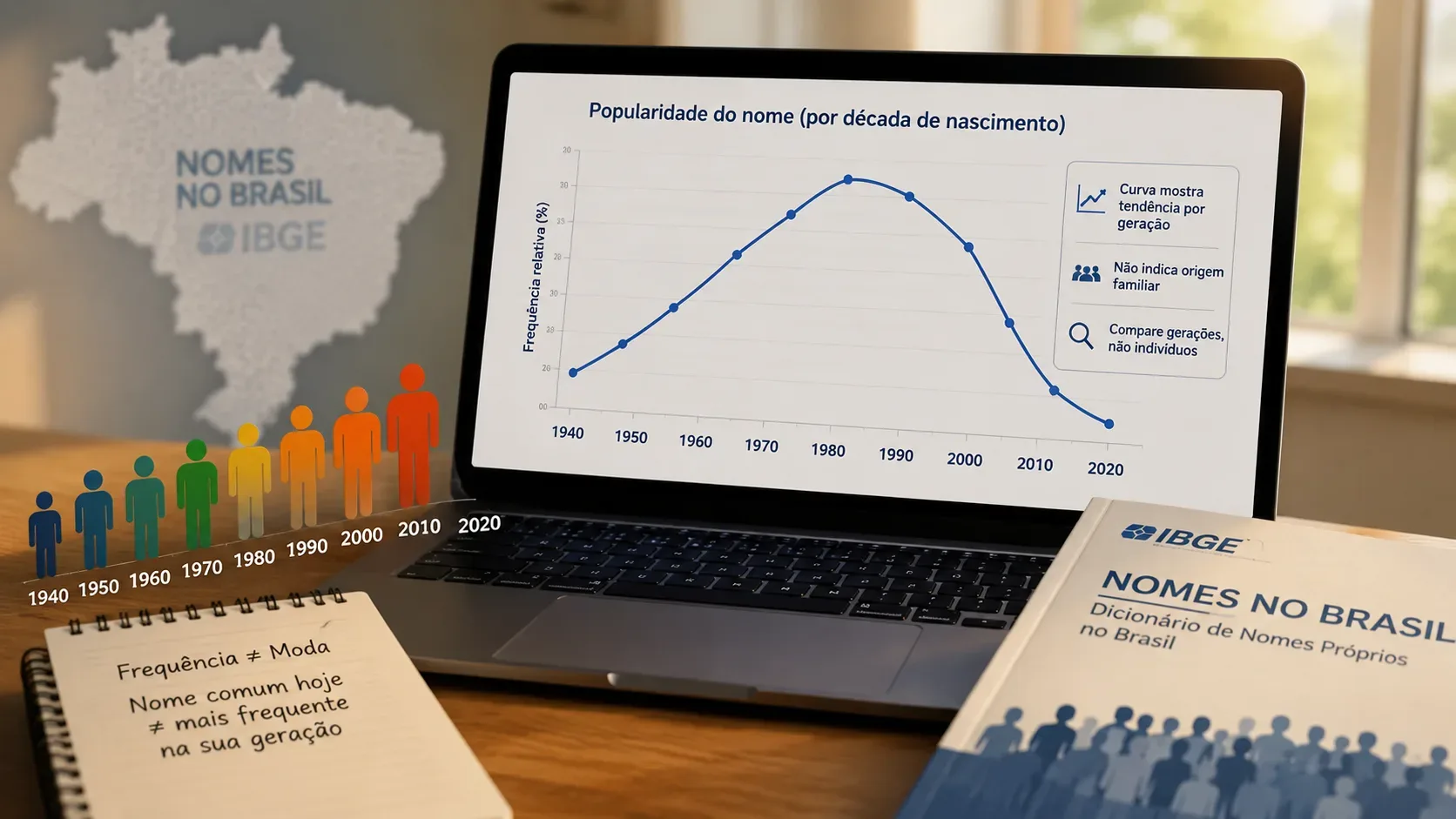
- behavior by periods or decades of birth.
It does not work as a search by person. The system does not inform who has a given name, does not present addresses and does not allow individual identities to be confirmed. Results are statistical and aggregated.
It is also not an updated database with births, deaths, name changes or population movements after August 1, 2022. A child born after this date, for example, could not be on the list of residents used for publication.
The rule that best explains an empty result
Technical Note 01/2025 establishes minimum frequencies for a name to be presented. These limits vary according to the section consulted.
| Consulted clipping | Minimum frequency for dissemination |
|---|---|
| Brazil | 20 |
| Federal Unit | 15 |
| Municipality | 10 |
| Result by decade | The same cutoff limit is reapplied in each decade |
This means that a name can exist in the database and still not be shown in a given query.
In the national profile, the interface only presents names with a frequency equal to or greater than 20. In a state, at least 15 occurrences are required. In a municipality, at least 10. When the user selects a decade, the minimum filter is applied again to the data from that decade.
Therefore, “did not appear” and “no one has that name” are different conclusions.
The IBGE itself warns that, because of these filters, the national total of a name may not coincide with the sum of the state numbers. Likewise, the total for a state may not be equal to the sum of the municipalities displayed. Part of the occurrences may remain outside the smaller cut-off tables.
Decision tree: what to check when the name does not appear in IBGE
1. Did you research the spelling treated by the base?
Start by checking for swapped, duplicated or missing letters. Spelling variants were counted separately. The technical note cites examples such as Ana and Anna, Ian and Yan, Luis and Luiz: each form makes up its own frequency.
So finding “Ana” does not tell you how many people were registered as “Anna”. Likewise, the absence of one variant cannot be automatically compensated for by the frequency of another.
There is an important difference for accents and other diacritical marks. According to IBGE, these signs were not considered in the processing: names such as Antônio, Cauã, Luís and Luísa were processed without accent, tilde, cedilla or equivalent signs.
How to test:
- check the spelling letter by letter;
- try the form without accents;
- search separately for variants such as S and Z, I and Y or one and two consonants;
- do not add variants and treat the result as if it were a single name.
If only one other spelling appears, the query reports the frequency of that other spelling — not that of the originally searched name.
2. Is the name compound?
This is one of the points that most often produces misinterpretations.
During the collection, the census taker could record the first name or the compound name in the field designated for the name. For disclosure, however, IBGE considered only the first name reported. The treatment separated the first element by finding a space between the characters.
This means that the tool should not be read as a reliable counter of the complete combination of compound names.
If someone searches for “João Pedro” and does not find the entire expression, this result does not demonstrate that the combination is rare. In statistical publications, the component considered as a first name tends to be “João”.
Recommended path:
- search for the starting component first;
- check if the second component could have been treated as part of the other names;
- do not use the frequency of the first component as the frequency of the entire compound name;
- see also the specific guide on compound names.
Read also: How to search for a compound name in the 2022 Census without interpreting the wrong result.
Internal link pending insertion.
3. Are you looking at Brazil, state or municipality?
A name may appear in Brazil and disappear when the query is limited to one city. This does not necessarily mean that it does not exist in that municipality.
The explanation may just be the disclosure limit:
- in Brazil, the minimum frequency is 20;
- in state, 15;
- in the municipality, 10.
If the name appears nationally but not in a municipality, the safe reading is: the interface did not show a municipal frequency of 10 or greater for that form. You cannot turn this into an exact count of zero.
Search in order:
- Brazil;
- Federal Unit;
- municipality.
This sequence helps to separate a national absence from a local suppression.
4. Is there a selected birth decade or period?
A name can exceed the minimum threshold in cumulative total and fall below it within a specific decade.
Imagine a spelling with occurrences distributed over several generations. Added together, they can reach the national minimum of 20. Separated by decade, no band needs to reach this level.
Technical note confirms that minimum filters are re-applied every decade.
When encountering an empty period:
- remove decade filter;
- see total;
- compare other periods;
- do not conclude that no one received the name in that decade.
The possible conclusion is simply that there was not enough dissemination in that time frame.
5. Is there an active sex filter?
The results are organized according to the sex declared at the time of the Census collection. The technical note emphasizes that this information exclusively reflects what was stated in the questionnaire.
If the search is limited to a category, reset the filter and see the total available. A result missing in a specific selection should not be generalized to the entire population.
The data is also not used to determine whether a name “belongs” exclusively to men or women. It describes the distribution observed on the basis and according to the categories used in the collection.
6. Did you choose to search by first name or last name?
Names and surnames were treated differently.
For names, the first element entered was considered. For surnames, IBGE calculated the frequency of each registered surname, regardless of the order in which it appeared in the full name.
The treatment also excluded connectives such as “da”, “das”, “de”, “do”, “dos”, “di” and similar forms.
If the searched word can function as both a first name and a surname:
- make a query in each modality;
- do not transfer the result from one category to another;
- remember that the position of the surname in the full name does not change its published frequency.
7. Was the person part of the reference population?
The database describes residents on the Census reference date, including those present and those absent for a period not exceeding 12 months, according to the definition used in the list of residents.
Consequently, the tool should not be treated as a list of all people who have ever lived in Brazil, all Brazilians abroad or all birth records in registry offices.
It also doesn't automatically answer questions about people who:
- born after August 1, 2022;
- had their name changed later;
- belong to a historical generation not represented among the residents of that date;
- appear in family documents, but not necessarily in the reference census population.
How to interpret each type of result
| Situation observed | Secure interpretation |
|---|---|
| The name does not appear in the Brazil clipping | The tool did not disclose a national frequency equal to or greater than 20 for the form researched |
| Appears in Brazil, but not in the state | No state frequency equal to or greater than 15 was displayed |
| Appears in the state, but not in the municipality | No municipal frequency equal to or greater than 10 was displayed |
| Appears in total, but not in a decade | The minimum limit may not have been reached within that period |
| One variant appears and another does not | The spellings were counted separately |
| The compound name does not appear in full | Disclosure considered only the first name |
| The national number does not match the sum of the states | Values below disclosure limits may not appear in smaller sections |
The expression “undisclosed frequency” is almost always more accurate than “the name does not exist.”
What absence never proves alone
Even after reviewing all filters, an empty result does not show:
- that there is only one person with that name;
- that the person researched is the only one in Brazil;
- that two people with the same surname are related;
- that the name belongs to a specific ethnicity, nationality or religion;
- that there is noble ancestry or ties to a certain family;
- that a spelling was created by a person or their parents;
- that the name does not appear in civil records, historical archives or immigration documents.
Statistical frequency and etymological origin are different questions. A name can be infrequent in the Census and have a well-documented linguistic origin. It can also be common in a region without its carriers having any close relationship.
For genealogy, the IBGE search works as population context, not as documentary evidence.
Why the tool does not confirm relationship or identity
Individual data provided to IBGE is confidential and used for statistical purposes. The institute informs that these responses cannot be used as a certificate or as evidence in administrative, tax or judicial proceedings.
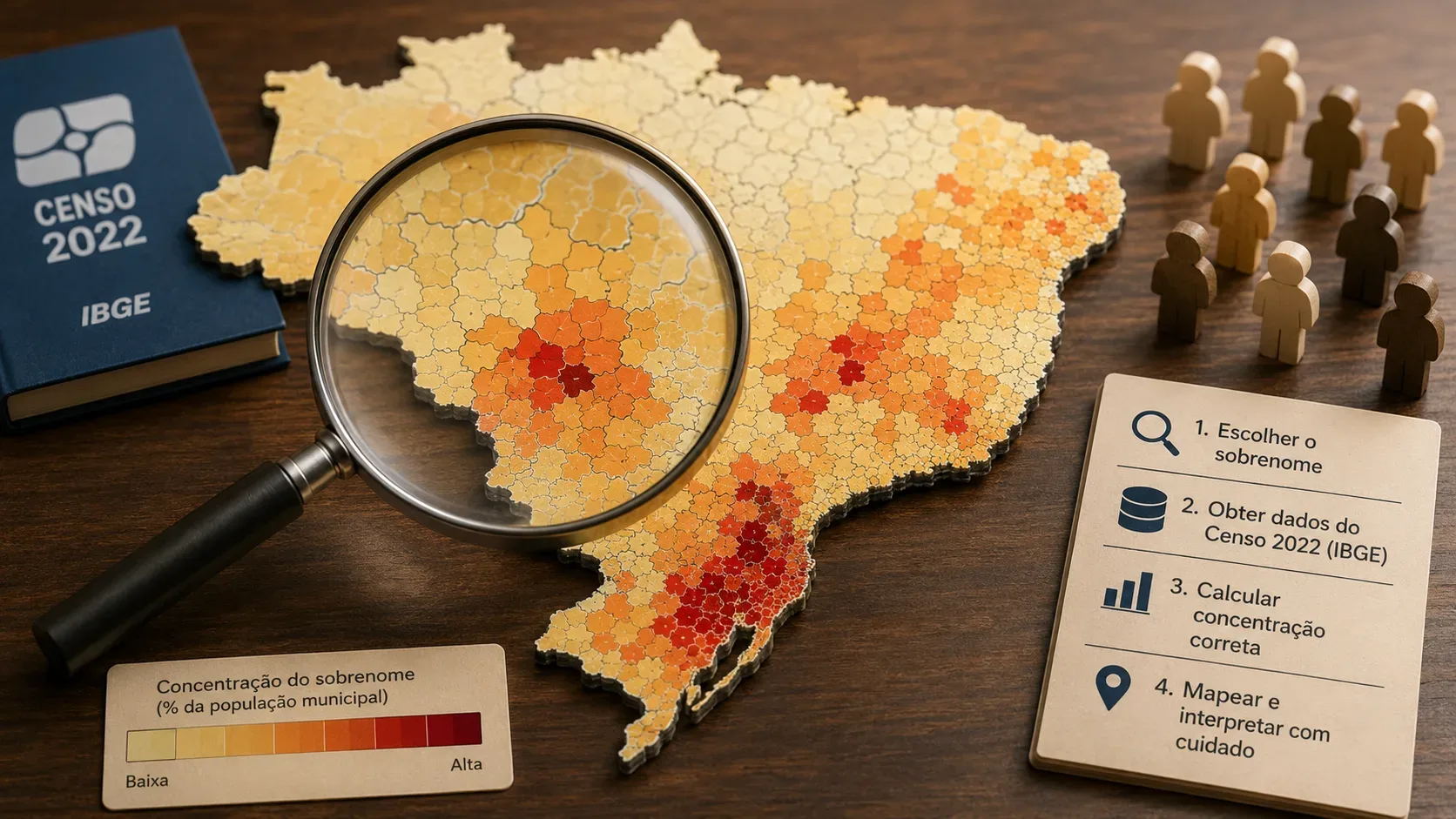
The public interface presents aggregated frequencies, not personal records. Therefore, the fact that a surname appears concentrated in a certain municipality does not confirm that all its bearers descend from the same family.
A genealogical investigation requires crossing documents such as birth, marriage and death certificates, religious records, migration files and other sources appropriate to the period studied. The census distribution may suggest where to look, but it does not replace these documents.
It is also recommended to avoid disclosing full names, dates of birth, addresses or family links of living people without editorial necessity and without evaluating the impacts on privacy.
Three examples to avoid hasty conclusions
Ana appears, but Anna does not
The two spellings are counted separately. Ana's result cannot be used as an automatic estimate of Anna. If Anna is not displayed in a city, there may still be people with that spelling below the city limit.
João appears, but João Pedro does not
The publication considered only the first name. The frequency of João does not correspond to the total number of people called João Pedro, and the absence of the complete expression does not prove the rarity of the compound name.
One name appears in total, but not in the 1990s
The disclosure limit has been re-applied to the decade. The accumulated total may reach the minimum while the period frequency falls below it.
Checklist before calling a name rare
Save this string to use in future queries:
- Confirm spelling.
- Test the form without accents.
- See variants separately.
- Check if the name is composed.
- Search for the first isolated component.
- Start with the Brazil section.
- Then check state and municipality.
- Remove the period or decade filter.
- Check out the sex filter.
- Select first or last name correctly.
- Consider the reference date of August 1, 2022.
- Read “undisclosed” rather than assuming “zero.”
The IBGE tool is valuable for understanding the distribution of names among registered residents. Your result, however, needs to be read within the publication rules.
Zero results are not proof that only you have that name. It is the beginning of a check — not the conclusion.