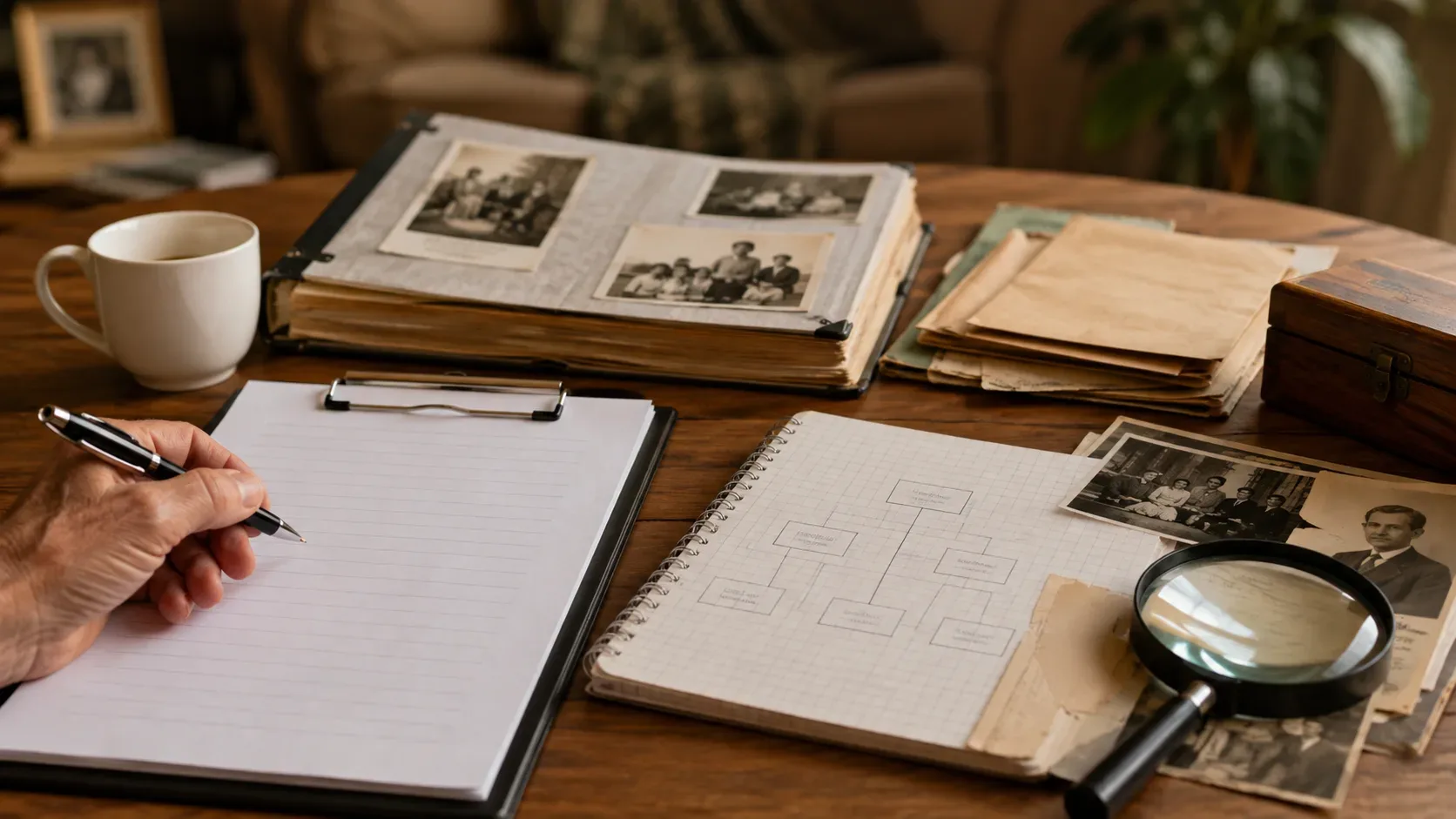
In 2026, Father's Day will be celebrated on Sunday, August 9th. The family reunion can provide an opportunity to record names, places, city changes, professions and documents that may never have been organized.
The purpose of the interview is not to decide, during the conversation, where the family came from or which version is correct. It is about collecting clues with enough context to guide the following research. A report can preserve details that do not appear in certificates, but information presented as facts must be verified and compared with other sources. The Oral History Association also recommends informed consent, open-ended questions, respect for the right not to respond, and prior determination of access and use of the recording.
The rule of thumb is simple: record the memory as a memory and turn every searchable detail into a documentary question.
Before the interview, agree on the use of conversation
Don't start recording by surprise. Explain why the interview is being done, where the file will be kept and who will be able to hear it. The interviewee must be able to refuse topics, ask for a break, restrict the circulation of the recording or request that a certain excerpt not be shared. For a domestic interview, this agreement can be simple, but it needs to be clear.
Use this initial authorization:
- I authorize audio or video recording.
- Content can only be shared with family members.
- I authorize publication on a website, social network or public file.
- I want to review the recording or transcript before any publication.
- There are matters that should not be addressed or disclosed.
- I can stop the interview or withdraw an answer.
Do not record unnecessary data about living people in the identification file, such as CPF, full document number, home address or medical information. When indicating the location, expressions such as “the interviewee’s home, in Recife” are usually sufficient; Professional oral history guidelines also recommend avoiding the full private address.
Family interview form
Name of interviewee: ______________________________________________
Name used at birth, if different: _________________________________
Interviewer: ______________________________________________________
Relationship between the two: ___________________________________________
Interview date: ____ / ____ / ______
General location: ________________________________________________________
Recording method: audio / video / notes
Use permission: private / family / authorized publication
Location where the file will be saved: _______________________________
People mentioned who should be interviewed later:
Recall confidence level
Mark a rating next to each important information:
- A — direct experience: the person lived or witnessed the event.
- B — participant report: heard the information from someone directly involved.
- C — family tradition: the story circulates in the family, but the origin of the story is unclear.
- D — estimate or doubt: there is uncertainty about name, date, place or sequence.
This scale describes the path of memory, not its veracity. Information classified as A may still contain date or spelling errors; a C tradition can be confirmed later by documents.
20 questions that generate genealogical clues
The questions below are open-ended to allow for complete responses. When a name, place or date comes up, ask for clarification without turning the question into an interrogation: “How was it spelled?”, “What did this happen before or after?”, “Who else was there?” and “Is there any document or photograph from that time?”.
Names, relationships and variations
- What was your full name on the birth record? Was there a nickname, abbreviation, change of surname or different spelling in other documents?
- What were your parents' and grandparents' full names? Do you remember any maiden surnames, nicknames, or alternative ways of writing these names?
- Did anyone in the family change their name when they married, migrated, were recognized by another guardian, or corrected a record? What do you know about this change?
- Who were the godparents, witnesses, close neighbors or relatives who frequently appeared at family events?
Places and dwellings
- Where were you born? Ask for the municipality, district, town, farm, neighborhood, hospital or geographic reference known at the time.
- What places have you and your parents lived in over the years? Try to establish a rough sequence of counties and time periods.
- Where did your parents or grandparents meet, get married and have children?
- Which churches, parishes, cemeteries, schools, hospitals, farms or associations were linked to the family?
Migrations and shifts
- Who in the family moved to another city, state or country? Where did they come from and where did they go?
- When did the change occur? What event helps locate the date: marriage, birth of a child, job, drought, war, death, or property purchase?
- How was the trip? Was there a port, ship, train, road, inn or relatives who traveled together?
- Who received the family at the destination? Was there a relative, employer, religious community or acquaintance who helped with their arrival?
Work, study and service
- What professions and activities did each person practice? Ask for the name of the company, farm, office, trade or workshop and the city where it operated.
- Did the family keep work cards, pay stubs, employment records, union documents or proof of retirement?
- Where did your parents and grandparents study? Ask for the name of the school, municipality, course, teachers and approximate years.
- Has anyone served in the military, worked in public service, or participated in a professional council, association, sorority, or cooperative?
Documents, photographs and other witnesses
- What old documents still exist in the family? Look for certificates, notebooks, passports, wallets, deeds, diplomas, titles, letters and processes.
- Are there photographs with names or dates on the back? Who appears, where the photo was taken and who wrote the identification?
- Who keeps the original documents and how did they get to that person? Are there copies in other houses?
- Which part of the family history makes you least sure? Who else could come up with another version or help confirm the details?
How to write down the answer without correcting your memory
First record the wording used by the interviewee. If it says “Vila de Santa Rita, near Palmeira”, don’t immediately replace it with a current municipality. Write the original expression and, in another field, add the possible geographic identification to search.
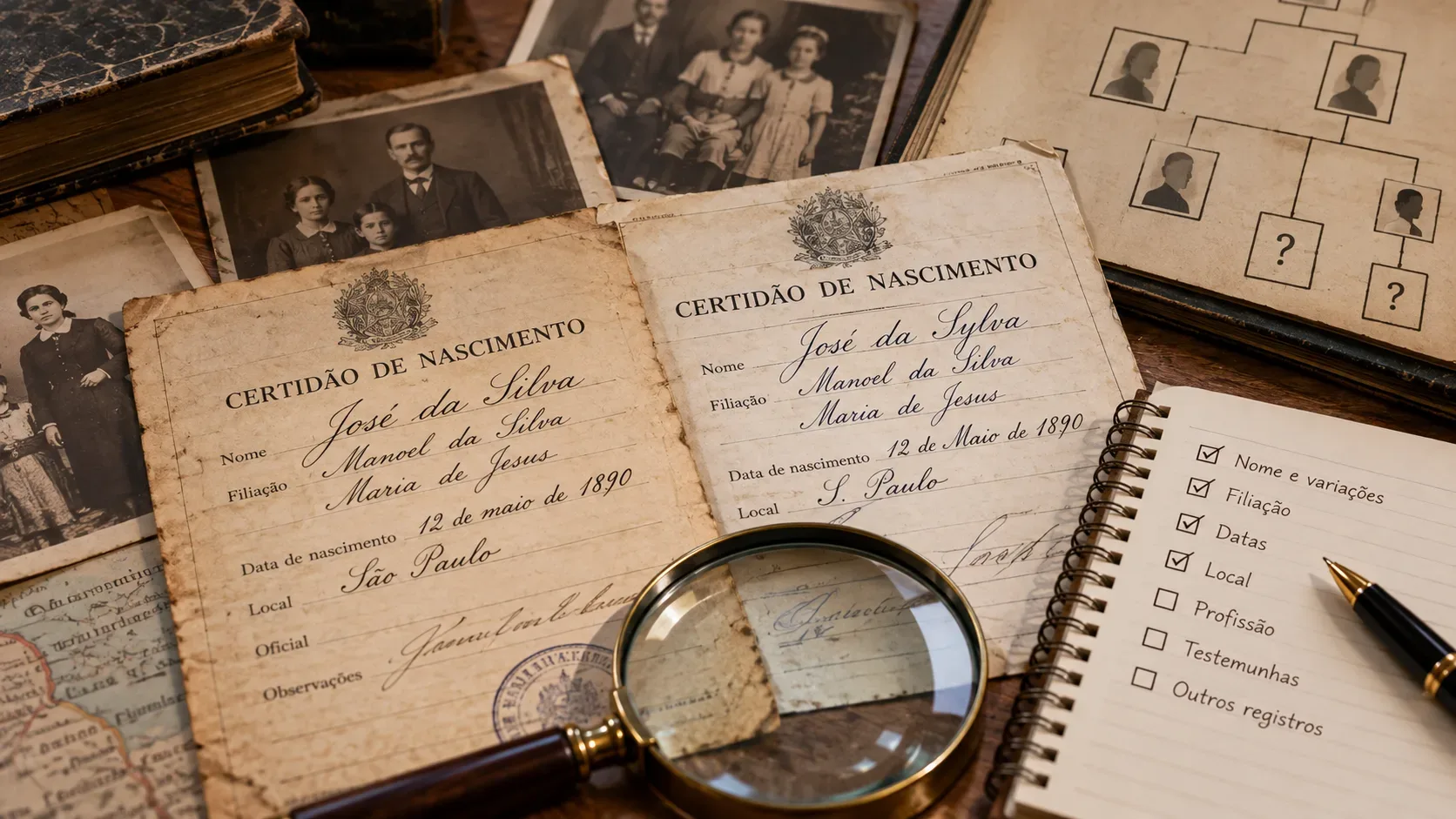
The same separation must be done with names. Preserve “Manoel”, “Manuel” and “M. de Souza” as they appear in each source. A different spelling may be an error, adaptation, abbreviation or an indication that the documents belong to different people.
A clue sheet can contain:
Remembered information: ________________________________________________
Interviewee's exact words: ____________________________________
Degree of confidence: A / B / C / D
Approximate period: _________________________________________________
Place mentioned: __________________________________________________
Person who can offer another version: ______________________________
Suggested document: ________________________________________________
Search result: confirmed / contradicted / partially supported / not yet found
Track matrix → document
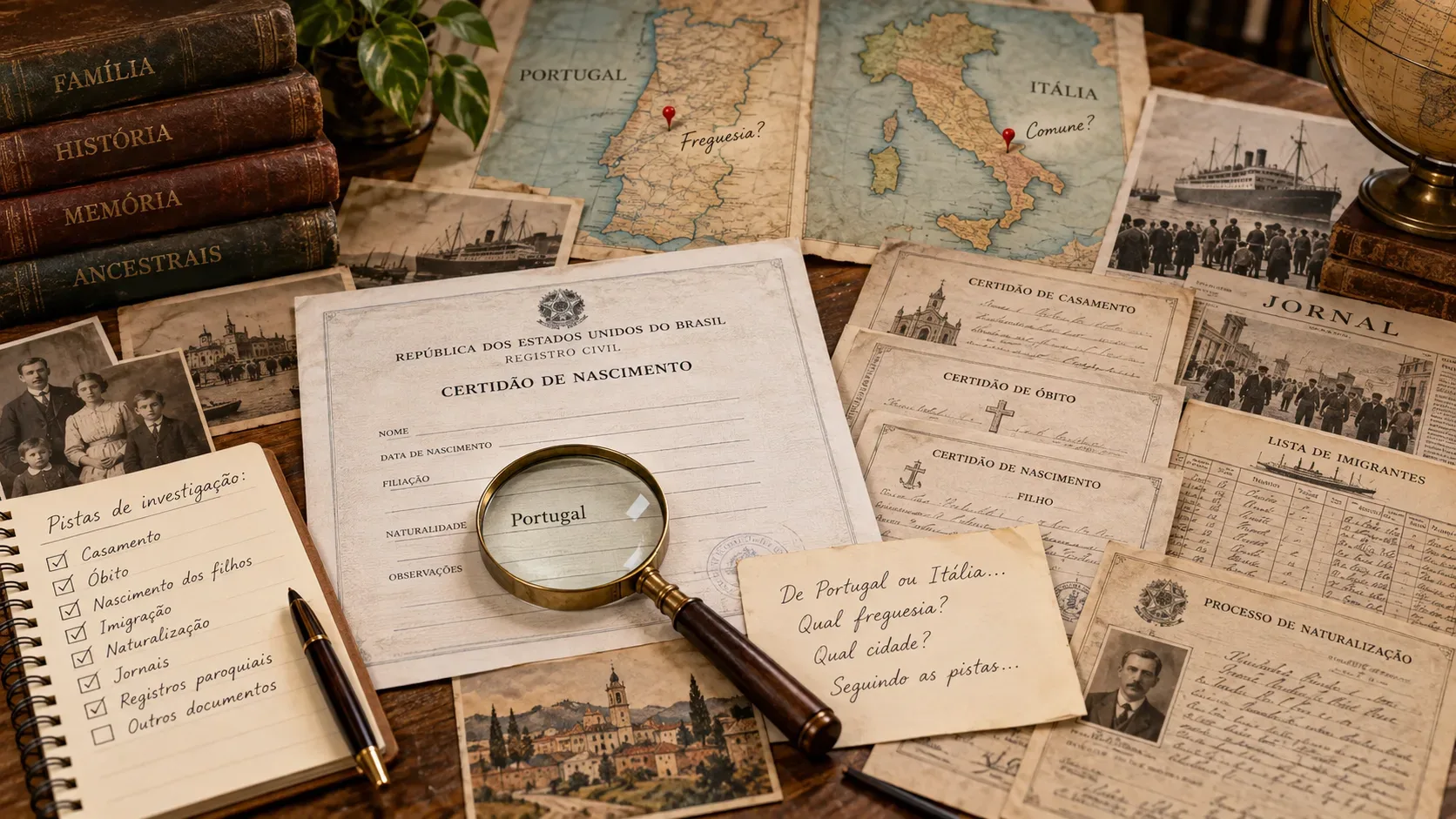
Genealogical files can bring together civil records, passenger lists, military documents, naturalization processes, land records and other sets. The collection of each institution, however, depends on the country, location and period. The United States National Archives guide is useful for recognizing document categories, but it mainly describes North American collections.
In Brazil, the National Archive maintains certain sets of civil records and documents about foreigners, including entry lists, medical records, naturalization processes and records linked to migratory movements. These collections do not form a complete index of all the people who lived in the country; research may also require notary offices, state or municipal archives, religious institutions and other custodian entities.
| Clue obtained in the interview | Documents that can confirm, correct or delimit | Where to look first | What to compare |
|---|---|---|---|
| Full name, nickname or different spelling | Birth, marriage and death certificates; baptism; identity documents; subscriptions | Registry office, public archive, parish or diocese | Parents, spouse, age, place, profession and signature |
| Affiliation or kinship | Birth or baptism, parents' marriage, matrimonial license, inventory, will | Registry office, forum, judicial archive, parish | Names of those responsible, residence, witnesses and dates |
| Marriage and change of surname | Registration and marriage certificate, qualification, banns, religious registration and endorsements | Registry office, public archive or religious institution | Previous name, parents, place of birth, age and witnesses |
| Date or place of death | Death certificate, cemetery record, inventory, funeral announcement | Registry office, cemetery, forum, newspaper library | Age, spouse, affiliation, residence and informant |
| Former address or change of city | Children's certificates, deeds, school, functional, electoral or notary records | Notary offices, schools, employers and local archives | Address, profession, family composition and sequence of dates |
| Migration within Brazil | Civil records in places of origin and destination, work documents, school, real estate and newspapers | State and municipal archives, notary offices and newspaper libraries | Last record in source and first record in destination |
| Alien entry | Passenger list, alien registration, passport, medical records and consular document | SIAN, National Archives, port and consular archives | Name, ship, port, date, origin, destination and family |
| Naturalization or declared nationality | Naturalization process or certificate, civil registration of origin, consular and migration documents | National Archive and competent authority of the country involved | Dates, parentage, place of birth and possible name variations |
| Profession or employer | Work card, employment record, union, social security, commercial or professional council records | Family, successor company, union, institutional file | Position, period, unit, address and name used |
| School, course or training | Registration, transcript, diploma, student book, class photo or yearbook | School, education department, university or local archive | Name, age, guardians, grade and school year |
| Military or public service | Enlistment, service record, functional settlement, bulletin or official publication | Military archive or competent public body | Name, affiliation, date of birth, unit and period |
| Photograph, letter or family object | Inscription on back, envelope, postmark, dedication, purchase receipt and origin report | Family archive and related institution | Author, recipient, date, place and people portrayed |
The “documents” column should not be read as a guarantee of access or a promise of confirmation. A record may not have been preserved, be in another institution, contain an error, or repeat an incorrect statement. When sources disagree, keep versions on record and look for new identifiers before choosing a conclusion.
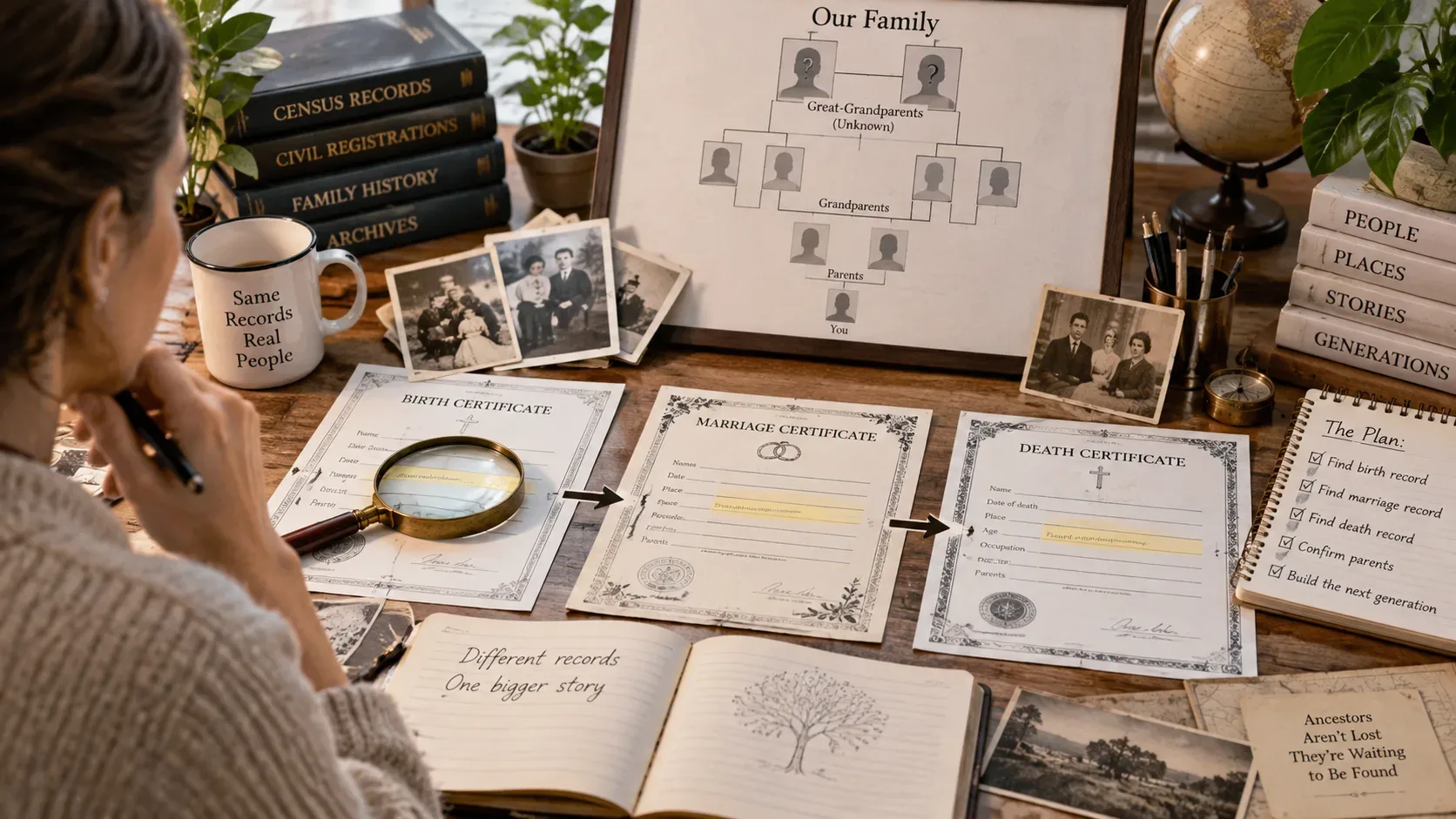
From the interview to the documentary research plan
- Choose a specific statement. Instead of researching “origin of the Silva family”, work with something verifiable, such as “Antônio da Silva was born in Penedo between 1910 and 1915 and was the son of Joaquim.”
- List the variants. Separate spellings of the name, ancient locations, likely period, spouse, parents, occupation, and other associated people.
- Search for the document closest to the event. For birth, try to locate the birth or baptism record; for marriage, registration and qualification; for immigration, entry, alien registration or naturalization.
- Record the complete reference. Note institution, fund or collection, book, sheet, term, code, image, URL when applicable and date of consultation. An unreferenced image may become difficult to locate again.
- Compare all identifiers. Similar name is not enough. Check parents, spouse, age, profession, residence, witnesses and chronology.
- Note conflicts without hiding them. If the interview indicates 1932 and the certificate records 1935, preserve both pieces of information and investigate the reason for the difference.
- Define the next document. Each result should produce a new question, not a conclusion greater than the evidence allows.
When the first clue leads to a wedding, further reading What a marriage certificate proves and what it doesn't about your family helps interpret names, place of birth, affiliation and witnesses without attributing more to the document than it claims.
Print the script, choose a person to interview and reserve space to listen without rushing. When you're done, don't try to solve the entire family tree. Select a well-defined clue and organize the next document search. The best question is the one that points to the next document.